



Jean-Paul Charles Aymard Sartre (, US also ; French: [saʁtʁ]; 21 June 1905 – 15 April 1980) was a French philosopher, political activist, and writer, considered a leading figure in 20th-century French philosophy and Marxism. Sartre was one of the key figures in the philosophy of existentialism (and phenomenology) and was a proponent of Libertarian Marxism. His work has influenced sociology, critical theory, post-colonial theory, and literary studies. He was awarded the 1964 Nobel Prize in Literature despite attempting to refuse it, saying that he always declined official honors and that "a writer should not allow himself to be turned into an institution".
Sartre had an open relationship with prominent feminist and fellow existentialist philosopher Simone de Beauvoir. Together, Sartre and de Beauvoir challenged the cultural and social assumptions and expectations of their upbringings, which they considered bourgeois, in both lifestyles and thought. The conflict between oppressive, spiritually destructive conformity (mauvaise foi, literally, 'bad faith') and an "authentic" way of "being" became the dominant theme of Sartre's early work, a theme embodied in his principal philosophical work Being and Nothingness (L'Être et le Néant, 1943). Sartre provided an introduction to his philosophy in his work Existentialism Is a Humanism (L'existentialisme est un humanisme, 1946), originally presented as a lecture.
Born in Paris, Sartre lost his father at the age of two and was raised primarily by his mother and grandfather, who introduced him to literature. He studied at the prestigious École Normale Supérieure, where he developed a deep interest in philosophy, influenced by thinkers like Henri Bergson, Edmund Husserl, and Martin Heidegger. Sartre's early academic career included teaching in several French lycées and engaging in provocative pranks and debates.
Sartre's life was marked by strong political engagement. During World War II, he was drafted, captured, and later released, after which he co-founded the resistance group Socialisme et Liberté. Though the group dissolved, Sartre became an influential voice in occupied France, contributing to underground literature and writing plays like No Exit. After the war, he co-founded the journal Les Temps modernes and increasingly used his platform to advocate for political and social causes. He supported anti-colonial movements, condemned French policies in Algeria, opposed U.S. intervention in Vietnam, and aligned himself at various times with Marxism and Maoism. Despite declining health in his later years, Sartre remained committed to activism and intellectual debate until his death in 1980. His funeral drew 50,000 mourners.
Contents
Biography
Early life
Jean-Paul Sartre was born on 21 June 1905 in Paris, the only child of Jean-Baptiste Sartre, an officer of the French Navy, and Anne-Marie (Schweitzer). When Sartre was two years old, his father died of an illness, which he most likely contracted in Indochina. Anne-Marie moved back to her parents' house in Meudon, where she raised Sartre with help from her father Charles Schweitzer, a teacher of German who taught Sartre mathematics and introduced him to classical literature at a very early age. The theologian/organist/physician Albert Schweitzer was Sartre's cousin. When he was twelve, Sartre's mother remarried, and the family moved to La Rochelle, where he was frequently bullied, in part due to the wandering of his blind right eye (sensory exotropia).
As a teenager in the 1920s, Sartre became attracted to philosophy upon reading Henri Bergson's essay Time and Free Will: An Essay on the Immediate Data of Consciousness. He attended the Cours Hattemer, a private school in Paris. He studied and earned certificates in psychology, history of philosophy, logic, general philosophy, ethics and sociology, and physics, as well as his diplôme d'études supérieures (roughly equivalent to an MA) in Paris at the École Normale Supérieure (ENS), an institution of higher education that was the alma mater for several prominent French thinkers and intellectuals. (His 1928 MA thesis under the title "L'Image dans la vie psychologique: rôle et nature" ["Image in Psychological Life: Role and Nature"] was supervised by Henri Delacroix.) It was at ENS that Sartre began his lifelong, sometimes fractious, friendship with Raymond Aron. He also befriended Paul Nizan, whom he considered his alter ego during the university years and who shared his literary ambitions. Perhaps the most decisive influence on Sartre's philosophical development was his weekly attendance at Alexandre Kojève's seminars, which continued for a number of years.
From his first years in the École normale, Sartre was one of its fiercest pranksters. In 1927, his antimilitarist satirical cartoon in the revue of the school, which he co-wrote with Georges Canguilhem, particularly upset the director Gustave Lanson. In the same year, with his comrades Nizan, Larroutis, Baillou and Herland, he organized a media prank following Charles Lindbergh's successful New York City–Paris flight; Sartre and his friends called newspapers and informed them that Lindbergh was going to be awarded an honorary École degree. Many newspapers, including Le Petit Parisien, announced the event on 25 May. Thousands, including journalists and curious spectators, showed up, unaware that what they were witnessing was a stunt involving a Lindbergh look-alike. The scandal led Lanson to resign.
World War II
In 1939, Sartre was drafted into the French Army, where he served as a meteorologist. He was captured by German troops in 1940 in Padoux, and he spent nine months as a prisoner of war—in Nancy and finally in Stalag XII-D, Trier, where he wrote his first theatrical piece, Bariona, ou le fils du tonnerre, a drama concerning Christmas. It was during this period of confinement that Sartre read Martin Heidegger's Sein und Zeit, later to become a major influence on his own essay on phenomenological ontology. Because of poor health (he claimed that his poor eyesight and exotropia affected his balance), Sartre was released in April 1941. According to other sources, he escaped after a medical visit to the ophthalmologist. Given civilian status, he recovered his teaching position at Lycée Pasteur in Neuilly, near Paris, and settled at the Hotel Mistral. In October 1941, he was given a position, previously held by a Jewish teacher who had been forbidden to teach by Vichy law, at the Lycée Condorcet in Paris.
After coming back to Paris in May 1941, he participated in the founding of the underground group Socialisme et Liberté ("Socialism and Liberty", a continuation of his 1940 group Sous la Botte, "Under the Boot") with other writers Simone de Beauvoir, Maurice Merleau-Ponty, Jean-Toussaint Desanti, Dominique Desanti, Jean Kanapa, and École Normale students. In spring of 1941, Sartre suggested with "cheerful ferocity" at a meeting that the Socialisme et Liberté assassinate prominent war collaborators like Marcel Déat, but de Beauvoir noted his idea was rejected as "none of us felt qualified to make bombs or hurl grenades". The British historian Ian Ousby observed that the French always had far more hatred for collaborators than they did for the Germans, noting it was French people like Déat that Sartre wanted to assassinate rather than the military governor of France, General Otto von Stülpnagel, and the popular slogan always was "Death to Laval!" rather than "Death to Hitler!". In August Sartre and de Beauvoir went to the French Riviera seeking the support of André Gide and André Malraux. However, both Gide and Malraux were undecided, and this may have been the cause of Sartre's disappointment and discouragement. Socialisme et Liberté soon dissolved and Sartre decided to write instead of being involved in active resistance. He then wrote Being and Nothingness (published with Gallimard in a choice emblematic of Sartre's project of bringing philosophy to a mass public), The Flies, and No Exit, none of which were censored by the Germans, and also contributed to both legal and illegal literary magazines.
In his essay "Paris under the Occupation", Sartre wrote that the "correct" behaviour of the Germans had entrapped too many Parisians into complicity with the occupation, accepting what was unnatural as natural:
Cold War politics and anticolonialism
The first period of Sartre's career, defined in large part by Being and Nothingness (1943), gave way to a second period—when the world was perceived as split into communist and capitalist blocs—of highly publicized political involvement. Sartre tended to glorify the Resistance after the war as the uncompromising expression of morality in action, and recalled that the résistants were a "band of brothers" who had enjoyed "real freedom" in a way that did not exist before nor after the war. Sartre was "merciless" in attacking anyone who had collaborated or remained passive during the German occupation; for instance, criticizing Camus for signing an appeal to spare the collaborationist writer Robert Brasillach from being executed. His 1948 play Les mains sales (Dirty Hands) in particular explored the problem of being a politically "engaged" intellectual. He embraced Marxism but did not join the Communist Party. For a time in the late 1940s, Sartre described French nationalism as "provincial" and in a 1949 essay called for a "United States of Europe". In an essay published in the June 1949 edition of the journal Politique étrangère, Sartre wrote:
If we want French civilization to survive, it must be fitted into the framework of a great European civilization. Why? I have said that civilization is the reflection on a shared situation. In Italy, in France, in Benelux, in Sweden, in Norway, in Germany, in Greece, in Austria, everywhere we find the same problems and the same dangers ... But this cultural polity has prospects only as elements of a policy which defends Europe's cultural autonomy vis-à-vis America and the Soviet Union, but also its political and economic autonomy, with the aim of making Europe a single force between the blocs, not a third bloc, but an autonomous force which will refuse to allow itself to be torn into shreds between American optimism and Russian scientificism.
About the Korean War, Sartre wrote: "I have no doubt that the South Korean feudalists and the American imperialists have promoted this war. But I do not doubt either that it was begun by the North Koreans". In July 1950, Sartre wrote in Les Temps Modernes about his and de Beauvoir's attitude to the Soviet Union:
As we were neither members of the [Communist] party nor its avowed sympathizers, it was not our duty to write about Soviet labor camps; we were free to remain aloof from the quarrel over the nature of this system, provided that no events of sociological significance had occurred.
Career as public intellectual
While the broad focus of Sartre's life revolved around the notion of human freedom, he began a sustained intellectual participation in more public matters towards the end of the Second World War, around 1944–1945. Before World War II, he was content with the role of an apolitical liberal intellectual: "Now teaching at a lycée in Laon ... Sartre made his headquarters the Dome café at the crossing of Montparnasse and Raspail boulevards. He attended plays, read novels, and dined [with] women. He wrote. And he was published." Sartre and his lifelong companion, de Beauvoir, existed, in her words, where "the world about us was a mere backdrop against which our private lives were played out".
The war opened Sartre's eyes to a political reality he had not yet understood until forced into continual engagement with it: "the world itself destroyed Sartre's illusions about isolated self-determining individuals and made clear his own personal stake in the events of the time." Returning to Paris in 1941, he formed the "Socialisme et Liberté" resistance group. In 1943, after the group disbanded, Sartre joined a writers' Resistance group, in which he remained an active participant until the end of the war. He continued to write ferociously, and it was due to this "crucial experience of war and captivity that Sartre began to try to build up a positive moral system and to express it through literature".
The symbolic initiation of this new phase in Sartre's work is packaged in the introduction he wrote for a new journal, Les Temps modernes, in October 1945. Here he aligned the journal, and thus himself, with the Left and called for writers to express their political commitment. Yet, this alignment was indefinite, directed more to the concept of the Left than a specific party of the Left.
During the trial of Robert Brasillach, Sartre was among a small number of prominent intellectuals advocating for his execution for 'intellectual crimes'.
Sartre's philosophy lent itself to his being a public intellectual. He envisaged culture as a very fluid concept; neither pre-determined, nor definitely finished; instead, in true existential fashion, "culture was always conceived as a process of continual invention and re-invention." This marks Sartre, the intellectual, as a pragmatist, willing to move and shift stance along with events. He did not dogmatically follow a cause other than the belief in human freedom, preferring to retain a pacifist's objectivity. It is this overarching theme of freedom that means his work "subverts the bases for distinctions among the disciplines". Therefore, he was able to hold knowledge across a vast array of subjects: "the international world order, the political and economic organisation of contemporary society, especially France, the institutional and legal frameworks that regulate the lives of ordinary citizens, the educational system, the media networks that control and disseminate information. Sartre systematically refused to keep quiet about what he saw as inequalities and injustices in the world."
Writing
Sartre wrote successfully in a number of literary modes and made major contributions to literary criticism and literary biography. His plays are richly symbolic and serve as a means of conveying his philosophy. The best-known, Huis-clos (No Exit), contains the famous line "L'enfer, c'est les autres", usually translated as "Hell is other people." Aside from the impact of Nausea, Sartre's major work of fiction was The Roads to Freedom trilogy which charts the progression of how World War II affected Sartre's ideas. In this way, Roads to Freedom presents a less theoretical and more practical approach to existentialism.
John Huston got Sartre to script his film Freud: The Secret Passion. However it was too long and Sartre withdrew his name from the film's credits. Nevertheless, many key elements from Sartre's script survive in the finished film.
Despite their similarities as polemicists, novelists, adapters, and playwrights, Sartre's literary work has been counterposed, often pejoratively, to that of Camus in the popular imagination. In 1948 the Catholic Church placed Sartre's œuvre on the Index Librorum Prohibitorum (List of Prohibited Books).
Later life and death
In 1964, Sartre renounced literature in a witty and sardonic account of the first ten years of his life, Les Mots (The Words). The book is an ironic counterblast to Marcel Proust, whose reputation had unexpectedly eclipsed that of André Gide (who had provided the model of littérature engagée for Sartre's generation). Literature, Sartre concluded, functioned ultimately as a bourgeois substitute for real commitment in the world. In October 1964, Sartre was awarded the Nobel Prize in Literature, but he declined it. He was the first Nobel laureate to voluntarily decline the prize, and remains one of only two laureates to do so. According to Lars Gyllensten, in the book Minnen, bara minnen ("Memories, Only Memories") published in 2000, Sartre himself or someone close to him got in touch with the Swedish Academy in 1975 with a request for the prize money, but was refused. In 1945, he had refused the Légion d'honneur. The Nobel prize was announced on 22 October 1964; on 14 October, Sartre had written a letter to the Nobel Institute, asking to be removed from the list of nominees, and warning that he would not accept the prize if awarded, but the letter went unread; on 23 October, Le Figaro published a statement by Sartre explaining his refusal. He said he did not wish to be "transformed" by such an award, and did not want to take sides in an East vs. West cultural struggle by accepting an award from a prominent Western cultural institution. Nevertheless, he was that year's prizewinner.
Though his name was then a household word (as was "existentialism" during the tumultuous 1960s), Sartre remained a simple man with few possessions, actively committed to causes until the end of his life, such as the May 1968 strikes in Paris during the summer of 1968 during which he was arrested for civil disobedience. President Charles de Gaulle intervened and pardoned him, commenting that "you don't arrest Voltaire".
In 1975, when asked how he would like to be remembered, Sartre replied:
I would like [people] to remember Nausea, [my plays] No Exit and The Devil and the Good Lord, and then my two philosophical works, more particularly the second one, Critique of Dialectical Reason. Then my essay on Genet, Saint Genet. ... If these are remembered, that would be quite an achievement, and I don't ask for more. As a man, if a certain Jean-Paul Sartre is remembered, I would like people to remember the milieu or historical situation in which I lived, ... how I lived in it, in terms of all the aspirations which I tried to gather up within myself.
Philosophy
Existentialism
Sartre's primary idea is that people, as humans, are "condemned to be free". He explained, "This may seem paradoxical because condemnation is normally an external judgment which constitutes the conclusion of a judgment. Here, it is not the human who has chosen to be like this. There is a contingency of human existence. It is a condemnation of their being. Their being is not determined, so it is up to everyone to create their own existence, for which they are then responsible. They cannot not be free, there is a form of necessity for freedom, which can never be given up."
This theory relies upon his position that there is no creator, and is illustrated using the example of the paper cutter. Sartre says that if one considered a paper cutter, one would assume that the creator would have had a plan for it: an essence. Sartre said that human beings have no essence before their existence because there is no Creator. Thus: "existence precedes essence". This forms the basis for his assertion that because one cannot explain one's own actions and behavior by referring to any specific human nature, they are necessarily fully responsible for those actions. "We are left alone, without excuse." "We can act without being determined by our past which is always separated from us."
Sartre maintained that the concepts of authenticity and individuality have to be earned but not learned. We need to experience "death consciousness" so as to wake up ourselves as to what is really important; the authentic in our lives which is life experience, not knowledge. Death draws the final point when we as beings cease to live for ourselves and permanently become objects that exist only for the outside world. In this way death emphasizes the burden of our free, individual existence. "We can oppose authenticity to an inauthentic way of being. Authenticity consists in experiencing the indeterminate character of existence in anguish. It is also to know how to face it by giving meaning to our actions and by recognizing ourselves as the author of this meaning. On the other hand, an inauthentic way of being consists in running away, in lying to oneself in order to escape this anguish and the responsibility for one's own existence."
While Sartre had been influenced by Heidegger, the publication of Being and Nothingness did mark a split in their perspectives, with Heidegger remarking in Letter on Humanism:
Existentialism says existence precedes essence. In this statement he is taking existentia and essentia according to their metaphysical meaning, which, from Plato's time on, has said that essentia precedes existentia. Sartre reverses this statement. But the reversal of a metaphysical statement remains a metaphysical statement. With it, he stays with metaphysics, in oblivion of the truth of Being.
Personal life
In 1929 at the École normale, he met Simone de Beauvoir, who studied at the Sorbonne and later went on to become a noted philosopher, writer, and feminist. The two became inseparable and lifelong companions, initiating a romantic relationship, though they were not monogamous. The first time Sartre took the agrégation, he failed. He took it a second time and virtually tied for first place with Beauvoir, although Sartre was eventually awarded first place, with Beauvoir second.
Relationship with Albert Camus
In June 1943, Sartre first met Albert Camus at the opening of Sartre's play The Flies. The two quickly became close frequently talking philosophy, women, corresponded frequently, and spent nights in town together. In 1945, Sartre accepted an assignment by Camus's newspaper Combat to travel to America to write a series of articles. Sartre praised Camus and his work writing in a Vogue magazine article "In Camus’s sombre, pure works one can already detect the main traits of the French literature of the future. It offers us the promise of a classical literature, without illusions, but full of confidence in the grandeur of humanity; hard but without useless violence; passionate, without restraint … A literature that tries to portray the metaphysical condition of man while fully participating in the movements of society".
In 1951, Camus published The Rebel in which he expressed his strong disdain for communism, political violence, and authoritarianism. Sartre reportedly disagreed with Camus, believing that violence at times was necessary in order for change to take place. This put an end to their close relationship. However, after Camus's death, Sartre wrote a eulogy for his once close friend which both praised Camus for his commitment to life, consciousness, and his "stubborn" pursuit of meaning against the absurd.
Controversy
Allegations of sexual exploitation
In 1993, French author Bianca Lamblin (originally Bianca Bienenfeld) wrote in her book Mémoires d'une jeune fille dérangée (Memoirs of a deranged young girl, published in English under the title A Disgraceful Affair) of her sexual exploitation by Sartre and Beauvoir. Lamblin claims that while a student at Lycée Molière, she was sexually exploited by her teacher Beauvoir, who introduced her to Sartre a year later. Bianca wrote her Mémoires in response to the posthumous 1990 publication of Jean-Paul Sartre's Lettres au Castor et à quelques autres: 1926–1963 (Letters to Castor and other friends), in which she noted that she was referred to by the pseudonym Louise Védrine. Olga Kosakiewicz and Natalie Sorokin made similar allegations against Sartre and Beauvoir.
Sartre and Beauvoir frequently followed this pattern, in which Beauvoir would seduce female students and then pass them on to Sartre.
In 1977, Sartre and his partner Simone de Beauvoir signed petitions calling for reforms to the age of consent laws in France, including the decriminalization of consensual sexual relations between adults and minors.
Works
Novels and short story collections
Nausea / La nausée (1938)
The Wall / Le mur (1939) – collection of 5 short stories
Hurricane over Sugar, (1960)
The Age of Reason / L'âge de raison (1945)
The Reprieve / Le sursis (1945)
Troubled Sleep (London ed. (Hamilton) has title: Iron in the Soul) / La mort dans l'âme (1949)
The Last Chance (1949 and 1981) – unfinished
Plays
Bariona / Bariona, ou le fils du tonnerre (1940)
The Flies / Les mouches (1943)
No Exit / Huis clos (1944)
The Respectful Prostitute / La putain respectueuse (1946)
The Victors (Men Without Shadows) / Morts sans sépulture (1946)
In the Mesh / L'engrénage (1948)
Dirty Hands (Crime Passionnel, The Assassin, Red Gloves ) / Les mains sales (1948)
Intimacy (1949)
The Devil and the Good Lord (Lucifer and the Lord) / Le diable et le bon dieu (1951)
Kean (1953)
Nekrassov (1955)
The Condemned of Altona / Les séquestrés d'Altona (1959)
The Trojan Women / Les Troyennes (1965)
Screenplays
Typhus, wr. 1944, pub. 2007; adapted as The Proud and the Beautiful
The Chips Are Down / Les jeux sont faits (screenplay, dir. Jean Delannoy; 1947)
The Crucible (screenplay, 1957; dir. Raymond Rouleau)
Freud: The Secret Passion (screenplay, 1962; dir. John Huston; Sartre had his name removed from the film)
The Freud Scenario / Le scénario Freud (1984)
Autobiographical
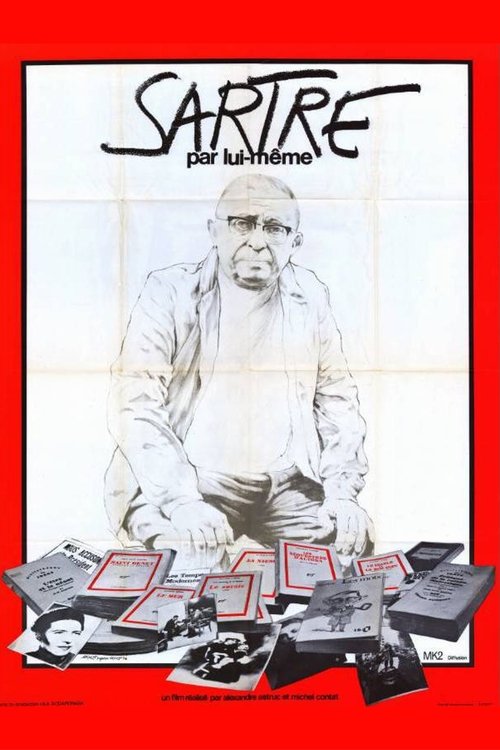
Sartre By Himself / Sartre par lui-mème (1959)
The Words / Les Mots (1964)
Witness to My Life & Quiet Moments in a War / Lettres au Castor et à quelques autres (1983)
War Diaries: Notebooks from a Phony War / Les carnets de la drole de guerre (1984)
Biographical
The Family Idiot: Gustave Flaubert, 1821-1857 (5 vol) (1971)
Philosophical essays
The Transcendence of the Ego / La transcendence de l'égo (1936)
Imagination: A Psychological Critique / L'imagination (1936)
Sketch for a Theory of the Emotions / Esquisse d'une théorie des émotions (1939)
The Imaginary / L'imaginaire (1940)
Being and Nothingness / L'être et le néant (1943)
Existentialism Is a Humanism / L'existentialisme est un humanisme (1946)
Existentialism and Human Emotions / Existentialisme et émotions humaines (1957)
Search for a Method / Question de méthode (1957)
Critique of Dialectical Reason / Critique de la raison dialectique (1960, 1985)
Notebooks for an Ethics / Cahiers pour une morale (1983)
Truth and Existence / Vérité et existence (1989)
Anti-Semite and Jew / Réflexions sur la question juive (wr. 1944, pub. 1946)
Baudelaire (1946)
Situations I: Literary Critiques / Critiques littéraires (1947)
Situations II: What Is Literature? / Qu'est-ce que la littérature ? (1947)
"Black Orpheus" / "Orphée noir" (1948)