



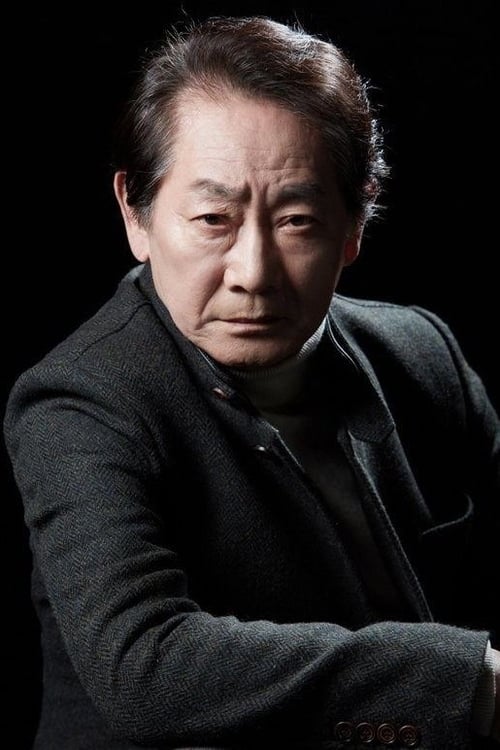
Jeon Moo-song (Korean: 전무송; born September 28, 1941) is a South Korean actor. Jeon began his career on stage in the play 'Chunhyangjeon' in 1964 and has since been active in Korean theatre, film and television. In 1977, he performed as the title character in Crown Prince Hamyeol (an adaptation of Hamlet) at La MaMa in New York City, which marked the first time a Korean theatre troupe had traveled outside Korea. Jeon also won two trophies from the Grand Bell Awards for his portrayal of an eccentric monk in Im Kwon-taek's 1981 film Mandala.
Contents
Early life and education
Jeon was born on September 28, 1941, in Nae-dong, Jinsen (modern-day Incheon), Korea, during the period of Japanese rule. He was the eldest of seven children born into a working-class fishing family. His father originated from Haeju, Kōkai Province (now part of Hwanghae Province), Korea, and his mother is from Seosan, Chungcheongnam-do. During his childhood, Jeon frequently visited his maternal relatives in Seosan. His uncle, a farmer and storyteller, performed one-man shows that significantly influenced Jeon. Supported by his maternal aunt and uncle, Jeon was the only child in his family to attend kindergarten.
During his second year of elementary school, Jeon and his family evacuated their home due to the outbreak of the Korean War. He continued his education at a school near the evacuation site until the family returned to Incheon following the conclusion of the conflict. Around this time, Jeon began playing baseball at the suggestion of a friend and initially aspired to become a professional athlete.
In the 1950s, Jeon gained admission to Incheon Middle School, a prestigious institution at the time. His enrollment was a source of significant pride for his father, who hosted a celebration for local residents to mark the achievement. Although Jeon intended to continue playing baseball, the school lacked an established team. He organized a baseball club with fellow students; however, the group was soon disbanded by the principal, who argued that athletic pursuits would distract from academic responsibilities.
Following middle school, Jeon grew concerned regarding the financial burden of higher education on his family, as he had six younger siblings. At the encouragement of principal Gil Young-hee, he enrolled at Incheon Technical High School (now Incheon Mechanical Engineering High School) to study mechanical engineering. This decision resulted in a three day period of conflict with his father, who disapproved of the vocational path.
Before beginning high school, Jeon worked briefly at the Ae Kwan Theater, where he assisted a friend employed as a signboard designer. His initial duties involved whitewashing the boards for new advertisements. Though he resigned upon starting high school, his interest in the arts persisted. He frequently bypassed school hours to visit the theater district in Sinpo-dong, changing into civilian clothes to watch films and live theater. At Ae Kwan Theater he watched movies such as "Break Through the Wall" and "Long Live Freedom", along with stage productions by the Yeoseong Gukgeuk Company and Lim Chun-Aeng's Gukgeuk. He was particularly moved by the play "Princess Nangrang and Prince Hodong" and remembered "Blue Bird" with great clarity. His exposure to cinematic works like "Stagecoach" and "Samson and Delilah" eventually solidified his desire to pursue a career in acting. Jeon participated in his high school's musical program as a clarinetist in the school band.
Upon graduating, Jeon gained admission to the Department of Theater and Film at Hanyang University. The high cost of tuition, however, presented a significant financial barrier. Following a period of severe distress, Jeon attempted self harm by ingesting a substance he believed to be rat poison. He survived the incident and subsequently questioned his decision to attempt suicide.
Jeon later underwent practical training at the Incheon Mechanical Workshop under the Incheon Railroad Administration. Due to positive performance evaluations, he was hired as an apprentice following his training period. His primary responsibility involved the repetitive machining of bolts and nuts. While observing the accumulation of red, rusting iron shavings beneath his machinery, Jeon began to view the decaying metal as a metaphor for his own professional stagnation. Reflecting on this experience, Jeon stated that the sight of the iron powder made him feel as though he were rusting. He questioned his career path and eventually resigned from the company to pursue his original ambition in the arts.
Following his resignation from the mechanical workshop, Jeon accepted a position as a collection agent at the Incheon branch of the Seoul Shinmun. His responsibilities included managing newspaper distribution to local student carriers and soliciting door to door subscriptions. The flexible schedule afforded by this role allowed Jeon to watch a wide variety of films, which intensified his interest in pursuing a career as a cinema actor. During this period, he frequented bookstores to research the industry and spent significant time in the Chungmuro district, a hub for the Korean film industry.
After he had spent over a year working at the newspaper, he was encouraged by friends from Seorabeol Arts College (predecessor of Chung-Ang University College of Arts) who said, "You are so handsome. Why don't you try acting?" Flattered by the compliments, Jeon and his friends gathered at a bakery to plan a theatrical production. When the group was unable to pay the bill, his friends fled, leaving Jeon to settle the debt. Lacking sufficient cash, he was forced to surrender his high school graduation watch to the shop owner as collateral. To retrieve the watch, Jeon requested an advance on his wages from his branch manager. Upon hearing the request, the manager provided the funds along with two tickets to a 1962 production of Hamlet, the opening performance of the Namsan Drama Center. It turned out that the branch manager's daughter worked as a receptionist there.
Jeon traveled from Incheon to the Namsan Drama Center to attend the performance of Hamlet, directed by Yoo Chi-jin. He was profoundly affected by the production, which featured prominent actors such as Kim Dong-won in the title role, Jang Min-ho as King Claudius, and Hwang Jeong-soon as Queen Gertrude. The experience was so transformative that Jeon returned the following day to use his second ticket. During this repeat visit, he discovered a recruitment notice for the Drama Center's affiliated theater academy printed on the back of the program. Identifying this as an opportunity, he decided to pursue it.
For his entrance audition, Jeon was required to perform a physical improvisation task involving the breaking of a honey jar. He successfully passed the examination and was admitted to the Namsan Drama Center Actor Academy in 1962. Founded by the playwright and director Yoo Chi-jin, the academy served as the predecessor to the current Department of Theater and Film at the Seoul Institute of the Arts. Jeon was a member of the academy's first class in 1962, studying alongside future notable figures in Korean entertainment, including actors Shin Goo, Lee Ho-jae, Min Ji-hwan, Kim Ki-soo, Ban Hyo-jeong (who did not graduate), and playwright Yoon Dae-seong.
Career
1960s to 1970s: Beginning with Dong-rang Repertory Theater
Dongrang Yoo Chi-jin recognized Jeon's talent and gave him the opportunity to play the role of Lee Mong-ryeong in the 1963 graduate performance of "Chunhyangjeon". The following year, Jeon played the lead character in "Prince of Horses", a play that commemorated the founding of the Drama Center theater company.
After completing his studies in 1964, Jeon joined the Dong-rang Repertory Theater. In 1970, he returned to the company after completing three years of military service. However, he struggled with the role of Stanley in Harold Pinter's "Birthday Party", which was completely different from the historical or realism dramas he was used to perform. He was ultimately replaced by Shin Goo, and this decision left him feeling angry and frustrated. He ended up drinking heavily and protested against the director Yoo Deok-hyung, causing a commotion that shook the entire troupe. The day after the incident, Jeon received a call from Dongrang. At the time, Jeon feared that he would be kicked out of the theater company. However, to his surprise, Dongrang offered him a cigarette. Though Jeon declined several times, Dongrang insisted, saying "You drink well and smoke well. Smoke it!" and even lit it for him.
During their conversation, Dongrang told Jeon this: "You have one great weapon that other actors do not have, and that is compassion. When you stand on stage, you make the audience feel compassion,' he said. 'I was thinking of you like that, but would it be okay if you acted like that? Be human first. That way, you will become a great actor." This conversation had a profound impact on Jeon, and he began to improve his attitude from that day forward. Jeon stayed at the trope for five more years. In 1975, Jeon with his fellow actor Lee Ho-jae and playwright Oh Taeseok joined National Theater Company of Korea (NTCK). He played various characters as an actor of the National Theater Company.
In 1977, Jeon joined The Dongnang Repertory World Tour. The troupe performed as part of the World Theater Month commemorative event, sponsored by the USA headquarters of the International Association of Dramatic Arts, in New York, US from March 15. Following this event, the troupe toured various cities in the US, including Dallas, Minneapolis, Los Angeles, and Hawaii, as well as Lane in France, Paris, and the Netherlands, to showcase their level of theater to audiences worldwide.
1980s: Theater
In 1981, Jeon became widely known to the general public by playing the role of a monk with Ahn Seong-ki in director Im Kwon-taek's film 'Mandala'. "When I filmed with director Lim, he showed respect to the extras and supporting actors. I felt a sense of respect as a human being. If Yoo Chi-jin, Hae-rang Lee, and Young-woong Lim paved the way for me in theater, director Lim is like that in film."
He became popular with Sanwoolim's 'Waiting for Godot'. After gaining popularity with 'Mandala', offers to appear on the night stage followed. They said that they would pay a lot of money if they appeared in monk clothes and sang. The arrangers said that locusts are in season, so grab your share when they are popular. Then he replied: "I am not a locust, I am Jeon Mu-song." Since then, he has appeared frequently on TV screens, especially through 'TV Literature' and showed off his outstanding acting skills. Even so, he always kept the theater stage.
In 1983, Jeon founded his own theater company, Jihyeon, and a year later, in 1984, he became a member of the theater company Sanwoolim. In 1992, he founded the Theater Development Research Association and became its representative. Two years later, in 1994, he were invited to participate in the World Youth Theater Festival in Okinawa, Japan.
In 1995, Jeon was part of the Housekeeping Coordinator. It is clear from their experiences that they have had a successful career in theater, participating in different productions and theater companies, touring internationally, and founding their own theater company and research association.
Jeon is also the subject of an internet meme titled "High Expectations Asian Father" wherein his image, taken from his cameo in the film Epitaph, is paired with an exaggerated quote usually associated with the stereotypical image of an Asian parent trying to set a high standard for their children.
Since 2006, he has been active as an artistic director of the Gyeonggi Provincial Theater Company. In this literary concert, he narrates Kim Dong-in's potato, Hyun Jin-geon's lucky day, and Love Letter with Superintendent B.
2020s
The play Life Delivery, which commemorated the 60th anniversary of Jeon Moo-song's debut and his 80th birthday, premiered from February 4 to 7, 2020 at the Palgong Hall of the Daegu Culture and Arts Center. Co-hosted by the Daegu Culture and Arts Center and Theatre Company Haru, the production depicted the lives of a former vice principal and a barber working as senior delivery couriers after their retirement. Jeon and Kang In-deok shared the role of Lee Jin-beop, the former vice principal, while Choi Jong-won performed the role of Jang Ga-wi, the barber. The production was overseen by Kim Gun-pyo, a professor of theater and film at Daekyung University.
In 2022, Jeon participated in the documentary I Love What I See, which explores the history and cultural significance of the Ae Kwan Theater. Established in 1895, the venue is recognized as the first theater in Korea to be founded by Korean nationals, representing a significant link to Jeon's early formative experiences in the arts.
Personal life
Jeon married Lee Ki-soon, a friend of his younger sister, in 1970. The couple had two children: a daughter, Jeon Hyeon-ah and a son, Jeon Jin-woo. Due to persistent financial difficulties, the children were temporarily raised by Lee's family. During this period, Lee supported the household through various informal jobs, including transporting goods from weaving factories to sell at Namdaemun Market.
Both of Jeon's children pursued careers in the performing arts. Jeon Hyeon-ah became a playwright and actress, and she is married to theater director Kim Jin-man. Jeon Jin-woo also became an actor and is married to actress Kim Mi-rim.