




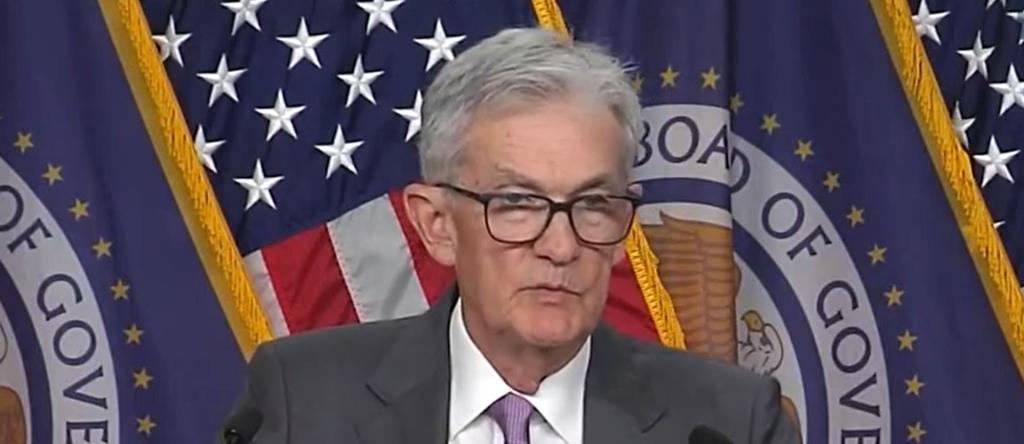
Jerome Hayden "Jay" Powell (born February 4, 1953) is an American central banker who currently serves as a governor of the Federal Reserve. He was the 16th chair of the Federal Reserve from 2018 to 2026. He was previously both a lawyer and investment banker in the private sector before entering public service.
A native of Washington, D.C., Powell graduated from Princeton University and the Georgetown University Law Center. After working as an attorney for five years, he began a career in investment banking and private equity during the mid-1980s, eventually becoming a partner at the Carlyle Group in 1997. He left Carlyle in 2005 to launch Severn Capital Partners, a boutique private equity firm. He was a visiting scholar at the Bipartisan Policy Center from 2010 to 2012.
Powell entered public service in 1990, serving in multiple positions within the United States Treasury Department under President George H. W. Bush. He became a member of the Federal Reserve Board of Governors upon President Barack Obama's nomination in 2012. President Donald Trump elevated Powell to Chair in 2018 and President Joe Biden re-nominated him in 2021. As a Fed governor, Powell built a reputation during the 2010s as a consensus-builder in Washington.
Under Powell, the Federal Reserve navigated the economic impact of the COVID-19 pandemic, the 2021–2023 inflation surge, and global trade instability. His tenure saw a broad uplift in financial markets apart from three notable stock markets declines in 2020, in 2022, and in 2025. The scale and type of monetary stimulus pursued by Powell led to a noted divergence between the U.S. economy and the nation's financial sector, leading to mixed reception among the American public. In March 2026, he received the Governor of the Year award at the Central Banking Awards 2026.
Contents
Early life and education
Jerome Powell was born on February 4, 1953, in Washington, D.C. to Patricia (née Hayden) and Jerome Powell Sr., a lawyer in private practice. His maternal grandfather, James J. Hayden, was Dean of the Columbus School of Law at Catholic University of America and later a lecturer at Georgetown Law School. He has five siblings.
Powell graduated from Georgetown Preparatory School, a Jesuit university-preparatory school, in 1971. He received a Bachelor of Arts in political science from Princeton University in 1975, where his senior thesis was titled "South Africa: Forces for Change." After spending a year as a legislative assistant to Republican U.S. Senator Richard Schweiker of Pennsylvania, Powell attended the Georgetown University Law Center. He was editor-in-chief of the Georgetown Law Journal and graduated in 1979 with a Juris Doctor.
Early career
Legal and investment banking
After law school, Powell moved to New York City and spent two years as a law clerk to Judge Ellsworth Van Graafeiland of the U.S. Court of Appeals for the Second Circuit. He then entered private practice at the law firm Davis Polk & Wardwell before moving to the firm of Werbel & McMillen in 1983.
From 1984 to 1990, Powell worked at investment bank Dillon, Read & Co. (later acquired by UBS), where he concentrated on financing, merchant banking, and mergers and acquisitions, rising to the position of vice president.
Between 1990 and 1993, Powell worked in the United States Department of the Treasury, at which time Nicholas F. Brady, the former chairman of Dillon, Read & Co., was the United States Secretary of the Treasury. In 1992, Powell became the Under Secretary of the Treasury for Domestic Finance after being nominated by George H. W. Bush. During his stint at the Treasury, Powell oversaw the investigation and sanctioning of Salomon Brothers after one of its traders submitted false bids for a United States Treasury security. Powell was also involved in the negotiations that made Warren Buffett the chairman of Salomon Brothers.
In 1993, Powell began working as a managing director for Bankers Trust. He left in 1995 after the bank suffered reputational damage when some complex derivative transactions caused large losses for major corporate clients. He then went back to work for Dillon, Read & Co. From 1997 to 2005, Powell was a partner at the Carlyle Group, where he founded and led the Industrial Group within the Carlyle U.S. Buyout Fund. After leaving Carlyle, Powell founded Severn Capital Partners, a small private equity firm focused on specialty finance and opportunistic investments in the industrial sector. In 2008, Powell became a managing partner of the Global Environment Fund, a private equity and venture capital firm that invests in sustainable energy.
Between 2010 and 2012, Powell was a visiting scholar at the Bipartisan Policy Center, a think tank in Washington, D.C., where he worked on getting Congress to raise the United States debt ceiling during the United States debt-ceiling crisis of 2011. Powell presented the implications to the economy and interest rates of a default or a delay in raising the debt ceiling. He worked for a salary of $1 per year.
Federal Reserve Board of Governors (2012–2018)
In December 2011, along with Jeremy C. Stein, Powell was nominated to the Federal Reserve Board of Governors by President Barack Obama. The nomination included two people to help garner bipartisan support for both nominees since Stein's nomination had previously been filibustered. Powell's nomination was the first time since 1988 that a president nominated a member of the opposition party for such a position. He took office on May 25, 2012, filling the unexpired term vacated by Frederic Mishkin. In June 2014, he was reappointed to the Board of Governors for a full 14-year term, after being confirmed by the United States Senate in a 67–24 vote. His term as a member of the Board of Governors ends January 31, 2028.
Powell was a skeptic of round 3 of quantitative easing (or QE3), initiated in September 2012, although he eventually voted for it.
In 2013 Powell endorsed financial regulation to end the problem of institutions that are too big to fail, while urging that it should be implemented carefully. In April 2017, he was assigned to head the bank oversight committee.
In a July 2017 speech, Powell said that in regard to Fannie Mae and Freddie Mac the status quo is "unacceptable" and that the current situation "may feel comfortable, but it is also unsustainable." He warned that "the next few years may present our last best chance" to "address the ultimate status of Fannie Mae and Freddie Mac" and avoid "repeating the mistakes of the past." Powell expressed concerns that, in the current situation, the government is responsible for mortgage defaults and that lending standards were too rigid, noting that these can be solved by encouraging "ample amounts of private capital to support housing finance activities."
In an October 2017 speech, Powell stated that higher capital and liquidity requirements and stress tests from the Dodd–Frank Wall Street Reform and Consumer Protection Act have made the financial system safer and must be preserved. However, he also stated that the Volcker Rule should be re-written to exclude smaller banks.
Federal Reserve Chairman (2018–2026)
On November 2, 2017, President Donald Trump nominated Powell to serve as the chairman of the Federal Reserve, replacing Janet Yellen at the helm of the central bank. On December 5, the Senate Banking Committee approved Powell's nomination to be chair in a 22–1 vote, with Senator Elizabeth Warren casting the lone dissenting vote. His nomination was confirmed by the Senate on January 23, 2018, by an 84–13 vote. Powell assumed office as chair on February 5, 2018.
First Trump administration (2018–2021)
One of Powell's first actions was to continue to raise US interest rates, as a response to the increasing strength of the US economy. He also announced that the Fed would reduce its asset portfolio from $4.5 trillion to a range of $2.5–3 trillion over four years in a process called quantitative tightening. This tight policy drew public criticism from President Trump, who expressed second thoughts about nominating Powell and said that the chair was too enthusiastic about raising rates. Financial assets of all classes declined over 2018 and markets erupted in volatility in December. Powell abandoned quantitative tightening in early 2019, leading to a recovery in asset prices. Trump continued to state, with increasing hostility, that Powell was not reacting quickly enough. As a trade war with China escalated over the summer of 2019, Trump called the Fed's policies "insane" and labelled Powell an "enemy." He privately discussed with White House counsel the possibility of firing Powell, which Powell dismissed. In an August interview, Trump said that he completely disagreed with Powell's approach and called for a sharp cut in interest rates. Trump also questioned if Powell or General Secretary Xi Jinping of the Chinese Communist Party was a greater "enemy" of the United States.
In October 2019, as asset prices waned, Powell announced the Fed would return to expanding its balance sheet, which led to a global rally in assets. Powell said the Fed's actions were not quantitative easing, but some dubbed them as being QE4. Where Bernanke-era quantitative easing was conducted through outright purchases of assets, Powell's expansion operates through overnight repurchase agreements (repos) where the seller has the option to reverse the transaction. The Fed's primary dealers and other banks use the repo facilities to sell Treasury and agency securities in exchange for credit to supplement their cash on hand.
In early 2020, Powell launched an unprecedented series of actions to counter the financial market impact of the COVID-19 pandemic, which included a dramatic expansion of the Fed's balance sheet and introduction of new tools, including the direct purchase of corporate bonds and direct lending programs. Powell emphasized monetary policy alone without an equivalent fiscal policy response from Congress would widen income inequality. Powell's actions earned him bipartisan praise, including from Trump, who told Fox News that he was "very happy with his performance" and that "over the last period of six months, he's really stepped up to the plate."
Biden administration (2021–2025)
In April 2021, Powell reassured concerns over a potential housing bubble, similar to the one that preceded the Great Recession. He stated, "we don't see bad loans and unsustainable prices and that kind of thing."
In August 2021, Powell expected the Fed to reduce economic support later in the year. Powell considered inflation transitory—a term Powell states should now be "retired." By December, Jerome Powell indicated an increase in the speed of tapering asset purchases—up to $30 billion per month—in response to widespread high inflation readings. In Jerome Powell's confirmation hearing in 2022 he described inflation as being a "severe threat" to the U.S. economic recovery due to "higher costs of essentials like food, housing and transportation."
In response to high inflation, the U.S. Federal Reserve began its rate hike cycle on March 17, 2022 when it raised rates by 25 basis points. The central bank proceeded to hike rates ten more times through July 2023—raising the benchmark rate by 5.25% cumulatively. US CPI—a widely used measure of inflation—peaked at 9.1% y/y in July 2022.
In light of his term as chair expiring in February 2022, many Democrats began to express opposition to Powell's reappointment. In August 2021, progressive Democrats, including Alexandria Ocasio-Cortez, called on President Joe Biden to replace Powell, criticizing him for failing to "mitigate the risk climate change poses to our financial system." In September 2021, Senator Elizabeth Warren, Democrat of Massachusetts, criticized Powell for his financial regulation track record and called him a "dangerous man to head up the Fed." Powell was renominated for a second term by President Joe Biden on November 22, 2021. His initial nomination expired at the end of the year and was returned to President Biden on January 3, 2022.
President Biden presented his nomination to the Senate the following day. Hearings were held on Powell's nomination before the Senate Banking Committee on January 11, 2022. The committee favorably reported Powell's nomination to the Senate floor on March 16, 2022, in a 22–1 vote; Senator Elizabeth Warren was the lone member to vote against his nomination. His nomination for another term as chair through May 2026 was confirmed by the full U.S. Senate on May 12, 2022, in an 80–19 vote. He was sworn in for his second term as chair on May 23, 2022. Following Biden's renomination of Powell, the Fed Chairman retired his previous words "transitory inflation," and indicated a reduction in quantitative easing (QE) and mortgage-backed security (MBS) purchases due to the 2021–2023 inflation surge, with the consumer price index (CPI) in November 2021 having reached 6.8%.
Second Trump administration (2025–2026)
Trump has expressed disapproval regarding the Fed's maintenance of higher interest rates. When questioned regarding whether the president has the authority to remove a sitting Fed chair, Powell stated that this is "not permitted under the law." In April 2025, Trump posted on Truth Social that "Powell's termination cannot come fast enough!" Legal scholars agree that a sitting Fed Chair cannot be removed without cause. Trump has continued to raise the possibility of firing Powell, with varying degrees of urgency. On July 16, 2025, Trump reportedly penned a letter to dismiss Powell as Fed Chair. However, Trump later denied those reports to reporters at the White House. Powell remained as Fed chair pro tempore until Warsh was sworn into office.
In 2025, Powell became the subject of a federal investigation related to his congressional testimony. In July 2025, Politico reported that Russell Vought, the director of the Office of Management and Budget, was investigating a $2.5 billion renovation to the Eccles Building that could serve as the basis for a "for cause" removal.
On January 11, 2026, Powell stated that the Department of Justice had served the Federal Reserve with grand jury subpoenas two days earlier, threatening a criminal indictment related to his testimony in June 2025 before the Senate Banking Committee, which concerned, in part, a multi-year project to renovate historic Federal Reserve office buildings. Powell issued a press release that stated:
This new threat is not about my testimony last June or about the renovation of the Federal Reserve buildings. It is not about Congress's oversight role; the Fed through testimony and other public disclosures made every effort to keep Congress informed about the renovation project. Those are pretexts. The threat of criminal charges is a consequence of the Federal Reserve setting interest rates based on our best assessment of what will serve the public, rather than following the preferences of the President.
In a joint public statement released the day after Powell announced the subpoenas and investigation, former Federal Reserve Chairs Alan Greenspan, Ben Bernanke, and Janet Yellen, former U.S. Secretaries of the Treasury Henry Paulson, Timothy Geithner, Robert Rubin, and Jacob Lew, economists Glenn Hubbard, Kenneth Rogoff, and Jared Bernstein with others in defense of Powell that argued that the investigation was "an unprecedented attempt to use prosecutorial attacks to undermine [the Federal Reserve's] independence", and that "This is how monetary policy is made in emerging markets with weak institutions, with highly negative consequences for inflation and the functioning of their economies more broadly". In an interview with CNBC, Yellen stated that Trump's demands for the Federal Reserve to cut interest rates to lower interest payments on the national debt "is the road to a banana republic."
Personal life
Powell married Elissa Leonard in 1985 at the Episcopal Washington National Cathedral. They have three children and live in Chevy Chase Village, Maryland, where Elissa is chair of the board of managers of the village. In 2010, Powell was on the board of governors of Chevy Chase Club, a country club.
Based on public filings, as of 2019, Powell's net worth was estimated to be in a range between $20 and $55 million. Powell has served on the boards of charitable and educational institutions including DC Prep, a public charter school, the Bendheim Center for Finance at Princeton University, and The Nature Conservancy. He was also a founder of the Center City Consortium, a group of 16 parochial schools in the poorest areas of Washington, D.C.
Powell is a registered Republican. He is a "Deadhead", a fan of American rock band the Grateful Dead.
In 2026, Powell and the people of the Twin Cities of Minnesota were presented with the John F. Kennedy Profile in Courage Award.