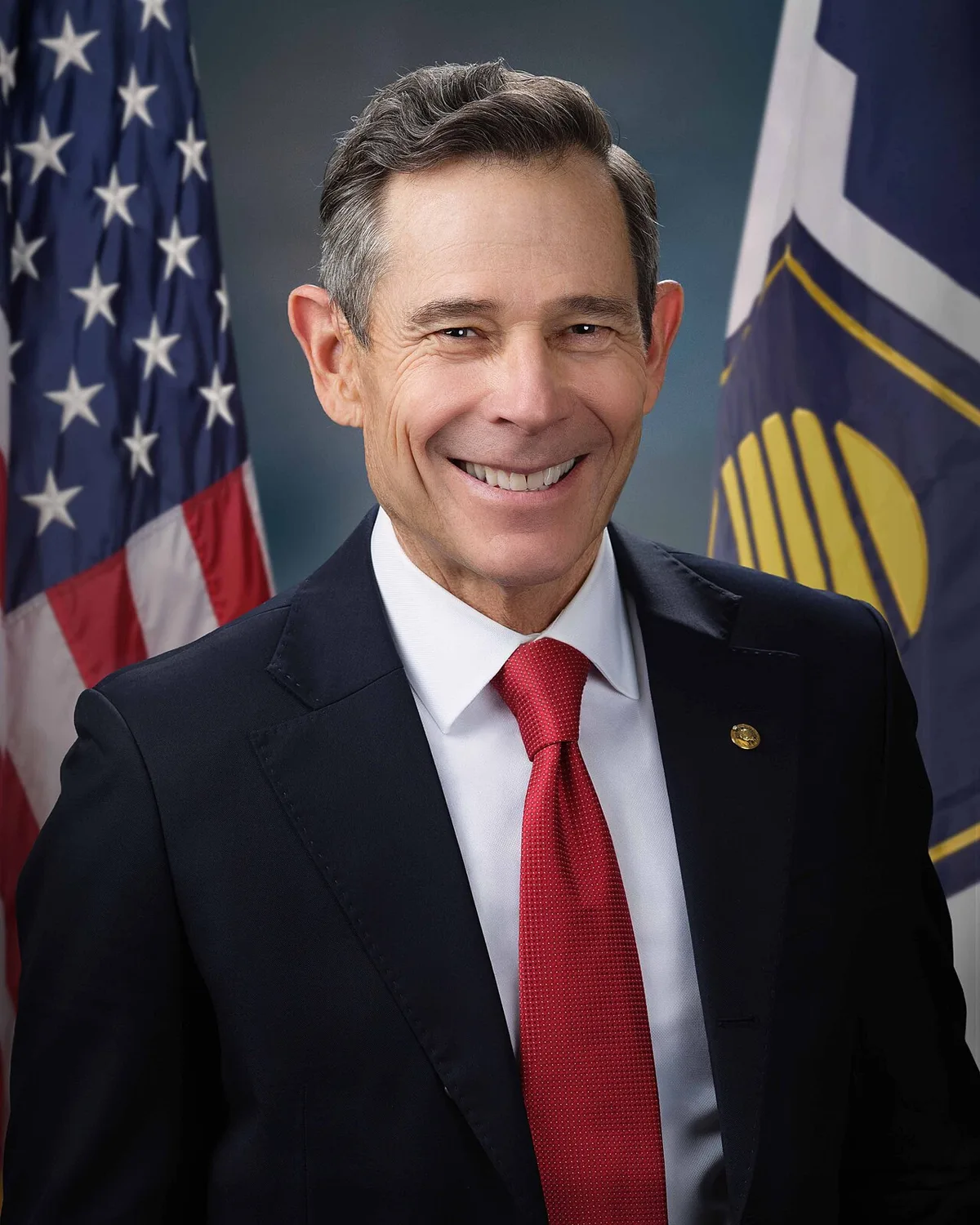
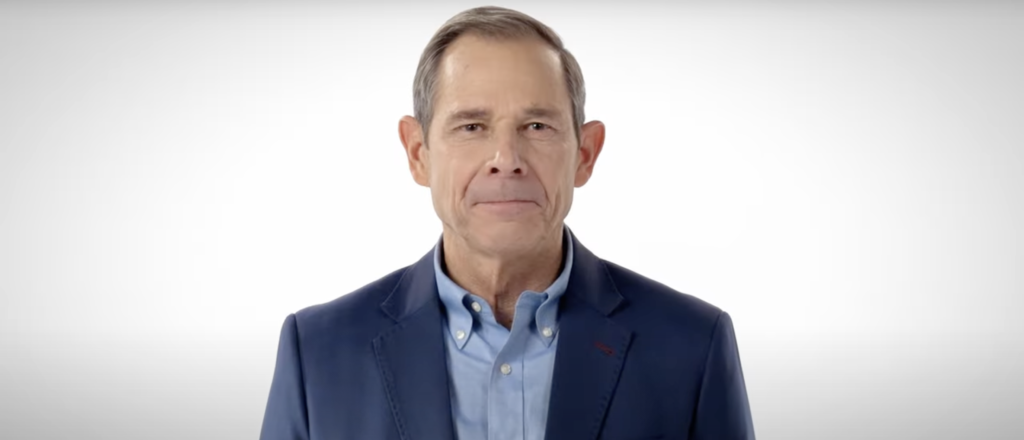
John Ream Curtis (born May 10, 1960) is an American politician serving since 2025 as the junior United States senator from Utah. A member of the Republican Party, Curtis served from 2017 to 2025 as the U.S. representative for Utah's 3rd congressional district and from 2010 to 2017 as the 44th mayor of Provo.
Curtis was first elected to Congress in a 2017 special election to succeed Jason Chaffetz in the U.S. House of Representatives. He was reelected three more times. In the 2024 election, Curtis was elected to the U.S. Senate to succeed Mitt Romney.
Curtis is generally considered a moderate Republican. He is the founder of the Conservative Climate Caucus and was a member of the centrist Republican Governance Group. Curtis did not support Donald Trump during the 2024 Republican primaries. Given his votes for bills such as the Respect for Marriage Act, analysts have generally considered Curtis's positions as similar to Romney's, although he has rejected such characterizations.
Contents
Early life, education, and career
John Curtis was born on May 10, 1960, in Ogden, Utah. His parents were Jesse Duckworth "Dee" Curtis and Hazel Dawn Curtis (née Ream). They married in 1955.
Curtis attended high school at Skyline High School, where he met his wife, Sue Snarr. He graduated from Brigham Young University with a degree in business management. He worked for OC Tanner and the Citizen Watch Company before taking a position as COO of a Provo-based company, Action Target, in 2000.
Curtis ran for the Utah State Senate in 2000 as a Democrat against Curt Bramble, losing 33% to 66%. From 2002 to 2003, he served as vice chairman and chairman of the Utah County Democratic Party.
Mayor of Provo
Curtis was elected mayor of Provo in 2009, defeating former legislator Stephen Clark with 53% of the vote on a platform of safety, prosperity, and unity. As mayor, he focused on economic development, revitalization of downtown Provo, and getting a beach at Utah Lake. He launched clean air and recreation initiatives, preserved Rock Canyon, and launched a blog widely read by residents. He also assisted with the purchase of iProvo, Provo City's existing fiber internet network, by Google Fiber.
Curtis was reelected in 2013 with 86% of the vote. In 2016, he announced he would not seek a third term. Under his leadership, Provo saw various improvements, and he maintained a high approval rating, averaging 93% in his final years in office.
During Curtis's mayoralty, there was controversy involving the Provo police chief, John King. Allegations of sexual misconduct by King emerged, leading to a 2018 lawsuit that claimed the City and Curtis did not adequately protect employees from King's behavior. Reporters learned that King had been investigated and forced to resign in 2012 from his post at the Baltimore Police Department following similar complaints of sexual assault, a fact not discovered in a background check before he was hired by Provo. Curtis said that any meetings regarding King focused on administrative concerns and that he never intended to discourage reports of misconduct. He ordered King to retake sexual harassment training and, upon learning of a rape accusation in 2017, requested King's resignation. The city paid $750,000 to settle the lawsuit in July 2018.
Awards
Community Hero Award (Silicon Slopes, 2017)
Civic Innovator of the Year Award (UVU, Office of New Urban Mechanics, 2017)
Outstanding Citizen Award (BYU, Office of Civic Engagement Leadership, 2017)
2017 Freedom Festival Grand Marshal
Person of the Year (Utah Clean Air, 2017)
Person of the Year Award (Utah Valley Magazine, 2017)
Top Elected Official on Social Media (Government Social Media, 2015)
The Star Award (SCERA Center for the Arts, 2015)
U.S. House of Representatives
Elections
On May 25, 2017, Curtis announced his candidacy for that year's special election in Utah's 3rd congressional district to replace Jason Chaffetz, who resigned on June 30. On August 15, Curtis won the Republican nomination over Christopher Herrod and Tanner Ainge. On November 7, he won the general election over Democratic nominee Kathie Allen.
Tenure
Curtis was sworn into office on November 13, 2017. Since being elected to Congress, he has held more than 100 town hall meetings, including a "walking town hall" to the top of Mount Timpanogos.
On October 16, 2019, Utah Policy reported Curtis had the second-highest approval rating among Utah's four U.S. representatives. According to the Utah Policy and Y2 Analytics poll, 45% of 3rd Congressional District registered voters approved of his performance.
FiveThirtyEight found that during Donald Trump's first presidency, Curtis voted with Trump's preferred position 94.4% of the time. Curtis has a reputation for being occasionally critical of Trump. On December 18, 2019, he voted against both articles of impeachment against Trump, calling it "a rather easy decision". Of the 195 Republicans who voted, all voted against both impeachment articles. Despite calling for Trump to be censured for the January 6 attack, Curtis voted against the second impeachment of Trump.
Curtis did not join the majority of Republican members of Congress who signed an amicus brief in support of Texas v. Pennsylvania, a lawsuit filed at the United States Supreme Court contesting the results of the 2020 presidential election. He voted to certify both Arizona's and Pennsylvania's results in the 2021 United States Electoral College vote count.
On May 19, 2021, Curtis and 34 other Republicans voted to establish a commission to investigate the events of January 6 modeled after the 9/11 Commission. Curtis did not vote to establish the Select Committee to investigate the events of January 6 that received only two Republican votes in the House.
In 2021, Curtis co-sponsored the Fairness for All Act, the Republican alternative to the Equality Act. The bill would prohibit discrimination based on sex, sexual orientation, and gender identity, and protect the free exercise of religion.
On July 19, 2022, Curtis and 46 other Republican representatives voted for the Respect for Marriage Act, which would codify the right to same-sex marriage in federal law. Curtis was noted for not endorsing Trump in the 2024 Republican primary.
Conservative Climate Caucus
On June 28, 2021, Curtis announced the new Conservative Climate Caucus in a press conference at the Capitol. He serves as chairman and leads the caucus's 73 members, including representatives from every committee with jurisdiction over climate policy and various ranking members. The caucus's purpose is to educate Republican House members on conservative climate solutions that align with Republican principles. Curtis said: "Without Republicans engaging in this debate, we will not make the progress we need to make as a country. Any significant accomplishment in the United States has been bipartisan. The ideas that Republicans bring to the table are essential to meeting the goals that we all have for a better environment."
Sponsored legislation
Bears Ears National Monument
On December 4, 2017, Curtis and fellow Utah representatives Rob Bishop, Chris Stewart, and Mia Love introduced a bill to codify the Trump administration's reduction of Bears Ears National Monument by creating two new national monuments in the remaining areas Trump defined.
On January 9, 2018, members of the Tribes of the Bears Ears Inter-Tribal Coalition testified against the bill, including Shaun Chapoose, a member of the Ute Indian Tribe and Utah Business Committee.
SPEED Act
On June 13, 2018, Curtis introduced H.R. 6088, the Streamlining Permitting Efficiencies in Energy Development (SPEED) Act. The legislation proposes streamlining the oil and gas permitting process by allowing the Bureau of Land Management to expedite approval for drilling activities that pose little or no environmental harm. The bill would have amended the Mineral Leasing Act to establish procedures where an operator may conduct drilling and production activities on available federal and non-federal land. Community members criticized Curtis for his sponsorship, saying the act omitted the required environmental impact analysis and allowed drilling on land without notifying the public or providing an opportunity to comment.
Public-Private Partnership Advisory Council to End Human Trafficking Act
On December 12, 2018, Curtis introduced H.R. 7271, the "Public-Private Partnership Advisory Council to End Human Trafficking Act", the companion bill to Senator Orrin Hatch's legislation. The bill creates a Public-Private Advisory Council to provide a direct line to federal government agencies to streamline bureaucratic hurdles while empowering nonprofits and nongovernmental organizations in fighting human trafficking.
Government Shutdown Prevention Act
On January 16, 2019, Curtis and Lloyd Smucker introduced the Government Shutdown Prevention Act. The legislation aims to end political game-playing and fix Congress's dysfunctional budget process. If passed, it would automatically continue government funding through a continuing resolution. The bill would implement a five percent spending penalty when the continuing resolution begins. Federal spending would be reduced by two percent 60 days after the first day of the fiscal year and by an additional two percent each subsequent 60-day period. Curtis said, "The American people expect Congress to do its most basic job: pass a budget and fund the government. If we can't, then we shouldn't get paid." Curtis asked the Clerk of the House to withhold his pay until Congress fully funded the government. He believes that Republicans and Democrats should be held accountable to find common ground to solve funding impasses.
Committee assignments
United States House Committee on Energy and Commerce
Subcommittee on Health
Subcommittee on Communications & Technology
Subcommittee on Environment & Climate Change
Caucus memberships
Congressional Taiwan Caucus
Congressional Motorcycle Caucus
Republican Governance Group
Republican Main Street Partnership
Congressional Solar Caucus
Congressional Western Caucus
Ski and Snowboard Caucus
Republican Study Committee
Congressional Dietary Supplement Caucus
Problem Solvers Caucus
Conservative Climate Caucus (chair)
Climate Solutions Caucus
Congressional Blockchain Caucus
U.S. Senate
Elections
In 2024, Curtis announced his candidacy for the United States Senate, despite saying in October 2023 he would not run for the seat. The seat was being vacated by Mitt Romney, who chose not to seek reelection. Known for his moderate stance and strong emphasis on environmental issues, Curtis positioned himself as a unifying candidate who could appeal to both the conservative base and independent voters. He defeated former Utah House Speaker Brad Wilson and Riverton Mayor Trent Staggs in the Republican primary and Democratic nominee Caroline Gleich in the general election, with 62.6% of the vote.
Curtis's campaign focused on his legislative achievements and ability to connect with Utahns. He cited his ranking as one of the most effective lawmakers and his office's ranking as #1 in accessibility and accountability. The race attracted significant attention within Utah and nationally, as Curtis faced several challengers in the Republican primary. His campaign was marked by a strong grassroots effort, bolstered by his popularity in his congressional district and his reputation as a principled and approachable leader. Curtis focused on local issues important to Utah voters, such as public lands management, water resources, and economic development. He also addressed national concerns, including the need to balance the federal budget. This election was closely watched as a barometer of the Republican Party's direction, with Curtis representing a more traditional, policy-focused approach in contrast to some of the more populist candidates in the field. Curtis's campaign strategy included extensive town hall meetings, social media outreach, and targeted advertising aimed at highlighting his record and vision for Utah's future.
Tenure
Curtis took office on January 3, 2025.
Even before he was sworn in, Curtis wielded influence as a crucial opposition vote to the nomination of Matt Gaetz as United States Attorney General. Alongside senators Mitch McConnell, Susan Collins, and Lisa Murkowski, his potential "no" vote sank Gaetz's chances, leading him to withdraw.
In January 2025, Curtis co-sponsored the Kids Off Social Media Act (KOSMA), which was introduced by Brian Schatz, Chris Murphy, Ted Cruz, and Katie Britt. Senators Ted Budd, Peter Welch, John Fetterman, Angus King, and Mark Warner also co-sponsored the Act, which would set a minimum age of 13 to use social media platforms and prevent social media companies from feeding "algorithmically targeted" content to users under 17.
In April 2025, Curtis introduced the Fix Our Forests Act alongside Senators John Hickenlooper, Alex Padilla, and Tim Sheehy. The bill aims to improve forest management for wildfire risk reduction.
Committee assignments
For the 119th Congress:
Committee on Commerce, Science, and Transportation
Subcommittee on Telecommunications and Media
Subcommittee on Consumer Protection, Technology, and Data Privacy
Subcommittee on Coast Guard, Maritime, and Fisheries
Committee on Environment and Public Works
Subcommittee on Transportation and Infrastructure
Subcommittee on Clean Air, Climate, and Nuclear Innovation and Safety
Subcommittee on Chemical Safety, Waste Management, Environmental Justice and Regulatory Oversight (Chair)
Committee on Foreign Relations
Subcommittee on East Asia, The Pacific, and International Cybersecurity Policy
Subcommittee on Europe and Regional Security Cooperation
Subcommittee on Western Hemisphere, Transnational Crime, Civilian Security, Democracy, Human Rights, and Global Women's Issues (Chair)
Committee on Small Business and Entrepreneurship
Personal life
Curtis is a member of the Church of Jesus Christ of Latter-day Saints and served a two-year mission in Taiwan. He and his wife Sue have six children and seventeen grandchildren.
As a public figure, Curtis has gained recognition for his expansive collection of socks. He is fluent in Mandarin Chinese.