




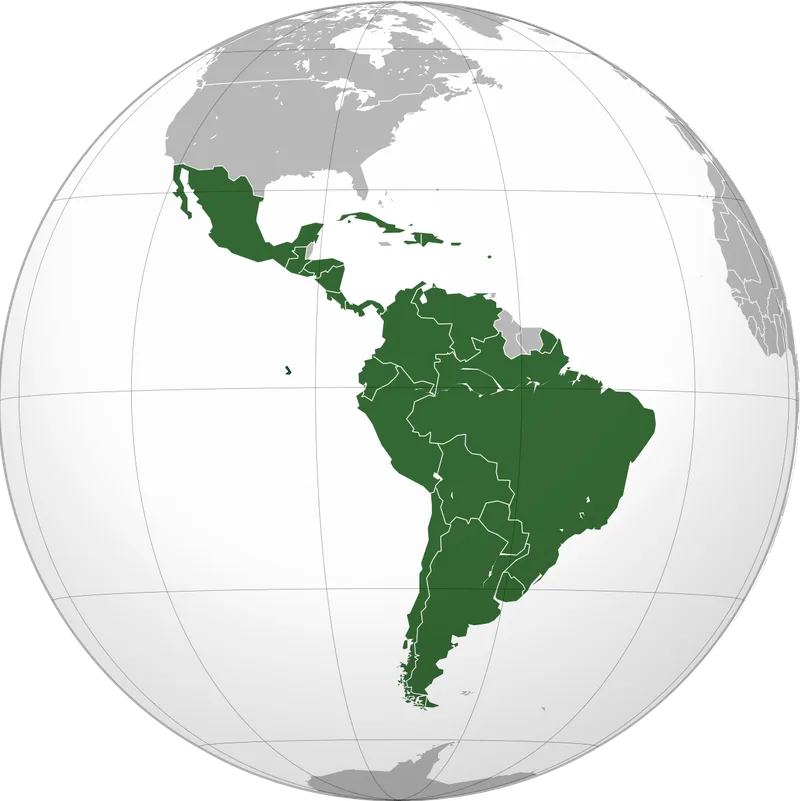



Latin America (Spanish: América Latina or Latinoamérica; Portuguese: América Latina) is the cultural region of the Americas where Romance languages are predominantly spoken, primarily Spanish and Portuguese.
Since it is defined according to its cultural identity instead of its geography, Latin America includes countries from both North and South America. For instance, countries from North America like Mexico, Honduras, Guatemala, etc. tend to be included. In fact, most of the countries in Central America, South America and the Caribbean are considered Latin American countries. English or Dutch-speaking countries in South America or the Caribbean like Belize, Guyana, Jamaica, Trinidad and Tobago, Suriname, etc. are not considered "Latin American" because they speak Germanic languages. As such, Latin America comprises Hispanic America along with Brazil. Related terms include the narrower Hispanic America, which exclusively refers to Spanish-speaking nations; and the broader Ibero-America, which includes all Iberian countries in the Americas.
The term Latin America was first introduced in 1856 at a conference named Initiative of the Americas: Idea for a Federal Congress of the Republics (Iniciativa de la América. Idea de un Congreso Federal de las Repúblicas), at Paris. Chilean politician Francisco Bilbao coined the term to refer to countries sharing cultural and linguistic heritage. It gained further prominence during the 1860s under the rule of Napoleon III, whose government sought to justify France's intervention in the Second Mexican Empire.
Contents
Etymology and definitions
Latin America is a geographical region where Spanish or Portuguese is the national language with a common culture, and tradition. As a whole, it can be traced back to the 1830s, in the writing of the French Saint-Simonian Michel Chevalier, who postulated that a part of the Americas was inhabited by people of a "Latin race", and that it could, therefore, ally itself with "Latin Europe", ultimately overlapping the Latin Church, in a struggle with "Teutonic Europe" and "Anglo-Saxon America" with its Anglo-Saxonism, as well as "Slavic Europe" with its Pan-Slavism.
Published in 1492, Gramática de la lengua castellana (lit. 'Grammar of the Castilian Language') written by Antonio de Nebrija was the first work dedicated to the Spanish language and its rules, and it was the first grammar of a modern European language to be published.
Uruguayan historian Arturo Ardao and Chilean historian Miguel Rojas Mix found evidence that the term "Latin America" was used earlier than John Leddy Phelan had claimed, and that the first use of the term was in opposition to imperialist projects in the Americas. Ardao wrote about this subject in his book Génesis de la idea y el nombre de América latina (Genesis of the Idea and the Name of Latin America, 1980), and Miguel Rojas Mix in his article "Bilbao y el hallazgo de América latina: Unión continental, socialista y libertaria" (Bilbao and the Finding of Latin America: a Continental, Socialist, and Libertarian Union, 1986).
Michel Gobat notes that "Arturo Ardao, Miguel Rojas Mix, and Aims McGuinness have revealed [that] the term 'Latin America' had already been used in 1856 by Central Americans and South Americans protesting US expansion into the Southern Hemisphere". Edward Shawcross summarizes Ardao's and Rojas Mix's findings: "Ardao identified the term in a poem by a Colombian diplomat and intellectual resident in France, José María Torres Caicedo, published on 15 February 1857 in a French-based Spanish-language newspaper, while Rojas Mix located it in a speech delivered in France by the radical liberal Chilean politician Francisco Bilbao in June 1856".
By the late 1850s, the term was being used in California (by then a part of the United States), with local newspapers such as El Clamor Público writing about América latina and latinoamérica, and identifying as Latinos as the abbreviated term for their "hemispheric membership in la raza latina".
Modern definitions
The most common definition of Latin America is the countries and territories in the Americas where the populations speak Spanish or Portuguese and the dominant religion is Roman Catholic, with it being synonymous with Ibero-America ("Iberian America"). Puerto Rico, the Spanish-speaking Caribbean territory of the United States, acquired from the Spanish Empire following its defeat in the 1898 Spanish–American War, is usually included. This definition excludes the predominantly Protestant English-speaking and Dutch-speaking regions, as well as French-speaking predominantly Catholic regions. Belize, Guyana and Suriname, as well as several French overseas departments, are excluded from the definition.
In a less used definition, Latin America designates the set of countries in the Americas where any Romance language (a language derived from Latin) predominates: Spanish, Portuguese, or French. Thus, it includes Mexico; most of Central and South America; and in the Caribbean, Cuba, Puerto Rico, the Dominican Republic, and Haiti. French Guiana and the French West Indies are sometimes included. By this definition, Latin America then comprises all of the countries in the Americas that were once part of the Spanish, Portuguese, and French Empires.
The term is sometimes used more broadly to refer to all of the Americas south of the United States, thus including the Guianas (French Guiana, Guyana, and Suriname); the Anglophone Caribbean (and Belize); the Francophone Caribbean; and the Dutch Caribbean. This definition emphasizes a similar socioeconomic history of the region, which was characterized by formal or informal colonialism, rather than cultural aspects (see, for example, dependency theory). Some sources use the alternative phrase "Latin America and the Caribbean", as in the United Nations geoscheme for the Americas.
Quebec and Acadia, Francophone parts of North America, are generally excluded from the definition of Latin America.
Subregions and countries
Latin America can be subdivided into several subregions based on geography, politics, democracy, demographics and culture. The basic geographical subregions are North America, Central America, the Caribbean and South America; the latter contains further politico-geographical subdivisions such as the Southern Cone, the Guianas and the Andean civilizations. It may be subdivided on linguistic grounds into Spanish America and Portuguese America.
*: Not a sovereign state
History
Before the arrival of Europeans in the late 15th and early 16th centuries, the region was home to many indigenous peoples, including advanced civilizations, most notably from South: the Olmec, Maya, Muisca, Aztecs and Inca. The region came under control of the kingdoms of Spain and Portugal which established colonies, and imposed Roman Catholicism and their languages. These countries brought African slaves to their colonies as laborers, exploiting large, settled societies and their resources. The Spanish Crown regulated immigration, allowing only Christians to travel to the New World.
The colonization process led to significant native population declines due to disease, forced labor, and violence. They imposed their culture, destroying native codices and artwork. Colonial-era religion played a crucial role in everyday life, with the Spanish Crown ensuring religious purity and aggressively prosecuting perceived deviations like witchcraft. The decline of Spain was the gradual process of financial and military exhaustion and attrition suffered by Spanish Empire throughout the 17th century, in particular when viewed in comparison with ascendant rival powers of the Kingdom of France and Kingdom of England.
Because Catholicism had played such an important role in the Reconquista (Catholic reconquest) of the Iberian Peninsula from the Muslims, the Catholic Church in essence became another arm of the Spanish government, since the crown was granted sweeping powers over ecclesiastical affairs in its overseas territories. The Spanish Crown granted it a large role in the administration of the state, and this practice became even more pronounced in the New World, where prelates often assumed the role of government officials.
Under Philip II of Spain, royal power over Latin America increased, but the crown knew little about its overseas possessions. Although the Council of the Indies was tasked with oversight there, it acted without advice of high officials with direct colonial experience. Another serious problem was that the crown did not know what Spanish laws were in force there.
Spanish Golden Age
The Spanish Golden Age was a period of intense artistic, literary, and intellectual flourishing in Spain is generally associated with the reigns of Isabella I, Ferdinand II, Charles V, Philip II, Philip III, and Philip IV, during which Spain became a leading political and military power. The Spanish Golden Age is conventionally considered to have begun in 1492, and is often regarded as having ended in 1659 with the Treaty of the Pyrenees, which marked the decline of Spanish hegemony in Europe, although the period is commonly understood to have continued in cultural terms until 1681, the year of Pedro Calderón de la Barca's death.
The era was characterized by extensive royal, aristocratic, and ecclesiastical patronage, which supported literature, painting, architecture, music, and theatre. Major artistic and cultural projects, including El Escorial, contributed to the formation of a distinctive Spanish court and religious culture. The period encompassed the Plateresque and Renaissance styles and extended into the early Spanish Baroque. It produced many of the best-known figures in Spanish cultural history, including Miguel de Cervantes, Lope de Vega, Luis de Góngora, Francisco de Quevedo, Diego Velázquez, and composers such as Tomás Luis de Victoria and Francisco Guerrero.
Independence movements
In the early nineteenth century nearly all of areas of Spanish America attained independence by armed struggle, with the exceptions of Cuba and Puerto Rico. Brazil, which had become a monarchy separate from Portugal, became a republic in the late nineteenth century. Political independence from European monarchies did not result in the abolition of black slavery in the new nations, and it resulted in political and economic instability in Spanish America immediately after independence. Yet, as regional Caudillos started to rise in power, nation-builders started to view themselves as more modern than their former European colonizers. Leaders began to shift away from aristocracy toward republicanism and democracy, which allowed all citizens, not just the Creole elites, to have a voice in politics. This shift helped unify many of the Latin American nations as all people, even illiterate people, would gather in their communities to talk about political ideals and how they should be used in their nation. Great Britain and the United States exercised significant influence in the post-independence era, resulting in a form of neo-colonialism, where political sovereignty remained in place, but foreign powers exercised considerable power in the economic sphere. Newly independent nations faced domestic and interstate conflicts, struggling with economic instability and social inequality.
The 20th century brought U.S. intervention and the Cold War's impact on the region, with revolutions in countries like Cuba influencing Latin American politics. The late 20th and early 21st centuries saw shifts towards left-wing governments, followed by conservative resurgences, and a recent resurgence of left-wing politics in several countries.
After 2000
In many countries in the early 2000s, left-wing political parties rose to power, known as the Pink tide. The presidencies of Hugo Chávez (1999–2013) in Venezuela, Ricardo Lagos and Michelle Bachelet in Chile, Lula da Silva and Dilma Rousseff of the Workers Party (PT) in Brazil, Néstor Kirchner and his wife Cristina Fernández in Argentina, Tabaré Vázquez and José Mujica in Uruguay, Evo Morales in Bolivia, Daniel Ortega in Nicaragua, Rafael Correa in Ecuador, Fernando Lugo in Paraguay, Manuel Zelaya in Honduras (removed from power by a coup d'état), Mauricio Funes and Salvador Sánchez Cerén in El Salvador are all part of this wave of left-wing politicians who often declare themselves socialists, Latin Americanists, or anti-imperialists, often implying opposition to US policies towards the region. An aspect of this has been the creation of the eight-member ALBA alliance, or "The Bolivarian Alliance for the Peoples of Our America" (Spanish: Alianza Bolivariana para los Pueblos de Nuestra América) by some of these countries.
Following the pink tide, there was a Conservative wave across Latin America. In Mexico, the rightwing National Action Party (PAN) won the presidential election of 2000 with its candidate Vicente Fox, ending the 71-year rule of the Institutional Revolutionary Party. He was succeeded six years later by another conservative, Felipe Calderón (2006–2012), who attempted to crack down on the Mexican drug cartels and instigated the Mexican drug war. Several right-wing leaders rose to power, including Argentina's Mauricio Macri and Brazil's Michel Temer, following the impeachment of the country's first female president. In Chile, the conservative Sebastián Piñera succeeded the socialist Michelle Bachelet in 2017. In 2019, center-right Luis Lacalle Pou ended a 15-year leftist rule in Uruguay, after defeating the Broad Front candidate.
Economically, the 2000s commodities boom caused positive effects for many Latin American economies. Another trend was the rapidly increasing importance of their relations with China.
However, with the Great Recession beginning in 2008, there was an end to the commodity boom, resulting in economic stagnation or recession in some countries. A number of left-wing governments of the Pink tide lost support. The worst-hit was Venezuela, which is facing severe social and economic upheaval.
Charges against a major Brazilian conglomerate, Odebrecht, have raised allegations of corruption across the region's governments (see Operation Car Wash). This bribery ring has become the largest corruption scandal in Latin American history. As of July 2017, the highest ranking politicians charged were former Brazilian President Luiz Inácio Lula da Silva, who was arrested, and former Peruvian presidents Ollanta Humala and Alejandro Toledo, who fled to the United States and was extradited back to Peru.
Geography
Neotropical realm
Most of Latin America is part of the Neotropical realm, one of the eight biogeographic realms of Earth's land surface. The Neotropic is delimited by similarities in fauna or flora, which are distinct from the Nearctic realm, which includes most of North America. The Neotropic includes more tropical rainforest (tropical and subtropical moist broadleaf forests) than any other realm. It extends from southern Mexico through Central America and northern South America to southern Brazil, including the vast Amazon rainforest. These rainforest ecoregions are one of the most important reserves of biodiversity on Earth.
Climate
As part of the Hadley model of atmospheric circulation, the equator is characterised by the ascending branches of separate meridional cells, driven by intense insolation. The vertical convection draws in air from the surrounding atmosphere, known as the trade winds. As these inward flows of air converge they reduce horizontal wind speed, and as they rise, they form precipitation. The vertical convection also results in a net export of heat and freshwater from the lower atmosphere into the troposphere.
The Great American Interchange was an important late Cenozoic paleozoogeographic biotic interchange event in which land and freshwater fauna migrated from North America to South America via Central America and vice versa, as the volcanic Isthmus of Panama rose up from the sea floor, forming a land bridge between the previously separated continents. Although earlier dispersals had occurred, probably over water, the migration accelerated dramatically about 2.7 million years (Ma) ago during the Piacenzian age. It resulted from the joining of the Neotropic (roughly South American) and Nearctic (roughly North American) biogeographic realms to definitively form the Americas.
Environment
The environment of Latin America has been changed by human use in the expanding of agriculture, new agricultural technologies, including the Green Revolution, extraction of minerals, growth of cities, and redirection of rivers by the construction of dams for irrigation, drinking water, and hydroelectric power. In the twenty-first century, there is a growing movement to protect nature, and many governments have sought recognition of natural sites by the UNESCO World Heritage Sites. Brazil, Mexico, and Peru currently have the greatest number of natural sites.
Economy
Economic history
Before independence from Spain, international trade was regulated by the royal Casa de Contratación (House of Trade) based in Seville. Inter-regional trade was severely limited with merchants based in Spain and with overseas connections in the main colonial centers controlling the transatlantic trade. Economic thought between 1500 and 1700 was predominantly mercantilist, such as the School of Salamanca. This reflected early modern Europe before the Industrial Revolution but after the Renaissance.
British traders began making inroads into the theoretically closed Spanish system in the eighteenth century, and the Spanish crown instituted a series of changes in policy in the eighteenth century, known as the Bourbon Reforms, designed to bring the Spanish America under closer crown control. However, one innovation was comercio libre ("free commerce"), which was not free trade as generally understood, but allowed all Spanish and Spanish American ports to be accessible to each other, excluding foreign traders, in a move to stimulate economic activity yet maintain crown control.
At independence in the early nineteenth century, Spanish America and Brazil had no foreign investment or direct, legal contact with economic partners beyond those allowed within controlled trade. Unlike the later East India Companies, which were chartered companies established by the Dutch, English, and others, the Casa collected all colonial taxes and duties, approved all voyages of exploration and trade, maintained secret information on trade routes and new discoveries, licensed captains, and administered commercial law.
In the period before the 18th century, Latin America's economy was larger than that of British America, and had a similar level of development. The English and French colonies in North America had a temperate climate and no major indigenous populations whose labor could be exploited. France was developing Colbertism in the 17th century, during the reign of Louis XIV, which would later evolve into Dirigisme.
The Southern United States used plantation agriculture and had large black slave populations, sharing more characteristics with Brazil and the Caribbean than the northern English colonies. The main difference with Latin America is that the southern English colonies are predominantly Protestant to this day, forming a "Bible Belt," rather than Catholic. The northern English colonies were characterized by the family farm, with a homogeneous European-descent population and a much less sharp divide between rich and poor. Unlike Spanish America and Brazil which restricted immigration, the northern English colonies were a magnet for migration, encouraged by the British crown.
Agriculture
The four countries with the strongest agricultural sector in South America are Brazil, Argentina, Chile and Colombia. Currently:
Brazil is the world's largest producer of sugarcane, soy, coffee, oranges, guaraná, açaí and Brazil nut; is one of the top five producers of maize, papaya, tobacco, pineapple, banana, cotton, beans, coconut, watermelon, lemon and yerba mate; is one of the top ten world producers of cocoa, cashew, avocado, tangerine, persimmon, mango, guava, rice, oat, sorghum and tomato; and is one of the top 15 world producers of grapes, apples, melons, peanuts, figs, peaches, onions, palm oil and natural rubber.
Argentina is the world's largest producer of yerba mate; is one of the five largest producers in the world of soy, maize, sunflower seeds, lemons and pears, one of the 10 largest producers in the world of barley, grapes, artichokes, tobacco and cotton, and one of the 15 largest producers in the world of wheat, oats, chickpeas, sugarcane, sorghum and grapefruit.
Chile is one of the five largest world producers of cherries and cranberries, and one of the ten largest world producers of grapes, apples, kiwi, peaches, plums and hazelnuts, focusing on exporting high-value fruits.
Colombia is one of the five largest producers in the world of coffee, avocados and palm oil, and one of the ten largest producers in the world of sugarcane, bananas, pineapples and cocoa. It is the main producer of Coca, an illegal plant that is the main ingredient in Cocaine
Peru is the world's largest producer of quinoa; is one of the five largest producers of avocados, blueberry, artichokes and asparagus; one of the ten largest producers in the world of coffee and cocoa; one of the 15 largest producers in the world of potatoes and pineapples, and also has a large production of grapes, sugarcane, rice, bananas, maize and cassava; its agriculture is considerably diversified.
Paraguay is currently the 6th largest producer of soy in the world and entering the list of the 20 largest producers of maize and sugarcane.
Mining and petroleum
Mining is one of the most important economic sectors in Latin America, especially for Chile, Peru and Bolivia, whose economies are highly dependent on this sector. The continent has large productions of:
Gold (mainly in Peru, Mexico, Brazil and Argentina);
Silver (mainly in Mexico, Peru, Chile, Bolivia and Argentina);
Copper (mainly in Chile, Peru, Mexico and Brazil);
Iron ore (Brazil, Peru and Chile);
Zinc (Peru, Mexico, Bolivia and Brazil);
Molybdenum (Chile, Peru and Mexico);
Lithium (Chile, Argentina and Brazil);
Lead (Peru, Mexico and Bolivia);
Bauxite (Brazil and Jamaica);
Tin (Peru, Bolivia and Brazil);
Manganese (Brazil and Mexico);
Antimony (Bolivia, Mexico, Guatemala and Ecuador);
Nickel (Brazil, Dominican Republic and Cuba);
Niobium (Brazil);
Rhenium (Chile);
Iodine (Chile),
Brazil stands out in the extraction of
Iron ore (where it is the 2nd largest producer and exporter in the world—iron ore is usually one of the three export products that generate the greatest value in the country's trade balance)
Manufacturing
The World Bank annually lists the top manufacturing countries by total manufacturing value. According to the 2019 list:
Mexico had the twelfth most valuable industry in the world (US$217.8 billion)
Brazil the thirteenth largest (US$173.6 billion)
Venezuela the thirtieth largest (US$58.2 billion, however, it depends on oil to reach this value)
Argentina the 31st largest (US$57.7 billion)
Colombia the 46th largest (US$35.4 billion)
Peru the 50th largest (US$28.7 billion)
Chile the 51st largest (US$28.3 billion).
In Latin America, few countries stand out in industrial activity: Brazil, Argentina, Mexico and, less prominently, Chile. Begun late, the industrialization of these countries received a great boost from World War II: this prevented the countries at war from buying the products they were used to importing and exporting what they produced. At that time, benefiting from the abundant local raw material, the low wages paid to the labor force and a certain specialization brought by immigrants, countries such as Brazil, Mexico and Argentina, as well as Venezuela, Chile, Colombia and Peru, were able to implement important industrial parks. In general, in these countries there are industries that require little capital and simple technology for their installation, such as the food processing and textile industries. The basic industries (steel, etc.) also stand out, as well as the metallurgical and mechanical industries.
The industrial parks of Brazil, Mexico, Argentina and Chile, however, present much greater diversity and sophistication, producing advanced technology items. In the rest of Latin American countries, mainly in Central America, the processing industries of primary products for export predominate.
Infrastructure
Transport in Latin America is carried out primarily by road, the most developed mode in the region. There is also considerable port and airport infrastructure. The railway and fluvial sector, although it has potential, is usually treated in a secondary way.
Brazil has more than 1,700,000 km (1,100,000 mi) of roads, of which 215,000 km (134,000 mi) are paved, and about 14,000 km (8,700 mi) are divided highways. The two most important highways in the country are BR-101 and BR-116. Argentina has more than 600,000 km (370,000 mi) of roads, of which about 70,000 km (43,000 mi) are paved, and about 2,500 km (1,600 mi) are divided highways. The three most important highways in the country are Route 9, Route 7 and Route 14. Colombia has about 210,000 km (130,000 mi) of roads, and about 2,300 km (1,400 mi) are divided highways. Chile has about 82,000 km (51,000 mi) of roads, 20,000 km (12,000 mi) of which are paved, and about 2,000 km (1,200 mi) are divided highways. The most important highway in the country is the Route 5 (Pan-American Highway) These 4 countries have the most developed road infrastructure and the largest number of double-lane highways in South America.
The roadway network in Mexico has an extent of 366,095 km (227,481 mi), of which 116,802 km (72,577 mi) are paved, Of these, 10,474 km (6,508 mi) are multi-lane expressways: 9,544 km (5,930 mi) are four-lane highways and the rest have 6 or more lanes.
Due to the Andes Mountains, Amazon River and Amazon Forest, there have always been difficulties in implementing transcontinental or bioceanic highways. Practically the only route that existed was the one that connected Brazil to Buenos Aires, in Argentina and later to Santiago, in Chile. However, in recent years, with the combined effort of countries, new routes have started to emerge, such as Brazil-Peru (Interoceanic Highway), and a new highway between Brazil, Paraguay, northern Argentina and northern Chile (Bioceanic Corridor).
There are more than 2,000 airports in Brazil. The country has the second largest number of airports in the world, behind only the United States. São Paulo International Airport, located in the Metropolitan Region of São Paulo, is the largest and busiest in the country – the airport connects São Paulo to practically all major cities around the world. Brazil has 44 international airports, such as those in Rio de Janeiro, Brasília, Belo Horizonte, Porto Alegre, Florianópolis, Cuiabá, Salvador, Recife, Fortaleza, Belém and Manaus, among others. Argentina has important international airports such as Buenos Aires, Cordoba, Bariloche, Mendoza, Salta, Puerto Iguazú, Neuquén and Ushuaia, among others. Chile has important international airports such as Santiago, Antofagasta, Puerto Montt, Punta Arenas and Iquique, among others. Colombia has important international airports such as Bogotá, Medellín, Cartagena, Cali and Barranquilla, among others. Peru has important international airports such as Lima, Cuzco and Arequipa. Other important airports are those in the capitals of Uruguay (Montevideo), Paraguay (Asunción), Bolivia (La Paz) and Ecuador (Quito). The 10 busiest airports in South America in 2017 were: São Paulo-Guarulhos (Brazil), Bogotá (Colombia), São Paulo-Congonhas (Brazil), Santiago (Chile), Lima (Peru), Brasília (Brazil), Rio de Janeiro (Brazil), Buenos Aires-Aeroparque (Argentina), Buenos Aires-Ezeiza (Argentina), and Minas Gerais (Brazil).
Energy
As of 2023, Latin America and the Caribbean generates 60% of its electricity from renewable energy – double the global average of 30%. Despite this, fossil fuels still play a substantial role, especially in transportation and industry, with oil and gas constituting a notable portion. Approximately two-thirds of the region's energy mix comes from fossil fuels, Of the region's total energy production, 43% is hydroelectric, 8% wind and 6% is solar.
The Brazilian government has undertaken an ambitious program to reduce dependence on imported petroleum. Imports previously accounted for more than 70% of the country's oil needs but Brazil became self-sufficient in oil in 2006–2007. Brazil was the 10th largest oil producer in the world in 2019, with 2.8 million barrels / day. Production manages to supply the country's demand. In the beginning of 2020, in the production of oil and natural gas, the country exceeded 4 million barrels of oil equivalent per day, for the first time. In January this year, 3.168 million barrels of oil per day and 138.753 million cubic meters of natural gas were extracted.
Brazil is one of the main world producers of hydroelectric power. In 2019, Brazil had 217 hydroelectric plants in operation, with an installed capacity of 98,581 MW, 60.16% of the country's energy generation. In the total generation of electricity, in 2019 Brazil reached 170,000 megawatts of installed capacity, more than 75% from renewable sources (the majority, hydroelectric).
In 2013, the Southeast Region used about 50% of the load of the National Integrated System (SIN), being the main energy consuming region in the country. The region's installed electricity generation capacity totaled almost 42,500 MW, which represented about a third of Brazil's generation capacity. The hydroelectric generation represented 58% of the region's installed capacity, with the remaining 42% corresponding basically to the thermoelectric generation. São Paulo accounted for 40% of this capacity; Minas Gerais by about 25%; Rio de Janeiro by 13.3%; and Espírito Santo accounted for the rest. The South Region owns the Itaipu Dam, which was the largest hydroelectric plant in the world for several years, until the inauguration of Three Gorges Dam in China. It remains the second largest operating hydroelectric in the world. Brazil is the co-owner of the Itaipu Plant with Paraguay: the dam is located on the Paraná River, located on the border between countries. It has an installed generation capacity of 14 GW for 20 generating units of 700 MW each. North Region has large hydroelectric plants, such as Belo Monte Dam and Tucuruí Dam, which produce much of the national energy. Brazil's hydroelectric potential has not yet been fully exploited, so the country still has the capacity to build several renewable energy plants in its territory.
Tourism
Income from tourism is key to the economy of several Latin American countries. Mexico is the only Latin American country to be ranked in the top 10 worldwide in the number of tourist visits. It received by far the largest number of international tourists, with 39.3 million visitors in 2017, followed by Argentina, with 6.7 million; then Brazil, with 6.6 million; Chile, with 6.5 million; Dominican Republic, with 6.2 million; Cuba with 4.3 million; Peru and Colombia with 4.0 million. The World Tourism Organization reports the following destinations as the top six tourism earners for the year 2017: Mexico, with US$21,333 million; the Dominican Republic, with US$7,178 million; Brazil, with US$6,024 million; Colombia, with US$4,773 million; Argentina, with US$4,687 million; and Panama, with US$4,258 million.
Places such as Cancún, Riviera Maya, Chichen Itza, Cabo San Lucas, Mexico City, Acapulco, Puerto Vallarta, Guanajuato City, San Miguel de Allende, Guadalajara in Mexico, Punta Cana, Santo Domingo in Dominican Republic, Punta del Este in Uruguay, San Juan, Ponce in Puerto Rico, Panama City in Panama, Poás Volcano National Park in Costa Rica, Viña del Mar in Chile, Rio de Janeiro, Florianópolis, Iguazu Falls, São Paulo, Armação dos Búzios, Salvador, Bombinhas, Angra dos Reis, Balneário Camboriú, Paraty, Ipojuca, Natal, Cairu, Fortaleza and Itapema in Brazil; Buenos Aires, Bariloche, Salta, Jujuy, Perito Moreno Glacier, Valdes Peninsula, Guarani Jesuit Missions in the cities of Misiones and Corrientes, Ischigualasto Provincial Park, Ushuaia and Patagonia in Argentina;
Isla Margarita, Angel Falls, Los Roques archipelago, Gran Sabana in Venezuela; Machu Picchu, Lima, Nazca Lines, Cuzco in Peru; Lake Titicaca, Salar de Uyuni, La Paz, Jesuit Missions of Chiquitos in Bolivia; Tayrona National Natural Park, Santa Marta, Bogotá, Cali, Medellín, Cartagena, San Andrés in Colombia, and the Galápagos Islands in Ecuador are popular among international visitors in the region.
Trade blocs
The major trade blocs (or agreements) in the region are the Pacific Alliance and Mercosur. Minor blocs or trade agreements are the G3 Free Trade Agreement, the Dominican Republic – Central America Free Trade Agreement (DR-CAFTA), the Caribbean Community (CARICOM) and the Andean Community of Nations (CAN). However, major reconfigurations are taking place along opposing approaches to integration and trade; Venezuela has officially withdrawn from both the CAN and G3 and it has been formally admitted into the Mercosur (pending ratification from the Paraguayan legislature). The president-elect of Ecuador has manifested his intentions of following the same path. This bloc nominally opposes any Free Trade Agreement (FTA) with the United States, although Uruguay has manifested its intention otherwise. Chile, Peru, Colombia and Mexico are the only four Latin American nations that have an FTA with the United States and Canada, both members of the North American Free Trade Agreement (NAFTA).
China's economic influence in Latin America increased substantially in the 21st century. Imports from China valued $8.3 billion in 2000, but by 2022 its value was $450 billion and had grown to be the largest trading partner of South America, as well as the second-largest for the broader Latin America. In particular, many of the investments are related to the Belt and Road Initiative or energy. China has also provided loans to several Latin American countries; this has raised concerns about the possibility of debt traps." Specifically, Venezuela, Brazil, Ecuador, and Argentina received the most loans from China during 2005–2016.
Inequality
Wealth inequality in Latin America remains a serious issue despite strong economic growth and improved social indicators. A report released in 2013 by the UN Department of Economic and Social Affairs entitled Inequality Matters: Report of the World Social Situation, observed that: 'Declines in the wage share have been attributed to the impact of labour-saving technological change and to a general weakening of labour market regulations and institutions.' Such declines are likely to disproportionately affect individuals in the middle and bottom of the income distribution, as they rely mostly on wages for income. In addition, the report noted that 'highly-unequal land distribution has created social and political tensions and is a source of economic inefficiency, as small landholders frequently lack access to credit and other resources to increase productivity, while big owners may not have had enough incentive to do so.
According to the United Nations ECLAC, Latin America is the most unequal region in the world. In 2025, The Economist said that Latin America's "tax and welfare systems are shockingly bad at reducing inequality."
History of inequality
Spanish society in 17th century Habsburg Spain was extremely inegalitarian. The nobility, being wealthier than ordinary people, also had the privilege of being exempt from taxes. Spanish society associated social status with leisure and thus work was undignified for nobles. Even wealthy merchants invested in land, titles, and juros. Two acceptable careers for the nobility were the church and education. In 1620, there were 100,000 Spaniards in the clergy, by the late 17th century there were 150,000. Many Spaniards spent long years in universities, taking advantage of the increase in its numbers. By 1660, there were about 200,000 Spaniards in the clergy and the Church owned 20% of all the land in Spain.
Inequality in Latin America has deep historical roots in the Latin European racially based Casta system instituted in Latin America during colonial times that has been difficult to eradicate because of the differences between initial endowments and opportunities among social groups have constrained the poorest's social mobility, thus causing poverty to transmit from generation to generation, and become a vicious cycle. Inequality has been reproduced and transmitted through generations because Latin American political systems allow a differentiated access on the influence that social groups have in the decision-making process, and it responds in different ways to the least favored groups that have less political representation and capacity of pressure. Recent economic liberalisation also plays a role as not everyone is equally capable of taking advantage of its benefits. Differences in opportunities and endowments tend to be based on race, ethnicity, rurality, and gender. Because inequality in gender and location are near-universal, race and ethnicity play a larger, more integral role in discriminatory practices in Latin America. The differences have a strong impact on the distribution of income, capital and political standing.
One indicator of inequality is access to and quality of education. During the first phase of globalization in Latin America, educational inequality was on the rise, peaking around the end of the 19th century. In comparison with other developing regions, Latin America then had the highest level of educational inequality, which is certainly a contributing factor for its current general high inequality. During the 20th century, however, educational inequality started decreasing.
Standard of living
Latin America has the highest levels of income inequality in the world. The following table lists all the countries in Latin America indicating a valuation of the country's Human Development Index, GDP at purchasing power parity per capita, measurement of inequality through the Gini index, measurement of poverty through the Human Poverty Index, a measure of extreme poverty based on people living on less than 1.25 dollars a day, life expectancy, murder rates and a measurement of safety through the Global Peace Index. Green cells indicate the best performance in each category, and red the lowest.
Demographics
Largest cities
Urbanization accelerated starting in the mid-twentieth century, especially in capital cities, or in the case of Brazil, traditional economic and political hubs founded in the colonial era. In Mexico, the rapid growth and modernization in country's north has seen the growth of Monterrey, in Nuevo León. The following is a list of the ten largest metropolitan areas in Latin America. Entries in "bold" indicate they are ranked the highest.
Race and ethnicity
Latin American populations are diverse, with descendants of the Indigenous peoples, Europeans, Africans initially brought as slaves, and Asians, as well as new immigrants.
Mixing of groups was a fact of life at contact of the Old World and the New, but colonial regimes established legal and social discrimination against non-white populations simply on the basis of perceived ethnicity and skin color. Social class was usually linked to a person's racial category, with European-born Spaniards and Portuguese on top. During the colonial era, with a dearth initially of European women, European men and Indigenous women and African women produced what were considered mixed-race children. In Spanish America, the so-called Sociedad de castas or Sistema de castas was constructed by white elites to try to rationalize the processes at work. In the sixteenth century the Spanish crown sought to protect Indigenous populations from exploitation by white elites for their labor and land. The crown created the República de indios to paternalistically govern and protect Indigenous peoples. It also created the República de Españoles, which included not only European whites, but all non-Indigenous peoples, such as Black, mulattoes, and mixed-race castas who were not dwelling in Indigenous communities. In the religious sphere, the Indigenous were deemed perpetual neophytes in the Catholic faith, which meant Indigenous men were not eligible to be ordained as Catholic priests; however, Indigenous were also excluded from the jurisdiction of the Inquisition. Catholics saw military conquest and religious conquest as two parts of the assimilation of Indigenous populations, suppressing Indigenous religious practices and eliminating the Indigenous priesthood. Some worship continued underground. Jews and other non-Catholics, such as Protestants (all called "Lutherans") were banned from settling and were subject to the Inquisition.
Considerable mixing of populations occurred in cities, while the countryside was largely Indigenous. At independence in the early nineteenth century, in many places in Spanish America formal racial and legal distinctions disappeared, although slavery was not uniformly abolished. Significant black populations exist in Brazil and Spanish Caribbean islands such as Cuba and Puerto Rico and the circum-Caribbean mainland (Venezuela, Colombia, Panama), as long as in the southern part of South America and Central America (Honduras, Costa Rica, Nicaragua, Ecuador, and Peru) a legacy of their use in plantations. All these areas also have significant white populations. In Brazil, coastal Indigenous peoples largely died out in the early sixteenth century, with Indigenous populations surviving far from cities, sugar plantations, and other European enterprises. Many mixed-race people in much of Latin America are tri-racial, usually of European, African, and Indigenous blood, where European (mostly Spanish/Portuguese) tends to be the strongest of the three. In most of Brazil and the Spanish Caribbean, the average ancestral mix is European and African blood, with much smaller amounts of indigenous blood. While the opposite is true in many mainland Spanish-speaking Latin American countries like Venezuela, Colombia, and Panama, where the average ancestral mix is of European and indigenous blood, with smaller amounts of African. But in Mexico, and other places in northern Central America and southern South America, mixed race people tend to be completely of European and indigenous blood.
Language
Spanish is the predominant language of Latin America. It is spoken as a first language by about 60% of the population. Portuguese is spoken by about 30%, and about 10% speak other languages such as Quechua, Mayan languages, Guaraní, Aymara, Nahuatl, English, French, Dutch and Italian. Spanish is the official language of most of the countries and territories on the Latin American mainland, as well as in Cuba, Puerto Rico (where it is co-official with English), and the Dominican Republic. Portuguese is spoken mostly in Brazil, the largest and most populous country in the region. French is spoken in Haiti and in the French overseas departments of Guadeloupe, Martinique, and French Guiana. It is also spoken by some Panamanians of Afro-Antillean descent. Dutch is the official language in Suriname, Aruba, Curaçao and Bonaire. As Dutch is a Germanic language, the territories are not necessarily considered part of Latin America. However, the native and co-official language of Aruba, Bonaire, and Curaçao, is Papiamento, a creole language largely based on Portuguese and Spanish that has had a considerable influence from Dutch and other Portuguese-based creole languages.
Amerindian languages are widely spoken in Peru, Guatemala, Bolivia, Paraguay and Mexico, and to a lesser degree, in Panama, Ecuador, Brazil, Colombia, Venezuela, Argentina, and Chile. In other Latin American countries, the population of speakers of Indigenous languages tend to be very small or even non-existent, for example in Uruguay. Mexico is possibly contains more Indigenous languages than any other Latin American country, but the most-spoken Indigenous language there is Nahuatl.
In Peru, Quechua is an official language, alongside Spanish and other Indigenous languages in the areas where they predominate. In Ecuador, while Quichua holds no official status, it is a recognized language under the country's constitution; however, it is only spoken by a few groups in the country's highlands. In Bolivia, Aymara, Quechua, and Guaraní hold official status alongside Spanish. Guaraní, like Spanish, is an official language of Paraguay, and is spoken by a majority of the population, which is, for the most part, bilingual, and it is co-official with Spanish in the Argentine province of Corrientes. In Nicaragua, Spanish is the official language, but on the country's Caribbean coast English and Indigenous languages such as Miskito, Sumo, and Rama also hold official status. Colombia recognizes all Indigenous languages spoken within its territory as official, though fewer than 1% of its population are native speakers of these languages. Nahuatl is one of the 62 Native languages spoken by Indigenous people in Mexico, which are officially recognized by the government as "national languages" along with Spanish.
Religion
The vast majority of Latin Americans are Christians (90%), mostly Roman Catholics belonging to the Latin Church. About 70% of the Latin American population considers itself Catholic. In 2012 Latin America constitutes in absolute terms the second world's largest Christian population, after Europe.
According to the detailed Pew multi-country survey in 2014, 69% of the Latin American population is Catholic and 19% is Protestant. Protestants are 26% of the population in Brazil and over 40% in much of Central America. More than half of these are converts from Roman Catholicism.
Family structure
Latin America has the highest rates of non-marital childbearing in the world, with 55–74% of all children in the region born to unmarried parents. In most countries in this traditionally Catholic region, children born outside marriage are now the norm. In 2014, non-marital births were 74% in Colombia, 70% in Paraguay, 69% in Peru, 63% in the Dominican Republic, 58% in Argentina, and 55% in Mexico. In Brazil, non-marital births increased to 65.8% in 2009, up from 56.2% in 2000. In Chile, non-marital births increased to 70.7% in 2013, up from 48.3% in 2000.
Latin America also has relatively high teenage pregnancy rates, much higher than North America, Europe, and much of Asia, but lower than sub-Saharan Africa.
Migration
The entire hemisphere was settled by migrants from Asia, Europe, and Africa. Indigenous Amerindian populations settled throughout the hemisphere before the arrival of Europeans in the late fifteenth and sixteenth centuries and the forced migration of slaves from Africa.
In the post-independence period, a number of Latin American countries sought to attract European immigrants as a source of labor as well as to deliberately change the proportions of racial and ethnic groups within their borders. Chile, Argentina, and Brazil actively recruited labor from Catholic southern Europe, where populations were poor and sought better economic opportunities. Many nineteenth-century immigrants went to the United States and Canada, but a significant number arrived in Latin America. Although Mexico tried to attract immigrants, it largely failed. As black slavery was abolished in Brazil in 1888, coffee growers recruited Japanese migrants to work in coffee plantations. There is a significant population of Japanese descent in Brazil. Cuba and Peru recruited Chinese labor in the late nineteenth century. Some Chinese immigrants who were excluded from immigrating to the United States settled in northern Mexico. When the United States acquired its southwest by conquest in the Mexican–American War, Latin American populations did not cross the border to the United States, the border crossed them.
In the twentieth century there have been several types of migration. One is the movement of rural populations within a given country to cities in search of work, causing many Latin American cities to grow significantly. Another is international movement of populations, often fleeing repression or war. Other international migration is for economic reasons, often unregulated or undocumented. Mexicans immigrated to the U.S. during the violence of the Mexican Revolution (1910–1920) and the religious Cristero War (1926–29); during World War II, Mexican men worked in the U.S. in the bracero program. Economic migration from Mexico followed the crash of the Mexican economy in the 1980s.
Spanish refugees fled to Mexico following the fascist victory in the Spanish Civil War (1936–38), with some 50,000 exiles finding refuge at the invitation of President Lázaro Cárdenas. Following World War II a larger wave of refugees to Latin America, many of them Jews, settled in Argentina, Brazil, Chile, Cuba, and Venezuela. Some were only transiting through the region, but others stayed and created communities. A number of Nazis escaped to Latin America, living under assumed names, in an attempt to avoid attention and prosecution.
Education
Despite significant progress, education access and school completion remains unequal in Latin America. The region has made great progress in educational coverage; almost all children attend primary school, and access to secondary education has increased considerably. Quality issues such as poor teaching methods, lack of appropriate equipment, and overcrowding exist throughout the region. These issues lead to adolescents dropping out of the educational system early. Most educational systems in the region have implemented various types of administrative and institutional reforms that have enabled reach for places and communities that had no access to education services in the early 1990s. School meal programs are also employed to expand access to education, and at least 23 countries in the Latin America and Caribbean region have large-scale school feeding activities, altogether reaching 88% of primary school-age children in the region. Compared to prior generations, Latin American youth have seen an increase in their levels of education. On average, they have completed two more years of school than their parents.
However, there are still 23 million children in the region between the ages of 4 and 17 outside of the formal education system. Estimates indicate that 30% of preschool age children (ages 4–5) do not attend school, and for the most vulnerable populations, the poor and rural, this proportion exceeds 40 percent. Among primary school age children (ages 6 to 12), attendance is almost universal; however, there is still a need to enroll five million more children in the primary education system. These children mostly live in remote areas, are Indigenous or Afro-descendants and live in extreme poverty.
Among people between the ages of 13 and 17 years, only 80% are full-time students, and only 66% of these advance to secondary school. These percentages are lower among vulnerable population groups: only 75% of the poorest youth between the ages of 13 and 17 years attend school. Tertiary education has the lowest coverage, with only 70% of people between the ages of 18 and 25 years outside of the education system. Currently, more than half of low income or rural children fail to complete nine years of education.
Life expectancy
List of countries by life expectancy at birth for 2023 according to the World Bank Group.
Public health
Latin America has made notable progress in developing healthcare throughout the recent decades, and this is mostly driven even by both domestic policy and international collaborations. Some developments that were used:
The Pan American Health Organization. (This section is an excerpt from Pan American Health Organization). The Pan American Health Organization (PAHO) is a specialized agency of the United Nations (UN) in charge of international health cooperation in the Americas. This organization has played a crucial role in making efforts to combat communicable and noncommunicable diseases, strengthen health systems, and respond to emergencies and disasters.
Public/Private Initiatives and Partnerships. An example that has been in place since 2015 is the Salud Mesoamérica Initiative (SMI). This research project that focuses on the inequalities in health outcomes and access in Central America. It is a model that supports the transformation of health systems in each country, to bring coverage, access to healthcare, and health services among the poor in Mesoamérica, in particular women and children.
Crime and violence
Latin America has been cited by numerous sources to be the most dangerous region in the world. Studies have shown that Latin America contains the majority of the world's most dangerous cities.
Crime and violence prevention and public security are now important issues for governments and citizens in the Latin America region. Homicide rates in Latin America are the highest in the world. From the early 1980s through the mid-1990s, homicide rates increased by 50 percent. Latin America experienced more than 2.5 million murders between 2000 and 2017. There were a total of 63,880 murders in Brazil in 2018.
The most frequent victims of such homicides are young men, 69 percent of them between the ages of 15 and 19. Countries in Latin America and the Caribbean with the highest homicide rate per year per 100,000 inhabitants in 2015 were: El Salvador 109, Honduras 64, Venezuela 57, Jamaica 43, Belize 34.4, St. Kitts and Nevis 34, Guatemala 34, Trinidad and Tobago 31, the Bahamas 30, Brazil 26.7, Colombia 26.5, the Dominican Republic 22, St. Lucia 22, Guyana 19, Mexico 16, Puerto Rico 16, Ecuador 13, Grenada 13, Costa Rica 12, Bolivia 12, Nicaragua 12, Panama 11, Antigua and Barbuda 11, and Haiti 10. Most of the countries with the highest homicide rates are in Africa and Latin America. Countries in Central America, like El Salvador and Honduras, top the list of homicides in the world.
Brazil has more overall homicides than any country in the world, at 50,108, accounting for one in 10 globally. Crime-related violence is the biggest threat to public health in Latin America, striking more victims than HIV/AIDS or any other infectious disease. Countries with the lowest homicide rate per year per 100,000 inhabitants as of 2015 were: Chile 3, Peru 7, Argentina 7, Uruguay 8 and Paraguay 9.
Culture
Latin American culture is a mixture of many influences including cultures from their indigenous people as well as European, African, Asian, and US influences.
Indigenous cultures are that of the people who inhabited the continent prior to European colonization. Ancient and advanced civilizations developed their own political, social and religious systems. The Maya, the Aztec and the Inca are examples of these. Indigenous legacies in music, dance, foods, arts and crafts, clothing, folk culture and traditions are strong in Latin America. Indigenous languages affected Spanish and Portuguese, giving rise to loanwords like pampa, taco, tamale, moccassin, cacique.
European cultures were brought mainly by the colonial powers – the Spanish and Portuguese – between the 16th and 19th centuries, including as part of the Spanish Golden Age. The most enduring European colonial influences are language, institutions, customs and Catholicism.
Additional cultural influences came from Europe during the 18th, 19th and 20th centuries, due to growing immigration from Spain, Portugal, France, Italy and Germany; as well as artistic, ideological and technological developments of the time. Due to the impact of Enlightenment ideals after the French Revolution, a certain number of Iberian American countries decriminalized homosexuality after France and French territories in the Americas did so in 1791.
Some of the countries that abolished sodomy laws or banned state interference in consensual adult sexuality in the 19th century were:
Dominican Republic (1822)
Brazil (1824)
Peru (1836)
Mexico (1871)
Paraguay (1880)
Argentina (1887)
Honduras (1899)
Art
Beyond the tradition of Indigenous art, the development of Latin American visual art was influenced by Spanish, Portuguese and French Baroque painting, which in turn often followed the trends of the Italians. In general, artistic Eurocentrism began to wane in the early twentieth century with the increased appreciation for indigenous forms of representation.
From the early twentieth century, the art of Latin America was greatly inspired by the Constructivist Movement. The movement rapidly spread from Russia to Europe and then into Latin America. Joaquín Torres García and Manuel Rendón have been credited with bringing the Constructivist Movement into Latin America from Europe.
An important artistic movement generated in Latin America is muralism represented by Diego Rivera, David Alfaro Siqueiros, José Clemente Orozco and Rufino Tamayo in Mexico, Santiago Martinez Delgado and Pedro Nel Gómez in Colombia and Antonio Berni in Argentina. Some of the most notable Muralista works can be found in Mexico, Colombia, New York City, San Francisco, Los Angeles, and Philadelphia.
Painter Frida Kahlo, one of the most famous Mexican artists, painted about her own life and the Mexican culture in a style combining Realism, Symbolism, and Surrealism. Kahlo's work commands the highest selling price of all Latin American paintings.
The Venezuelan Armando Reverón, whose works are recognized internationally, is one of the most important artists of the 20th century in South America; he is a precursor of Arte Povera and Happening. In the 60s kinetic art emerged in Venezuela. Its main representatives are Jesús Soto, Carlos Cruz-Diez, Alejandro Otero, and Gego.
Colombian sculptor and painter Fernando Botero has gained regional and international recognition for his works which, on first examination, are noted for their exaggerated proportions and the corpulence of the human and animal figures.
The Ecuadorian Oswaldo Guayasamín is considered one of the most important and seminal artists in Ecuador and South America. In his life, he made over 13,000 paintings and held more than 180 exhibitions all over the world, including Paris, Barcelona, New York, Buenos Aires, Moscow, Prague, and Rome. He brought his unique style of expressionism and cubism to the collection of Ecuador artwork during the Age of Anger which relates to the period of the Cold War when the United States opposed communist presence in South America. Social criticism of human and social inequality was central to his artwork.
Film
Latin American film encompasses a wide range of genres and national industries. Historically, the main centers of production have been Mexico, Argentina, Brazil, and Cuba. Latin American film flourished after sound was introduced in cinema, which added a linguistic barrier to the export of Hollywood film south of the border.
Mexican cinema began in the silent era from 1896 to 1929 and flourished in the Golden Era of the 1940s. It boasted a huge industry comparable to Hollywood at the time, with stars such as María Félix, Dolores del Río, and Pedro Infante. In the 1970s, Mexico was the location for many cult horror and action movies. More recently, films such as Amores Perros (2000) and Y tu mamá también (2001) enjoyed box office and critical acclaim and propelled Alfonso Cuarón and Alejandro González Iñárritu to the front rank of Hollywood directors. Iñárritu in 2010 directed Biutiful and Birdman (2014), Alfonso Cuarón directed Harry Potter and the Prisoner of Azkaban in 2004 and Gravity in 2013. A close friend of both, Guillermo del Toro, a top rank Hollywood director in Hollywood and Spain, directed Pan's Labyrinth (2006) and produced El Orfanato (2007). Carlos Carrera (The Crime of Father Amaro), and screenwriter Guillermo Arriaga are also some of the best known modern Mexican film makers. Rudo y Cursi released in December (2008) in Mexico, was directed by Carlos Cuarón.
Argentine cinema has also been prominent since the first half of the 20th century and today averages over 60 full-length titles yearly. The industry suffered during the 1976–1983 military dictatorship; but re-emerged to produce the Academy Award winner The Official Story in 1985. A wave of imported US films again damaged the industry in the early 1990s, though it soon recovered, thriving even during the Argentine economic crisis around 2001. Many Argentine movies produced during recent years have been internationally acclaimed, including Nueve reinas (2000), Son of the Bride (2001), El abrazo partido (2004), El otro (2007), the 2010 Foreign Language Academy Award winner El secreto de sus ojos, Wild Tales (2014) and Argentina, 1985 (2022).
In Brazil, the Cinema Novo movement created a particular way of making movies with critical and intellectual screenplays, clearer photography related to the light of the outdoors in a tropical landscape, and a political message. The modern Brazilian film industry has become more profitable inside the country, and some of its productions have received prizes and recognition in Europe and the United States, with movies such as Central do Brasil (1999), Cidade de Deus (2002) and Tropa de Elite (2007).
Literature
Pre-Columbian cultures were primarily oral, although the Aztecs and Maya, for instance, produced elaborate codices. Oral accounts of mythological and religious beliefs were also sometimes recorded after the arrival of European colonizers, as was the case with the Popol Vuh. Moreover, a tradition of oral narrative survives to this day, for instance among the Quechua-speaking population of Peru and the Quiché (K'iche') of Guatemala.
From the very moment of Europe's discovery of the continents, early explorers and conquistadores produced written accounts and crónicas of their experience – such as Columbus's letters or Bernal Díaz del Castillo's description of the conquest of Mexico. During the colonial period, written culture was often in the hands of the church, within which context Sor Juana Inés de la Cruz wrote memorable poetry and philosophical essays. Towards the end of the 18th century and the beginning of the 19th, a distinctive criollo literary tradition emerged, including the first novels such as Lizardi's El Periquillo Sarniento (1816).
The 19th century was a period of "foundational fictions" in critic Doris Sommer's words, novels in the Romantic or Naturalist traditions that attempted to establish a sense of national identity, and which often focussed on the Indigenous question or the dichotomy of "civilization or barbarism" (for which see, say, Domingo Sarmiento's Facundo (1845), Juan León Mera's Cumandá (1879), or Euclides da Cunha's Os Sertões (1902)). The 19th century also witnessed the realist work of Machado de Assis, who made use of surreal devices of metaphor and playful narrative construction, much admired by critic Harold Bloom.
At the turn of the 20th century, modernismo emerged, a poetic movement whose founding text was Nicaraguan poet Rubén Darío's Azul (1888). This was the first Latin American literary movement to influence literary culture outside of the region, and was also the first truly Latin American literature, in that national differences were no longer so much at issue. José Martí, for instance, though a Cuban patriot, also lived in Mexico and the United States and wrote for journals in Argentina and elsewhere.
However, what really put Latin American literature on the global map was no doubt the literary boom of the 1960s and 1970s, distinguished by daring and experimental novels (such as Julio Cortázar's Rayuela (1963)) that were frequently published in Spain and quickly translated into English. The Boom's defining novel was Gabriel García Márquez's Cien años de soledad (1967), which led to the association of Latin American literature with magic realism, though other important writers of the period such as the Peruvian Mario Vargas Llosa and Carlos Fuentes do not fit so easily within this framework. Arguably, the Boom's culmination was Augusto Roa Bastos's monumental Yo, el supremo (1974). In the wake of the Boom, influential precursors such as Juan Rulfo, Alejo Carpentier, and above all Jorge Luis Borges were also rediscovered.
Music and dance
Latin America has produced many successful worldwide artists in terms of recorded global music sales. Among the most successful have been Juan Gabriel (Mexico), the only Latin American musician to have sold over 200 million records worldwide, Gloria Estefan (Cuba), Carlos Santana, Luis Miguel (Mexico), who all have sold over 90 million records, and Shakira (Colombia) and Vicente Fernández (Mexico) with over 50 million records sold worldwide. Enrique Iglesias, although not a Latin American, has also contributed for the success of Latin music.
Other notable successful mainstream acts through the years include RBD, Celia Cruz, Soda Stereo, Thalía, Ricky Martin, Maná, Marc Anthony, Ricardo Arjona, Selena, and Menudo.
Latin Caribbean music, such as merengue, bachata, salsa, and more recently reggaeton, from countries such as the Dominican Republic, Puerto Rico, Cuba, and Panama, has been strongly influenced by African rhythms and melodies.
Another well-known Latin American musical genre includes the Argentine and Uruguayan tango (with Carlos Gardel as the greatest exponent), as well as the distinct nuevo tango, a fusion of tango, acoustic and electronic music popularized by bandoneón virtuoso Ástor Piazzolla. Samba, North American jazz, European classical music and choro combined to form bossa nova in Brazil, popularized by guitarist João Gilberto with singer Astrud Gilberto and pianist Antonio Carlos Jobim.
Other influential Latin American sounds include the Colombian cumbia and vallenato, the Chilean cueca, the Ecuadorian boleros and rockoleras, the Honduran punta, the Mexican ranchera and the mariachi, which is the epitome of Mexican soul, the Nicaraguan palo de Mayo, the Peruvian marinera and tondero, the Uruguayan candombe and the various styles of music from pre-Columbian traditions that are widespread in the Andean region.
The classical composer Heitor Villa-Lobos (1887–1959) worked on the recording of Native musical traditions within his homeland of Brazil. The traditions of his homeland heavily influenced his classical works. Also notable is the recent work of the Cuban Leo Brouwer, Uruguayan-American Miguel del Águila, guitar works of the Venezuelan Antonio Lauro and the Paraguayan Agustín Barrios. Latin America has also produced world-class classical performers such as the Chilean pianist Claudio Arrau, Brazilian pianist Nelson Freire and the Argentine pianist and conductor Daniel Barenboim. Brazilian opera soprano Bidu Sayão, one of Brazil's most famous musicians, was a leading artist of the Metropolitan Opera in New York City from 1937 to 1952.
World Heritage Sites
The following is a list of the twelve countries with the most UNESCO World Heritage Sites in Latin America.