
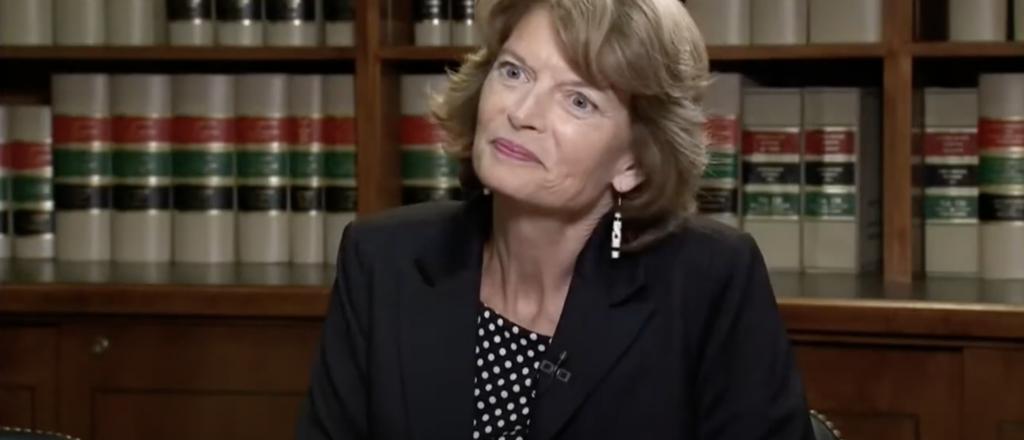
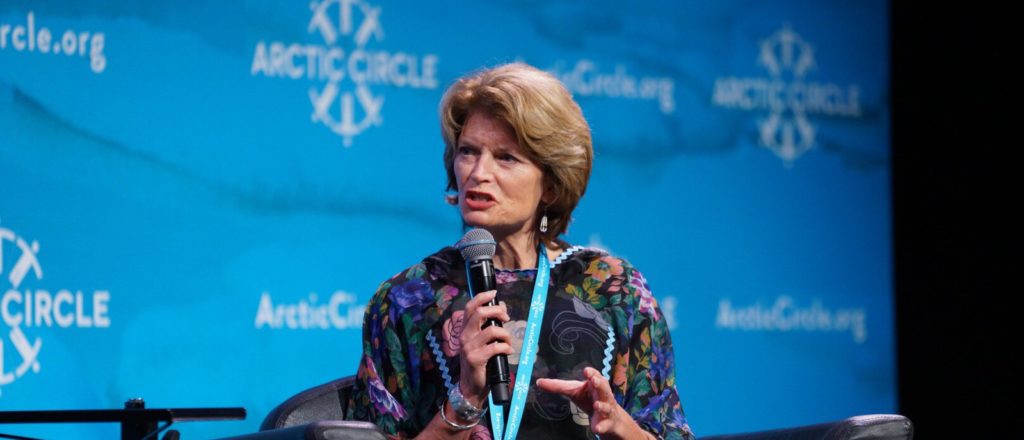
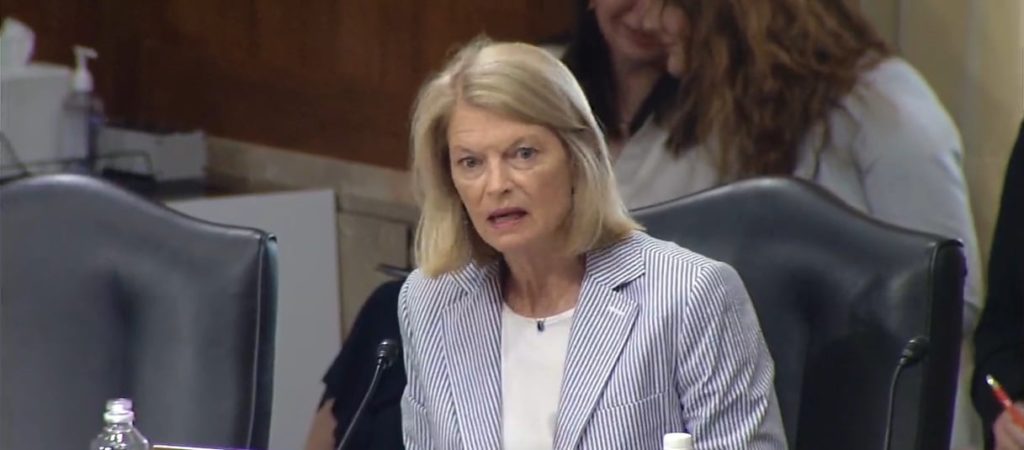


Lisa Ann Murkowski (
mər-KOW-ski; born May 22, 1957) is an American attorney and politician serving as the senior United States senator from the state of Alaska, having held the seat since 2002. She is the first woman to represent Alaska in the U.S. Congress and is the Senate's second-most senior Republican woman. Murkowski became dean of Alaska's congressional delegation upon Representative Don Young's death.
Murkowski is the daughter of former U.S. senator and governor of Alaska Frank Murkowski. She was appointed to the Senate by her father, who resigned his seat in 2002 to become Alaska's governor. Murkowski became the first Alaskan-born member of Congress and completed her father's unexpired Senate term, which ended in January 2005. Before her appointment to the Senate, she had been a member of the Alaska House of Representatives since 1999. Murkowski ran for and won a full term in 2004 with 48% of the vote. After losing the 2010 Republican primary to Tea Party candidate Joe Miller, she ran as a write-in candidate and defeated both Miller and Democrat Scott McAdams in the general election. Murkowski was reelected in 2016 and again in 2022. She was vice chair of the Senate Republican Conference from 2009 to 2010 and chair of the Senate Energy and Natural Resources Committee from 2015 to 2021. She served as vice chair of the Senate Indian Affairs Committee from 2021 to 2025 and has served as chair of the committee since January 2025.
Murkowski is often described as one of the Senate's most moderate Republicans and a swing vote. According to Roll Call, she voted with President Barack Obama's position 72.3% of the time in 2013; she was one of only two Republicans to vote with Obama over 70% of the time. She opposed Brett Kavanaugh's Supreme Court nomination in 2018 and supported Ketanji Brown Jackson's Supreme Court nomination in 2022. In 2021, she was one of seven Republican senators to vote to convict Donald Trump of incitement of insurrection in his second impeachment trial; the Alaska Republican Party censured her for that vote. Murkowski was a pivotal Republican vote for the first Trump administration's Tax Cuts and Jobs Act and the second Trump administration's One Big Beautiful Bill Act.
Contents
Early life, education, and early career
Murkowski was born in Ketchikan in the Territory of Alaska, the daughter of Nancy Rena (née Gore) and Frank Murkowski. Her paternal great-grandfather was of Polish descent, and her mother's ancestry is Irish and French Canadian. As a child, she and her family moved around the state with her father's job as a banker. After high school, Murkowski interned under Senator Ted Stevens in a Washington summer internship program. She attended Willamette University for two years before transferring to Georgetown University. She earned a B.A. degree in economics from Georgetown University in 1980, the same year her father was elected to the U.S. Senate. She is a member of Pi Beta Phi sorority and represented Alaska as the 1980 Cherry Blossom Princess. She received her J.D. degree in 1985 from Willamette University College of Law. Murkowski failed the bar exam four times, passing on her fifth attempt.
Murkowski worked as an attorney in the Anchorage District Court Clerk's office from 1987 to 1989. From 1989 to 1998, she was an attorney in private practice in Anchorage. She served on the Mayor's Task Force for the Homeless from 1990 to 1991.
Alaska House of Representatives
In 1998, Murkowski was elected to the Alaska House of Representatives. Her District 18 included northeast Anchorage, Fort Richardson and Elmendorf Air Force Base (now Joint Base Elmendorf-Richardson, or JBER), and suburban parts of Eagle River-Chugiak. In 1999, she introduced legislation establishing a Joint Armed Services Committee. She was reelected in 2000 and, after her district boundaries changed, in 2002. That year she had a conservative primary opponent, Nancy Dahlstrom, who challenged her because Murkowski supported abortion rights and rejected conservative economics. Murkowski won by 56 votes. She was named as House Majority Leader for the 2003–04 legislative session. She resigned her House seat before taking office, due to her appointment by her father to the seat he had vacated in the U.S. Senate, upon his stepping down to assume the Alaska governorship. Murkowski sat on the Alaska Commission on Post Secondary Education and chaired both the Labor and Commerce and the Military and Veterans Affairs Committees. After she resigned to join the U.S. Senate, her father appointed Dahlstrom, the choice of the district's Republican committee, as her replacement.
U.S. Senate
Appointment
In December 2002, Murkowski—while a member of the state House—was appointed by her father, Governor Frank Murkowski, to fill his own U.S. Senate seat made vacant when he resigned from the Senate after being elected governor. The appointment, which many Alaska voters saw as a product of nepotism, caused considerable controversy. Her appointment eventually resulted in a referendum that stripped the governor of the power to directly appoint replacement senators. Along with others eligible to be considered, future Alaska governor Sarah Palin interviewed for the seat. Murkowski was sworn in on January 7, 2003.
Elections
Murkowski has had several close challenges but has never lost a general election. She has won four full terms to the Senate; she won 48.6% of the vote in 2004, 39.5% in 2010, 44.4% in 2016 and 53.7% in 2022.
Murkowski ran for a full Senate term against former Governor Tony Knowles in the 2004 election after winning a primary challenge by a large margin. She was considered vulnerable due to the controversy over her appointment, and polling showed the race was very close. The centrist Republican Main Street Partnership, which wanted to run TV ads for Murkowski, was told no airtime was left to buy. Murkowski defeated Knowles by 9,349 votes.
Murkowski faced a challenge from Joe Miller, a former U.S. magistrate judge supported by former Governor Sarah Palin, in the August 24, 2010, Republican Party primary election. The initial results showed Murkowski trailing Miller, 51–49%, with absentee ballots yet to be tallied. After the first round of absentee ballots was counted on August 31, Murkowski conceded, saying that she did not believe that Miller's lead could be overcome in the next round of absentee vote counting. Miller received 55,878 votes to Murkowski's 53,872.
After the primary, the Murkowski campaign floated the idea of her running as a Libertarian in the general election. On August 29, 2010, the state Libertarian Party executive board voted not to consider Murkowski as its Senate nominee.
On September 17, 2010, Murkowski said she would mount a write-in campaign for the Senate seat. Her campaign was aided in large part by substantial funding from state teachers' and firefighters' unions, Native corporations, and PACs.
On November 17, 2010, the Associated Press reported that Murkowski had become only the second Senate candidate (after Strom Thurmond in 1954) to win a write-in campaign. She emerged victorious after a two-week count of write-in ballots showed that she had overtaken Miller. Miller did not concede. U.S. Federal District Judge Ralph Beistline granted an injunction to stop the certification of the election due to "serious" legal issues and irregularities Miller raised about the hand count of absentee ballots. On December 10, 2010, an Alaskan judge dismissed Miller's case, clearing the way for Murkowski's certification, but on December 13, Miller appealed the decision to the Alaska Supreme Court. The state Supreme Court rejected Miller's appeal on December 22. On December 28, Beistline dismissed Miller's lawsuit. Governor Sean Parnell certified Murkowski as the winner on December 30.
Tenure and political positions
Murkowski is considered a moderate Republican. Since she was reelected in 2010, her voting record has been said to be more moderate than before. In 2013, the National Journal gave Murkowski a composite score of 56% conservative and 45% liberal, and ranked her the 56th most liberal and 44th most conservative member of the Senate. According to CQ Roll Call, Murkowski voted with President Barack Obama's position 72.3% of the time in 2013; she was one of only two Senate Republicans to support Obama's position over 70% of the time. In 2017, The New York Times arranged Republican senators by ideology and ranked Murkowski the second-most liberal Republican. According to GovTrack, as of 2018, Murkowski was the second-most liberal Republican senator, to the left of all Senate Republicans except Susan Collins, and to the left of Democratic Senator Joe Manchin. According to FiveThirtyEight, Murkowski had voted in accordance with President Donald Trump's position approximately 72.6% of the time as of January 2021. According to FiveThirtyEight, as of January 2023, Murkowski had voted with President Joe Biden's position about 67% of the time. In 2023, the Lugar Center ranked Murkowski seventh among senators for bipartisanship.
In 2018, Murkowski stated her opposition to the confirmation of Justice Brett Kavanaugh to the Supreme Court of the United States. Nevertheless, she voted "present" on the nomination as a favor to Senator Steve Daines, who supported the nomination but was unavailable to attend the vote because of his daughter's wedding. In 2020, she voted against procedural motions to accelerate Amy Coney Barrett's confirmation to that court, though she later voted to confirm Barrett. On April 7, 2022, she voted to confirm Ketanji Brown Jackson to the Supreme Court, with only two other Republicans, Collins and Mitt Romney, joining her.
In a March 2019 op-ed for The Washington Post, Murkowski and Joe Manchin wrote that climate change debate in Congress was depicted as "an issue with just two sides—those who support drastic, unattainable measures to reduce greenhouse-gas emissions, and those who want to do nothing", and affirmed their support for "adopting reasonable policies that...build on and accelerate current efforts [and] ensure a robust innovation ecosystem."
During the first impeachment trial of Donald Trump, Murkowski called Trump's actions "shameful and wrong", but said "she cannot vote to convict" Trump and that his personal interests did not take precedence over those of the nation. She joined almost all Senate Republicans in voting to acquit Trump on both articles.
119th United States Congress Committee assignments
Source:
Committee on Appropriations
Committee on Energy and Natural Resources
Subcommittee on National Parks
Subcommittee on Public Lands, Forests, and Mining
Committee on Health, Education, Labor, and Pensions
Subcommittee on Education and the American Family
Subcommittee on Primary Health and Retirement Security
Committee on Indian Affairs (Chair)
Caucus memberships
Senate Oceans Caucus (co-chairwoman)
Senate Cultural Caucus
Afterschool Caucuses
Senate Republican Conference
Senate Arctic Caucus (chairwoman)
Congressional Coalition on Adoption
Personal life
Murkowski is married to Verne Martell. They have two sons, Nicolas and Matthew. Murkowski is Roman Catholic. As of 2018, according to OpenSecrets.org, Murkowski's net worth was more than $1.4 million. Her sister, Carol, is married to the son of State Senator Arliss Sturgulewski, a former gubernatorial nominee.
Property sale controversy
In July 2007, Murkowski said she would sell back land she bought from Anchorage businessman Bob Penney, a day after a Washington watchdog group filed a Senate ethics complaint against her alleging that Penney sold the property well below market value. The Anchorage Daily News wrote, "The transaction amounted to an illegal gift worth between $70,000 and $170,000, depending on how the property was valued, according to the complaint by the National Legal and Policy Center." According to the Associated Press, Murkowski bought the land from two developers tied to the Ted Stevens probe.
In 2008, Murkowski amended her Senate financial disclosures for 2004 through 2006, adding income of $60,000 per year from the sale of a property in 2003, and more than $40,000 a year from the sale of her "Alaska Pasta Company" in 2005.