




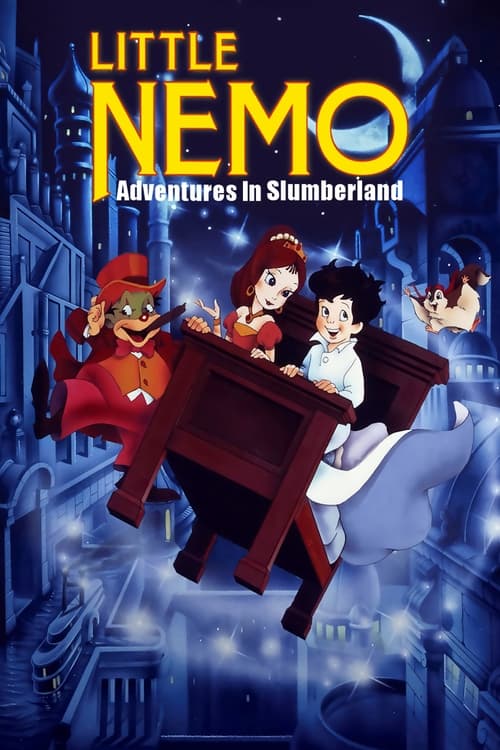
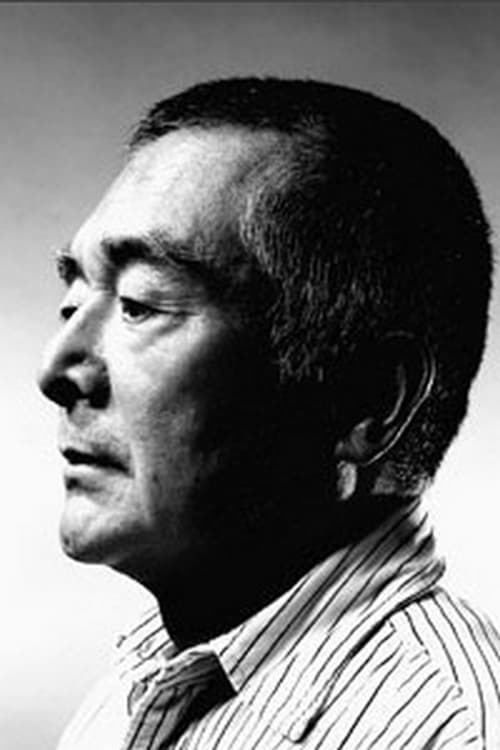
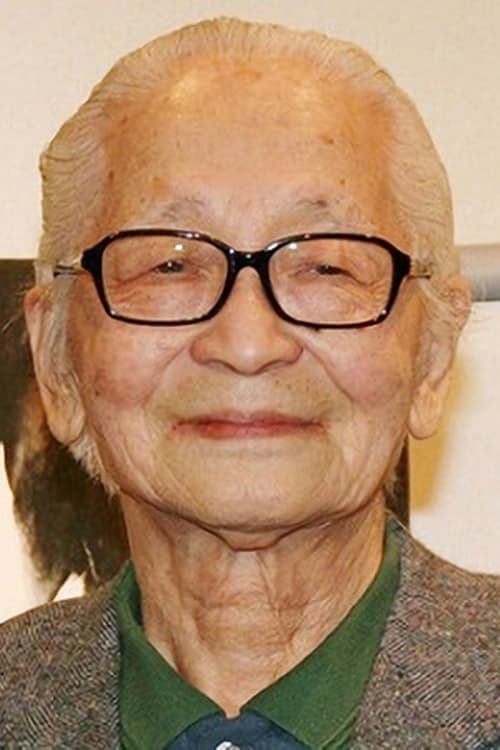
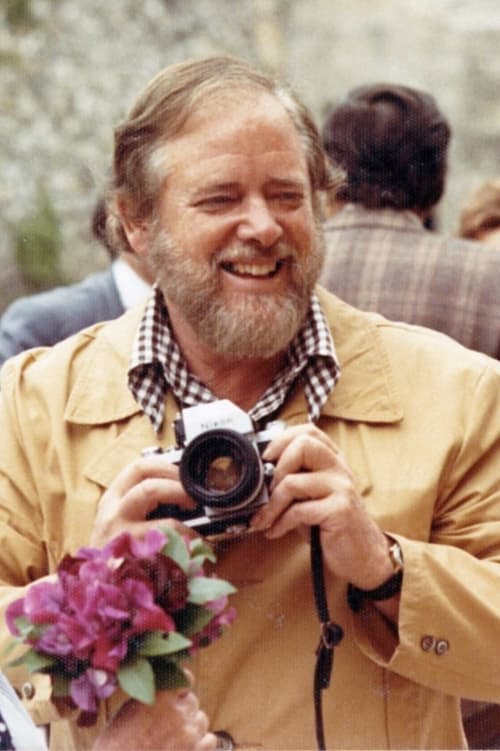











Little Nemo: Adventures in Slumberland (released in Japan as simply Nemo (ニモ, Nimo) and credited in some territories as Little Nemo) is a 1989 animated musical fantasy film directed by Masami Hata and William Hurtz. Based on the comic strip Little Nemo in Slumberland by Winsor McCay, the film went through a lengthy development process with a number of screenwriters. Ultimately, the screenplay was credited to Chris Columbus and Richard Outten; the storyline and art style differed from the original version. The original soundtrack was penned by the Academy Award-winning Sherman Brothers. The film features the English dub voices of Gabriel Damon, Mickey Rooney, René Auberjonois, Danny Mann, Bernard Erhard, Laura Mooney, William E. Martin, Alan Oppenheimer, Michael Bell, Sidney Miller, Neil Ross, and John Stephenson.
Even though it derived from an American comic strip, Little Nemo was animated by the Japanese company Tokyo Movie Shinsha and thus is often considered an anime film, although it was a joint production of Japanese and American animators and production companies.
The movie was infamous for being in development hell for much of the 1980s, with many people involved with the production at some point before dropping out. Some of those attached to the film worked at Disney, Lucasfilm, Warner Bros. Cartoons, and Studio Ghibli. Those who expressed interest or were involved at some stage included George Lucas, Chuck Jones, Ray Bradbury, Isao Takahata, Brad Bird, Jerry Rees, Chris Columbus, Ken Anderson, Frank Thomas, Oliver Johnston, Paul Julian, Osamu Dezaki, the Sherman Brothers (Richard M. Sherman and Robert B. Sherman), Hayao Miyazaki (who was working at TMS at the time), and Gary Kurtz.
The film was first released in Japan on July 15, 1989, by the Toho-Towa and in the United States on August 21, 1992, by the Hemdale Film Corporation for the dub. It received mixed reviews and was a box-office bomb, earning $11.4 million on a $35 million budget. However, it sold well on home video and has since become a cult film.
Contents
Plot
A young boy named Nemo experiences a series of nightmares (including being pursued by a locomotive). Upon awakening the one day, he goes with his pet flying squirrel, Icarus to see a parade welcoming a traveling circus. However, Nemo is unable to see the circus since his parents are too busy to take him. That night, Nemo imitates sleepwalking in an attempt to sneak some pie away, which acts against a promise he had made earlier to his mother, who catches him in the act and makes him run back to his room empty-handed.
Upon falling asleep, Nemo is approached by figures from the circus parade. The circus organist introduces himself as Professor Genius and claims that they had been sent on a mission by King Morpheus, the king of a realm named Slumberland. The mission involves Nemo becoming the playmate of the princess, Camille. Although Nemo initially has reservations about interacting with a girl, he and Icarus decide to set off to fulfill his mission after being persuaded with a gift box of cookies from the princess.
Nemo is taken to Slumberland in a dirigible which he is allowed to drive, causing some chaos, and is introduced to King Morpheus. Morpheus reveals that he summoned Nemo to become his heir to the throne. Morpheus gives Nemo a golden key that opens every door in the kingdom and warns him of a door with a dragon insignia that must never be opened. Nemo is introduced to Princess Camille and the pair roam Slumberland together.
Afterward, Nemo meets the mischievous clown Flip who convinces him to ditch his prince lessons, and later angers a group of cops, forcing him and Nemo to hide out in a cave. There, Nemo discovers the door that Morpheus warned him not to open. Flip tempts Nemo into unlocking the door, which unleashes "the nightmare". Nemo rushes back to Morpheus' castle in time for his coronation ceremony where he is handed the royal scepter, the only thing capable of defeating the Nightmare King, the ruler of Nightmare Land, should he ever return to Slumberland. In the middle of a dance session between Morpheus and Genius, "The Nightmare" reaches the castle and steals Morpheus away. As the partygoers search for a scapegoat, Flip and Nemo accuse each other, though the responsibility goes to Nemo who had the key.
Nemo awakens in his home, which floods with seawater and ejects him and Icarus into the ocean. Genius discovers them and tells Nemo not to blame himself for Morpheus's capture and that Flip is at fault for tempting him, but Nemo accepts his role in the situation, and pledges to find the King. When the three return to Slumberland, they rescue Flip from being shot out of a cannon into outer space because he withheld information on owning a map of Nightmare Land where Morpheus is currently being held.
Cast
Gabriel Damon (Takuma Gōno in the Japanese adaptation) as Nemo, a human boy living in New York City who is taken to Slumberland to be the official playmate of Princess Camille. In actuality, he is being summoned to be the heir to the elderly King Morpheus.
Mickey Rooney (Chikao Ōtsuka in the Japanese adaptation) as Flip, a clown who is described as a "frightful fellow" by Professor Genius, he is wanted throughout Slumberland for "having fun". He tricks Nemo into accidentally releasing the Nightmare King and blames Nemo for the ruin of Slumberland. In the real world, he is a clown in a circus that stops in Nemo's town.
René Auberjonois (Kōichi Kitamura in the Japanese adaptation) as Professor Genius, King Morpheus' advisor. He comes to the real world to bring Nemo to Slumberland. In the real world, he is an organ player in a circus that stops in Nemo's town.
Danny Mann as Icarus, a flying squirrel who is Nemo's best friend. He detests being called a "little rat" (which Princess Camille mistakes him for). His initial relationship with Princess Camille, though rough, eventually changes for the better.
Bernard Erhard (Kenji Utsumi in the Japanese adaptation) as King Morpheus, the sovereign of Slumberland. He has protected Slumberland for years with the help of the royal scepter: an ancient weapon of great power. In the real world, he is the ringmaster of a circus that stops in Nemo's town.
William E. Martin (Tarō Ishida in the Japanese adaptation) as the Nightmare King, a demonic horned creature who rules over the realm of nightmares.
Laura Mooney (Hiroko Kasahara in the Japanese adaptation) as Princess Camille, the daughter of King Morpheus. Though she initially acts somewhat spoiled, she eventually grows to like Nemo. In the real world, she is riding on an elephant in a circus that stops in Nemo's town. Camille was modeled after Leah Allers and TMS wrote her a two-page thank-you letter.
Greg Burson (Tesshō Genda in the Japanese adaptation) as Nemo's father
Production
Nemo was the brainchild of producer Yutaka Fujioka, then president of Tokyo Movie Shinsha (TMS). He had long realized the limitations of the animation business in Japan and wanted to enter the U.S. market, so he started a new animation studio and planned to distribute U.S.-Japan co-produced animation films worldwide.
He founded Telecom Animation Film in 1975, and embarked on a film adaptation of the legendary comic strip Little Nemo, which was so well known in the U.S. that two film adaptations were proposed during Walt Disney's lifetime.
As the first step towards realizing this project, in 1977 he personally flew to Monterey, California, to convince the McCay descendants to allow him to obtain the film rights, and he finally won it in the summer of 1978.
Fujioka had another dream: to make a "full animation" (not Japanese limited animation) film that could compete with Disney. For this purpose, Fujioka hired newcomers with no experience in Japanese TV animation and had them trained by Sadao Tsukioka, followed by Yasuo Ōtsuka. Incidentally, the 1980 pilot film was created by Tsukioka.
However, a lack of funding and inexperienced animators made it difficult to go into Nemo production, so he hired veteran staff away from other studios to work on Lupin the Third Part II, Hayao Miyazaki's film Lupin III: The Castle of Cagliostro, and Isao Takahata's film Jarinko Chie. And he frequently held screenings of those two films of Miyazaki and Takahata for film professionals in the U.S. to showcase his company's capabilities.
In the spring of 1981, Fujioka launched the project after securing a 4 billion yen investment from consumer finance company Lake.
Fujioka initially approached George Lucas, who was then at the height of his career with Star Wars and Indiana Jones, about co-producing the film as a foothold to penetrate the American market. Lucas, however, declined the offer, citing difficulties with the initial draft plot. Fujioka also approached Chuck Jones, but Jones also declined. Fujioka asked Gary Kurtz, who had been recommended by Lucas to replace him, as producer of the American side, and Kurtz readily agreed, appointing Ray Bradbury as screenwriter.
Music
The award-winning Sherman Brothers wrote the songs for Little Nemo: Adventures in Slumberland.
Original songs performed in the film include:
Release
The Japanese cut was released in Japan on July 15, 1989. In a summer that included strong competition, including Studio Ghibli's Kiki's Delivery Service, which was ironically directed by one of the animators who left the production of this film, it grossed ¥0.9 billion (US$10 million) in its release and was considered a box-office flop, against a budget of around ¥3 billion (US$35 million).
The English dub was released three years later in the United States in 579 theaters on August 21, 1992, through Hemdale Film Corporation. 11 minutes were cut in order to secure a family-friendly "G" rating by Motion Picture Association of America. This version's opening credits were shortened, as a result, the opening song plays during the opening scene.
Critical reception
It received generally mixed reviews from publications including The New York Times. Roger Ebert gave the film 2 out of 4 stars, though on a positive note, he wrote: "Little Nemo is an interesting if not a great film, with some jolly characters, some cheerful songs, and some visual surprises."
On the review aggregator Rotten Tomatoes, Little Nemo: Adventures in Slumberland has an approval rating of 55%, based on 29 reviews, with an average score of 5.8/10. The website's critical consensus reads: "Despite a creative team and source material that should be any animation fan's fantasy, uneven craft and an inert story keep Little Nemo from being a proper dream come true."
Box office
In its opening weekend in the United States, Nemo made about $407,695 with a total US gross of approximately $1,368,000. It won the "Audience Award" at Amsterdam's 1992 Cinekid Festival and was nominated for "Best Animated Feature" at the 1993 Annie Awards.
In March 2005, Little Nemo was given a very limited re-release in Denver, Seattle, Atlanta, Austin, Houston, and other cities in the US. This was through Regal Entertainment Group's Regal Cinemas, Edwards Theatres, and United Artists Theatres as part of a Kidtoon Films family matinées promotion. It was only shown on weekends.
Aftermath
After the film's release, Fujioka decided to retire from the animation business. TMS, having to recoup Little Nemo's losses, increased production on locally based anime programs and became highly involved in animation for Western-based productions, including Tiny Toon Adventures, Animaniacs, and Batman. Since the early 2000s, TMS has no longer supplied animation services to Western studios due to increasingly demanding costs. The studio still does features, but primarily films spinning off existing anime properties, which include the likes of Anpanman and Detective Conan.
Home media
The film was released on VHS through Hemdale Home Video, Inc. on March 2, 1993. Nemo became the #4 best-selling children's title of 1993, with 1.5 million copies sold.
On October 5, 2004, Little Nemo was released on DVD through Funimation (under the Our Time Family Entertainment name, and under license from TMS, which had regained North American rights to the film after Hemdale closed). All of the cuts that were made in the 1992 release were restored in this DVD, bringing the runtime of the film to the full 95 minutes, resulting in the DVD being released unrated instead. Only the English dub was included.
After the title went out of print, Little Nemo could be seen selling anywhere from $80 to $200 US for a sealed copy (usually DVD) on Internet sites such as Amazon and eBay. Funimation's DVD was re-released as a budget title from Echo Bridge Home Entertainment on January 27, 2009, appearing commonly in department stores in low-price bargain bins. Then on September 20, 2011, after Echo Bridge's reissue went out of print, it was released again on DVD by Discotek Media, but that release is dub-only. On November 6, 2012, Discotek released a Blu-ray of the film containing the Japanese dub and original English audio tracks and included bonus features such as the pilot films from 1984 and 1987.
On March 2, 2016, TMS Entertainment's official YouTube channel uploaded the original 95-minute film version with English dub.
Video games
After the Japanese release, but before the US release, Capcom developed an NES game titled Little Nemo: The Dream Master, which was released in late 1990. An arcade game, also by Capcom and titled Nemo, was developed that same year.


