




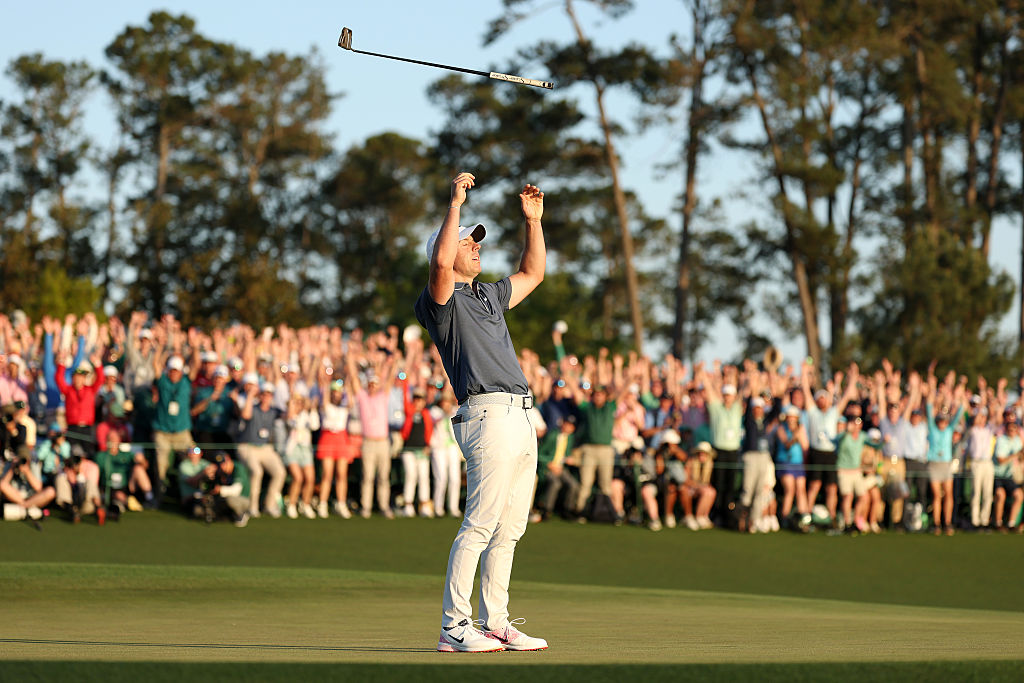
The Masters Tournament (usually referred to as simply the Masters, or as the U.S. Masters outside North America) is one of the four men's major championships in professional golf. Scheduled for the first full week in April, the Masters is the first major golf tournament of the year. Unlike the other major tournaments which change host venues with each tournament, the Masters is always held at the same host venue: Augusta National Golf Club, a private course in the city of Augusta, Georgia.
Amateur golf champion Bobby Jones and investment banker Clifford Roberts founded the tournament. After his grand slam in 1930, Jones acquired a former plant nursery and co-designed Augusta National with course architect Alister MacKenzie. First played in 1934 as the "Augusta National Invitation Tournament", the Masters is an official money event on the PGA Tour, the European Tour, and the Japan Golf Tour. The field of players is smaller than those of the other major championships because it is an invitational event, held by the Augusta National Golf Club.
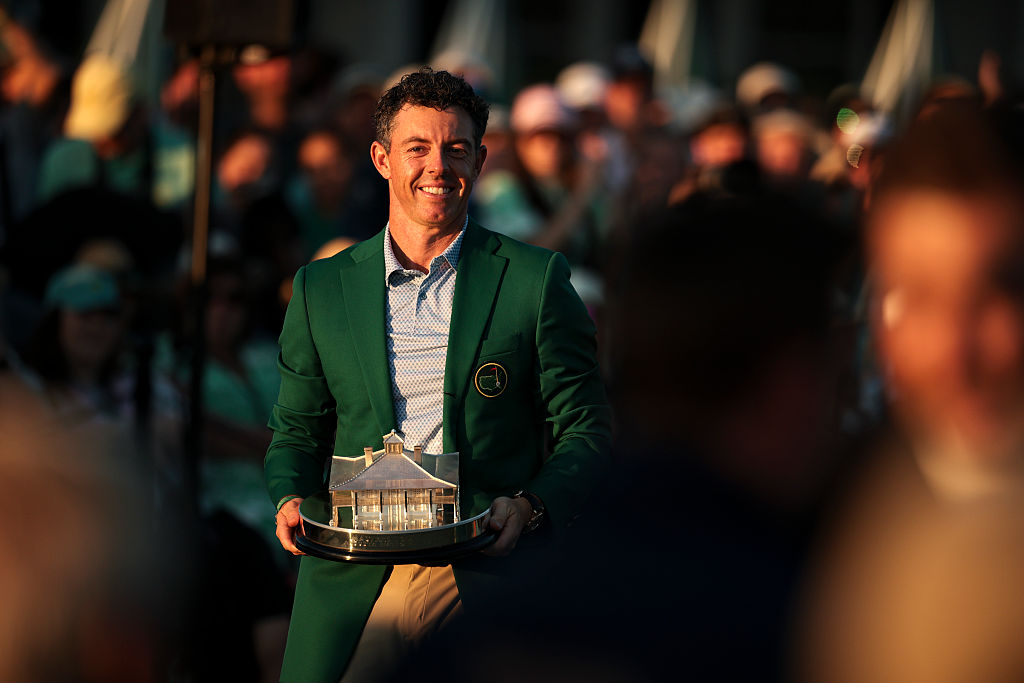
The tournament has a number of traditions. Since the 1949 Masters, a green jacket (specifically Pantone 342C, "Augusta Green") has been awarded to the champion, who must return it to the clubhouse one year after his victory, although it remains his personal property and is stored with other champions' jackets in a specially designated cloakroom. In most instances, only a first-time and reigning champion may remove his jacket from the club grounds. A golfer who wins the event multiple times uses the same green jacket awarded upon his initial win unless he needs to be re-fitted with a new jacket. The Champions Dinner, inaugurated by Ben Hogan at the 1952 Masters, is held on the Tuesday before each Masters and is open only to past champions and certain board members of the Augusta National Golf Club. Beginning in 1963, distinguished golfers, usually past champions, have hit an honorary tee shot on the morning of the first round to commence play. These have included Fred McLeod, Jock Hutchinson, Gene Sarazen, Sam Snead, Byron Nelson, Arnold Palmer, Jack Nicklaus, Gary Player, Lee Elder, and Tom Watson. Since 1960, a semi-social contest on the Par 3 course has been played on Wednesday, the day before the first round.
Nicklaus has the most Masters wins, with six between 1963 and 1986. Tiger Woods won five between 1997 and 2019. Palmer won four between 1958 and 1964. Five have won three titles at Augusta: Jimmy Demaret, Sam Snead, Gary Player, Nick Faldo, and Phil Mickelson. Gary Player, from South Africa, was the first non-American player to win the tournament, in 1961; the second was Seve Ballesteros of Spain, the champion in 1980 and 1983.
The Augusta National course first opened in 1933 and has been modified many times by different architects. Among the changes: greens have been reshaped and, on occasion, entirely re-designed, bunkers have been added, water hazards have been extended, new tee boxes have been built, hundreds of trees have been planted, and several mounds have been installed.
Contents
History
Augusta National Golf Club
The idea for Augusta National originated with Bobby Jones, who wanted to build a golf course after his retirement from the game. He sought advice from Clifford Roberts, who later became the chairman of the club. They came across a piece of land in Augusta, Georgia, of which Jones said: "Perfect! And to think this ground has been lying here all these years waiting for someone to come along and lay a golf course upon it."
The land had been an indigo plantation in the early nineteenth century and a plant nursery since 1857. Jones hired Alister MacKenzie to help design the course, and work began in 1931. The course formally opened in 1933, but MacKenzie died before the first Masters Tournament was played.
Early tournament years
After Clifford Roberts invited then-USGA tournament committee chairman Prescott Bush to ANGC in early 1933, Jones and Roberts strenuously petitioned the USGA to hold the U.S. Open at Augusta in 1934, but the USGA denied the petition, noting that the hot Georgia summers would create difficult playing conditions. Indeed, the professional golf schedule would have needed to change, and to date no golf major had been held in the south. The club was deeply disappointed and had been seeking publicity as it was struggling financially and in debt, but Roberts took the rejection as an opportunity to found his own annual tournament.
Roberts told the PGA of his plan for a new tournament in late 1933. The official PGA schedule, in a small endnote, mentioned Augusta's tournament alongside three others: the 1934 Tournament of the Gardens Open, the 1934 North and South Open, and a tournament in Columbus, Georgia. The fact that the new tournament would bring Jones out of retirement made the idea attractive to both Augusta and the PGA, which itself was facing hard times financially; Grantland Rice announced the news in a syndicated column.
Due to Augusta National's financial hardships, the tournament was set to feature a small contingent of players. Initially the Augusta National Invitation field was composed largely of Bobby Jones' close associates. Due to the early calendar date of the Masters, it was not uncommon for professional golfers to be unable to attend because of jobs and prior commitments.
The first "Augusta National Invitation Tournament", as the Masters was originally known, began on March 22, 1934, and was won by Horton Smith, who took the first prize of $1,500. (The club could not afford to pay the winnings, so 17 Augusta National members personally chipped in instead.) Roberts had borrowed chairs for spectators to use from two local funeral homes, and the printed program included advertisements given for free to the club's creditors. Tournament passes cost $2.00. The tournament was played with current holes 10 through 18 played as the first nine, and 1 through 9 as the second nine, then reversed permanently to its present layout for the 1935 tournament. After the first tournament, around 20 new members joined ANGC, giving the club a much-needed financial lifeline.
The present name, Masters Tournament, was officially adopted in 1939, but had been in use since the first tournament (newspapers sometimes called it the "Masters Open").
1960s–1970s
Through the 50s and into the 60s, the Masters was still not widely attended. Locals were able to buy tickets at the gate on the day of each round. The city held a "Masters hospitality week", featuring a parade, from 1957 through 1967.
In 1967, series badge prices rose to $15; by 1975, they were $30.
The "Big Three" of Arnold Palmer, Gary Player, and Jack Nicklaus dominated the Masters from 1960 through 1978, winning the event 11 times between them during that span. After winning by one stroke in 1958, Palmer won by one stroke again in 1960 in memorable circumstances. Trailing Ken Venturi by one shot in the 1960 event, Palmer made birdies on the last two holes to prevail. Palmer would go on to win another two Masters in 1962 and 1964. Palmer's caddie at Augusta each time was Nathaniel "Iron Man" Avery.
Nicklaus emerged in the early 1960s and served as a rival to the popular Palmer. Nicklaus won his first green jacket in 1963, defeating Tony Lema by one stroke. Two years later, he shot a then-course record of 271 (17 under par) for his second Masters win, leading Bobby Jones to say that Nicklaus played "a game with which I am not familiar." The next year, Nicklaus won his third green jacket in a grueling 18-hole playoff against Tommy Jacobs and Gay Brewer. This made Nicklaus the first player to win consecutive Masters. He won again in 1972 by three strokes. In 1975, Nicklaus won by one stroke in a close contest with Tom Weiskopf and Johnny Miller in one of the most exciting Masters to date.
Player became the first non-American to win the Masters in 1961, beating Palmer, the defending champion, by one stroke when Palmer double-bogeyed the final hole. In 1974, he won again by two strokes. After not winning a tournament on the U.S. PGA tour for nearly four years, and at the age of 42, Player won his third and final Masters in 1978 by one stroke over three players. Player is second in consecutive cuts made with 23 straight (tied with Fred Couples), and has played in a record 52 Masters.
A controversial ending to the Masters occurred in 1968. Argentine champion Roberto De Vicenzo signed his scorecard (attested by playing partner Tommy Aaron) incorrectly recording him as making a par 4 instead of a birdie 3 on the 17th hole of the final round. According to the rules of golf, if a player signs a scorecard (thereby attesting to its veracity) that records a score on a hole higher than what he actually made on the hole, the player receives the higher score for that hole. This extra stroke cost De Vicenzo a chance to be in an 18-hole Monday playoff with Bob Goalby, who won the green jacket. De Vicenzo's mistake led to the famous quote, "What a stupid I am."
1980s–2000s
Non-Americans collected 11 victories in 20 years in the 1980s and 1990s, by far the strongest run they have had in any of the three majors played in the United States since the early days of the U.S. Open. The first European to win the Masters was Seve Ballesteros in 1980; badges at that point were $48. Nicklaus became the oldest player to win the Masters in 1986 when he won for the sixth time at age 46.
During this period, no golfer suffered more disappointment at the Masters than Greg Norman. In his first appearance at Augusta in 1981, he led during the second nine but ended up finishing fourth. In 1986, after birdieing holes 14 through 17 to tie Nicklaus for the lead, he badly pushed his 4-iron approach on 18 into the patrons surrounding the green and missed his par putt for a closing bogey. In 1987, Norman lost a sudden-death playoff when Larry Mize holed out a remarkable 45-yard pitch shot to birdie the second playoff hole. Mize thus became the first Augusta native to win the Masters. In 1996, Norman tied the course record with an opening-round 63 and had a six-stroke lead over Nick Faldo entering the final round. However, he stumbled to a closing 78 while Faldo, his playing partner that day, carded a 67 to win by five shots for his third Masters championship. Norman also led the 1999 Masters on the second nine of the final round, only to falter again and finish third behind winner José María Olazábal, who won his second green jacket. Norman finished in the top five at the Masters eight times, but never won.
In 1993, the price of a four-day badge was raised to $100.
Two-time champion Ben Crenshaw captured an emotional Masters win in 1995, just days after the death of his lifelong teacher and mentor Harvey Penick. After making his final putt to win, he broke down sobbing at the hole and was consoled and embraced by his caddie Carl Jackson. In the post-tournament interview, Crenshaw said: "I had a 15th club in my bag," a reference to Penick. (The "15th club" reference is based on the golf rule that limits a player to carrying 14 clubs during a round.) Crenshaw first won at Augusta in 1984.
In 1997, 21-year-old Tiger Woods became the youngest champion in Masters history, winning by 12 shots with an 18-under par 270 which broke the 72-hole record that had stood for 32 years. In 2001, Woods completed his "Tiger Slam" by winning his fourth straight major championship at the Masters by two shots over David Duval. He won again the following year, making him only the third player in history (after Nicklaus and Faldo) to win the tournament in consecutive years, as well as in 2005 when he defeated Chris DiMarco in a playoff for his first major championship win in almost three years.
Traditions, logistics, and rules
Pre-tournament events
The Augusta National Women's Amateur (ANWA) is held the week before the Masters. The ANWA was established in 2019 by Augusta National chairman Fred Ridley. The winner of the Augusta National Women's Amateur is exempt from two women's golf majors.
In 2013, Augusta National partnered with the USGA and the PGA of America to establish "Drive, Chip and Putt" (DCP), a youth golf skills competition which was first held in 2014. The event was established as part of an effort to help promote the sport of golf among youth; the winners of local qualifiers in different age groups advance to the national finals, which have been held at Augusta National on the Sunday immediately preceding the Masters. The driving and chipping portions of the event are held on the course's practice range, and the putting portion has been played on the 18th hole.
Practice rounds are held on the Monday, Tuesday, and Wednesday before the tournament begins on Thursday. During the practice rounds, Redbud (hole 16) is well-known for spectators shouting "Skip it!" at players, encouraging the golfers to attempt to skip the ball across the pond.
The three days of practice are the only times during which attendees are allowed to bring cameras onto the course.
First established in 1948, the Amateur Dinner is held on the Monday before the tournament, on the same day practice rounds begin. The amateurs competing in the Masters are invited.
The Champions' Dinner is held each year on the Tuesday evening preceding Thursday's first round. The dinner was first held in 1952, hosted by defending champion Ben Hogan, to honor the past champions of the tournament. At that time 15 tournaments had been played, and the number of past champions was 11. Officially known as the "Masters Club", it includes only past winners of the Masters, although selected members of the Augusta National Golf Club have been included as honorary members, usually the chairman.
The defending champion, as host, selects the menu for the dinner. Frequently, Masters champions have served cuisine from their home regions prepared by the Masters chef. Notable examples have included haggis, served by Scotsman Sandy Lyle in 1989, and bobotie, a South African dish, served at the behest of 2008 champion Trevor Immelman. Other examples include German Bernhard Langer's 1986 Wiener schnitzel, Britain's Nick Faldo's fish and chips, Canadian Mike Weir's elk and wild boar, and Vijay Singh's tom kha thale and chicken phanaeng. The 2011 dinner of Phil Mickelson was a Spanish-themed menu in hopes that Seve Ballesteros would attend, but he was too sick and died weeks later.
Tournament
Since 1963, the custom in most years has been to start the tournament with an honorary opening tee shot at the first hole, typically by one or more older players. For a number of years before 1963, Jock Hutchison and Fred McLeod had been the first pair to tee off, both being able to play as past major championship winners. In 1963 the eligibility rules were changed and they were no longer able to compete. The idea of honorary starters was introduced with Hutchison and McLeod being the first two. This twosome led off every tournament from 1963 until 1973 when poor health prevented Hutchison from swinging a club. McLeod continued on until his death in 1976. Byron Nelson and Gene Sarazen started in 1981 and were then joined by Sam Snead in 1984. This trio continued until 1999 when Sarazen died, while Nelson stopped in 2001. Snead hit his final opening tee shot in 2002, a little over a month before he died.
In 2007, Arnold Palmer took over as the honorary starter. Palmer also had the honor in 2008 and 2009. At the 2010 and 2011 Masters Tournaments, Jack Nicklaus joined Palmer as an honorary starter for the event. In 2012, Gary Player joined them. Palmer announced in March 2016 that a lingering shoulder issue would prevent him from partaking in the 2016 tee shot. Palmer was still in attendance for the ceremony.
Following Palmer's death in 2016, the 2017 ceremony featured tributes; his green jacket was draped over an empty white chair, while everyone in attendance wore "Arnie's Army" badges.
In 2021 Lee Elder joined Nicklaus and Player as an honorary starter. He was invited to join them as he was the first African-American to take part in the Masters in 1975. Despite bad health preventing Elder from hitting a shot, he was still present and received a standing ovation from the crowd.
Two-time Masters champion Tom Watson joined Nicklaus and Player, starting in 2022.
Until 1983, all players in the Masters were required to use the services of an Augusta National Club caddie, who by club tradition was always an African-American man. Club co-founder Clifford Roberts is reputed to have said, "As long as I'm alive, golfers will be white, and caddies will be black." Since 1983—six years after Roberts's death in 1977—players have been allowed the option of bringing their own caddie to the tournament.
Experience and hospitality
Berckmans Place, sometimes called Berckmans or BP, is a 90,000-square-foot (8,400 m2) non-public shopping and dining complex built in 2012. It operates for one week each year, during the tournament. Entry passes for the week cost $10,000 (up from $6,000) are sold only to corporations, and require Augusta National's approval; there is a 10-ticket limit per pass. As in the rest of the club, neither cell phones nor photography are allowed. The price includes free dining at Berckmans' five full-service restaurants, each of which can seat hundreds of guests: Augusta's (a seafood restaurant), Calamity Jane's, Ike's at the Pavilion, Isabella, and MacKenzie's Pub. Bathroom stalls are attended and cleaned after each use. There is a pro shop and four putting greens dubbed the "Putting Experience": three slightly smaller replicas of holes 7, 14, and 16; and a "composite course". BP customers can use an exclusive parking lot and entryway (Gate 9). The complex is located near hole 5.
Berckmans Place is named after Belgian Louis Mathieu Berckmans, whose family owned the land the club is built on from 1858 to 1910.
Pimento cheese sandwiches have a long history at the Masters. They have been served as a concession since the 1940s. Minor controversy ensued in 2013 when the club switched food suppliers for the Masters and the new supplier was unable to duplicate the recipe used by the previous supplier, resulting in a sandwich with a markedly different taste. Southern Living and Golf Digest called the sandwich "iconic" of the tournament. Sports Illustrated called the sandwich "legendary" and "more than a food option – it's a representation of the sport's history and its traditions".
The club introduced its own private label wheat ale beer called Crow's Nest in 2021, which is served in its own green cup and only sold during the Masters. The beer is not available during any other time of the year. The club's private-label cola is widely believed to be made by Coca-Cola.
Concessions at the Masters are renowned for their low prices compared to other sporting events in North America; the aforementioned pimento cheese sandwich is $1.50, no food item on the menu is more expensive than $3, and a pint of Crow's Nest sells for $6.
Post-tournament events
Augusta National holds a lottery for members of the press pool to play the course the Monday after the end of the Masters; the event is called the Monday Golf Outing.
Format
The Masters is the first major championship of the year. Since 1948, its final round has been scheduled for the second Sunday of April, with several exceptions. It ended on the first Sunday four times (1952, 1957, 1958, 1959) and the 1979 and 1984 tournaments ended on April 15, the month's third Sunday. The first edition in 1934 was held in late March and the next ten were in early April, with only the 1942 event scheduled to end on the second Sunday. The 2020 event, postponed by the COVID-19 pandemic, was held from November 12 to 15, thus being the last major of the year.
Similar to the other majors, the tournament consists of four rounds at 18 holes each, Thursday through Sunday (when there are no delays). The Masters has a relatively small field of contenders when compared with other golf tournaments, so the competitors play in groups of three for the first two rounds (36 holes) and the field is not split to start on the 1st and 10th tees unless weather shortens the available playing time. The tournament is unique in that it is the only major tournament conducted by a private club rather than a national golf organization like the PGA.
Originally, the Masters was the only tournament to use two-man pairings during the first two rounds. It was also the only event to re-pair based on the leaderboard before Friday's round, as most tournaments only do this on the weekend. This practice ended in the early 2000s when the Masters switched to the more standard three-man groups and the groups are now kept intact on Friday, with players sharing the same playing partners in both of the first two rounds.
After 36 holes of play, a cut-off score is calculated to reduce the size of the field for the weekend rounds. In 2020, to "make the cut", players must be in the top 50 places (ties counting). Before 1957, there was no 36-hole cut and all of the invitees played four rounds, if desired. From 1957 to 1961, the top 40 scores (including ties) made the cut. From 1962 to 2012, it was the top 44 (and ties) or within 10 strokes of the lead. From 2013 to 2019, it was the top 50 (and ties) or within 10 strokes of the lead.
Following the cut, an additional 36 holes are played over the final two days. Should the fourth round fail to produce a winner, all players tied for the lead enter a sudden-death playoff. Play begins on the 18th hole, followed by the adjacent 10th, repeating until one player wins. Adopted in 1976, the sudden-death playoff was originally formatted to start on the first hole, but was not needed for the first three years. It was changed for 1979 to the inward (final) nine holes, starting at the tenth tee, where the television coverage began. First employed that same year, the Masters' first sudden-death playoff, won by Fuzzy Zoeller, ended on the 11th green. The current arrangement, beginning at the 18th tee, was amended for 2004 and first used the following year. Through 2017, the eleven sudden-death playoffs have yet to advance past the second extra hole. The Masters is the only major tournament that currently uses a sudden-death playoff, which is used on most professional tour tournaments. Earlier playoffs were 18 holes on the following day, except for the first in 1935, which was 36 holes (Gene Sarazen defeated Craig Wood); the last 18-hole playoff was in 1970 when Billy Casper defeated Gene Littler, and none of the full-round playoffs went to additional holes.
Planning
The Masters is planned by 24 committees made up of Augusta National members, which include:
Beautification Committee
Competition Committee
Concession Committee
Executive Committee
Finance Committee
Grounds Committee
Litter Control Committee
Local Operating Committee
Media Committee
Motion Picture Committee
Pin Placement Committee
Press Committee
Rules Committee
Tee Marking Committee
Television Committee
Tournament Improvements Committee
Course
The golf course was formerly a plant nursery and each hole is named after the tree or shrub with which it has become associated. The 11th, 12th, and 13th holes have been referred to as Amen Corner.
The course layout in 2024:
Lengths of the course for the Masters at the start of each decade:
Course adjustments
As with many other courses, Augusta National's championship setup was lengthened in recent years. In 2001, the course measured 6,925 yards (6,332 m) and was extended to 7,270 yards (6,648 m) for 2002, and again in 2006 to 7,445 yards (6,808 m); 520 yards (475 m) longer than the 2001 course. The changes attracted many critics, including the most successful players in Masters history, Jack Nicklaus, Arnold Palmer, Gary Player and Tiger Woods. Woods claimed that the "shorter hitters are going to struggle". Augusta National chairman Hootie Johnson was unperturbed, stating, "We are comfortable with what we are doing with the golf course." After a practice round, Gary Player defended the changes, saying, "There have been a lot of criticisms, but I think unjustly so, now I've played it ... The guys are basically having to hit the same second shots that Jack Nicklaus had to hit (in his prime)".
The first hole was shortened by 10 yards (9 m) for the 2009 Masters Tournament. For the 2019 Masters Tournament, the fifth hole was lengthened by 40 yards (37 m) from 455 yards to 495 yards, with two new gaping bunkers on the left side of the fairway. The length of the course is 7,475 yards (6,835 m).
Originally, the grass on the putting greens was wide-bladed Bermuda. The greens lost speed, especially during the late 1970s, after the introduction of a healthier strain of narrow-bladed Bermuda, which thrived and grew thicker. In 1978, the greens on the Par 3 course were reconstructed with bentgrass, a narrow-bladed species that could be mowed shorter, eliminating grain. After this test run, the greens on the main course were replaced with bentgrass in time for the 1981 Masters. The bentgrass resulted in significantly faster putting surfaces, which has required a reduction in some of the contours of the greens over time.
Just before the 1975 tournament, the common beige sand in the bunkers was replaced with the now-signature white feldspar. It is a quartz derivative of the mining of feldspar and is shipped in from North Carolina.
Field
The Masters has the smallest field of the major championships, with 85–100 players. Unlike other majors, there are no alternates or qualifying tournaments. It is an invitational event, with invitations largely issued on an automatic basis to players who meet published criteria. The top 50 players in the Official World Golf Ranking are all invited.
Past champions are always eligible, but since 2002 the Augusta National Golf Club has discouraged them from continuing to participate at an advanced age. Some will later become honorary starters.
Invitation categories (from 2026)
See footnote.
Note: Categories 7–12 are honored only if the participants maintain their amateur status prior to the tournament.
Masters Tournament Champions (lifetime)
U.S. Open champions (five years)
The Open champions (five years)
PGA champions (five years)
Winners of the Players Championship (three years)
Current Olympic Gold Medalist (one year)
Current U.S. Amateur champion and runner-up
Current British Amateur champion
Current Asia-Pacific Amateur champion
Current Latin America Amateur champion
Current U.S. Mid-Amateur champion
Current NCAA Division I individual champion
The first 12 players, including ties, in the previous year's Masters Tournament
The first 4 players, including ties, in the previous year's U.S. Open
The first 4 players, including ties, in the previous year's Open Championship
The first 4 players, including ties, in the previous year's PGA Championship
Changes since 2014
Changes for the 2014 tournament include invitations now being awarded to the autumn events in the PGA Tour, which now begin the wraparound season, tightening of qualifications (top 12 plus ties from the Masters, top 4 from the U.S. Open, Open Championship, and PGA Championship), and the top 30 on the PGA Tour now referencing the season-ending points before the Tour Championship, not the former annual money list. The 2015 Masters added the winner of the newly established Latin America Amateur Championship, which effectively replaced the exemption for the U.S. Amateur Public Links, which ended after the 2014 tournament. (The final Public Links champion played in the 2015 Masters.)
Prior to the start of the 2023 Masters Tournament, several changes to the criteria were announced to come into effect from 2024. An additional criterion was added for amateur golfers, for the reigning individual champion of the NCAA Division I Men's Golf Championship, and PGA Tour criteria were modified to account for scheduling changes (previously only regular season and playoff events were included) and to clarify that players must remain eligible for the Tour Championship.
Most wins
The first winner of the Masters Tournament was Horton Smith in 1934, and he repeated in 1936. The player with the most Masters victories is Jack Nicklaus, who won six times between 1963 and 1986. Tiger Woods has five wins, followed by Arnold Palmer with four, and Jimmy Demaret, Gary Player, Sam Snead, Nick Faldo, and Phil Mickelson have three titles to their name. Player was the tournament's first overseas winner with his first victory in 1961. Two-time champions include Byron Nelson, Ben Hogan, Tom Watson, Seve Ballesteros, Bernhard Langer, Ben Crenshaw, José María Olazábal, Bubba Watson, Scottie Scheffler, and Rory McIlroy.
Winners
In the "Runner(s)-up" column, the names are sorted alphabetically, based on the last name of that year's runner(s)-up.
The sudden-death format was adopted in 1976, first used in 1979, and revised in 2004.
None of the 11 sudden-death playoffs has advanced past the second hole; four were decided at the first hole, seven at the second.
Playoffs prior to 1976 were full 18-hole rounds, except for 1935, which was 36 holes.
None of the six full-round playoffs were tied at the end of the round; the closest margin was one stroke in 1942 and 1954.
The 1962 playoff included three players: Arnold Palmer (68), Gary Player (71), and Dow Finsterwald (77).
The 1966 playoff included three players: Jack Nicklaus (70), Tommy Jacobs (72), and Gay Brewer (78).
Low amateurs
In 1952, the Masters began presenting an award, known as the Silver Cup, to the lowest-scoring amateur to make the cut. In 1954 they began presenting an amateur silver medal to the low amateur runner-up. There have been seven players to win low amateur and then go on to win the Masters as a professional. These players are Cary Middlecoff, Jack Nicklaus, Ben Crenshaw, Phil Mickelson, Tiger Woods, Sergio García, and Hideki Matsuyama.
Records
Jack Nicklaus has won the most Masters (six) and was 46 years, 82 days old when he won in 1986, making him the oldest winner of the Masters. Nicklaus is the record holder for the most top tens, with 22, and the most cuts made, with 37. The youngest winner of the Masters is Tiger Woods, who was 21 years, 104 days old when he won in 1997. In that year, Woods also broke the records for the widest winning margin (12 strokes), and the lowest winning score, with 270 (−18). Jordan Spieth tied his score record in 2015. Dustin Johnson broke the record in 2020 with a 268 (−20).
In 2013, Guan Tianlang became the youngest player to compete in the Masters, at age 14 years, 168 days on the opening day of the tournament; the following day, he became the youngest to make the cut at the Masters or any men's major championship.
Justin Rose holds the record for the most times having led the tournament field after the first round, having done it 5 times. These were achieved in 2004, 2007, 2008, 2021 and 2025.
In 2020, Australian Cameron Smith became the first golfer in Masters history to shoot all four rounds in the 60s (67, 68, 69, 69), finishing at 15 under par, en route to a tie for second-place finish with Sungjae Im.
Gary Player holds the record for most appearances, with 52. Tiger Woods holds the record for consecutive cuts made with 24 between 1997 and 2024; he did not compete in 2014, 2016, 2017, and 2021. In 2023, Fred Couples became the oldest player to make the cut, doing so at age 63 years, 186 days.
Nick Price and Greg Norman share the course record of 63, with their rounds coming in 1986 and 1996 respectively.
The highest winning score of 289 (+1) has occurred three times: Sam Snead in 1954, Jack Burke Jr. in 1956, and Zach Johnson in 2007. Anthony Kim holds the record for most birdies in a round with 11 in 2009 during his second round.
There have been only four double eagles carded in the history of the Masters; the latest was by a contender in the fourth round in 2012. In the penultimate pairing with eventual champion Bubba Watson, Louis Oosthuizen's 260-yard (238 m) downhill 4 iron from the fairway made the left side of the green at the par-5 second hole, called Pink Dogwood, rolled downhill, and in. The other two occurrences of this feat after Sarazen's double eagle on the course's Fire Thorn hole in 1935: Bruce Devlin made double eagle from 248 yards (227 m) out with a 4-wood at the eighth hole (Yellow Jasmine) in the first round in 1967, while Jeff Maggert hit a 3-iron 222 yards (203 m) at the 13th hole (Azalea) in the fourth round in 1994.
Broadcasting
United States television
NBC acquired the radio rights to the Masters from CBS in the 1940s, which also included television coverage, but never opted to televise the tournament. After years of pressure from Clifford Roberts to air the Masters on TV, NBC instead decided not to renew its contract. CBS then picked up the Masters again and broadcast the 1956 Masters Tournament on TV to 10 million viewers.
CBS has televised the Masters in the United States every year since 1956, when it used six cameras and covered only the final four holes. Tournament coverage of the first eight holes did not begin until 1993 because of resistance from the tournament organizers, but by 2006, more than 50 cameras were used. Chairman Jack Stephens felt that the back nine was always more "compelling", increased coverage would increase the need for sponsorship spending, and that broadcasting the front nine of the course on television would cut down on attendance and television viewership for the tournament. USA Network added first- and second-round coverage in 1982. In 2008, ESPN replaced USA as broadcaster of early-round coverage. These broadcasts use the CBS Sports production staff and commentators, but with ESPN personality Scott Van Pelt (succeeding Mike Tirico, who replaced Bill Macatee's similar role under USA Network) as studio host, as well as Curtis Strange as studio analyst. CBS carries two 15-minute highlight programs in late night covering the first and second rounds, which airs after their affiliates' late night local newscasts.
In 2005, CBS broadcast the tournament with high-definition fixed and handheld wired cameras, as well as standard-definition wireless handheld cameras. In 2006, a webcast called "Amen Corner Live" began providing coverage of all players passing through holes 11, 12, and 13 through all four rounds. This was the first full tournament multi-hole webcast from a major championship. In 2007, CBS added "Masters Extra," an extra hour of full-field bonus coverage daily on the internet, preceding the television broadcasts. In 2008, CBS added full coverage of holes 15 and 16 live on the web. In 2011, "Masters Extra" was dropped after officials gave ESPN an extra hour each day on Thursday and Friday. In 2016, the Amen Corner feed was broadcast in 4K ultra high definition exclusively on DirecTV—as one of the first live U.S. sports telecasts in the format. A second channel of 4K coverage covering holes 15 and 16 was added in 2017, and this coverage was produced with high-dynamic-range (HDR) color in 2018. In 2025, Paramount+ began streaming two-hour blocks of third- and final-round coverage preceding CBS television coverage. In 2026, Amazon Prime Video similarly began streaming two-hour blocks of early-round coverage preceding ESPN's television coverage.
Radio coverage
The first tournament in 1934, broadcast by CBS, was the first golf tournament aired nationally in the US; Roberts saw this as an advertising opportunity. CBS declined to renew its contract in the early 1940s, and NBC took over radio broadcasts.
Historically, network radio coverage of the Masters Tournament in the United States was provided for decades by Westwood One and its predecessors, including CBS News Radio and Dial Global. During Masters week, Westwood One syndicated live hole-by-hole coverage to affiliate stations, along with regular leaderboard updates and a nightly review program known as "The Masters Tonight".
Since 2021, SiriusXM has been the exclusive audio broadcaster of the Masters Tournament, producing and presenting live play-by-play audio coverage of all four rounds, pre-round and recap programming, and special event coverage on its PGA Tour Radio channel, which temporarily rebrands to "Masters Radio" for the week of the tournament.
The current SiriusXM broadcast team features lead play-by-play announcers and on-course reporters covering the action around Augusta National Golf Club, and Masters Radio also includes related programming such as tournament specials and ancillary event coverage.
International television
The first UK live coverage of the event was in 1984 when Channel 4 aired coverage of the closing moments of the 3rd and 4th rounds. Channel 4 repeated this level of coverage in 1985. The rights then transferred to the BBC which also initially only provided coverage of the 3rd and 4th rounds. With the 2007 launch of BBC HD, UK viewers were able to watch the championship in that format. BBC Sport held the exclusive TV and radio rights through to 2010. The BBC's coverage airs without commercials because it is financed by a licence fee. From the 2011 Masters, Sky Sports began broadcasting all four days, as well as the par 3 contest in HD and, for the first time, in 3D. The BBC continued to air live coverage of the weekend rounds in parallel with Sky until 2019, when it was announced that Sky will hold exclusive rights to live coverage of all four rounds beginning 2020. The BBC will only hold rights to delayed highlights. With its loss of live rights to the Open Championship to Sky in 2016, it marks the first time since 1955 that the BBC no longer holds any rights to live professional golf. although the Corporation continues to provide live radio commentary on BBC Radio 5 Live.
In Ireland, Setanta Ireland previously showed all four rounds, and now since 2017 Eir Sport broadcast all four rounds live having previously broadcast the opening two rounds with RTÉ broadcasting the weekend coverage. After Eir Sport's closure in 2021, Sky Sports will broadcast the event exclusively in Ireland for the first time, like in the UK.
In Canada, broadcast rights to the Masters are held by Bell Media, with coverage divided between TSN (cable), which carries live simulcasts and primetime encores of CBS and ESPN coverage for all four rounds, CTV (broadcast), which simulcasts CBS's coverage of the weekend rounds, and RDS, which carries French-language coverage. Prior to 2013, Canadian broadcast rights were held by a marketing company, Graham Sanborn Media, which in turn bought time on the Global Television Network, TSN, and RDS (except for 2012 when French-language coverage aired on TVA and TVA Sports) to air the broadcasts, also selling all of the advertising for the Canadian broadcasts. This was an unusual arrangement in Canadian sports broadcasting, as in most cases broadcasters acquire their rights directly from the event organizers or through partnerships with international rightsholders, such as ESPN International (ESPN owns a minority stake in TSN). In 2013, Global and TSN began selling advertising directly, and co-produced supplemental programs covering the tournament (while still carrying U.S. coverage for the tournament itself).
Other
The Masters has an app developed by IBM as a "365-day operation" for its development team.
In 2025, ANGC introduced Mornings @ The Masters, a 45-minute daily live-streamed show focused on culture and lifestyle, featuring influencers Hally Leadbetter and Roger Steele, co-produced with CBS Sports, and broadcast on YouTube.