Overview
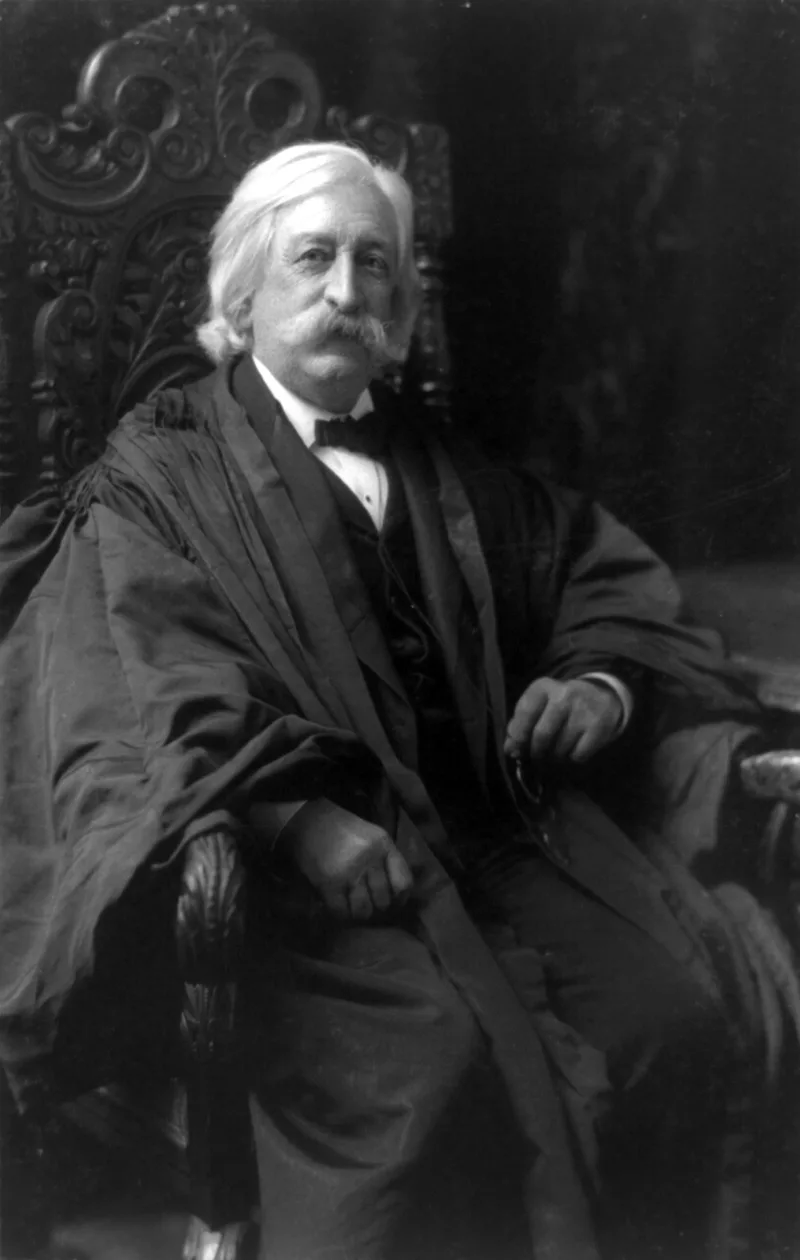
Melville Weston Fuller (February 11, 1833 – July 4, 1910) was an American politician, attorney, and jurist who served as the eighth chief justice of the United States from 1888 until his death in 1910. Staunch conservatism marked his tenure on the Supreme Court, exhibited by his tendency to support unfettered free enterprise and to oppose broad federal power. He wrote major opinions on the federal income tax, the Commerce Clause, and citizenship law, and he took part in important decisions about racial segregation and the liberty of contract. Those rulings often faced criticism in the decades during and after Fuller's tenure, and many were later overruled or abrogated. The legal academy has generally viewed Fuller negatively, although a revisionist minority has taken a more favorable view of his jurisprudence.
Born in Augusta, Maine, Fuller established a legal practice in Chicago after graduating from Bowdoin College. A Democrat, he became involved in politics, campaigning for Stephen A. Douglas in the 1860 presidential election. During the Civil War, he served a single term in the Illinois House of Representatives, where he opposed the policies of President Abraham Lincoln. Fuller became a prominent attorney in Chicago and was a delegate to several Democratic national conventions. He declined three separate appointments offered by President Grover Cleveland before accepting the nomination to succeed Morrison Waite as chief justice. Despite some objections to his political past, Fuller won Senate confirmation in 1888. He served as chief justice until his death in 1910, gaining a reputation for collegiality and able administration.
Fuller's jurisprudence was conservative, focusing strongly on states' rights, limited federal power, and economic liberty. His majority opinion in Pollock v. Farmers' Loan & Trust Co. (1895) ruled a federal income tax to be unconstitutional; the Sixteenth Amendment later superseded the decision. Fuller's opinion in United States v. E. C. Knight Co. (1895) narrowly interpreted Congress's authority under the Commerce Clause, limiting the reach of the Sherman Act and making government prosecution of antitrust cases more difficult. In Lochner v. New York (1905), Fuller agreed with the majority that the Constitution forbade states from enforcing wage-and-hour restrictions on businesses, contending that the Due Process Clause prevents government infringement on one's liberty to control one's property and business affairs.
From Wikipedia (CC BY-SA 4.0).