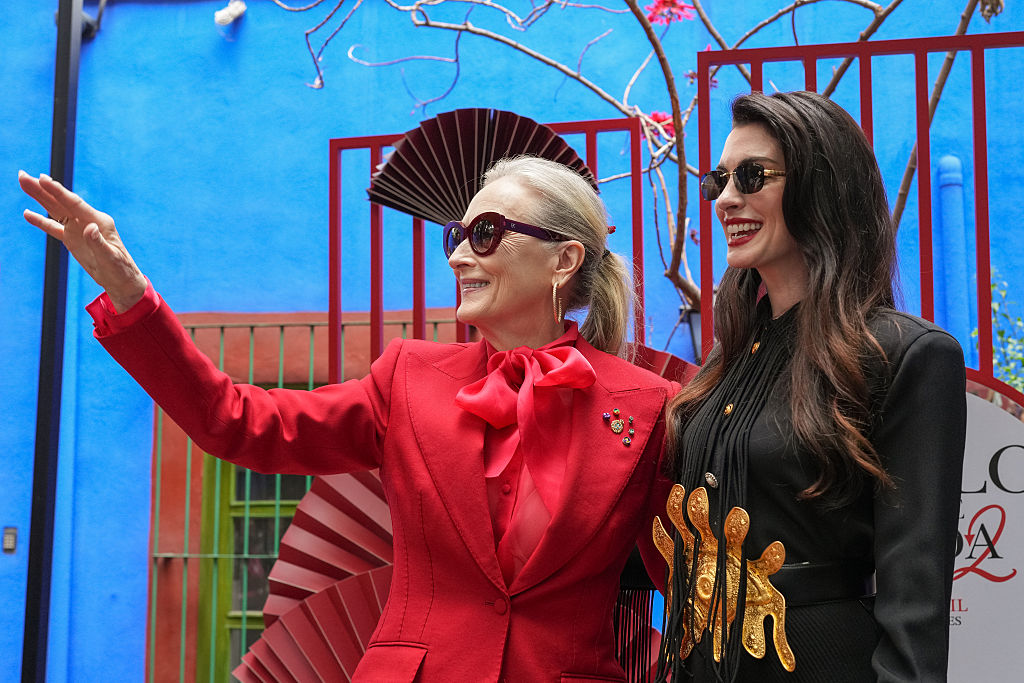
Mary Louise "Meryl" Streep (born June 22, 1949) is an American actress. Widely regarded by peers and critics as the greatest actress of her generation, and by many as the greatest of all time, she is recognized as one of the most versatile performers in cinema, noted for her technical precision, nuanced emotional depth, command of dialects, and professional longevity. Streep is an alumna of Vassar College and the Yale School of Drama, holding a Bachelor of Arts and a Master of Fine Arts. Her artistic process often includes refining her characters' dialogue so that their motivations possess a psychological depth and agency that transcend traditional archetypes. Beyond her creative work, she is a prominent advocate for gender parity, labor protections, and a challenge to the influence of the male gaze in film criticism and production.
Streep began her professional stage career in 1975 in Trelawny of the Wells and earned a Tony Award nomination the following year for 27 Wagons Full of Cotton. She transitioned to film in Julia (1977), followed by her first Academy Award nomination for The Deer Hunter (1978). For Kramer vs. Kramer (1979), she won her first Oscar after advocating to rewrite her character's courtroom testimony, shifting the role from a secondary antagonist to a portrayal focused on a woman's autonomy. She became a leading actress of the 1980s with performances in The French Lieutenant's Woman (1981), Sophie's Choice (1982), Out of Africa (1985), and A Cry in the Dark (1988), for which she received the Best Actress Award at Cannes.
After expanding into various genres in the 1990s, Streep achieved a new level of commercial stardom in the 2000s. She transitioned from her established dramatic niche to lead high-grossing mainstream successes, portraying a formidable antagonist in The Devil Wears Prada (2006) and a singing lead in the musical Mamma Mia! (2008). During this period, she continued to receive critical acclaim for her dramatic turns in Doubt (2008) and The Iron Lady (2011), the latter earning her a third Academy Award.
Streep's career honors include three Academy Awards, eight Golden Globe Awards, two British Academy Film Awards, three Primetime Emmy Awards, one Children's and Family Emmy Award, and two Screen Actors Guild Awards. She is a recipient of the AFI Life Achievement Award, the Honorary Palme d'Or, the Kennedy Center Honor, the Golden Globe Cecil B. DeMille Award, and an Honorary César. In 2014, she was awarded the Presidential Medal of Freedom. She holds the record for the most Academy Award and Globe nominations of any performer, with 21 and 34 respectively. A prolific artist, her career spans over 64 films and 18 television projects, alongside more than 20 musical recordings and 30 audiobooks.
Contents
Early life and education
Mary Louise Streep was born on June 22, 1949, in Summit, New Jersey, to artist Mary Wilkinson Streep and pharmaceutical executive Harry William Streep Jr. She has two younger brothers, Harry William Streep III and Dana David Streep, both actors. Streep's mother, who she claims looks like Dame Judi Dench, strongly encouraged her daughter and instilled confidence in her from a very young age. Streep said, "She was a mentor because she said to me, 'Meryl, you're capable. You're so great.' She was saying, 'You can do whatever you put your mind to. If you're lazy, you're not going to get it done. But if you put your mind to it, you can do anything.' And I believed her." Although she was naturally more introverted than her mother, when she later needed an injection of confidence in adulthood, she would consult her mother at times for advice.
Streep was raised as a Presbyterian in Basking Ridge, New Jersey, and attended Cedar Hill Elementary School and the Oak Street School, which was a junior high school at that time. In her junior high debut, she starred as Louise Heller in the play The Family Upstairs. In 1963, the family moved to Bernardsville, New Jersey, where she attended Bernards High School. As a "gawky kid with glasses and frizzy hair", she liked to show off in front of the camera in family home movies from a young age. At age 12, Streep was selected to sing at a school recital, leading to her having opera lessons from Estelle Liebling. Despite her talent, she later remarked, "I was singing something I didn't feel and understand. That was an important lesson—not to do that. To find the thing that I could feel through." She quit after four years. Streep had many Catholic school friends and regularly attended Mass. She was a high school cheerleader for the Bernards High School Mountaineers. She was also chosen as the homecoming queen her senior year.
Although Streep appeared in numerous school plays during her high school years, she was uninterested in serious theater until acting in the play Miss Julie at Vassar College in 1969, in which she gained attention across the campus. Vassar drama professor Clinton J. Atkinson noted, "I don't think anyone ever taught Meryl acting. She really taught herself." Streep demonstrated an early ability to mimic accents and to quickly memorize her lines. She earned her AB in drama cum laude in 1971, before applying for a Master of Fine Arts (MFA) degree from the Yale School of Drama. At Yale, she supplemented her course fees by working as a waitress and typist, and appeared in over a dozen stage productions per year; at one point, she became overworked and developed ulcers, so she contemplated quitting acting and switching to study law. Streep played a variety of roles on stage, from Helena in A Midsummer Night's Dream to an 80-year-old woman in a wheelchair in a comedy written by then-unknown playwrights Christopher Durang and Albert Innaurato. She was a student of choreographer Carmen de Lavallade, whom she introduced at the 2017 Kennedy Center Honors. Another of her teachers was Robert Lewis, a co-founder of the Actors Studio. Streep disapproved of some of the acting exercises she was asked to do, remarking that one professor taught the emotional recall technique by delving into personal lives in a way she found "obnoxious". She earned her MFA in drama from Yale in 1975. She also enrolled as a visiting student at Dartmouth College in 1970 and received an honorary Doctor of Arts degree from the college in 1981.
Career
1970s: Early work and breakthrough
One of Streep's first professional jobs in 1975 was at the Eugene O'Neill Theater Center's National Playwrights Conference, during which she acted in five plays over six weeks. She moved to New York City in 1975, and was cast by Joseph Papp in a production of Trelawny of the Wells at the Vivian Beaumont Theater, opposite Mandy Patinkin and John Lithgow. She went on to appear in five more roles in her first year in New York, including in Papp's New York Shakespeare Festival productions of Henry V, The Taming of the Shrew with Raul Julia, and Measure for Measure opposite Sam Waterston and John Cazale. She entered into a relationship with Cazale at this time, and resided with him until his death three years later. She starred in the musical Happy End on Broadway, and won an Obie for her performance in the off-Broadway play Alice at the Palace.
Although Streep had not aspired to become a film actor, Robert De Niro's performance in Taxi Driver (1976) had a profound impact on her; she said to herself, 'That's the kind of actor I want to be when I grow up.' Streep began auditioning for film roles, and underwent an unsuccessful audition for the lead role in Dino De Laurentiis's remake of the action adventure King Kong which was released in 1976. De Laurentiis, referring to Streep as she stood before him, said in Italian to his son: "This is so ugly. Why did you bring me this?" Unknown to Laurentiis, Streep understood Italian, and she remarked, "I'm very sorry that I'm not as beautiful as I should be, but, you know – this is it. This is what you get." She continued to work on Broadway, appearing in the 1976 double bill of Tennessee Williams' 27 Wagons Full of Cotton and Arthur Miller's A Memory of Two Mondays. She received a Tony Award nomination for Best Featured Actress in a Play. Streep's other Broadway credits include Anton Chekhov's The Cherry Orchard and the Bertolt Brecht-Kurt Weill musical Happy End, in which she had originally appeared off-Broadway at the Chelsea Theater Center. She received Drama Desk Award nominations for both productions.
Streep's first feature film role came opposite Jane Fonda in the 1977 film Julia, in which she had a small role during a flashback sequence. Most of her scenes were edited out, but the brief time on screen horrified the actress, "I had a bad wig and they took the words from the scene I shot with Jane and put them in my mouth in a different scene. I thought, I've made a terrible mistake, no more movies. I hate this business." However, Streep stated in 2015 that Fonda had a lasting influence on her as an actress, and credited her with opening "probably more doors than I probably even know about". Robert De Niro, who had spotted Streep in her stage production of The Cherry Orchard, suggested that she play the role of his girlfriend in the war film The Deer Hunter (1978). Cazale, who had been diagnosed with lung cancer, was also cast in the film, and Streep took on the role of a "vague, stock girlfriend" to remain with Cazale for the duration of filming. Pauline Kael, who later became a strong critic of Streep, remarked that she was a "real beauty" who brought much freshness to the film with her performance. The film's success exposed Streep to a wider audience and earned her a nomination for the Academy Award for Best Supporting Actress.
1980s: Rise to prominence
In 1979, Streep began workshopping Alice in Concert, a musical version of Alice's Adventures in Wonderland, with writer and composer Elizabeth Swados and director Joseph Papp; the show was put on at New York's Public Theater from December 1980. Frank Rich of The New York Times referred to Streep as the production's "one wonder", but questioned why she devoted so much energy to it. By 1980, Streep had progressed to leading roles in films. She was featured on the cover of Newsweek magazine with the headline "A Star for the 80s"; Jack Kroll commented, "There's a sense of mystery in her acting; she doesn't simply imitate (although she's a great mimic in private). She transmits a sense of danger, a primal unease lying just below the surface of normal behavior".
Streep denounced her fervent media coverage at the time as "excessive hype". The story within a story drama The French Lieutenant's Woman (1981) was Streep's first leading role. The film paired Streep with Jeremy Irons as contemporary actors, telling their modern story, as well as the Victorian era drama they were performing. Streep developed an English accent for the part, but considered herself a misfit for the role: "I couldn't help wishing that I was more beautiful". A New York magazine article commented that, while many female stars of the past had cultivated a singular identity in their films, Streep was a "chameleon", willing to play any type of role. Streep was awarded a BAFTA Award for Best Actress in a Leading Role for her work. The following year, she re-united with Robert Benton for the psychological thriller, Still of the Night (1982), co-starring Roy Scheider and Jessica Tandy. Vincent Canby, writing for The New York Times, noted that the film was an homage to the works of Alfred Hitchcock, but that one of its main weaknesses was a lack of chemistry between Streep and Scheider, concluding that Streep "is stunning, but she's not on screen anywhere near long enough".
Greater success came later in the year when Streep starred in the drama Sophie's Choice (also 1982), portraying a Polish survivor of Auschwitz caught in a love triangle between a young naïve writer (Peter MacNicol) and a Jewish intellectual (Kevin Kline). Streep's emotional dramatic performance and her apparent mastery of a Polish accent drew praise. William Styron wrote the novel with Ursula Andress in mind for the role of Sophie, but Streep was determined to get the role. Streep filmed the "choice" scene in one take and refused to do it again, finding it extremely painful and emotionally exhausting. That scene, in which Streep is ordered by an SS guard at Auschwitz to choose which of her two children would be gassed and which would proceed to the labor camp, is her most famous scene, according to Emma Brockes of The Guardian who wrote in 2006: "It's classic Streep, the kind of scene that makes your scalp tighten, but defter in a way is her handling of smaller, harder-to-grasp emotions".
1990s: Commercial fluctuations
Biographer Karen Hollinger described the early 1990s as a downturn in the popularity of Streep's films, attributing this partly to a critical perception that her comedies had been an attempt to convey a lighter image following several serious, but commercially unsuccessful, dramas, and, more significantly, to the lack of options available to an actress in her forties. Streep commented that she had limited her options by her preference to work in Los Angeles, close to her family, a situation that she had anticipated in a 1981 interview when she commented, "By the time an actress hits her mid-forties, no one's interested in her anymore. And if you want to fit a couple of babies into that schedule as well, you've got to pick your parts with great care." At the Screen Actor's Guild National Women's Conference in 1990, Streep keynoted the first national event, emphasizing the decline in women's work opportunities, pay parity, and role models within the film industry. She criticized the film industry for downplaying the importance of women both on screen and off.
After roles in the comedy-drama Postcards from the Edge (1990), and the comedy-fantasy Defending Your Life (1991), Streep starred with Goldie Hawn in the farcical black comedy, Death Becomes Her (1992), with Bruce Willis as their co-star. Streep persuaded writer David Koepp to re-write several of the scenes, particularly the one in which her character has an affair with a younger man, which she believed was "unrealistically male" in its conception. The seven-month shoot was the longest of Streep's career, during which she got into character by "thinking about being slightly pissed off all of the time". Due to Streep's allergies to numerous cosmetics, special prosthetics had to be designed to age her by ten years to look 54, although Streep believed that they made her look nearer 70. Although it was a commercial success, earning $15.1 million in just five days, Streep's contribution to comedy was generally not taken well by critics. Time's Richard Corliss wrote approvingly of Streep's "wicked-witch routine" but dismissed the film as "She-Devil with a make-over" and one which "hates women". Streep later admitted to having disliked filming the scenes involving heavy special effects, and vowed never to work again on a film with heavy special effects.
Streep appeared with Jeremy Irons, Glenn Close and Winona Ryder in The House of the Spirits (1993), set in Chile during Augusto Pinochet's dictatorship. The film was not well received by critics. Anthony Lane of The New Yorker wrote: "This is really quite an achievement. It brings together Jeremy Irons, Meryl Streep, Winona Ryder, Antonio Banderas, and Vanessa Redgrave and insures that, without exception, they all give their worst performances ever". The following year, Streep starred in The River Wild, as the mother of children on a whitewater rafting trip who encounter two violent criminals (Kevin Bacon and John C. Reilly) in the wilderness. Though critical reaction was generally mixed, Peter Travers of Rolling Stone found her to be "strong, sassy and looser than she has ever been onscreen".
2000s: Career resurgence and stage work
Streep entered the 2000s with a voice cameo in Steven Spielberg's A.I. Artificial Intelligence (2001), a science fiction film about a childlike android, played by Haley Joel Osment. The same year, Streep co-hosted the annual Nobel Peace Prize Concert with Liam Neeson which was held in Oslo, Norway, on December 11, 2001, in honour of the Nobel Peace Prize laureate, the United Nations and Kofi Annan. In 2001, Streep returned to the stage for the first time in more than twenty years, playing Arkadina in The Public Theater's revival of Anton Chekhov's The Seagull, directed by Mike Nichols and co-starring Kevin Kline, Natalie Portman, John Goodman, Marcia Gay Harden, Stephen Spinella, Debra Monk, Larry Pine and Philip Seymour Hoffman.
The same year, Streep began work on Spike Jonze's comedy-drama Adaptation. (2002), in which she portrayed real-life journalist Susan Orlean. Lauded by critics and viewers alike, the film won Streep her fourth Golden Globe in the Best Supporting Actress category. A. O. Scott in The New York Times considered Streep's portrayal of Orlean to have been "played with impish composure", noting the contrast in her "wittily realized" character with love interest Chris Cooper's "lank-haired, toothless charisma" as the autodidact arrested for poaching rare orchids. Streep appeared alongside Nicole Kidman and Julianne Moore in Stephen Daldry's The Hours (2002), based on the 1999 novel by Michael Cunningham. Focusing on three women of different generations whose lives are interconnected by the novel Mrs. Dalloway by Virginia Woolf, the film was generally well received and won all three leading actresses a Silver Bear for Best Actress.
In 2003, Streep re-united with Mike Nichols to star with Al Pacino and Emma Thompson in the HBO's adaptation of Tony Kushner's six-hour play Angels in America, the story of two couples whose relationships dissolve amidst the backdrop of Reagan era politics. Streep, who was cast in four roles in the miniseries, received her second Emmy Award and fifth Golden Globe for her performance. She appeared in Jonathan Demme's moderately successful remake of The Manchurian Candidate in 2004, co-starring Denzel Washington, playing the role of a woman who is both a U.S. senator and the manipulative, ruthless mother of a vice-presidential candidate. The same year, she played the supporting role of Aunt Josephine in Lemony Snicket's A Series of Unfortunate Events alongside Jim Carrey, based on the first three novels in Snicket's book series. The black comedy received generally favorable reviews from critics, and won the Academy Award for Best Makeup. Streep also narrated the film Monet's Palate. Streep was next cast in the comedy film Prime (2005), directed by Ben Younger. In the film, she played Lisa Metzger, the Jewish psychoanalyst of a divorced and lonesome business-woman, played by Uma Thurman, who enters a relationship with Metzger's 23-year-old son (Bryan Greenberg). A modest mainstream success, it eventually grossed US$67.9 million internationally. Roger Ebert noted how Streep had "that ability to cut through the solemnity of a scene with a zinger that reveals how all human effort is, after all, comic at some level".
2010s: Further critical and commercial success
Streep re-teamed with Mamma Mia! director Phyllida Lloyd on The Iron Lady (2011), a British biographical film about Margaret Thatcher, which takes a look at the Prime Minister during the Falklands War and her years in retirement. Streep, who attended a session of the House of Commons to see British Members of Parliament (MPs) in action in preparation for her role as Thatcher, called her casting "a daunting and exciting challenge". While the film had a mixed reception, Streep's performance gained rave reviews, earning her Best Actress awards at the Golden Globes and the BAFTAs, as well as her third win at the 84th Academy Awards. Former advisers, friends, and family of Thatcher criticized Streep's portrayal of her as "inaccurate" and "biased". The following year, after Thatcher's death, Streep issued a formal statement describing Thatcher's "hard-nosed fiscal measures" and "hands-off approach to financial regulation", while praising her "personal strength and grit".
Streep re-united with Prada director David Frankel on the set of the romantic comedy-drama film Hope Springs (2012), co-starring Tommy Lee Jones and Steve Carell. Streep and Jones play a middle-aged couple, who attend a week of intensive marriage counseling to try to bring back the intimacy missing in their relationship. Reviews for the film were mostly positive, with critics praising the "mesmerizing performances ... which offer filmgoers some grown-up laughs – and a thoughtful look at mature relationships". In 2013, Streep starred alongside Julia Roberts and Ewan McGregor in the black comedy drama August: Osage County (2013) about a dysfunctional family that re-unites into the familial house when their patriarch suddenly disappears. Based on Tracy Letts's Pulitzer Prize-winning eponymous play, Streep received positive reviews for her portrayal of the family's strong-willed and contentious matriarch, who is suffering from oral cancer and an addiction to narcotics. She was subsequently nominated for another Golden Globe, SAG, and Academy Award.
In 2014's The Giver, a motion picture adaptation of the young adult novel, Streep played a community leader. Set in 2048, the social science fiction film recounts the story of a post-apocalyptic community without war, pain, suffering, differences or choice, where a young boy is chosen to learn the real world. Streep was aware of the book before being offered the role by co-star and producer Jeff Bridges. Upon its release, The Giver was met with generally mixed to negative reviews from critics. Streep also had a small role in the period drama film The Homesman (2014). Set in the 1850s midwest, the film stars Hilary Swank and Tommy Lee Jones as an unusual pair who help three women driven to madness by the frontier to get back East. Streep does not appear until near the end of the film, playing a preacher's wife, who takes the women into care. The Homesman premiered at the 2014 Cannes Film Festival where it garnered largely positive reviews from critics.
2020s: Streaming and theatrical projects
In 2020, she voiced a role in the Apple TV+ animated short film Here We Are: Notes for Living on Planet Earth. Streep had leading roles in two films, both released by streaming services. She reunited with Nicole Kidman for Netflix, in Ryan Murphy's The Prom (2020), a film adaptation of the Broadway musical of the same name. That same year she also reunited with director Steven Soderbergh for his HBO Max comedy film Let Them All Talk (2020). Streep starred alongside Dianne Wiest, Candice Bergen, Lucas Hedges, and Gemma Chan. Richard Lawson of Vanity Fair noted, "Streep could, in some senses, be approaching the film as a meta commentary on her own ivied stature as the world's greatest living actor (in some people's estimation, anyway). If that is what's happening, she never betrays her motivations with a wink. It's all played pretty earnestly".
Streep then starred opposite Leonardo DiCaprio and Jennifer Lawrence in Don't Look Up (2021), directed by Adam McKay for Netflix. Streep played a comical role as the fictional President of the United States who waves off the fears of climate change. In his mixed review, Peter DeBruge of Variety stated she was "clearly having more fun than we are". Streep served as an executive producer on Sell/Buy/Date (2022), directed by Sarah Jones. She acted in the Apple TV+ anthology series Extrapolations (2023). Later that year, she began playing Loretta Durkin, a struggling actress, from the third season of the Hulu comedy series Only Murders in the Building, starring Steve Martin, Martin Short and Selena Gomez. Leila Latif of The Guardian wrote, "Streep, unsurprisingly, plays Loretta beautifully, truly tapping into the agony of a woman who's faced a lifetime of rejection but somehow kept her dream alive". She received Golden Globe and Primetime Emmy Award nominations and won a Critics' Choice Television Award. In 2025, Streep attended the Saturday Night Live 50th Anniversary Special, in which she acted in an alien abduction skit portraying the mother of Colleen Rafferty, played by Kate McKinnon. It marked Streep's first SNL appearance. Streep then voiced Queen Butterfly in the Pixar Animation Studios film Hoppers, which was released on March 6, 2026.
She reprised the role of Miranda Priestly in The Devil Wears Prada 2, which was released on May 1, 2026. It debuted as her highest grossing film in the opening weekend, in both global ($233.6 million) and domestic ($77 million) box office.
On August 18, 2025, it was announced that a biopic on the life and career of musician Joni Mitchell was in the works with Cameron Crowe set to direct the film. Streep has signed on to play Mitchell in present day with Anya Taylor-Joy playing Mitchell in the 1960s and 1970s.
Other ventures
After Streep starred in Mamma Mia!, her rendition of the titular song rose to popularity on the Portuguese music charts, where it peaked at number eight in October 2008. At the 35th People's Choice Awards, her version of "Mamma Mia" won an award for "Favorite Song From A Soundtrack". In 2008, Streep was nominated for a Grammy Award (her fifth nomination) for her work on the Mamma Mia! soundtrack. Streep has narrated numerous audio books, including three by children's book author William Steig: Brae Irene, Spinky Sulks, and The One and Only Shrek!.
Streep is the spokesperson for the National Women's History Museum (NWHM), to which she has made significant donations (including her fee for The Iron Lady, which was $1 million), and hosted numerous events. In 2026, Streep made a seven-figure donation to the NWHM. In recognition of her contribution the NWHM established the Meryl Streep Educator Award "honoring an exceptional educator each year who advances the teaching of women's history and expands access to these vital narratives in classrooms and communities nationwide."
On October 4, 2012, Streep donated $1 million to The Public Theater in honor of both its late founder, Joseph Papp, and her friend, the author Nora Ephron. She also supports Gucci's "Chime for Change" campaign that aims to spread female empowerment.
In 2014, Streep established two scholarships for students at the University of Massachusetts Lowell – the Meryl Streep Endowed Scholarship for English majors, and the Joan Hertzberg Endowed Scholarship (named for Streep's former classmate at Vassar College) for math majors.
In April 2015, it was announced that Streep had funded a screenwriters lab for female screenwriters over forty years old, called the Writers Lab, to be run by New York Women in Film & Television and the collective IRIS. The Lab was the only one of its kind in the world for female screenwriters over forty years old. In 2015, Streep signed an open letter for which One Campaign had been collecting signatures; the letter was addressed to Angela Merkel and Nkosazana Dlamini-Zuma, urging them to focus on women as they served as heads of the G7 in Germany and the AU in South Africa, respectively, in setting development funding priorities. Also in 2015, Streep sent each member of the U.S. Congress a letter supporting the Equal Rights Amendment. Each of her letters was sent with a copy of the book Equal Means Equal: Why the Time for the ERA is Now by Jessica Neuwirth, president of the ERA Coalition.
Reception and legacy
In 2004, Streep was awarded the AFI Life Achievement Award by the board of directors of the American Film Institute. In 2011, she received a Kennedy Center Honors, introduced by Tracey Ullman, and speeches by 2009 Kennedy Center Honoree Robert De Niro and 2003 Kennedy Center Honoree Mike Nichols. Those also to honor Streep included, Kevin Kline, Emily Blunt, Stanley Tucci, and Anne Hathaway. The tribute ended with the whole cast who sang "She's My Pal", a play on "He's My Pal" from Ironweed.
In November 2014, President Barack Obama bestowed upon Streep the Presidential Medal of Freedom, the nation's highest civilian honor. The citation reads as follows, "Meryl Streep is one of the most widely known and acclaimed actors in history. Ms. Streep has captured our imaginations with her unparalleled ability to portray a wide range of roles and attract an audience that has only grown over time, portraying characters who embody the full range of the human experience." In January 2017, Viola Davis presented Streep with the Cecil B. DeMille at the Golden Globes. Davis stated to Streep "You make me proud to be an artist". In her acceptance speech, Streep quoted the recently departed Carrie Fisher, saying, "Take your broken heart and make it into art."
Vanity Fair commented that "it's hard to imagine that there was a time before Meryl Streep was the greatest-living actress". Emma Brockes of The Guardian notes that despite Streep's being "one of the most famous actresses in the world", it is "strangely hard to pin an image on Streep", in a career where she has "laboured to establish herself as an actor whose roots lie in ordinary life". Despite her success, Streep has always been modest about her own acting and achievements in cinema. She has stated that she has no particular method when it comes to acting, learning from the days of her early studies that she cannot articulate her practice. She said in 1987, "I have a smattering of things I've learned from different teachers, but nothing I can put into a valise and open it up and say 'Now, which one would you like?' Nothing I can count on, and that makes it more dangerous. But then, the danger makes it more exciting." She has stated that her ideal director is one who gives her complete artistic control, allowing her to have a degree of improvisation and to learn from her mistakes.
Streep is chameleon-like in her impersonation of characters, "subsuming herself into them, rather than personifying them". Early in her career, Streep was drawn to playing women who were difficult to like and lacked empathy. Streep has stated that many consider her to be a technical actor adding, "I come ready and I don't want to screw around and waste the first 10 takes on adjusting lighting and everybody else getting comfortable". Mike Nichols, who directed Streep in Silkwood, Heartburn, Postcards from the Edge, and Angels in America, praised Streep's ability to transform herself into her characters, remarking that, "In every role, she becomes a totally new human being. As she becomes the person she is portraying, the other performers begin to react to her as if she were that person." He said that directing her is "so much like falling in love that it has the characteristics of a time which you remember as magical, but which is shrouded in mystery". He also noted that Streep's acting ability had a profound impact on her co-stars, and that "one could improve by 1000% purely by watching her". Streep has at times infused a feminist point of view into her character portrayals; film critic Molly Haskell has stated, "None of her heroines are feminist, strictly speaking. Yet, they uncannily embody various crosscurrents of experience in the last twenty years, as women have re-defined themselves against the background of the women's movement".
Activism and advocacy
Politically, Streep has described herself as part of "the left". She gave a speech at the 2016 Democratic National Convention in support of presidential nominee Hillary Clinton. In January 2017, during her acceptance speech on receiving the Cecil B. DeMille Award for Lifetime Achievement at the 74th Golden Globe Awards, she criticized the conduct of then-President-elect Donald Trump, referring to him as "the person asking to sit in the most respected seat in our country." She specifically condemned his public mocking of disabled reporter Serge F. Kovaleski as an abuse of "privilege, power, and the capacity to fight back." Streep argued that such an "instinct to humiliate" from a powerful figure "filters down into everybody's life" and "gives permission for other people to do the same thing." The speech drew widespread media attention and became a focal point of national political discourse.
Streep has also focused her advocacy on systemic industry issues and labor rights. While promoting Suffragette in 2015, she challenged the male gaze in film criticism, citing a ratio of 760 men to 168 women among Rotten Tomatoes contributors. She argued that this imbalance creates a skewed consensus that adversely affects the commercial performance and perceived authenticity of female-driven narratives. In June 2023, she was among over 300 high-profile members of SAG-AFTRA who signed a letter threatening to strike to secure a "transformative" deal protecting performers' craft and likenesses from the unregulated rise of artificial intelligence.
Personal life
Relationships and family
Streep met actor John Cazale in 1976, when they were both in a production of William Shakespeare's Measure for Measure at the Delacorte Theater. They were living together when he was diagnosed with lung cancer in 1977; Streep cared for him until he died in March 1978. Streep said of his death:
I didn't get over it. I don't want to get over it. No matter what you do, the pain is always there in some recess of your mind, and it affects everything that happens afterwards. I think you can assimilate the pain and go on without making an obsession of it.
Streep married sculptor Don Gummer on September 30, 1978, six months after Cazale's death. They have four children: musician Henry Wolfe Gummer (born 1979), and actresses Mary Willa "Mamie" Gummer (born 1983), Grace Jane Gummer (born 1986), and Louisa Jacobson Gummer (born 1991). In 1985, the family moved into a $1.8-million private estate in Connecticut and lived there until they bought a $3-million mansion in Brentwood, Los Angeles, in 1990. They later moved back to Connecticut. In 2023, it was reported that Streep and Gummer had been separated for more than six years. They were publicly last seen together at the 90th Academy Awards in 2018.
Streep is the godmother of Billie Lourd, daughter of the late actress Carrie Fisher, who was a close friend to Streep. Fisher wrote the screenplay for Streep's 1990 film Postcards from the Edge, based on Fisher's book of the same name.
Beliefs
When asked if religion plays a part in her life in 2009, Streep replied: "I follow no doctrine. I don't belong to a church or a temple or a synagogue or an ashram." In an interview in 2008, she alluded to her lack of religious belief when she said: So, I've always been really, deeply interested because I think I can understand the solace that's available in the whole construct of religion. But I really don't believe in the power of prayer, or things would have been avoided that have happened, that are awful. So, it's a horrible position as an intelligent, emotional, yearning human being to sit outside of the available comfort there. But I just can't go there.
When asked where she draws consolation in the face of aging and death, Streep responded: Consolation? I'm not sure I have it. I have a belief, I guess, in the power of the aggregate human attempt – the best of ourselves. In love and hope and optimism – you know, the magic things that seem inexplicable. Why we are the way we are. I do have a sense of trying to make things better. Where does that come from?
Acting credits and awards
One of the most prolific actresses of screen and stage since her career's inception in the late 1970s, Streep's most acclaimed and highest-grossing films, according to the review aggregator site Rotten Tomatoes, include Julia (1977), The Deer Hunter (1978), Kramer vs. Kramer (1979), The French Lieutenant's Woman (1981), Sophie's Choice (1982), Silkwood (1983), A Cry in the Dark (1988), Postcards from the Edge (1990), Defending Your Life (1991), The Bridges of Madison County (1995), Marvin's Room (1996), Adaptation (2002), The Devil Wears Prada (2007), Mamma Mia! (2008), Fantastic Mr. Fox (2009), The Homesman (2014), Florence Foster Jenkins (2016), Little Women (2019), and Let Them All Talk (2020). Her television projects include the miniseries Holocaust (1978), the television film ...First Do No Harm (1997), the miniseries Angels in America (2003), and the drama series Big Little Lies (2019). Her stage roles include the Broadway theatre productions A Memory of Two Mondays, 27 Wagons Full of Cotton (both 1976) and The Cherry Orchard (1977), as well as multiple plays at the Delacorte Theater.
Streep has been recognized by the Academy of Motion Picture Arts and Sciences (AMPAS) for the following performances:
These nominations make Streep the most Academy Award-nominated performer in history, with 21 in total (17 for Best Actress and four for Best Supporting Actress), as well as one of only 13 performers to win an Oscar in both acting categories and one of only three performers to win three Academy Awards across the two acting categories (with Ingrid Bergman and Jack Nicholson being the only others to achieve this feat).
She has also received six Grammy Award nominations, six Primetime Emmy Award nominations (with three wins plus a Children's and Family Emmy Award win), and one Tony Award nomination. Streep is one of few performers to be nominated for the Triple Crown of Acting and EGOT. Her other accolades include two BAFTA Awards for Best Actress in a Leading Role (for The French Lieutenant's Woman and The Iron Lady), nine Golden Globe Awards (as well as the honorary Cecil B. DeMille Award), a Silver Bear and Honorary Golden Bear in Berlin International Film Festival, Best Actress, Honorary Palme d'Or in Cannes Film Festival and two Screen Actors Guild Awards.
Discography
Albums
The Velveteen Rabbit (1984)
A Prairie Home Companion (2006)
Mamma Mia! The Movie Soundtrack (2008)
Into the Woods (2014)
Florence Foster Jenkins (2016)
Mamma Mia! Here We Go Again: The Movie Soundtrack (2018)
Mary Poppins Returns (2018)
The Prom (2020)
Dream Requiem (2025)