Sponsored
Person
Michel Foucault
Comments
Ask Genius by OpenServe:
Free account · your comment posts right after signup
Person
Free account · your comment posts right after signup
Not who you're looking for? Others named Michel Foucault: biography of Michel Foucault by Didier Eribon
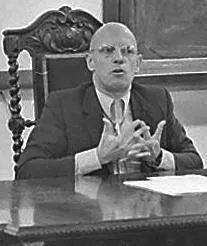
Paul-Michel Foucault (, ; ; 15 October 192625 June 1984) was a French philosopher, historian of ideas, writer, political activist, and literary critic. Foucault's theories primarily address the relationships between power and knowledge, and how they are used as a form of social control through societal institutions. Though often cited as a structuralist and postmodernist, Foucault rejected these labels. His thought has influenced academics, especially those working in communication studies, anthropology, psychology, sociology, criminology, cultural studies, literary theory, feminism, Marxism and critical theory.
“Do not ask who I am and do not ask me to remain the same: leave it to our bureaucrats and our police to see that our papers are in order. At least spare us their morality when we write.”
“My point is not that everything is bad, but that everything is dangerous, which is not exactly the same as bad. If everything is dangerous, then we always have something to do. So my position leads not to apathy but to a hyper- and pessimistic activism. I think that the ethico-political choice we have to make every day is to determine which is the main danger.”
“Nietzsche was the first to release the desire to know from the sovereignty of knowledge itself: to re-establish the distance and exteriority that Aristotle cancelled.”
“The public execution is to be understood not only as a judicial, but also as a political ritual. It belongs, even in minor cases, to the ceremonies by which power is manifested.”
“The perfect disciplinary apparatus would make it possible for a single haze to see everything constantly. A central point would be both the source of light illuminating everything, and a locus of convergence for everything that must be known: a perfect eye that nothing would escape and a centre towards which all gazes would be turned.”
“[W]hen a philosopher addresses himself to... a , and tells him... tyranny is incompatible with justice, then the philosopher speaks... [and] believes he is speaking the truth, and... takes a risk... [T]hat was Plato's situation with Dionysius in Syracuse... reference... Plato's Seventh Letter, and... The Life of Dion by Plutarch.”
Quotes via Wikiquote (CC BY-SA), each with its original source.