Overview
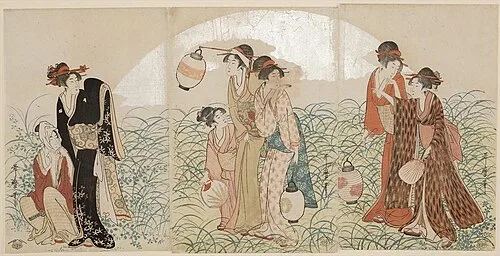
Musashino is a triptych print by the Japanese ukiyo-e artist Kitagawa Utamaro ( – 1806). It is a mitate-e parody picture that alludes to the story in the 12th section of The Tales of Ise.
Background
Ukiyo-e art flourished in Japan during the Edo period from the 17th to 19th centuries, and took as its primary subjects courtesans, kabuki actors, and others associated with the "floating world" lifestyle of the pleasure districts. Alongside paintings, mass-produced woodblock prints were a major form of the genre. In the mid-18th century full-colour prints became common, printed using a large number of woodblocks, one for each colour. A prominent genre was ("pictures of beauties"), which depicted most often courtesans and geisha at leisure, and promoted the entertainments of the pleasure districts.
Kitagawa Utamaro (–1806) made his name in the 1790s with his bijin ōkubi-e ("large-headed pictures of beautiful women") portraits, focusing on the head and upper torso, a style others had previously employed in portraits of kabuki actors. Utamaro experimented with line, colour, and printing techniques to bring out subtle differences in the features, expressions, and backdrops of subjects from a wide variety of class and background. Utamaro's individuated beauties were in sharp contrast to the stereotyped, idealized images that had been the norm.
From Wikipedia (CC BY-SA 4.0).