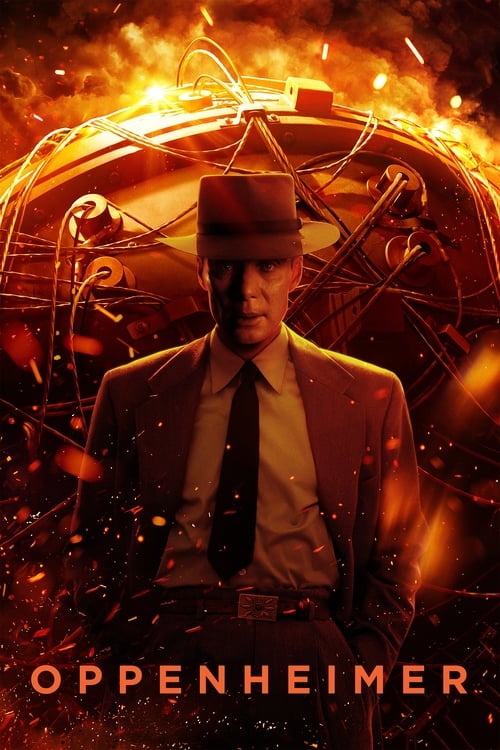
Oppenheimer is a 2023 epic biographical thriller film written, co-produced, and directed by Christopher Nolan. It follows the life of J. Robert Oppenheimer, the American theoretical physicist who helped develop the first nuclear weapons during World War II. Based on the 2005 biography American Prometheus by Kai Bird and Martin J. Sherwin, the film dramatizes Oppenheimer's studies, his direction of the Los Alamos Laboratory and his 1954 security hearing. Cillian Murphy stars as Oppenheimer, alongside Robert Downey Jr. as the United States Atomic Energy Commission member Lewis Strauss. The ensemble supporting cast includes Emily Blunt, Matt Damon, Florence Pugh, Josh Hartnett, Casey Affleck, Rami Malek, and Kenneth Branagh.
Oppenheimer was announced in September 2021. It was Nolan's first film not distributed by Warner Bros. Pictures since Memento (2000), due to his conflicts regarding the studio's simultaneous theatrical and HBO Max release schedule. Murphy was the first cast member to join, with the rest joining between November 2021 and April 2022. Pre-production began by January 2022, and filming took place from February to May. The cinematographer, Hoyte van Hoytema, used a combination of IMAX 65 mm and 65 mm large-format film, including, for the first time, selected scenes in IMAX black-and-white film photography. As with many of his previous films, Nolan used extensive practical effects and claimed minimal use of compositing; despite these claims, the final film contained several hundred VFX shots made by a mostly uncredited VFX crew of around 160.
Oppenheimer premiered at Le Grand Rex in Paris on Tuesday, July 11, 2023, and was theatrically released in the United States and the United Kingdom on July 21 by Universal Pictures. Its concurrent release with Warner Bros.'s Barbie was the catalyst of the "Barbenheimer" phenomenon, encouraging audiences to see both films as a double feature. Oppenheimer received widespread critical acclaim and grossed over $983 million worldwide, becoming the third-highest-grossing film of 2023. It was the highest-grossing biographical film of all time until being overtaken by Michael in 2026.
The recipient of many accolades, Oppenheimer was nominated for thirteen awards at the 96th Academy Awards and won seven, including Best Picture, Best Director (Nolan), Best Actor (Murphy), and Best Supporting Actor (Downey). It also won five Golden Globe Awards (including Best Motion Picture – Drama) and seven British Academy Film Awards (including Best Film), and was named one of the top 10 films of 2023 by the National Board of Review and the American Film Institute.
Contents
Plot
A 1959 Senate committee questions ex-AEC Chairman, Lewis Strauss, over his actions during Robert Oppenheimer's 1954 security hearing before the Gray Board, which revoked Oppenheimer's Q clearance and ended his government advisory role. Strauss, who is nominated for Commerce Secretary, alleges the FBI was suspicious of Oppenheimer since his teaching days, well before anti-Communist William Borden accused him of espionage in 1954. Strauss claims to not have acted against Oppenheimer through the Gray Board, despite having many public disagreements with him.
In the 1930s, Oppenheimer teaches at Caltech and Berkeley, after studying theoretical physics in Europe. A number of Berkeley academics are also Communist Party members, but Oppenheimer does not join himself. After World War II breaks out, Ernest Lawrence of the Radiation Lab cautions Oppenheimer against having communist connections. Oppenheimer scales back, and is approached by General Leslie Groves to lead the Manhattan Project. Oppenheimer proposes a new laboratory at Los Alamos, New Mexico, where they could endeavour to build an atomic bomb before the Nazis. Edward Teller is recruited to Los Alamos, and theorizes that an explosion would cause (global) atmospheric ignition. When his theory is disproved, he starts researching fusion-based weapons instead of working on the proposed fission bombs.
After the war, Soviets test a plutonium bomb, similar to one developed at Los Alamos. In a meeting of top advisors, Oppenheimer frustrates Strauss by favoring arms talks with Russia instead of escalating with Teller's proposed thermonuclear weapons. During a heated period of discussion, Oppenheimer's past security lapses are brought up, including rekindling an affair with Communist ex-lover, Jean Tatlock, immediately after gaining his security clearance in 1942. Oppenheimer had also protected his friend Haakon Chevalier from an espionage investigation, by directly lying to security officer Boris Pash. In his later hearing by the Gray Board at the AEC, the board's counsel, Roger Robb, replays these accusations to make Oppenheimer seem guilty of disloyalty towards the US.
In the present, Strauss alleges that Oppenheimer turned scientists against him, starting with Albert Einstein at Princeton in 1947. Teller testifies in Strauss' favor, and David Hill of the Chicago Met Lab is expected to do so too.
In July 1945, the Trinity plutonium test is successful, and two bombs are subsequently dropped on Japan. Oppenheimer meets with President Truman, to whom he expresses his remorse on building the bomb. Truman clears him of all responsibility, but is annoyed at Oppenheimer’s remorse. Oppenheimer is labeled 'father of the atomic bomb', but his public stance in the post-war years changes towards nuclear non-proliferation.
Cast
Cillian Murphy as J. Robert Oppenheimer, a theoretical physicist and director of the Los Alamos Laboratory
Emily Blunt as Katherine "Kitty" Oppenheimer, Robert Oppenheimer's wife and a former Communist Party USA member
Matt Damon as Gen. Leslie Groves, a United States Army Corps of Engineers (USACE) officer and director of the Manhattan Project
Robert Downey Jr. as Rear Admiral Lewis Strauss, a retired Naval Reserve officer and high-ranking member of the US Atomic Energy Commission (AEC)
Florence Pugh as Jean Tatlock, a psychiatrist, Communist Party USA member, and Robert Oppenheimer's romantic interest
Josh Hartnett as Ernest Lawrence, a Nobel-winning nuclear physicist who worked with Oppenheimer at the University of California, Berkeley
Casey Affleck as Boris Pash, a US Army military intelligence officer and commander of the Alsos Mission
Rami Malek as David L. Hill, a nuclear physicist at the Metallurgical Laboratory, who helped to create the Chicago Pile
Kenneth Branagh as Niels Bohr, a Nobel-winning Danish physicist, philosopher and Oppenheimer's personal idol
Benny Safdie as Edward Teller, a Hungarian theoretical physicist known for being the "father of the hydrogen bomb"
Jason Clarke as Roger Robb, an attorney and future US circuit judge who served as special counsel to the AEC at Oppenheimer's security hearing
Production
Development
Director Sam Mendes was interested in adapting the 2005 J. Robert Oppenheimer biography American Prometheus by Kai Bird and Martin J. Sherwin. After that project failed to materialize, the book was optioned by various filmmakers over the next fifteen years. The authors became pessimistic about a film adaptation. Oliver Stone declined an opportunity to direct, saying "I couldn't find my way to its essence". In 2015, J. David Wargo optioned the book, then commissioned and rejected several scripts. During the COVID-19 pandemic, Wargo flew to Hollywood to meet with actor James Woods, who set up a meeting with Charles Roven, a producer for various Christopher Nolan films, and in turn, Roven gave a copy of the book to Nolan. Both Wargo and Woods are executive producers of the film. Woods said he was asked not to promote the film because his outspoken political views posed a risk to the film's commercial success and awards campaign.
Nolan had long desired to make a film about Oppenheimer, even prior to reading American Prometheus. In 2019, towards the end of production on Nolan's science-fiction film Tenet (2020), star Robert Pattinson gave him a book of Oppenheimer's speeches. According to Nolan, the speeches showed Oppenheimer "wrestling with the implications ... of what's happened and what [he's] done". Nolan wanted to depict "what it would have been like to be Oppenheimer in those moments", in contrast to Tenet, which employs time travel to curb a potential weapon of mass destruction.
In December 2020, Warner Bros. Pictures announced plans to give its 2021 films simultaneous releases in theaters and on HBO Max, citing the impact of the COVID-19 pandemic on the film industry. Nolan, who had partnered with Warner Bros. on each of his films since Insomnia (2002), was outraged, as he was a staunch supporter of traditional film exhibition. In January 2021, media reports mentioned the possibility that Nolan's next film could be the first not to be financed or distributed by Warner Bros. By mid-2021, Nolan had left Warner Bros. and was meeting with other studios to develop his new project. Nolan had previously supported Warner Bros.' decision to give Wonder Woman 1984 (2020) a simultaneous release, saying he felt that situation had been handled properly, but said he had been excluded from any discussions regarding the postponed release of Tenet.
In September 2021, it was announced that Nolan would write and direct a biographical film about Oppenheimer and his contributions to the Manhattan Project, with Cillian Murphy in negotiations to star. Due to his strained relationship with Warner Bros., Nolan approached multiple studios, including Sony, Universal, Paramount, and Apple. According to insiders, Paramount was ruled out early in the process due to the replacement of the CEO and chairman, Jim Gianopulos, with Brian Robbins, an advocate for increased streaming-service releases.
Writing
Nolan became aware of Oppenheimer as a youth, after hearing the lyric "How can I save my little boy from Oppenheimer's deadly toy?" in the Sting song "Russians" (1985). He was also inspired by his fears of nuclear holocaust throughout childhood, as he lived during the era of Campaign for Nuclear Disarmament (CND) and the anti-nuclear protests in RAF Greenham Common. He felt that "while our relationship with that [nuclear] fear has ebbed and flowed with time, the threat itself never actually went away", and felt the 2022 Russian invasion of Ukraine had caused a resurgence of nuclear anxiety. Nolan had also penned a script for a biopic of Howard Hughes approximately during the time of production of Martin Scorsese's The Aviator (2004), which had given him insight on how to write a script regarding a person's life. Emily Blunt described the Oppenheimer script as "emotional" and remarked that Nolan had "Trojan-Horsed a biopic into a thriller".
By September 2021, both Roven and Nolan had begun contacting Bird and Sherwin to discuss the script. During Bird's first meeting with Nolan, he had already written a spec script while they discussed the script's content, although Nolan did not disclose the script to them yet. Oppenheimer is the first screenplay written by Nolan in the first person, as he wanted the narrative to be conveyed from Oppenheimer's perspective. He described the "texture" of the film being "how the personal interacts with the historic and the geopolitical" with the intention of making it a cautionary tale. He began developing the script after he completed Tenet and wrote it in only a few months; he had already been thinking about making a film about Oppenheimer for over 20 years.
A major plot element is Oppenheimer's response to the long-term consequences of his actions. Nolan wished to explore the phenomenon of delayed reactions, as he felt people are not "necessarily confronted with the strongest or worst elements of [their actions] in the moment". He also chose to alternate between scenes in color and black-and-white to convey the story from both subjective and objective perspectives, respectively, with most of Oppenheimer's view shown via the former, while the latter depicts a "more objective view of his story from a different character's point of view". Wanting to make the film as subjective as possible, the production team decided to include visions of Oppenheimer's conceptions of the quantum world and waves of energy. Nolan noted that while Oppenheimer never publicly apologized for his role in the atomic bombings of Hiroshima and Nagasaki, he still believed Oppenheimer had felt genuine guilt for his actions and thus portrayed him as exhibiting those feelings.
Casting
Oppenheimer marks the sixth collaboration between Nolan and Cillian Murphy, and the first starring Murphy as the lead. To prepare for the role, Murphy read extensively on Oppenheimer's life and was inspired by David Bowie's appearance in the 1970s. Nolan called Murphy one day to ask him to play the part, and Murphy enthusiastically accepted, excited to play a lead role in a Nolan film. Afterward, Nolan flew to Dublin to meet with Murphy, who read the script in Nolan's hotel room. Murphy lost an undisclosed amount of weight for the role in order to better match the real-life Oppenheimer's gaunt appearance. Nolan also set up a phone call between Murphy and Nobel laureate Kip Thorne, who had previously worked with Nolan on Interstellar (2014). As a graduate student, Thorne had attended some of Oppenheimer's seminars, and explained to Murphy his experience with Oppenheimer's gift for facilitating group discussions of difficult scientific concepts.
The casting process was so secretive that some cast members did not know which role they would be playing until they signed on. Robert Downey Jr., Matt Damon, and Emily Blunt took pay cuts to work on the film, with each earning $4 million in lieu of their usual $10–20 million upfront salary. Downey went to Nolan's house to read the script, which was printed in black on red paper. Downey would later describe Oppenheimer as "the best film" in which he has appeared to date. Downey previously met with Nolan for the role of Jonathan Crane / Scarecrow in Batman Begins (2005), but Nolan felt Downey wasn't right for the role, which went to Murphy. Blunt met Nolan in Los Angeles and, when she was offered the role of Katherine "Kitty" Oppenheimer, she enthusiastically accepted; she also contacted Murphy to get an expectation of what working with Nolan would be like. Asked to play the part of Leslie Groves, Damon—who had appeared in Nolan's Interstellar—was taking a break from acting as a result of negotiations with his wife Luciana Bozán Barroso in couples therapy, but signed on to Oppenheimer as he had reserved one exception: if Nolan offered him a role in a film.
Nolan cast writer-director Benny Safdie as physicist Edward Teller after asking director Paul Thomas Anderson about his experience directing Safdie in Licorice Pizza (2021). Safdie had worked alongside a nuclear physicist at Columbia University while in high school. It is Nolan's first film since Insomnia (2002) to not feature Michael Caine. Glen Powell auditioned and was rejected for the role that went to Josh Hartnett. For Harry S. Truman's appearance, Nolan sought his collaborator Gary Oldman, who was on a break from filming the Apple TV+ series Slow Horses (2022–present); Oldman told Nolan that he was contractually obliged to not cut his hair, so either he could play Truman with a prosthetic cap and a wig or get someone else to play the part, which Nolan agreed.
Filming
Pre-production had begun by January 2022 in New Mexico, where a two-day casting call took place in Santa Fe and Los Alamos for people to audition to play local residents, military personnel, and scientists. Another casting call was held in February.
Principal photography began on February 28, 2022, at Ghost Ranch in New Mexico, and lasted for 57 days with Hoyte van Hoytema serving as cinematographer. The original shooting schedule had set aside approximately 85 days for filming. However, during pre-production, it had become clear that principal photography could not be completed within $100 million over that many days on location all over the United States. To efficiently use the budget for location shooting in California and New Jersey and constructing high-quality historically accurate sets in New Mexico, Nolan compressed the shooting schedule from 85 to 57 days. Murphy, who appears in nearly every scene, described the pace as "insane".
Oldman said he would be on set for a day in May for "one scene, a page and a half". The original choice for Oval Office location in the Nixon Presidential Library fell through a week before filming, and since Oldman's dates were unmovable, the production design team redressed the Oval Office set from the HBO series Veep (2012–2019), which according to Ruth De Jong had fallen into "nightmarish" disrepair. Nolan filmed his eldest child, his daughter Flora, in a scene in which she played a young woman disintegrated in a nuclear explosion. It appears in the film as one of Oppenheimer's visions, in which Nolan intended to show "that if you create the ultimate destructive power, it will also destroy those who are near and dear to you".
The film used a combination of IMAX 65 mm and 65 mm large-format film. It is also the first film to shoot sections on IMAX black-and-white photographic film, which Kodak created and FotoKem developed specifically for the film. Van Hoytema used 50 mm and 80 mm Hasselblad lenses when filming on the IMAX MKIV or IMAX MSM 9802 cameras, while scenes shot on the Panavision Panaflex System 65 Studio cameras were shot using Panavision Sphero 65 and Panavision System 65 lenses. Additionally, the production had Panavision construct a custom probe lens to allow the filmmakers to use IMAX cameras for macro photography and microphotography to record the miniature effects. Miniatures were filmed with IMAX cameras at 48 frames per second, while miniatures needing higher speed were shot on Super 35 mm film with an Arriflex 435 ES camera at 150 frames per second. In the second week of April, filming took place on location at the Institute for Advanced Study in Princeton, New Jersey. Filming also occurred in California, primarily around the campus of the University of California, Berkeley. Scenes set in the city of Berkeley itself were filmed in Pasadena.
Post-production
Editing was completed by Jennifer Lame, who had previously edited Tenet. While inspecting the footage during editing, Nolan and Lame performed "character passes" to ensure all the characters were properly displayed on screen, due to the film having a faster pace than most traditional blockbusters. Visual effects were handled by DNEG, which produced more than 100 VFX shots from more than 400 practically shot elements, marking their eighth collaboration with Nolan. Andrew Jackson was the visual effects supervisor, who stated that the film used mostly "invisible" visual effects through "'in-camera' special effects created on set". Digital compositing was used for the Trinity scene to add multi-layers to the explosion which was shot in a multifaceted viewpoint. There were 160 VFX artists who worked on the film, 134 of whom were left uncredited.
Steven Spielberg was the first person to see the final cut, in a private screening of its first 70mm print. Nolan said: "He said some very kind things, but really just to watch him watch ... I wasn't even supposed to watch it with him, but seeing the great master watching? It was sort of irresistible."
Music
Ludwig Göransson composed the score for the film, after doing so for Nolan's previous film, Tenet. Göransson's score was featured in a trailer for the film on May 8, 2023. It was also featured in the Universal Pictures exclusive five-minute Opening Look on July 13. Nolan had advised him to use a solo violin for Oppenheimer's central theme in the film, with Göransson remarking that he had felt that it could go from "the most romantic, beautiful tone in a split second to neurotic and heart wrenching, horror sounds".
The score "is integral to the film ... which contains almost wall-to-wall music". Göransson estimates that music is played for at least 2.5 hours of the film, which is more than 83% of its length.
Release
Marketing
Oppenheimer's teaser trailer was released on July 28, 2022, featuring a live countdown to 5:29 a.m. (MDT) on July 16, 2023, the 78th anniversary of the first detonation of an atomic weapon; it premiered in screenings of Nope before being posted online on Universal's social media profiles. Empire commented that it is exemplary of Nolan's style: "heady, brooding stuff with a real sense of weight".
In December 2022, two trailers premiered in front of Avatar: The Way of Water, with one being exclusive to IMAX theaters and the other being shown in all other formats. The latter was eventually released online. In May 2023, an official main trailer debuted during preview screenings of Guardians of the Galaxy Vol. 3. It was subsequently released to the public on May 8, 2023, alongside a theatrical release poster.
Theatrical
Oppenheimer had its world premiere at Le Grand Rex in Paris on July 11, 2023, followed by the British premiere at Odeon Luxe Leicester Square in London on July 13, and the American premiere at AMC Lincoln Square 13 in New York City on July 17. Both the London and the New York premieres were affected by the SAG-AFTRA strike, as some actors left the London premiere early, and Universal Pictures canceled the red carpet event for the New York premiere. SAG-AFTRA President Fran Drescher later claimed the studios "duped" the guild into accepting a twelve-day-extension for negotiations to continue promoting summer films like Oppenheimer. Oppenheimer was released theatrically on July 21, 2023, by Universal Pictures. In addition to standard digital cinemas, it was also released in various film formats including IMAX 70 mm (30 prints), standard 70 mm (113 prints) and 35 mm (around 80 prints).
The film was released on the same day as Barbie, a fantasy comedy film directed by Greta Gerwig based on Mattel's Barbie fashion dolls and media franchise, and distributed by Warner Bros. Many speculated that the decision by Warner Bros. to release Barbie on the same day as Oppenheimer was made in order to deplete ticket sales of Oppenheimer as retaliation for Nolan releasing the film with Universal. Due to the tonal and genre dissonance between the two films, many social media users created memes about how the two films appealed to different audiences, and how they should be viewed as a double feature. The trend was dubbed "Barbenheimer", and was described as counterprogramming during a summer of "entertainment industry meltdown". Cillian Murphy had endorsed the phenomenon, saying "My advice would be for people to go see both, on the same day. If they are good films, then that's cinema's gain."
In March 2022, Universal Pictures halted the release of its titles in Russia, joining other major American film distributors in the boycott against the country following its invasion of Ukraine in February 2022. Oppenheimer had also been banned by Russia's Ministry of Culture, which had refused to license screenings of the film, stating that it did not meet their goals of "preserving and strengthening traditional Russian spiritual values".
The film was not released in Japan until eight months after its initial global release. Variety noted the controversial reputation in Japan due to the atomic bombings of Hiroshima and Nagasaki. A Universal spokesperson said that "plans have not been finalized in all markets". American films are often released in Japan a few months after the initial theatrical release. In December 2023, independent Japanese film distributor Bitters End announced that it would theatrically release the film in 2024, as Universal's distributor in Japan Toho-Towa opted against releasing it. The film was later released by Bitters End in Japan on March 29, and during its first three days, it was ranked as the country's highest grossing foreign film after making 379.3 million yen ($2.5 million) at the box office.
Home media
Oppenheimer was released on Ultra HD Blu-ray, regular Blu-ray and DVD formats including digital on November 21, 2023. As the former two releases sold out days after release, Universal worked on restocking before the holiday season. Nolan was vocal during the home release campaign of the film about the importance of physical media libraries, stating that letting films only exist digitally or on streaming services allows companies to have too much control and creates a danger for film preservation. The film was released for streaming in the United States exclusively on Peacock and in Canada on Amazon Prime Video on February 16, 2024. On July 12, 2025, Oppenheimer was released on Netflix in the UK & Ireland.
Reception
Box office
Oppenheimer grossed $330.1 million in the United States and Canada and $653.1 million in other territories, for a worldwide total of $983.1 million; $190 million of which came from IMAX alone. It is the fourth-highest-grossing R-rated film of all time behind Joker (2019), Deadpool & Wolverine (2024), and Nolan's next film, The Odyssey (2026). In September 2023, Oppenheimer became the highest-grossing biographical film of all time, surpassing Bohemian Rhapsody (2018). It was overtaken by Michael (2026) three years later, making it the second-highest-grossing biographical film.
By August 2023, Oppenheimer had become the highest-grossing film ever to not reach the top spot at the domestic box office, although in its sixth weekend it topped the worldwide box office with a total of $38.12 million, surpassing Barbie for the first time. It is also the highest grossing World War II-related film, surpassing Dunkirk (2017), also a Nolan film. Additionally, Oppenheimer became one of the top five highest-grossing IMAX releases, earning $183 million (approximately 20% of its total gross), over $17 million of which was earned from the 30 screens showing IMAX 70 mm prints. The film was booked to be rereleased in IMAX theaters on November 3, including six IMAX 70 mm prints, as these theaters reported selling out during the initial release. Deadline Hollywood calculated the net profit of the film to be $201.9 million, when factoring together all expenses and revenues.
In the United States and Canada, Oppenheimer was released alongside Barbie, in what became known as 'Barbenheimer'. The week of their releases, AMC Theatres announced that over 40,000 AMC Stubs members had already pre-booked tickets to both films on the same day. After grossing $33 million on its first day (including $10.5 million from Thursday night previews), it went on to debut to $82.5 million, finishing second behind Barbie and marking one of the best opening weekends ever for an R-rated drama, as well as the highest opening weekend for a 2023 R-rated film, beating John Wick: Chapter 4. 64% of the audience was male, with 33% being 18–34 years old. The Barbenheimer phenomenon was credited with boosting interest in the film, with a total of 79% of tickets sold over the weekend being for the two films (27% for Oppenheimer), a combined total of 18.5 million people. Oppenheimer's opening weekend was Nolan's best for an original film, being the highest of his filmography outside of the latter two films from The Dark Knight trilogy. It also achieved the third-highest opening weekend for a biopic film, behind The Passion of the Christ (2004) and American Sniper (2014).
Critical response
Oppenheimer received critical acclaim. Critics praised the film primarily for its screenplay, cast performances, and visuals. It was frequently ranked as one of Nolan's best films, and one of the best of 2023. On review aggregation website Rotten Tomatoes, 93% of 509 critics' reviews are positive, with an average rating of 8.6/10. The website's consensus reads, "Oppenheimer marks another engrossing achievement from Christopher Nolan that benefits from Murphy's tour-de-force performance and stunning visuals." Metacritic, which uses a weighted average, assigned the film a score of 90 out of 100, based on 69 critics, indicating "universal acclaim". Audiences polled by CinemaScore gave the film an average grade of "A" on an A+ to F scale, while those polled by PostTrak gave it a 93% overall positive score, with 74% saying they would definitely recommend the film.
Richard Roeper of the Chicago Sun-Times gave Oppenheimer a perfect four out of four, describing it as "magnificent" and "one of the best films of the 21st century". The A.V. Club's Matthew Jackson deemed it a "masterpiece", adding that "it's Christopher Nolan's best film so far, a step up to a new level for one of our finest filmmakers and a movie that burns itself into your brain". Empire's Dan Jolin labeled it a "masterfully constructed character study", taking particular note of Murphy's performance and van Hoytema's IMAX cinematography. Peter Suderman, writing for Reason, said that the film leaves the viewer with a sense of "fear and foreboding about the horror of full-on nuclear conflict in the wake of the nuclear bomb. Humanity is both great and terrible. Oppenheimer isn't just a movie—it's a warning."
Matt Zoller Seitz, writing for RogerEbert.com, awarded Oppenheimer a full four out of four rating. He lauded Nolan's storytelling, exploration of Oppenheimer's character and its technical achievements, concluding: "As a physical experience, Oppenheimer is something else entirely—it's hard to say exactly what and that's what's so fascinating about it". He also compared the role of the conversation between Oppenheimer and Einstein in the film to the role of "Rosebud" in Citizen Kane. Peter Travers described the film as a "monumental achievement" and "one of the best films you'll see anywhere". Caryn James of BBC similarly termed it "boldly imaginative and [Nolan's] most mature work yet", adding that it combined the "explosive, commercially-enticing action of The Dark Knight trilogy" with the "cerebral underpinnings" of Memento, Inception and Tenet. IGN critic Siddhant Adlakha ranked Oppenheimer 10/10, describing it as "a three-hour biopic that plays like a jolting thriller" and Nolan's most "abstract" work yet.
Influence on legislation
The renewed attention to the Trinity site and associated nuclear testing encouraged the United States Congress to revise the Radiation Exposure Compensation Act (1990), which provided compensation programs for people affected by radiation and nuclear testing during the Cold War, known as "Downwinders" and primarily consisting of the Navajo Nation. The United States Senate approved amendments to accommodate additional services to people in New Mexico, but it has not passed through Congress as the House of Representatives had not yet debated its inclusion as part of the national defense bill for the 2024 fiscal year.
As of March 2025, there have been continuous efforts to revive and expand the RECA. New Mexico lawmakers expressed, in a non-binding resolution (House Memorial 15), their support for federal legislation to expand compensation for individuals affected by radiation exposure, particularly those involved with uranium mining and Downwinders who were affected by the Trinity test and other related nuclear activities.
Historical accuracy
Some scenes in the movie were taken word-for-word out of the book or real life events. Many of the changes are small embellishments or changes from real life. For example, Oppenheimer was not as excited about his discovery of black holes as shown in the film since he did not know how significant it would become. The study was indeed released on the same day Germany invaded Poland, as shown in the film. During the Trinity test, Donald Hornig had his hand on the kill switch for a faster reaction time and not near it as depicted in the film. Truman did call Oppenheimer a "crybaby" but in a letter to Dean Acheson one year later, not immediately after meeting Oppenheimer.
The incorrect American flag for the time period was used in the film. In some shots, the current 50-star flag is shown, which was not adopted until 1960. During the war, the American flag had only 48 stars as Hawaii and Alaska had yet to become states.
The scene where Oppenheimer poisons his tutor's apple at university is based on accounts that Oppenheimer gave of the incident, but it is unclear whether it occurred in real life. Oppenheimer is depicted as putting potassium cyanide in the apple before having a change of heart the next day and narrowly preventing it from being eaten. There is no evidence that Niels Bohr nearly ate the apple or had any involvement in the incident.
John von Neumann is entirely absent from the film, yet was one of the most important scientists involved in the Manhattan Project. He was instrumental in developing the implosion method used in the plutonium bomb. And despite his disagreement with Oppenheimer over the hydrogen bomb programme, von Neumann testified on Oppenheimer’s behalf at the 1954 security hearing.
Oppenheimer and Einstein were friends, but the specific conversations which the film revolves around never happened. Oppenheimer took his concerns about an unstoppable chain reaction to physicist Karl Compton at MIT, not Einstein. Although the film portrays Groves' aggressive recruitment of Oppenheimer, Arthur Compton at the Metallurgical Laboratory had earlier recruited and appointed Oppenheimer to take over the research into the bomb-design part of what became the Manhattan Project.
Accolades
Oppenheimer earned a leading 13 nominations at the 96th Academy Awards, becoming Nolan's most Oscar-nominated film. At the ceremony, the film won Best Picture, Best Director, Best Actor for Murphy, Best Supporting Actor for Downey Jr., Best Cinematography, Best Film Editing, and Best Original Score. Besides composer Göransson, all recipients were first-time Oscar winners, including Nolan, Thomas, Roven, Downey Jr. and van Hoytema, who had each earned previous Academy Award nominations. Murphy became the first Irish-born performer to win the Academy Award for Best Actor. Oppenheimer became both the highest-grossing and longest Best Picture winning film since 2003's The Lord of the Rings: The Return of the King. The film was also nominated for Best Supporting Actress for Blunt, Best Adapted Screenplay, Best Costume Design, Best Makeup and Hairstyling, Best Production Design, and Best Sound.
The film won numerous other accolades. It won a leading five Golden Globe Awards, receiving Best Motion Picture – Drama, Best Director for Nolan, Best Actor in a Motion Picture – Drama for Murphy, Best Supporting Actor – Motion Picture for Downey Jr., and Best Original Score for Göransson at the 81st ceremony. The National Board of Review and the American Film Institute named Oppenheimer one of the top-ten films of 2023. Oppenheimer received nominations for 13 Critics' Choice Movie Awards (winning eight), 13 British Academy Film Awards (winning seven), 14 Saturn Awards (winning four), and four Screen Actors Guild Awards (winning three), while its score earned three nominations at the 66th Annual Grammy Awards (winning one).


.png?width=400)


.jpg?width=400)


.jpg?width=400)