
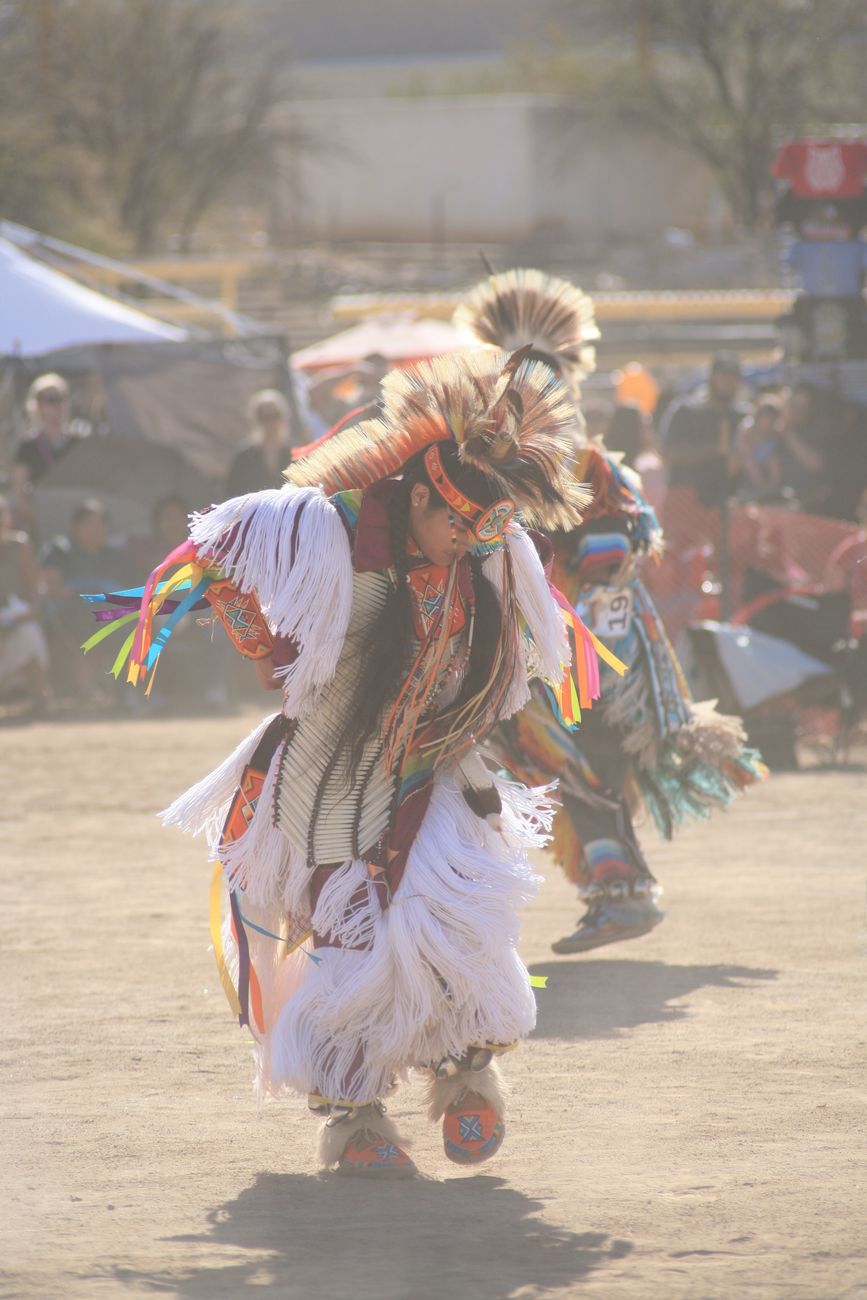
The Peoria (Miami–Illinois: Peewaalia) are a Native American people. They are enrolled in the federally recognized Peoria Tribe of Indians of Oklahoma headquartered in Miami, Oklahoma.
The Peoria people are the remnants of the nations that constituted the Illinois Confederation. The Peoria Tribe was located east of the Mississippi River and north of the Ohio River. In the colonial period, they traded with French colonists in that territory.
After 1763, when the British took over those lands following victory in the Seven Years' War, the Peoria were moved west across the Mississippi. In 1867 their descendants moved to Indian Territory with remnants of related tribes and were assigned land in present-day Ottawa County, Oklahoma. The land which they were assigned belonged to the Quapaw, who were made to cede this land for the Peoria and Miami.
Contents
Language and name
The Peoria speak a dialect of the Miami–Illinois language, a Central Algonquian language in which these two dialects are mutually intelligible.
The name Peoria, also Peouaroua, derives from their autonym, or name for themselves in the Illinois language, peewaareewa (modern pronunciation peewaalia). Originally it meant, "Comes carrying a pack on his back." No native speakers of the Peoria language survive. Revitalization efforts for the Peoria Language were initiated in August 2022 by a 10-week online course offered by the tribe. Along with the Miami language, a smaller number of historic citizens of the Peoria tribe of Oklahoma once spoke related Algonquian languages of Cahokia, Moingwea, and Tamaroa.
Government
The Peoria Tribe of Indians of Oklahoma is headquartered in Miami, Oklahoma. Their tribal jurisdictional area is in Ottawa County, in the northeast corner of the state. Of the 3,713 enrolled tribal citizens, some 777 live within the state of Oklahoma.
As of 2025, the current administration is:
Chief: Rosanna Dobbs
Second Chief: Paul J. Attocknie Jr.
Treasurer: Jason Dollarhide
Secretary: Isabella Clifford
First Councilman: Nick Hargrove
Second Councilman: Kara D. North
Third Councilman: Scott Myers
The Peoria issue their own tribal vehicle tags and operate their own housing authority.
Economic development
The tribe owns one casino and the Peoria Ridge Golf Course. The estimated annual economic impact of the tribe in the area is $60 million. Tribal businesses, the Peoria Gaming Center, Buffalo Run Casino and Hotel, and Joe's Outback are all located in Miami, Oklahoma, their tribal lands.
History
The Peoria are Algonquian-speaking people. Their ancestors traditionally lived in what are now the state jurisdictions of Illinois, Ohio, Michigan, and Missouri. The Peoria are related to, and partially descended from, the Cahokia people, not to be confused with Cahokia Mounds.
The Peoria were one of the many Illinois tribes encountered by early French explorers, Father Jacques Marquette and Louis Jolliet. French Jesuit missionaries converted tribal citizens to Roman Catholicism. Father Jacques Gravier, superior of the Illinois mission, compiled the most extensive bilingual dictionary of Kaskaskia Illinois and corresponding French terms, nearly 600 pages and 20,000 entries.
After 1763 France ceded its Illinois Country and other territories east of the Mississippi River to the British, who had defeated them in the Seven Years' War. Like many of the French colonists in villages in this area, the Peoria migrated southwest into Missouri Territory. For instance, Ste. Genevieve and St. Louis were founded in that era by French colonists from east of the river who did not want to live under British Protestant rule.
In 1818, after the United States (US) had taken over former British territory east of the Mississippi following their gaining independence, they pressed the Peoria to sign the Treaty of Edwardsville, which provided for the cession of Peoria lands in Illinois to the US. The US pressed for Indian Removal from areas desired by European-American settlers, who kept pushing west, and President Andrew Jackson signed the act of that name in 1830. By the 1832 Treaty of Lewisville, the Peoria ceded Missouri lands in exchange for land in Kansas near the Osage River, which was then part of Indian Territory.
The tribe suffered from the introduction of European and African infectious diseases and intertribal wars in new areas of resource competition. In 1849, remnant members of the Kaskaskia, Peoria, Piankeshaw, and Wea tribes formed a confederacy under the Peoria name. The confederation included the last members and descendants of the Cahokia, Moingwena, Michigamea and Tamaroa tribes, who had assimilated with the Peoria many year before. The Pepikokia also joined, having merged with the Wea and Piankashaw in the later part of the 18th century.
Namesakes
The city of Peoria, Illinois, and the surrounding Peoria County are named after the tribe that traditionally lived in that area.
The Peoria War occurred in their historic territory but is named for the town, as the tribe had migrated to Missouri before this conflict occurred.
Paola, Kansas, and Peoria, Oklahoma, are named directly for the tribe.
Many other places named Peoria and some U.S. Navy ships were named after the town in Illinois.
Notable Peoria people
Charles Edwin Dagenett (1873–1941), founder and leader of the Society of American Indians
Ruthe Blalock Jones (b. 1939), Shawnee/Peoria artist and educator
Moscelyne Larkin (1925–2012), Peoria/Shawnee ballerina