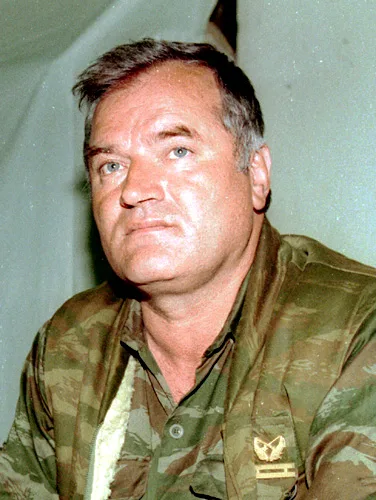
Ratko Mladić (Serbian Cyrillic: Ратко Младић, pronounced [râtko mlǎːdit͡ɕ]; 12 March 1942 – 27 August 2026) was a Bosnian Serb military officer who led the Army of Republika Srpska (VRS) during the Yugoslav Wars. Referred to as the "Butcher of Bosnia", he was found guilty in 2017 of committing war crimes, crimes against humanity, and genocide by the International Criminal Tribunal for the former Yugoslavia (ICTY). He served a life sentence for these crimes in The Hague until his death in 2026.
A long-time member of the League of Communists of Yugoslavia, Mladić began his career in the Yugoslav People's Army (JNA) in 1965. He came to prominence during the Yugoslav Wars, initially as a high-ranking officer of the JNA and subsequently as the chief of staff of the VRS in the Bosnian War of 1992–1995. In July 1996, the Trial Chamber of the ICTY, proceeding in the absence of Mladić under the ICTY's Rule 61, confirmed all counts of the original indictments, finding there were reasonable grounds to believe he had committed the alleged crimes, and issued an international arrest warrant. The Serbian and United States governments offered €5 million for information leading to Mladić's capture and arrest, but he remained at large for nearly sixteen years, initially sheltered by Serbian and Bosnian Serb security forces and later by family.
In 2011, Mladić was arrested in Lazarevo, Serbia, and extradited to The Hague. His capture was considered to be one of the pre-conditions for Serbia being awarded candidate status for European Union membership. His trial formally commenced in 2012 and lasted until 2017, when he was sentenced to life in prison by the ICTY after being found guilty of ten charges: one of genocide, five of crimes against humanity and four of violations of the laws or customs of war. He was cleared of one further count of genocide. As the top military officer with command responsibility, Mladić was deemed by the ICTY to be responsible for both the siege of Sarajevo and the Srebrenica massacre. Mladić was denied numerous requests for compassionate release due to terminal illness while incarcerated.
Contents
Early life and military career
Mladić was born in Božanovići near Kalinovik, at the time part of the Independent State of Croatia, on 12 March 1942.
His father, Neđa (1909–1945), was a member of the Yugoslav Partisans. His mother, Stana (née Lalović; 1919–2003), raised her three children; daughter Milica (born 1940), sons Ratko and Milivoje (1944–2001), by herself after the death of her husband in 1945 during World War II. Bosnia and Herzegovina was at the time part of the Independent State of Croatia, a fascist puppet state led by the Croatian Ustaše between 1941 and 1945, installed by Nazi Germany and Fascist Italy after having invaded and partitioned the Kingdom of Yugoslavia in 1941. Mladić's father Neđa was killed in action (on Mladić's third birthday) while leading a Partisan attack on the home village of Ustaše leader Ante Pavelić in 1945.
Upon finishing elementary school, Mladić worked in Sarajevo as a whitesmith for the PRETIS company. He entered the Military Industry School in Zemun in 1961. He then went on to the KOV Military Academy and the Officers Academy thereafter. Upon graduating on 27 September 1965, Mladić began his career in the Yugoslav People's Army. In the same year he joined the League of Communists of Yugoslavia, remaining a member until the party disintegrated in 1990. Mladić was initially posted to Macedonia and rose through the ranks in the folllowing decades, commanding a platoon, an armoured batallion, and a brigade in succession.
On 31 January 1989, Mladić was promoted to be head of the Education Department of the Third Military District of Skopje. On 14 January 1991, he was promoted again, to Deputy Commander in Priština.
Role in the Yugoslav Wars
In June 1991, Mladić was promoted to Deputy Commander of the Priština Corps in the Socialist Autonomous Province of Kosovo at a time of high tension between Kosovo Serbs and Kosovo's majority Albanian population. That year, Mladić was given command of the 9th Corps, and led this formation against Croatian forces in Knin, the capital of the self-declared Republic of Serbian Krajina.
On 4 October 1991, Mladić was promoted to major general. The JNA forces under his command participated in the Croatian War, notably during Operation Coast-91 in an attempt to cut off Dalmatia from the rest of Croatia, which resulted in a stalemate (the Croats held the entire coastline near Zadar and Šibenik, and Serb Krajina expanded its territory in the hinterland). Among other early operations, Mladić aided Milan Martić's militia in the 1991 siege of Kijevo and the battle of Zadar.
On 24 April 1992, Mladić was promoted to the rank of lieutenant colonel general. On 2 May 1992, one month after Bosnia and Hercegovina's declaration of independence, Mladić and his generals blockaded the city of Sarajevo, shutting off all traffic in and out of the city, as well as water and electricity. This began the four-year Siege of Sarajevo, the longest siege of a city in the history of modern warfare. The city was bombarded with shells and sniper shooting. On 9 May 1992, he assumed the post of Chief of Staff/Deputy Commander of the Second Military District Headquarters of the JNA in Sarajevo. The next day, Mladić assumed the command of the Second Military District Headquarters of the JNA. On 12 May 1992, in response to Bosnia's secession from Yugoslavia, the Bosnian Serb Parliament voted to create the Army of Republika Srpska (VRS). At the same time, Mladić was appointed Commander of the Main Staff of the VRS, a position he held until December 1996. During the 16th session of the Bosnian-Serb Assembly on 12 May 1992, Radovan Karadžić announced his "six strategic objectives", including "Demarcation of the state as separate from the other two national communities", "A corridor between Semberija and Krajina" and "Establishment of a corridor in the Drina river valley, and the eradication of the Drina river as a border between the Serbian states." Mladić then said:
There we cannot cleanse nor can we have a sieve to sift so that only Serbs would stay, or that the Serbs would fall through and the rest leave. ... I do not know how Mr Krajišnik and Mr Karadžić would explain this to the world. People, that would be genocide. We have to call upon any man who has bowed his forehead to the ground to embrace these areas and the territory of the state we plan to make.
Indictment by the ICTY
On 24 July 1995, Mladić was indicted by the International Criminal Tribunal for the Former Yugoslavia (ICTY) for genocide, crimes against humanity, and numerous war crimes (including crimes relating to the alleged sniping campaign against civilians in Sarajevo). On 16 November 1995, the charges were expanded to include charges of war crimes for the attack on the UN-declared safe area of Srebrenica in July 1995.
A fugitive from the ICTY, he was suspected to be hiding either in Serbia or in Republika Srpska. Mladić was reportedly seen attending a football match between the People's Republic of China and Yugoslavia in Belgrade in March 2000. He entered through a VIP entrance and sat in a private box surrounded by eight armed bodyguards. There were claims that he had been seen in a suburb of Moscow, and that he "regularly" visited Thessaloniki and Athens, which raised suspicions that numerous fake reports were sent to cover his trail. Some reports said that he took refuge in his wartime bunker in Han Pijesak, not far from Sarajevo, or in Montenegro.
In early February 2006, portions of a Serbian military intelligence report were leaked to Serbian newspaper Politika which stated that Mladić had been hidden in Army of Republika Srpska and Yugoslav army facilities up until 1 June 2002, when the National Assembly of Serbia passed a law mandating cooperation with the ICTY in The Hague.
Initially, Mladić lived freely in Belgrade. After the arrest of Slobodan Milošević in 2001, Mladić went into hiding, but he was still protected by Serb security services and the army. Serbia's failure to bring Mladić to justice seriously harmed its relationship with the European Union.
In 2004, Paddy Ashdown, then-United Nations high representative in Bosnia and Herzegovina, removed 58 officials from their posts due to suspicions that they helped war crimes suspects including Mladić and Karadžić to evade capture. Some officials were subjected to travel bans and had their bank accounts frozen. The ban was later lifted after the capture of Mladić.
In November 2004, British defense officials conceded that military action was unlikely to be successful in bringing Mladić and other suspects to trial. One winter's day British UN troops carrying sidearms were confronted by the general skiing down the piste at Sarajevo's former Olympic skiing resort but made no move for their guns; skiing behind Mladić were four bodyguards. Despite his Hague warrant, the British soldiers decided to carry on skiing. NATO later sent commandos to arrest various war crimes suspects, but Mladić simply went underground. No amount of NATO action or UN demands, or even a $5 million bounty announced by Washington, could bring him in.
Arrest, trial and conviction
Mladić was arrested on 26 May 2011 in Lazarevo, northern Serbia, where he had been staying at a relative's house. His arrest was carried out by two dozen officers wearing black uniforms and masks. They had been sent to check the house of Mladić's relatives but did not have a specific reason to believe he was there. At the time of his arrest, Mladić had been about to go for an early morning walk. He identified himself to police and surrendered two handguns he had been carrying. He was then taken to Belgrade.
Serbian president Boris Tadić confirmed Mladić's arrest at a press conference and announced that the process of extraditing him to the ICTY was underway. Mladić had been using the pseudonym "Milorad Komadić" while in hiding, but was not wearing a disguise when arrested. His appearance reportedly showed he had "aged considerably", and one of his arms was paralyzed due to a series of strokes.
Following his arrest, Mladić appeared before the Belgrade Higher Court for a hearing on whether he was fit to be extradited to The Hague. Judge Milan Dilparić suspended interrogation due to his poor health. Mladić's lawyer Miloš Šaljić said that his poor health prevented him from properly communicating. He was allegedly unable to confirm his personal data, but attempted to talk to the prosecutors on several occasions, especially to Deputy War Crimes Prosecutor Bruno Vekarić.
However, the court ruled that he was fit to be extradited on 27 May. According to the Serbian Health Ministry, a team of prison doctors described his health as stable following checkups. Mladić was also visited in prison by Health Minister Zoran Stanković, a former friend. Mladić was extradited to The Hague on 31 May 2011, and his trial formally opened in The Hague on 16 May 2012. Mladić also survived a heart attack in his detention unit on 23 December 2013.
Mladić was arrested on the same day the EU's representative, Catherine Ashton, was visiting Belgrade. His arrest improved Serbia's relations with the EU, which had been concerned that Serbia had been sheltering Mladić. In July 2015, media reports alleged Mladić had been "trying to find one Norwegian officer to have him come to The Hague as a witness" in the trial.
Personal life and death
Mladić and his wife Bosiljka married in 1966 and had two children; a son named Darko and a daughter named Ana.
Ana died in 1994, aged 23, in an apparent suicide. There were conflicting reports in Serbian publications regarding her death and the discovery of her body. Some said her body was found in her blood-splattered bedroom, others in a nearby park or in the woods near the Topčider cemetery. It was concluded that she had used her father's handgun, which he had been awarded at military school in his youth. There are also conflicting opinions regarding the potential reasons for her suicide, with one of the more common theories being that she had been under immense pressure from the general public as her father was frequently chided and scrutinized in the Serbian newspapers for his actions against civilians in Bosnia. Another theory points to the death of her boyfriend Dragan, who had been killed in the Bosnian War. Historian Jože Pirjevec supports this theory, writing that she killed herself to punish her father for sending her boyfriend to fight on the front line, and for failing to inform her about his death.
Mladić died at the United Nations Detention Unit in The Hague, on 27 August 2026, after suffering several strokes. He was 84.
Reactions
The head of the Srebrenica Genocide Memorial, Emir Suljagić, stated that Mladić's death "does not bring back the dead. It doesn't clear mass graves. It does not change judgment. It does not turn the criminal into a historical figure." Ćamil Duraković, Vice President of Republika Srpska, former mayor of Srebrenica and Srebrenica survivor, noted that Mladić "outlived" his victims by decades, stating that: "More than anything, we feel the bitterness that he lived to such an advanced age while thousands of others, unfortunately, did not." Bosniaks and survivors of his campaigns criticized the denials of his crimes.
Milorad Dodik, former President of Republika Srpska from 2022 until his removal in 2025, called Mladić's death a "murder" and praised him as a "commander and he stood to defend Serbs." In cities and towns in Republika Srpska, Serbs mourned and glorified Mladić in public gatherings. War veterans and government officials also attended such gatherings. The gathering in Zvornik was condemned by Duraković.
The speaker of the Croatian Parliament, Gordan Jandroković, condemned the expression of condolences by the president of the Montenegrin Parliament, Andrija Mandić, to Mladić's son and said that Montenegro cannot count on Croatia's support for its EU accession as long as leaders of Montenegrin institutions continue to make such statements. The Ministry of Foreign and European Affairs also condemned the expression of condolences calling it "unacceptable". Minister of Defense, Ivan Anušić, said he regretted that Mladić had not been convicted of war crimes in Croatia, and added that he would be remembered as a man convicted of genocide. The Ministry of Croatian Veterans called Mladić "a symbol of the collapse and defeat of an ideology and regime that left behind horrific devastation and thousands of murdered innocent civilians", and expressed regret that he was never held accountable for the Škabrnja massacre.
The Bridge party condemned the decision to bury Mladić in Serbia with the highest state honors, and called for "the strongest possible diplomatic response" from the Government of Croatia.
Pro-government media outlets glorified his role in the wars. War criminal and president of the far-right Serbian Radical Party, Vojislav Šešelj, praised Mladić's actions, stating that he "fought" against "villains". Former Interior Minister, Aleksandar Vulin, stated that Serbia should organise a state funeral and a day of mourning for Mladić. Dragan J. Vučićević, editor of the tabloid, the Informer, called the Hague Tribunal a "terrorist organization" and claimed that the tribunal "killed" Mladić. Serbian leftists and members of the opposition pointed out his crimes. Aleksandar Radovanović, general-secretary of the opposition party, Movement of Free Citizens, stated on X that Mladić's death was "the only correct way to write the lead of today's news". Aleksandar Vučić, President of Serbia, accuse the UNDU of "uncivilized behavior" and for refusing to grant an early release for Mladić.