



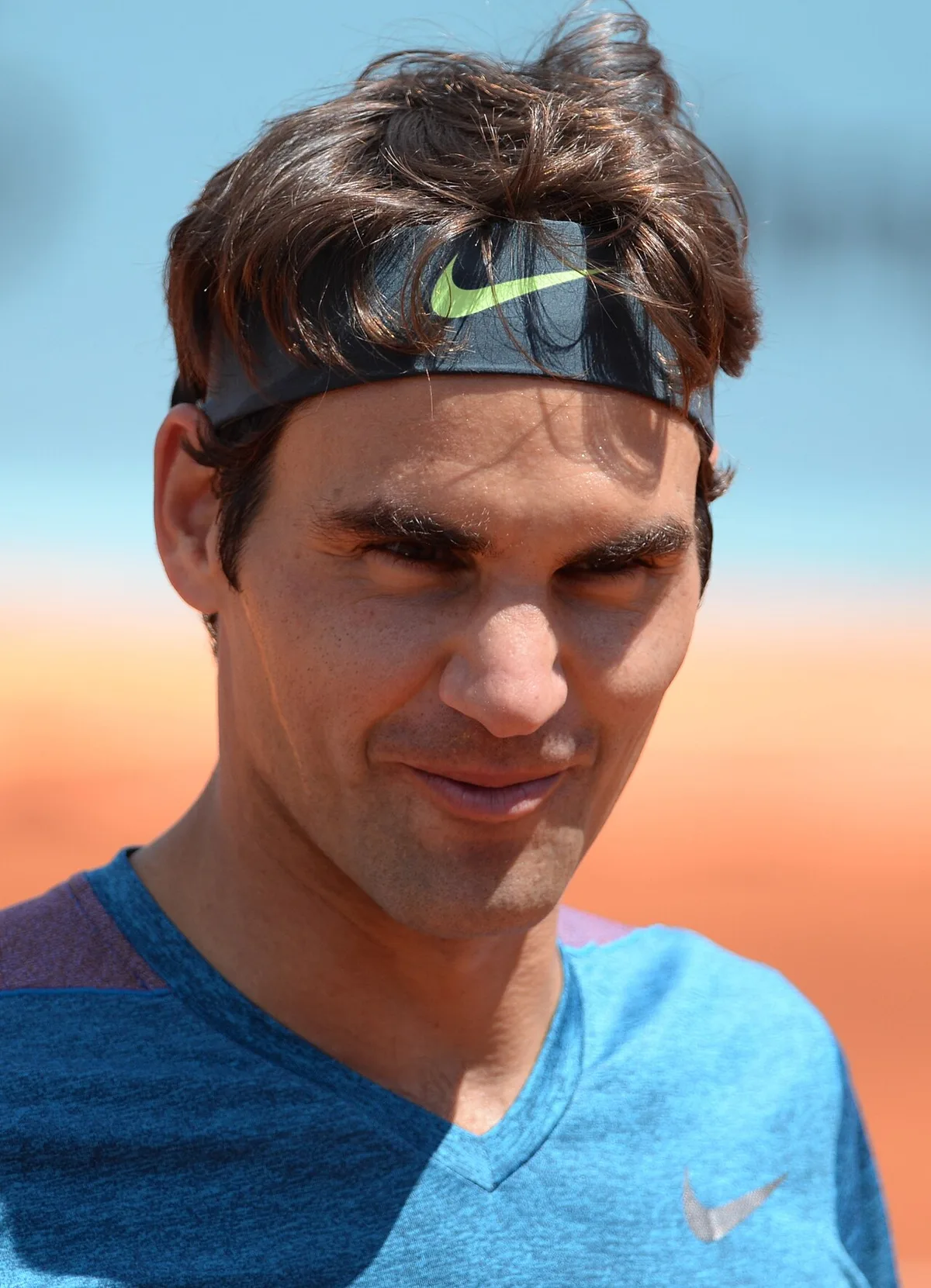
Roger Federer ( FED-ər-ər; Swiss Standard German: [ˈrɔdʒər ˈfeːdərər]; born 8 August 1981) is a Swiss former professional tennis player. He was ranked as the world No. 1 in men's singles by the Association of Tennis Professionals (ATP) for 310 weeks (second-most of all time), including a record 237 consecutive weeks, and finished as the year-end No. 1 five times. Federer won 103 singles titles on the ATP Tour, the second most since the start of the Open Era in 1968, including 20 major men's singles titles (among which a record eight men's singles Wimbledon titles, and an Open Era joint-record five men's singles US Open titles), 28 Masters and six year-end championships.
For nearly two decades, Federer was a leading figure in men's tennis alongside Rafael Nadal and Novak Djokovic, collectively known as the Big Three, and including Andy Murray, the Big Four, creating the Golden Era of men's tennis. A Wimbledon junior champion in 1998 and former ball boy, Federer won his first major singles title at Wimbledon in 2003 at age 21. For the next several years Federer was the dominant player in men's tennis, playing in 20 out of 24 major singles finals between 2004 and 2009. He won three of the four majors and the Tour Finals in 2004, 2006, and 2007, as well as five consecutive titles at both Wimbledon and the US Open. Federer completed the career Grand Slam at the 2009 French Open after three consecutive runner-up finishes to Nadal, his main rival until 2010. At age 27, he surpassed Pete Sampras's record of 14 major men's singles titles at Wimbledon in 2009.
Federer and Stan Wawrinka led the Switzerland Davis Cup team to their first title in 2014, following their Olympic doubles gold victory at the 2008 Beijing Olympics. He also won a silver medal in singles at the 2012 London Olympics, finishing runner-up to Andy Murray. After a half-year hiatus in 2016 to recover from knee surgery, Federer returned to tennis, winning three more majors over the next two years, including the 2017 Australian Open over Nadal and a record eighth singles title at the 2017 Wimbledon Championships. At the 2018 Australian Open, Federer became the first man to win 20 major singles titles and shortly after the oldest ATP world No. 1 at the time, at age 36. In September 2022, he retired from professional tennis following an appearance at the Laver Cup.
A versatile all-court player, Federer's grace on the court made him popular among tennis fans. Originally lacking self-control as a junior, he transformed his on-court demeanor to become well-liked for his graciousness, winning a record 13 Stefan Edberg Sportsmanship Awards and a record 19 consecutive ATP Fans' Favourite awards from 2003 to 2021, Federer was awarded the Laureus World Sports Sportsman of the Year a joint record five times and was twicenamed one of Time's 100 Most Influential People in the World in 2007 and 2018.
Outside of competition, Federer played an instrumental role in the creation of the Laver Cup team competition. He is also an active philanthropist, having established the Roger Federer Foundation, which targets impoverished children in southern Africa, and raising funds in part through the Match for Africa exhibition series. By the end of his career, Federer was listed by Forbes as one of the world's ten highest-paid athletes 12 times and ranked first among all athletes with $100 million in endorsement income in 2020. Boosted by his minority stake in Swiss shoe and apparel brand On, he became the seventh billionaire athlete in history in 2025. As of August 2026, Forbes estimates Federer's net worth at $1.1 billion.
Contents
Early life
Federer was born on 8 August 1981 in Basel, Switzerland. A member of the Federer family, his Swiss father, Robert Federer, is from Berneck in the canton of St. Gallen and his Afrikaner mother, Lynette Federer (née Durand), is from Kempton Park, Gauteng, in South Africa. He has one sibling, his older sister, Diana, the mother of twins. Since Federer's mother is South African, he holds both Swiss and South African citizenship. He is related to Swiss prelate Urban Federer as well as Swiss politician and philanthropist Barbara Schmid-Federer.
As youngsters, Federer and his elder sister Diana used to accompany their parents, both of whom worked for Ciba-Geigy Pharmaceuticals, to the company's private tennis courts at the weekends, where he first played tennis at the age of three.
Soon after enrolling in school at the age of six, Federer became the best in his age group. Feeling that Federer had outgrown the Ciba club and needed to be amongst better juniors, his mother Lynette enrolled him at age eight in the elite junior programme of the Old Boys Tennis Club in Basel, where he received his initial tennis instruction from veteran Czech coach Adolf Kacovsky. Federer began using a one-handed backhand from an early age not only because Kacovsky was a fan of it, but also because all of his childhood idols — Stefan Edberg, Boris Becker, and later Pete Sampras — used the stroke too. From ages 8 to 10, Federer received group and individual training from Kacovsky. At age 10, Federer began being taught at the club by Australian former tennis player Peter Carter. Federer has credited Carter for his "entire technique and coolness".
Federer grew up playing many sports, such as badminton, basketball, football, and tennis, but he was most taken by the latter two. He also tried skiing and swimming and spent hours playing soft tennis on the street. He credits his hand–eye coordination to the wide range of sports he played as a child. In 1993, Federer won the under-12 Swiss national junior championships in Lucerne. Becoming the best junior in the country helped him decide to become a professional tennis player, so he stopped playing football at age twelve to concentrate solely on tennis, where he felt he had more control over his victories or defeats, as opposed to team sports where he relied more on the performances of his teammates. Federer was also a ball boy at his hometown Basel event, the Swiss Indoors in 1992 and 1993, and even received a medal after the 1993 final, together with the other ballboys, from tournament champion Michael Stich.
Tennis career
1990s and 2000s
In 1995, at age 13, Federer won the U14 Swiss national junior championship and was subsequently invited to train at the prestigious National Tennis Centre in the French-speaking Écublens, where he enrolled shortly after his 14th birthday. There, he had the opportunity to combine three hours of tennis training per day along with education, but Federer had little interest in studying and struggled to balance his education with his tennis commitments. Speaking little French and struggling with living away from home, Federer found his first months at Écublens depressing. He was the youngest player in the group and also felt singled out as the "Swiss German" by many of the students and staff at the academy, experienced mild bullying, and was often on the verge of packing his bags and returning home. Federer credits this difficult period of his life as the reason for his independent spirit.
Federer played his first ITF junior match in July 1996, at the age of 14, at a grade-2 tournament in Switzerland. He then played in the 1996 NEC World Youth Cup Final in Zürich against tennis players like Lleyton Hewitt. In January 1997, at age 15, Federer won both the indoor and outdoor U18 Swiss national championship, defeating the Yves Allegro who was three years older than him, in both finals. In May, Federer won his first-ever ITF junior title on the clay courts of a second-category tournament in Prato, doing so without the loss of a set. In September, Federer earned the first 12 ATP points of his career in a four-week Swiss satellite tournament in Bossonnens, thus making his debut in the ATP rankings at No. 803, just five spots ahead of future rival Lleyton Hewitt.
His main accomplishments as a junior player came at Wimbledon in 1998, when he won both the Boys' singles final over Irakli Labadze, and the Boys' doubles final, teamed with Olivier Rochus, defeating the team of Michaël Llodra and Andy Ram. Federer then reached the US Open Junior final, which he lost to David Nalbandian. This was the only occasion Federer lost a final on the junior circuit. He then brought his junior career to an end at the prestigious Junior Orange Bowl in Miami, where he defeated Nalbandian in the semifinals and Guillermo Coria in the final. By the end of 1998 he had attained the No. 1 junior world ranking and was named ITF Junior World Champion. He ended his junior career at the end of 1998 with a high ranking of No. 1 in singles and No. 7 in doubles (both achieved on 31 December 1998) and a win–loss record of 78–20 in singles and 36–21 in doubles.
Junior Grand Slam results – Singles:
2010s
Federer started the year with a win at the Australian Open, where he defeated Andy Murray in the final, extending the Grand Slam singles record to sixteen titles and matching Andre Agassi's record of four Australian Open titles. Since 2005 Wimbledon, Federer had made 18 out of 19 finals in Grand Slam tournaments, a period of sustained excellence unparalleled in the Open Era. This tournament, however, marked the end of his dominance at the majors.
At the French Open, Federer won his 700th tour match and 150th tour match on clay. However, he failed to reach a Grand Slam semifinal for the first time since the 2004 French Open, losing to Söderling in the quarterfinals and relinquishing his No. 1 ranking, having been just one week away from equaling Pete Sampras's record of 286 weeks as world No. 1. In a huge upset at Wimbledon, Federer lost in the quarterfinals again to Tomáš Berdych and fell to No. 3 in the rankings for the first time in six years and eight months.
Towards the middle of July, Federer hired Pete Sampras's old coach, Paul Annacone, on a trial basis to put his tennis game and career back on track. At the US Open, Federer reached the semifinals, where he lost a five-set match to Novak Djokovic after holding two match points. Federer reached four Masters finals prevailing against Mardy Fish at Cincinnati.
Federer finished the year in strong form, winning indoor titles at the Stockholm Open, Swiss Indoors and the ATP Finals in London, beating Djokovic and Nadal in the finals of the latter two. It remains the only tournament in his career in which Federer defeated all fellow members of the Big Four. In 2010, Federer finished in the top two for the eighth consecutive season.
The year 2011 was a lean year for Federer, although great by most players' standards. He was defeated in straight sets in the semifinals of the Australian Open by eventual champion Novak Djokovic. At the French Open semifinals, Federer ended Djokovic's undefeated streak of 43 consecutive wins with a four-set victory, but he then lost in the final to Rafael Nadal. At Wimbledon, Federer lost in the quarterfinals to Jo-Wilfried Tsonga. It marked the first time in his career that he had lost a Grand Slam match after winning the first two sets.
At the US Open, Federer lost in the semifinals to Novak Djokovic in five sets after winning the first two sets for the second time in 2011. In a repeat of the previous year's semifinal event, Federer again squandered two match points, this time on his own serve. The loss meant that it was the first time since 2002 that Federer had not won any of the four Grand Slam titles.
2020s
Federer began his 2020 season at the Australian Open, where he reached the semifinals after saving seven match points in his five-set quarterfinal win over Tennys Sandgren. Federer then lost his semifinal match to Djokovic in straight sets, having sustained a groin injury earlier in the tournament. In February, Federer underwent arthroscopic surgery for a right knee injury and subsequently withdrew from the Dubai Championships, Indian Wells, Miami Open and the French Open to give time for his knee to recover for the grass season. On 10 June, due to a setback from his initial rehabilitation from the knee injury, Federer announced that he had to have an additional arthroscopic procedure on his right knee, vowing to return in 2021. This was only the second year in Federer's career since he won his first title that he finished without a title.
In January 2021, Federer withdrew from the Australian Open due to still recovering from knee surgery and strict COVID-19 quarantine measures in Australia. On 8 March, Novak Djokovic surpassed him for the most career weeks spent as the ATP number 1 ranked player. On 10 March, he made his return to the ATP Tour at the Qatar Open, where he won his first ATP match in 14 months against Dan Evans before losing to Nikoloz Basilashvili in the quarterfinals. At the French Open, Federer withdrew from the tournament before his fourth-round match citing knee problems, giving a walkover to Matteo Berrettini. In Halle, he lost in the second round to Félix Auger-Aliassime, with their 19-year age difference being the biggest in Federer's 1,521 career matches.
At Wimbledon, the nearly 40-year-old Federer became the oldest Wimbledon quarterfinalist in the Open Era, breaking the record held by Ken Rosewall, but he was then upset by 14th seed Hubert Hurkacz in straight sets. This was the first time in 19 years at Wimbledon he had lost in straight sets, and only the second time he had lost a set 6–0 in the 21st century (the previous occasion was against Nadal in the 2008 French Open final). On 15 August, Federer announced that he underwent another knee surgery after a further injury during the grass-court season. He withdrew from the US Open, but he hoped to make a return to the tour in 2022.
Federer did not play in a singles tournament after Wimbledon 2021, and dropped out of the top 50 on 13 June 2022. On 11 July 2022, he became unranked for the first time since his professional debut. However, Federer announced that he was set to return to the tour at the 2022 Laver Cup in September. On 15 September 2022, he announced his impending retirement from professional tennis on the ATP Tour, noting that the Laver Cup would be his final ATP event. He stated that he "will play more tennis in the future, of course, but just not in Grand Slams or on the tour." His final match resulted in a three-set loss in doubles partnering long-time rival and friend Rafael Nadal against Jack Sock and Frances Tiafoe. The match was his 1750th on the tour.
Rivalries
Rafael Nadal
Federer and Rafael Nadal played each other 40 times, with Nadal winning 24 of their matches and Federer winning 16. Federer performed better than Nadal on grass (winning three matches to Nadal's one) and on hard courts (winning 11 matches to Nadal's nine), while Nadal dominated the matchup on clay (winning 14 matches to Federer's two). Because tournament seedings are based on rankings, 24 of their matches were in tournament finals, included an all-time record nine major finals (tied with Djokovic–Nadal matches). Federer and Nadal played each other from 2004 to 2019, and their rivalry is a significant part of both men's careers. The last encounter was at the 2019 Wimbledon Championships, where Federer won to reach the final.
Federer and Nadal held the top two rankings on the ATP Tour from July 2005 until 17 August 2009, when Nadal fell to No. 3 (Andy Murray became the new No. 2), and again from 11 September 2017 until 15 October 2018 (Novak Djokovic became the new No. 2). They are the only pair of men to have ever finished six consecutive calendar years at the top. Federer was ranked No. 1 for a record 237 consecutive weeks beginning in February 2004. Nadal, who is five years younger, ascended to No. 2 in July 2005 and held it for 160 consecutive weeks, before surpassing Federer in August 2008.
From 2006 to 2008, Federer and Nadal played each other in every French Open final and every Wimbledon final. They then met in the 2009 Australian Open final, the 2011 French Open final and the 2017 Australian Open final. Nadal won six of the nine, losing the first two Wimbledon finals and the second Australian Open final. Four of these finals were five-set matches (2007 and 2008 Wimbledon, 2009 and 2017 Australian Open), with the 2008 Wimbledon final being lauded as the greatest match ever by many long-time tennis analysts.
Novak Djokovic
Federer and Novak Djokovic played one another 50 times, with Djokovic winning 27 matches and Federer winning 23. They are tied 4–4 on clay, while Federer trails 18–20 on hard-courts and 1–3 on grass. Their rivalry is the second most prolific rivalry in men's major history; Federer and Djokovic played each other 17 times at Grand Slam tournaments, while Djokovic and Nadal have played each other 18 times at Grand Slam tournaments.
Federer and Djokovic first played each other in a Grand Slam final at the 2007 US Open where No. 1 Federer emerged victorious in straight sets. Federer ended Djokovic's 28 straight wins in China at the 2014 Shanghai Open, and he also ended Djokovic's perfect 41–0 start to the 2011 season in the semifinals of the French Open, but Djokovic avenged this loss at the 2011 US Open in five sets after saving two match points against Federer for the second straight year. In the semifinals of the 2012 Wimbledon, Federer beat defending champion and No. 1 Djokovic in four sets. The two played three Wimbledon finals in 2014, 2015, and 2019, with Djokovic emerging victorious in all of them and even saving two match points in the latter final, which lasted almost 5 hours. The pair also met in the final of the 2015 US Open and once more Djokovic prevailed in four sets. Some experts have called the rivalry between Federer and Djokovic as one of the best rivalries in the Open Era.
Andy Murray
Federer and Andy Murray played each other 25 times, with Federer winning 14 matches and Murray winning 11. Federer leads 12–10 on hard courts and 2–1 on grass; the two never met on clay. After Federer won the first professional match they played, Murray dominated the first half of the rivalry, leading 8–5 in 2010, while the second half of the rivalry was dominated by Federer, who leads 9–3 from 2011 onwards. The two have met six times at the majors, with Federer leading 5–1. Their first three major matches were finals, with Federer winning all three of these matches; at the 2008 US Open and the 2010 Australian Open, both of which he won in straight sets, and at the 2012 Wimbledon Championships in which Murray took the opening set, but went on to lose in four sets.
Federer and Murray met in the final of the 2012 Summer Olympics, in which Murray defeated Federer in straight sets, denying Federer a career Golden Slam. Murray also leads 6–3 in ATP 1000 tournaments, 2–0 in finals. They have also met five times at the ATP Finals, with Murray winning in Shanghai in 2008, and Federer in London in 2009, 2010, 2012, and 2014.
Andy Roddick
Federer and Andy Roddick played each other 24 times, and Federer won their head-to-head matchup 21 matches to three. Roddick lost his No. 1 ranking to Federer after Federer won his first Australian Open in 2004. Their rivalry included four Grand Slam event finals (three at Wimbledon and one at the US Open), all of which were won by Federer. Roddick himself said that the Federer-Roddick rivalry was not much of a rivalry because it was so one-sided.
Other rivalries
Federer and Lleyton Hewitt played 27 times, with Federer winning 18 of their matches and Hewitt winning nine. Other head-to-head matchups include Federer-David Nalbandian (Federer won 11 matches to Nalbandian's eight) Federer-Marat Safin (Federer won 10 matches to Safin's two), Federer-Stan Wawrinka (Federer won 23 matches to Wawrinka's three), Federer-Juan Martín del Potro (Federer won 18 matches to del Potro's seven), Federer-Tomáš Berdych (Federer won 20 matches to Berdych's six), and Federer-Jo-Wilfried Tsonga (Federer won 12 matches to Tsonga's six).
Legacy
Federer has won the third most Grand Slam tournament titles (20), trailing Rafael Nadal (22) and Novak Djokovic (24). He has been in 31 major finals (the second most after Djokovic), including a record ten consecutive Grand Slam tournament finals. He has earned a men's doubles gold medal, and a men's singles silver medal at the Olympics in 2008 and 2012, respectively. He won a record eight Wimbledon titles, including a joint-record five in a row, and he won an Open Era joint-record five US Open titles, including a record five in a row. He has held the world No. 1 spot in the ATP rankings for the second-longest amount of time for a male player (310 weeks). Federer was ranked among the top eight players in the world continuously for 14 years and two weeks — from 14 October 2002 until 31 October 2016, when injuries forced him to skip much of the 2016 season.
Federer has won the ATP Player of the Year five times (2004–07, 2009), and has been named the ITF World Champion five times (2004–07, 2009). He has been voted by his peers to receive the tour Sportsmanship Award a record 13 times (2004–09, 2011–17) and voted by tennis fans to receive the ATP Fans' Favorite award for 19 consecutive years (2003–21). — both indicative of respect and popularity. He also won the Arthur Ashe Humanitarian of the Year Award twice (2006, 2013), the Laureus World Sportsman of the Year award five times (2005–08, 2018), the BBC Overseas Sports Personality of the Year a record four times, and the Laureus World Comeback of the Year award once, following his 2017 comeback season. He has been named the Swiss Sports Personality of the Year a record seven times.
Federer has huge popularity in the world of sport, and is considered by many to be the greatest tennis player of all time. After 2009, many players and analysts considered him to be the greatest player ever. He was also called the greatest athlete of his generation by some sports reporters after he won his 19th and 20th major titles. In 2005, Rod Laver described Federer as an "unbelievable talent", "capable of anything", and that "he could be the greatest tennis player of all time". When he finally won the French Open in 2009, former world No. 1s Björn Borg and Pete Sampras both hailed him as "the greatest player that played the game", though Sampras in 2021 and Borg in 2025 both said the greatest was now Djokovic. Federer himself has downplayed these claims, stating in 2012 that it is impossible to compare tennis players from different eras and that past champions are needed to pave the way for future champions.
Player profile
Playing style
Federer's versatility has been described by Jimmy Connors as follows: "In an era of specialists, you're either a clay court specialist, a grass court specialist, or a hard court specialist... or you're Roger Federer."
An elite athlete, Federer was an all-court, all-around player known for his speed, fluid style of play, and exceptional shot-making. Federer mainly played from the baseline but was also comfortable at the net, being one of the best volleyers in the game. He had a powerful, accurate smash, very effectively performed rare elements of professional tennis, such as the backhand smash and skyhook, half-volley, jump smash (slam dunk) and an aggressive serve return known affectionately as SABR (Sneak Attack By Roger, a half-volley attack on an opponent's second serve). The writer David Foster Wallace compared the brute force of Federer's forehand to a "great liquid whip", while John McEnroe referred to Federer's forehand as "the greatest shot in our sport".
Federer played with a single-handed backhand, which gave him great variety. He employed the slice, occasionally using it to lure his opponent to the net and deliver a passing shot. Federer could also fire topspin winners and possessed a "flick" backhand with which he could generate pace with his wrist; the "flick" backhand was usually used to pass opponents who came to the net. He averaged 90% of service games won throughout his career, often coming up victorious in clutch or pressure service games. His serve was difficult to read, as he always used a similar ball toss regardless of what type of serve he was going to hit and where he aimed to hit it. He was often able to produce big serves on key points in a match. His first serve averaged about 200 km/h (125 mph), but he was capable of serving at 220 km/h (137 mph). Federer was also accomplished at serve and volleying, and employed this tactic frequently in his early career.
Later in his career, Federer added the drop shot to his arsenal and could perform a well-disguised drop shot off both wings. He sometimes used a between-the-legs shot, which is colloquially referred to as a "tweener" or "hotdog". His most notable use of the tweener was in the semifinals of the 2009 US Open against Novak Djokovic, bringing him triple match point. Federer is one of the top players who successfully employed the "squash shot". After Stefan Edberg joined his coaching team at the start of the 2014 season, Federer played a more offensive game, attacking the net more often and improving his volleys. In the lead-up to the 2015 US Open, Federer successfully added a new unique shot to his arsenal called SABR (Sneak Attack by Roger), in which he charged forward to receive a second serve and hit a return on the service line. With the switch to a bigger 97-inch racket from a 90-inch racquet, Federer gained easier serving and better defense on both wings with fewer shanks; however, he experienced diminished control and power on his forehand, slice backhand and dropshot.
Demeanor and attitude
Federer was noted for his cool demeanor and emotional control on the court. Most of his professional game has been characterized by a lack of outbursts or emotional frustration at errors, giving him an advantage over less controlled opponents. In 2016, Federer declared: I don't get the anxiety during a match so much anymore. You know, to throw racquets, to toss balls out of the court, scream and stuff. I almost laugh [on the inside] about it a little bit today when an opponent does it. But that's something for me that's not a problem anymore.
Originally lacking self-control as a junior, he transformed his on-court demeanor to become well-liked for his graciousness. Despite clearly possessing talent from a young age, Federer tended to allow his emotions to get the best of him, causing his game to falter. On some occasions, this emotional state escalated into counter-productive actions such as racket abuse. Rarely a day went by when he would not throw his racquet against the fence in his search to play the "perfect game". Federer later confessed to having been a hot head at a young age as he often erupted if he hit a dumb shot. Despite this fragile temperament, Federer still impressed his then-coach Adolf Kacovsky, who said that during defeats he never gave up and was willing to learn from his mistakes afterwards. By the time he became professional, Federer had learned to temper his emotions, but still, he struggled to adapt to the work ethic and compromising mindset needed to be a competitive professional player.
In 2007, Rod Laver described him as follows: "One thing is for sure: he's the best player of his time and one of the most admirable champions on the planet. That's certainly something worth crowing over. The beauty is, Roger Federer won't".
Coaches
From ages 8 to 10, Federer received group and individual training from veteran Czech coach Adolf Kacovsky. Reflecting on Federer, Kacovsky said "The private lessons, which were partly funded by the club. Roger was a quick learner. When you wanted to teach him something new, he was able to pick it up after three or four tries, while others in the group needed weeks". At age 10, Federer began working with Peter Carter. Between the ages of 10 and 14, Federer spent more time with Carter than with his own family, working daily on all aspects of his game. Building on the work done earlier by Kacovsky, Carter helped perfect Federer's technique, along with teaching him the strategy and psychology required to play the game to a high level. Federer has credited Carter for his "entire technique and coolness".
In 1999, when Federer decided to play full-time on the ATP tour, he chose Peter Lundgren rather than Carter as his traveling coach, and they worked together until the end of 2003 before finally splitting. On 1 August 2002, Carter died in a car crash in South Africa. According to his autobiography, when Federer heard the news of Carter’s death, "he was never so upset in his life", while an Australian newspaper reported that when Federer heard the news, he "left his hotel and ran through the streets, bawling and hysterical". About Carter's funeral, Federer stated: "Any defeat in tennis is nothing compared to such a moment". His death had a deep impact on Federer, who would even call it "a wake-up call", before winning his first major in the following year, Wimbledon, which he dedicated to Carter.
Federer's playing style has been greatly influenced by his coaches over the years. For instance, he has credited his infamous SABR technique to his coach Severin Lüthi, who encouraged him to develop it and use it in big matches.
His other coaches were Tony Roche (2005–2007), Severin Lüthi (2007–2022), José Higueras (2008), Paul Annacone (2010–2013), Stefan Edberg (2014–2015), and Ivan Ljubičić (2016–2022).
Equipment
Federer began the 2014 season by changing rackets for the first time in his career. He switched from his longtime frame of 90 square inches to one measured at 97 square inches. He had long been at a comparative disadvantage in equipment to almost the entire tour, including his top rivals Nadal and Djokovic, who used more powerful frames of between 95 and 100 square inches. After that, Federer played with his signature Wilson Pro Staff RF97 Autograph racquet. It had a 97 square inch head, 16x19 string pattern, 366 gram strung weight, 340 gram swing weight, 68 RA stiffness, and 9 point head light balance. Federer strings his racquets using Wilson Natural Gut 16 gauge for his main strings and Luxilon ALU Power Rough 17 gauge (polyester) for his cross strings. In an interview in November 2017, Federer stated his favorite stringing tension is 26.5 kilograms (58.4 lb) mains & 25 kilograms (55.1 lb) crosses.
As a junior player, Federer played with a Wilson Pro Staff 6.0 85 square inch head racquet. He switched to a bigger custom-built Wilson 90 square inch head racquet in 2003. His grip size was 4+3⁄8 inches (L3). When asked about string tensions, Federer stated "this depends on how warm the days are and with what kind of balls I play and against who I play. So you can see – it depends on several factors and not just the surface; the feeling I have is most important."
Apparel
Federer first signed with Nike footwear and apparel in 1994. For the 2006 championships at Wimbledon, Nike designed a jacket emblazoned with a crest of three tennis racquets, symbolising the three Wimbledon Championships he had previously won, and which was updated the next year with four racquets after he won the Championship in 2006. At Wimbledon 2008, and again in 2009, Nike continued this trend by making him a personalised cardigan that also had his own logo, an R and an F joined, which was originally designed by his wife, Mirka.
Federer's contract with Nike expired in March 2018, and he later signed a deal with Uniqlo. It was reported that Uniqlo signed Federer for roughly $300 million for 10 years ($30 million per year), as opposed to Nike's previous deal with Federer, which was reportedly for roughly $10 million per year. Since 2021, Federer has worn tennis shoes produced by On, a Swiss-based athletic shoe and sports apparel manufacturer in which he became a shareholder in November 2019. A limited edition lifestyle shoe named "The Roger" was released by On in July 2020.
Off the court
In popular culture
Federer was nicknamed the "Federer Express" (shortened to "Fed Express" or "FedEx"), and the "Swiss Maestro". He was referred to as "King Roger" on occasion. Federer was also called "The Swiss Perfection", "The Master", "His Majesty", among other names. Throughout the 2007 US Open, the American press nicknamed him Darth Federer for his all-black attire (which included tuxedo-striped shorts) and the tournament played "The Imperial March" from Star Wars when he was announced onto the court for each of his matches.
Due to his performance on the court and his off-court personality, Time magazine named Federer one of the 100 most influential persons in the world in 2007 and 2010. In May 2009, Federer placed 22 positions ahead of US President Barack Obama on Forbes magazine's most powerful celebrities list. On winning the 2009 French Open and completing the career Grand Slam, Federer became the first male tennis player to grace the cover of Sports Illustrated since Andre Agassi in 1999. He was also the first non-American player to appear on the cover of the magazine since Stefan Edberg in 1992. He again made the cover of Sports Illustrated following his record-breaking 8th Wimbledon title and second Grand Slam of 2017, becoming the first male tennis player to be featured on the cover since his previous appearance in 2009.
In 2011, in the Reputation Institute's study of the World's most respected, admired, and trusted personalities, Federer ranked No. 2 just behind Nelson Mandela. In July 2016, Federer ranked No. 1 on the list of the most recognizable people from Switzerland, surpassing personalities such as Albert Einstein and William Tell. In a poll of more than 9,000 people from 15 countries, Federer topped the list with 916 votes, 600 more votes than the country's national hero, William Tell, who came second with 316 and Einstein who ranked third with 204.
Throughout his career, Federer was featured in several memorable TV ads, such as one for Switzerland's largest telecommunications company Sunrise in 2015, for the Italian pasta-maker Barilla in 2019, and for German car giant Mercedes-Benz in 2016 which featured Federer playing the role of various tennis legends, namely Rod Laver, John McEnroe, Andre Agassi and Borg, thus appearing with fake chest hair, golden hair extensions, smashing his racquet and having meltdowns on the court.
In January 2017, Federer was named the Most Marketable Sports Person for 2016 by researchers at the London School of Marketing. He earned £49.2 million in endorsements and sponsorships.
Homages and tributes
Federer has been honored for a multitude of reasons several times throughout his career: In 2012, the city of Halle, in Germany, unveiled "Roger-Federer-Allee" in recognition of Federer's success on the grass at the Gerry Weber Open. In 2016, the city of Biel renamed the street in which the national centre for Swiss Tennis where Federer trained as a junior is located, in his honour as "1 Allée Roger Federer". In October 2021, Basel, the city of his birth, honored Federer with the launch of a new tram named "The Federer Express", which is adorned with pictures representing iconic moments from his career.
On 24 November 2017, Federer received an honorary doctorate from his home university, the University of Basel, in recognition of his role in increasing the international reputation of Basel and Switzerland, and for his work for children in Africa through his charitable foundation.
In December 2019, Federer became the first living person to be celebrated on Swiss coins. His face will be on the 20-franc coin and in May 2020, Swissmint issued a Federer 50-franc gold coin featuring a different design. This was actually the second time that his image was put on an item of frequent circulation in Switzerland, since in 2007, the Swiss Post in Basel released a special edition stamp for Federer, and three years later, in 2010, Federer was awarded a special edition stamp by Austria's Postal Service.
On 20 July 2020, Federer was featured by Swiss National Museum in their 100-part chronicle of Swiss history and culture.
On June 9, 2024, Federer received an honorary Doctor of Humane Letters degree from Dartmouth, following his commencement address to the class of 2024. He said: "I just came here to give a speech, but I get to go home as Dr. Roger."
Philanthropy
In 2003, he established the Roger Federer Foundation to help disadvantaged children and to promote their access to education and sport.
Since May 2004, citing his close ties with South Africa (his mother is South African) he has been supporting the South Africa-Swiss charity IMBEWU, which helps children better connect to sports as well as social and health awareness. In 2005, he visited South Africa to meet children who had benefited from his support.
He was appointed a Goodwill Ambassador by UNICEF in April 2006 and has appeared in UNICEF public messages to raise public awareness of AIDS.
At the 2005 Pacific Life Open in Indian Wells, Federer arranged an exhibition with several top players from the ATP and WTA tour called Rally for Relief, whose proceeds went to the victims of the tsunami caused by the 2004 Indian Ocean earthquake. In December 2006, he visited Tamil Nadu, one of the areas in India most affected by the tsunami. Also in 2005, he auctioned his racquet from his US Open championship to aid victims of Hurricane Katrina.
In response to the 2010 Haiti earthquake, Federer arranged a collaboration with fellow top tennis players for a special charity event during the 2010 Australian Open called 'Hit for Haiti', whose proceeds went to Haiti earthquake victims. He participated in a follow-up charity exhibition during the 2010 Indian Wells Masters, which raised $1 million.
The Nadal vs. Federer "Match for Africa" in 2010 in Zürich and Madrid raised more than $4 million for the Roger Federer Foundation and Fundación Rafa Nadal. In January 2011, Federer took part in Rally for Relief, an exhibition to raise money for the victims of the Queensland floods. In 2014, the "Match for Africa 2" between Federer and Stan Wawrinka, again in Zürich, raised £850,000 for education projects in Southern Africa.
In the 2018 "Match for Africa" in San Jose, California, Federer paired up with Microsoft billionaire Bill Gates in a doubles clash against Jack Sock and NBC Today show host Savannah Guthrie. He and Gates won, and notably, Federer even won one point on his knees after returning two shots while on the ground.
Sponsorships and endorsements
He is endorsed by Japanese clothing company Uniqlo and Swiss companies Credit Suisse, On, Rolex, Lindt, Sunrise, and Jura Elektroapparate. In 2008, Federer partnered with German car giant Mercedes-Benz, and in 2010, this endorsement was extended into a global partnership deal. Federer, who has been the brand ambassador for Lindt since 2009, gelled perfectly with the brand's fundamental values of Swissness, premiumness, and quality. Federer joined hands with Sunrise, Switzerland's largest telecommunications company, in 2014, and since then, they have regularly collaborated to create a slew of interesting campaigns harping on Swiss values of excellence and precision.
His other sponsors include Gillette, Wilson, Barilla, and Moët & Chandon. Previously, he was an ambassador for Nike, NetJets, Emmi AG, and Maurice Lacroix.
Involvement in football
He grew up supporting FC Basel and the Swiss national team. In May 2022, when the Swiss national team was preparing to begin their UEFA Nations League campaign against the Czech Republic, Federer made a surprise visit to meet every member of the team, including head coach Murat Yakin at Bad Ragaz, and to unveil Puma’s new jersey for the team ahead of the 2022 FIFA World Cup.
Personal life
Family and children
Federer is married to former Women's Tennis Association player Miroslava Federer (née Vavrinec), whom he met while they were both competing for Switzerland at the 2000 Sydney Olympics. Usually called Mirka, she retired from the tour in 2002 because of a foot injury. They were married at Wenkenhof Villa in Riehen near Basel on 11 April 2009, surrounded by a small group of close friends and family. In 2009, she gave birth to identical twin girls. They had another pair of twins in 2014, this time fraternal twin boys. Their children were baptized in the Catholic faith by Federer's distant cousin Monsignor Urban Federer, who is the Abbot of Einsiedeln Abbey.
When they met, Mirka's dedication to training far out-stripped his own, since she was training for up to six hours a day while Federer was unable to do the same because he would "lose interest within an hour". At the time, Federer used to watch her training, but was "more just admiring it rather than thinking I could do the same one day, to be quite honest". It was quite some time until he developed a similar mentality to that of Mirka's.
Residences
Federer owns an apartment in Dubai. A major factor in his decision to purchase this property was the hot weather in Dubai, since training at high temperatures would help him to get accustomed to playing in extreme heat. He also owns two properties in his native Switzerland, one of which is a modern ski chalet in the Swiss Alps, and the other a penthouse apartment in Zürich.
Federer is sponsored by Mercedes-Benz and has said that his favourite vehicle is the Mercedes-Benz SLS AMG Roadster.
Military service
Like all male Swiss citizens, Federer was subject to compulsory military service in the Swiss Armed Forces, which was mandatory for all able-bodied male citizens when they reached the age of majority, and so Federer was drafted when he turned 18 in 1999. However, he was soon discharged due to a chronic back problem.
In 2003, Federer was ruled "unsuitable" and was subsequently exempted from his military service obligation. Instead, he served in the civil protection force and was required to pay 3% of his taxable income.
Religion and multilingualism
Federer was raised as a Catholic and met Pope Benedict XVI while playing the 2006 Italian Open tournament in Rome and was quoted as saying "This was just the perfect day". Growing up in Birsfelden, Riehen, Switzerland, and then Münchenstein, close to the French and German borders, Swiss German is his native language, but he also speaks Standard German, French and English fluently, as well as functional Italian and a few phrases of Swedish. Federer frequently conducts press conferences in German, French and English.
Health
In 1999, the then-18-year-old Federer was discharged from compulsory military service due to a chronic back problem. Throughout his 20-year career, Federer only conceded three singles walkovers, all due to back injuries. In March 2008, Federer revealed that he had recently been diagnosed with mononucleosis and that he may have suffered from it as early as December 2007. Despite being cleared to compete, Federer suffered a significant dip in fitness due to his struggle with mononucleosis.
Federer underwent three procedures on his knees, the first two on his left knee, in 2016 and 2020, and the third on his right knee in 2022. When he injured his knee in 2016, Federer underwent a knee surgery where a key portion of tissue was removed. He was able to return to top-level play for years. However, trimming the meniscus changes the burden on the tibia, which often leads to eventual pain, more surgery, more pain, and retirement. Though it often takes a few years to fully manifest, the surfaces may eventually erode and arthritis may set in. In Federer’s case, different injuries over the years may have combined to take their toll.
Federer employed a multi-faceted training programme that made use of every muscle. That included everything from medicine ball throws to racquet drills.
Career statistics
Other achievements
Channel Slam: An achievement that refers to the feat of a tennis player winning both the French Open and Wimbledon in a calendar year. Federer secured the Channel Slam by winning the aforementioned titles in the 2009 season.
Career Grand Slam: The feat achieved by a tennis player when winning the four majors in either singles, doubles or mixed doubles, throughout his career at least one time each. Federer secured the Career Grand Slam when winning the French Open singles title in the 2009 season.
Records
Guinness World Records
As of 2019, Federer holds the third highest number of Guinness World Records within one discipline, a total of 30, which include 18 performance based records.
Open Era records
These records were attained in the Open Era of tennis.
Records in bold indicate peerless achievements.