Overview
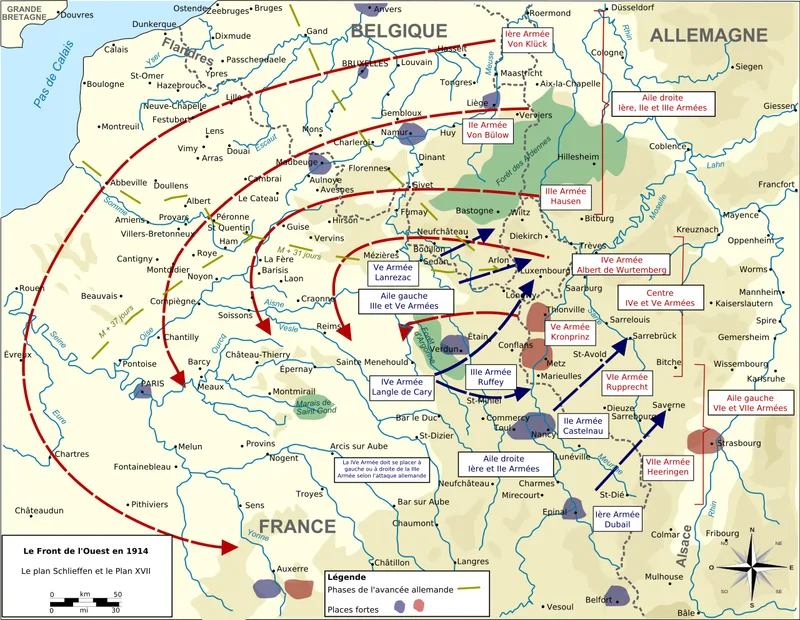
The Schlieffen Plan is a name given after the First World War to German war plans, due to the influence of Field Marshal Alfred von Schlieffen and his thinking on an invasion of France and Belgium, which began on 4 August 1914. Schlieffen was Chief of the General Staff of the German Army from 1891 to 1906. In 1905 and 1906, Schlieffen devised an army deployment plan for a decisive (war-winning) offensive against the French Third Republic. German forces were to invade France through the Netherlands and Belgium rather than across the common border.
After losing the First World War, German official historians of the and other writers described the plan as a blueprint for victory. (Colonel-General) Helmuth von Moltke the Younger succeeded Schlieffen as Chief of the German General Staff in 1906 and was dismissed after the First Battle of the Marne (5–12 September 1914). German historians claimed that Moltke had ruined the plan by tampering with it, out of timidity. They managed to establish a commonly accepted narrative that Moltke the Younger failed to follow the blueprint devised by Schlieffen, condemning the belligerents to four years of attrition warfare.
In 1956, Gerhard Ritter published (The Schlieffen Plan: Critique of a Myth), which began a period of revision, when the details of the supposed Schlieffen Plan were subjected to scrutiny. Treating the plan as a blueprint was rejected because this was contrary to the tradition of Prussian war planning established by Helmuth von Moltke the Elder, in which military operations were considered to be inherently unpredictable. Mobilisation and deployment plans were essential but campaign plans were pointless; rather than attempting to dictate to subordinate commanders, the commander gave the intent of the operation and subordinates achieved it through (mission tactics).
In writings from the 1970s, Martin van Creveld, John Keegan, Hew Strachan and others, studied the practical aspects of an invasion of France through Belgium and Luxembourg. They judged that the physical constraints of German, Belgian and French railways and the Belgian and northern French road networks made it impossible to move enough troops far enough and fast enough for them to fight a decisive battle if the French retreated from the frontier. Most of the pre-1914 planning of the German General Staff was secret and the documents were destroyed when deployment plans were superseded each April.
From Wikipedia (CC BY-SA 4.0).