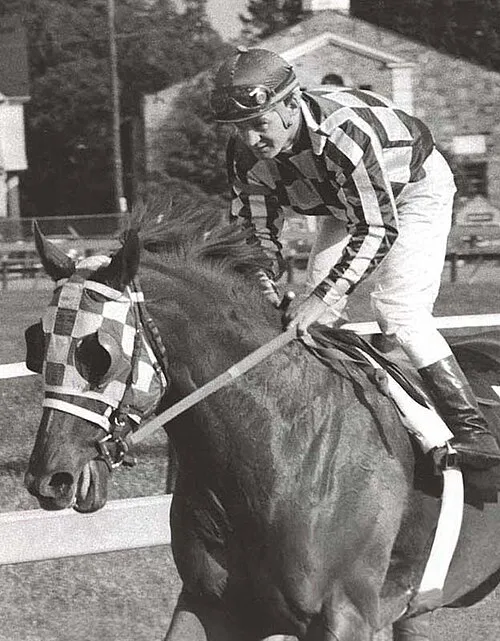
Secretariat (March 30, 1970 – October 4, 1989), also known as Big Red, was a champion American Thoroughbred racehorse who was the ninth winner of the American Triple Crown, setting and still holding the fastest time record in all three of its constituent races. He became the first Triple Crown winner in 25 years and his record-breaking victory in the 1973 Belmont Stakes, which he won by 31 lengths, is often considered the greatest race ever run by a thoroughbred racehorse. During his racing career, he won five Eclipse Awards, including Horse of the Year honors at ages two and three. Widely regarded as one of the greatest racehorses of all time, he was nominated to the National Museum of Racing and Hall of Fame in 1974. In the Blood-Horse magazine List of the Top 100 U.S. Racehorses of the 20th Century, Secretariat was second to Man o' War.
At age two, Secretariat finished fourth in his 1972 debut in a maiden race, but then won seven of his remaining eight starts, including five stakes victories. His only loss during this period was in the Champagne Stakes, where he finished first but was disqualified to second for interference. He received the Eclipse Award for champion two-year-old colt, and also was the 1972 Horse of the Year, a rare honor for a horse so young.
At age three, Secretariat not only won the Triple Crown, but he also set speed records in all three races. His time in the Kentucky Derby still stands as the Churchill Downs track record for 1+1⁄4 miles, and his time in the Belmont Stakes stands as the American record for 1+1⁄2 miles on the dirt. In 2012, his actual time of 1:53 in the Preakness Stakes was recognized as a stakes record after an official review.
Secretariat's win in the Gotham Stakes tied the track record for 1 mile, he set a world record in the Marlboro Cup at 1+1⁄8 miles and further proved his versatility by winning two major stakes races on turf. He lost three times that year: in the Wood Memorial, Whitney, and Woodward Stakes, but the brilliance of his nine wins made him an American icon. He won his second Horse of the Year title, plus Eclipse Awards for champion three-year-old colt and champion turf horse.
At the beginning of his three-year-old year, Secretariat was syndicated for a record-breaking $6.08 million (equivalent to $44.1 million in 2025), on the condition that he be retired from racing by the end of the year. Although he sired several successful racehorses, he ultimately was most influential through his daughters' offspring, becoming the leading broodmare sire in North America in 1992. His daughters produced several notable sires, including Storm Cat, A.P. Indy, Gone West, Dehere, Summer Squall, and Chief's Crown, and through them Secretariat appears in the pedigree of many modern champions. Secretariat died in 1989 as a result of laminitis at age 19.
Contents
Background
Secretariat was officially bred by Christopher Chenery's Meadow Stud, but the breeding was actually arranged by Penny Chenery (then known as Penny Tweedy), who had taken over the running of the stable in 1968 when her father became ill. Bred in Kentucky, Secretariat was sired by Bold Ruler and his dam was Somethingroyal, a daughter of Princequillo. Bold Ruler was the leading sire in North America from 1963 to 1969 and again in 1973. Owned by the Phipps family, Bold Ruler possessed both speed and stamina, having won the Preakness Stakes and Horse of the Year honors in 1957, and American Champion Sprint Horse honors in 1958. Bold Ruler was retired to stud at Claiborne Farm, but the Phipps family owned most of the mares to which Bold Ruler was bred, and few of his offspring were sold at public auction.
To bring new blood into their breeding program, the Phipps family sometimes negotiated a foal-sharing agreement with other mare owners: Instead of charging a stud fee for Bold Ruler, they would arrange for multiple matings with Bold Ruler, either with two mares in one year or one mare over a two-year period. Assuming two foals were produced, the Phipps family would keep one and the mare's owner would keep the other, with a coin toss determining who received first pick.
Under such an arrangement, Chenery sent two mares to be bred to Bold Ruler in 1968, Hasty Matelda and Somethingroyal. She then sent Cicada and Somethingroyal in 1969. The foal-sharing agreement stated that the winner of the coin toss would get first pick of the foals produced in 1969, while the loser of the toss would get first pick of the foals due in 1970. In the spring of 1969, a colt and filly were produced. In the 1969 breeding season, Cicada did not conceive, leaving only one foal due in the spring of 1970. Thus, the winner of the coin toss would get only one foal (the first pick from 1969), and the loser would get two (the second pick from 1969 and the only foal from 1970). Chenery later said that both owners hoped they would lose the coin toss, which was held in the fall of 1969 in the office of New York Racing Association Chairman Alfred G. Vanderbilt II, with Arthur "Bull" Hancock of Claiborne Farm as witness. Ogden Phipps won the toss and took the 1969 weanling filly out of Somethingroyal. The filly was named The Bride and never won a race, though she did later become a stakes producer. Chenery received the Hasty Matelda colt in 1969 and the as-yet-unborn 1970 foal of Somethingroyal, which turned out to be Secretariat.
Early years
Secretariat's Birthplace
Meadow Stable, located in Doswell, Virginia, was also called The Meadow. On Easter Monday, March 30, 1970, at 12:10 a.m. at the Meadow Stable, Somethingroyal foaled a bright-red chestnut colt with three white socks and a star with a narrow stripe. The foal stood when he was 45 minutes old and nursed 30 minutes later. Howard Gentry, the manager of Meadow Stable, was at the foaling and later said, "He was a very well-made foal. He was as perfect a foal that I ever delivered." The colt soon distinguished himself from the others. "He was always the leader in the crowd," said Gentry's nephew, Robert, who also worked at the farm. "To us, he was Big Red, and he had a personality. He was a clown and was always cutting up, always into some devilment." Sometime later, Chenery got her first look at the foal and made a one-word entry in her notebook - "Wow!"
That fall, Chenery and Elizabeth Ham, the Meadow's longtime secretary, worked together to name the newly weaned colt. The first set of names submitted to the Jockey Club (Sceptre, Royal Line, and Something Special) played on the names of his sire and dam but were rejected. The second set, submitted in January 1971, were Games of Chance, Deo Volente ("God Willing"), and Secretariat. Ham suggested naming the colt Secretariat after her former job in the secretariat of the League of Nations (predecessor of the United Nations). Ham had worked for diplomat Norman Davis sometime between 1920 and 1946, maybe around the time of his appointment in 1924.
Appearance and conformation
Secretariat grew into a massive, powerful horse said to resemble his sire's damsire, Discovery. He stood 16.2 hands (66 inches, 168 cm) when fully grown. He was noted for being exceptionally well-balanced, described as having "nearly perfect" conformation and stride biomechanics. His chest was so large that he required a custom-made girth, and he was noted for his large, powerful, well-muscled hindquarters. An Australian trainer said of him, "He is incredible, an absolutely perfect horse. I never saw anything like him."
Secretariat's absence of major conformation flaws was important, as horses with well formed limbs and feet are less likely to become injured. Secretariat's hindquarters were the main source of his power, with a sloped croup that extended the length of his femur. When in full stride, his hind legs were able to reach far under himself, increasing his drive. His ample girth, long back and well-made neck all contributed to his heart-lung efficiency.
The manner in which Secretariat's body parts fit together determined the efficiency of his stride, which affected his acceleration and endurance. Even very small differences in the length and angles of bones can have a major effect on performance. Secretariat was well put together even as a two-year-old, and by the time he was three, he had further matured in body and smoothed out his gait. The New York Racing Association's Dr. M. A. Gilman, a veterinarian who routinely measured leading thoroughbreds with a goal of applying science to create better ways to breed and evaluate racehorses, measured Secretariat's development from two to three as follows:
Secretariat's length of stride was considered large even after taking into account his large frame and strong build. While training for the Preakness Stakes, his stride was measured as 24 feet, 11 inches. His powerful hindquarters allowed him to unleash "devastating" speed and because he was so well-muscled and had significant cardiac capacity, he could simply out-gallop competitors at nearly any point in a race.
His weight before the Gotham Stakes in April 1973 was 1,155 pounds (524 kg). After completing the gruelling Triple Crown, his weight on June 15 had dropped only 24 pounds, to 1,131 pounds (513 kg). Secretariat was known for his appetite — during his three-year-old campaign, he ate 15 U.S. quarts (14 liters) of oats a day — and to keep his muscles in good condition, he needed fast workouts that could have won many a stakes race.
Racing career
Secretariat raced in Meadow Stable's memorable blue-and-white-checkered colors. He never raced in track bandages, but typically wore a blinker hood, mostly to help him focus, but also because he had a tendency to run in toward the rail during races. In January 1972, he joined trainer Lucien Laurin's winter stable at Hialeah. Secretariat gained a reputation as a kind horse, likeable and unruffled in crowds or by the bumping that occurs between young horses. He had the physique of a runner but at first was awkward and clumsy. He was frequently outpaced by more precocious stable mates, running a quarter-mile in 26 seconds compared to 23 seconds by his peers. His regular exercise riders were Jim Gaffney and Charlie Davis. Davis was not initially impressed. "He was a big fat sucker," Davis said. "I mean, he was big. He wasn't in a hurry to do nothin'. He took his time. The quality was there, but he didn't show it until he wanted to." Gaffney though recalled his first ride on Secretariat in early 1972 as "having this big red machine under me, and from that very first day I knew he had a power of strength that I have never felt before" It was Gaffney who nicknamed the horse, "Big Red".
Groom Eddie Sweat was another important member of the Secretariat team, providing most of the daily hands-on care. Sweat once told a reporter, "I guess a groom gets closer to a horse than anyone. The owner, the trainer, they maybe see him once a day. But I lived with him, worked with him."
Laurin sent Chenery regular updates on Secretariat's progress, saying that the colt was still learning to run, or that he still needed to lose his baby fat. Chenery recalled that when Secretariat was in training, Lucien once said: "Your big Bold Ruler colt don't show me nothin'. He can't outrun a fat man." But Secretariat made steady progress over the spring. On June 6, he wore blinkers for the first time to keep his attention focused and responded with a half-mile workout in a solid 473⁄5 seconds. On June 24, he ran a "bullet," the fastest workout of the day, at 6 furlongs in 1:124⁄5 on a sloppy track. Laurin called Chenery at her Colorado home and advised her that Secretariat was ready to race.
1972: Two-year-old season
For his first start on July 4, 1972, at Aqueduct Racetrack, Secretariat was made the lukewarm favorite at 3–1. At the start, a horse named Quebec cut in front of the field, causing a chain reaction that resulted in Secretariat being bumped hard. According to jockey Paul Feliciano, he would have fallen if he hadn't been so strong. Secretariat recovered, only to run into traffic on the backstretch. In tenth position at the top of the stretch, he closed ground rapidly and finished fourth, beaten by only 1+1⁄4 lengths. In many of his subsequent races, Secretariat hung back at the start, which Laurin later attributed to the bumping he received in his debut.
With Feliciano again up, Secretariat returned to the track on July 15 as the 6–5 favorite. He broke poorly, but then rushed past the field on the turn to win by six lengths. On July 31 in an allowance race at Saratoga, Feliciano was replaced by Ron Turcotte, the regular jockey for Meadow Stable. Turcotte had ridden the colt in several morning workouts but had missed his first two starts while recovering from a fall. Secretariat's commanding win as the 2–5 favorite caught the attention of veteran sportswriter Charles Hatton. He later reported, "You carry an ideal around in your head, and boy, I thought, 'This is it.' I never saw perfection before. I absolutely could not fault him in any way. And neither could the rest of them and that was the amazing thing about it. The body and the head and the eye and the general attitude. It was just incredible. I couldn't believe my eyes, frankly."
In August, Secretariat entered the Sanford Stakes, facing off with highly regarded Linda's Chief, the only horse ever to be favored against Secretariat in any of his races. Entering the stretch, Secretariat was blocked by the horses in front of him but then made his way through "like a hawk scattering a barnyard of chickens" on his way to a three-length win. Sportswriter Andrew Beyer covered the race for the Washington Star and later wrote, "Never have I watched a lightly raced 2-year-old stamp himself so definitively as a potential great."
Ten days later in the Hopeful Stakes, Secretariat made a "dazzling" move, passing eight horses within 1⁄4 mile to take the lead then drawing off to win by five lengths. His time of 1:161⁄5 for 6+1⁄2 furlongs was only 3⁄5 of a second off the track record. Returning to Belmont Park on September 16, he won the Belmont Futurity by a length and a half after starting his move on the turn. He then ran in the Champagne Stakes at Belmont on October 14 as the 7–10 favorite. As had become his custom, he started slowly and then made a big move around the turn, blowing past his rivals to win by two lengths. However, following an inquiry by the racecourse stewards, Secretariat was disqualified and placed second for bearing in and interfering with Stop the Music, who was declared the winner.
1973: Three-year-old season
In January 1973, Christopher Chenery, the founder of Meadow Stable, died and the taxes on his estate forced his daughter Penny to consider selling Secretariat. Together with Claiborne Farm, she instead managed to syndicate the horse, selling 32 shares worth $190,000 each for a total of $6.08 million, a world syndication record at the time, surpassing the previous record for Nijinsky who was syndicated for $5.44 million in 1970. Hancock said the sale was easy, citing Secretariat's two-year-old performance, breeding, and appearance. "He's, well, he's a hell of a horse." Chenery retained four shares in the horse and would have complete control over his three-year-old racing campaign, but agreed that he would be retired at the end of the year.
Secretariat wintered in Florida but did not race until March 17, 1973, in the Bay Shore Stakes at Aqueduct, where he went off as the heavy favorite. As the trainer of one of his opponents put it, "The only chance we have is if he falls down." Racing boxed in by horses on each side, Turcotte decided to go through a narrow gap between horses rather than try to circle the field. Secretariat broke free and won easily, but one of the other jockeys claimed that Secretariat had committed a foul going through the hole. The stewards reviewed photos from the race and determined that Secretariat was actually on the receiving end of a bump, so let the result stand. The Bay Shore established that Secretariat had improved over the winter and that he could also handle adversity.
In the Gotham Stakes on April 7, Laurin decided to experiment with Secretariat's running style. With no speed horses entered in the race, Secretariat would be allowed to set his own pace. Accordingly, Turcotte hustled Secretariat from the starting gate and they led easily. Down the stretch though, Champagne Charlie came running and at the eighth pole was almost even. Turcotte tapped Secretariat once on each side with the whip and Secretariat drew away to win by three lengths. He ran the first 3/4 mile in 1:083⁄5 and finished the one-mile race in 1:332⁄5, matching the track record.
His final preparatory race for the Kentucky Derby was the Wood Memorial, where he finished a surprising third to Angle Light and Santa Anita Derby winner Sham. Laurin was crushed, even though he had trained the winner, Angle Light, who set a slow pace and "stole" the race. Secretariat's loss was later attributed to a large abscess in his mouth, which made him sensitive to the bit. Before and after the race, there was some ill feeling between Laurin and the trainer of Sham, Pancho Martin, fanned by comments in the press. The dispute concerned the use of coupled entries as Martin had entered two horses in addition to Sham, all with the same owner. There was fear that an entry could be used tactically to gang up on another horse. Stung by such insinuations, Martin wound up scratching the two horses that he had originally entered with Sham, and asked Laurin to do the same, but Laurin could not follow suit as Secretariat and Angle Light had different owners.
Retirement
Stud career
When Secretariat first retired to Claiborne Farm, his sperm showed some signs of immaturity, so he was bred to three non-thoroughbred mares in December 1973 to test his fertility. One of these, an Appaloosa named Leola, produced Secretariat's first foal in November 1974. Named First Secretary, the foal was a chestnut like his sire, but spotted like his dam.
Secretariat's first official foal crop, arriving in 1975, consisted of 28 foals, the best of which was Dactylographer, who won the William Hill Futurity in October 1977. The first crop also included Canadian Bound, who at the 1976 Keeneland July sale was the first yearling to break the $1 million barrier, selling for $1.5 million. Canadian Bound, however, was a complete failure in racing, and for several years, the value of Secretariat's offspring declined considerably, especially given the rising popularity of Northern Dancer's offspring in the sales ring.
Secretariat eventually sired a number of major stakes winners, including:
General Assembly, winner of the 1979 Travers Stakes, setting a track record of 2:00 flat that stood for 37 years.
Lady's Secret, 1986 Horse of the Year.
Risen Star, 1988 Preakness and Belmont Stakes winner.
Kingston Rule, 1990 Melbourne Cup winner, breaking the course record.
Tinners Way, born in 1990 to Secretariat's last crop, winner of the 1994 and 1995 Pacific Classic.
Ultimately, Secretariat officially sired 663 named foals, including 341 winners (51.4%) and 54 stakes winners (8.1%). There has been some criticism of Secretariat as a stallion, mainly because he did not produce male offspring of his own ability and did not leave a leading sire son behind, but his legacy is assured through the quality of his daughters, several of whom were excellent racers and even more of whom were excellent producers. In 1992, Secretariat was the leading broodmare sire in North America. Overall, Secretariat's daughters produced 24 Grade/Group 1 winners. As a broodmare sire, Secretariat's most notable progeny were:
Death
In the fall of 1989, Secretariat became afflicted with laminitis—a painful and debilitating hoof condition. When his condition failed to improve after a month of treatment, he was euthanized on October 4 at the age of 19. Secretariat was buried at Claiborne Farm, given the rare honor of being buried whole (traditionally only the head, heart, and hooves of a winning race horse are buried).
At the time of Secretariat's death, the veterinarian who performed the necropsy, Thomas Swerczek, head pathologist at the University of Kentucky, did not weigh Secretariat's heart, but stated, "We just stood there in stunned silence. We couldn't believe it. The heart was perfect. There were no problems with it. It was just this huge engine." Later, Swerczek also performed a necropsy on Sham, who died in 1993. Swerczek did weigh Sham's heart, and it was 18 pounds (8.2 kg). Based on Sham's measurement, and having necropsied both horses, he estimated Secretariat's heart probably weighed 22 pounds (10.0 kg), or about 2.5 times that of the average horse (8.5 pounds (3.9 kg)).
An extremely large heart is a trait that occasionally occurs in thoroughbreds, hypothesized to be linked to a genetic condition, called the "x-factor" passed down in specific inheritance patterns. The x-factor can be traced to the historic racehorse Eclipse, who was necropsied after his death in 1789. Because Eclipse's heart appeared to be much larger than the hearts of other horses, it was weighed, and found to be 14 pounds (6.4 kg), almost twice the normal weight. Eclipse is believed to have passed the trait on via his daughters, and pedigree research verified that Secretariat traces his dam line to a daughter of Eclipse. Secretariat's success as a broodmare sire has been linked by some to this large heart theory. However, it has not been proven whether the x-factor exists, let alone if it contributes to athletic ability.
Honors, recognition, and legacy
Following his Triple Crown victory in 1973, Secretariat was nominated for Sports Illustrated's Sportsman of the Year. During the week of June 10, 1973, he also became the first athlete to appear on the covers of Time, Newsweek, and Sports Illustrated in the same week. In 1974, he was inducted into the National Museum of Racing and Hall of Fame. He was later in also inducted into the Kentucky Athletic Hall of Fame, marking the first time an animal received this honor. In 1999, ESPN listed him 35th of the 100 greatest North American athletes of the 20th century, the highest of three non-humans on the list. Secretariat ranked second behind Man o' War in The Blood-Horse's List of the Top 100 U.S. Racehorses of the 20th Century, an assessment shared by expert panels assembled by both the Associated Press and Sports Illustrated. Sports Illustrated also listed Secretariat winning the Triple Crown at #13 in their 2013 100 Greatest Moments in Sports History.
In 1999, the U.S. Postal Service honored Secretariat with a 33-cent U.S. postage stamp entitled "Secretariat Wins Triple Crown" in the Celebrate the Century (1970s) series. The national unveiling ceremony was held in the winner's circle at Keeneland Race Course in Lexington, Kentucky on Saturday, October 16, 1999. The stamp is among those listed in the Smithsonian Institution's record of exhibitions called, "Trailblazers and Trendsetters: Art of the Stamp: Sports." and was in the collection Celebrate the Century (1970). Due to Secretariat's enduring popularity, Chenery remained a prominent figure in racing and a powerful advocate for thoroughbred aftercare and veterinary research until her death in 2017. In 2004, the Maker's Mark Secretariat Center, dedicated to reschooling former racehorses and matching them to new homes, opened at the Kentucky Horse Park. In 2010, Chenery developed the fan-voted Secretariat Vox Populi Award, designed to honor "the horse whose popularity and racing excellence best resounded with the American public."
Various states and localities have also memorialized Secretariat. According to ESPN, 263 roads in the United States are named after him, more than any other athlete. In Illinois, the Secretariat Stakes was created in 1974, while the University of Kentucky football team incorporates blue-and-white checkers to honor the silks of Meadow Stable. To celebrate the 50th anniversary of his Triple Crown win in 2023, the state legislatures of Virginia and Kentucky issued official commemorative proclamations, accompanied by the release of regional commemorative bourbons.
Racing statistics
Secretariat's earnings in 1973 were, at the time, a single-season record.
Pedigree
Secretariat was sired by Bold Ruler, who led the North America sire list eight times, more than any other stallion in the 20th century. He also led the juvenile (two-year-old) sire list a record six times. Before Secretariat's Triple Crown run, Bold Ruler was often categorized as a sire of precocious juveniles that lacked stamina or did not train on past age two. However, even before Secretariat, Bold Ruler actually had sired 11 stakes winners of races at 10 furlongs or more. Ultimately, seven of the ten Kentucky Derby winners in the 1970s can be traced directly to Bold Ruler in their tail-male lines, including Secretariat and fellow Triple Crown winner Seattle Slew.
Secretariat's dam was Somethingroyal, the 1973 Kentucky Broodmare of the Year. Although Somethingroyal was unplaced in her only start, she had an excellent pedigree. Her sire Princequillo was the leading broodmare sire from 1966 to 1970 and was noted as a source of stamina and soundness. Her dam Imperatrice was a stakes winner who was purchased by Christopher Chenery at a dispersal sale in 1947 for $30,000. Imperatrice produced several stakes winners and stakes producers for the Meadow. Prior to foaling Secretariat at age 18, Somethingroyal had already produced three stakes winners: Sir Gaylord, First Family and Syrian Sea, the latter a full sister to Secretariat. Sir Gaylord became an important sire, whose offspring included Epsom Derby winner Sir Ivor. Somethingroyal's later foals included Straight Flush (1975) sired by Riva Ridge. Through his dam, Riva Ridge is descended from Man o' War.
Breeders speak of a "nick" occurring when a sire or grandsire produces significantly better offspring from the daughters of one particular sire than with mares from other bloodlines. The breeding of Bold Ruler with Somethingroyal is an example of a famous nick between Bold Ruler's sire Nasrullah and daughters of Princequillo. The goal was to balance the speed, precocity, and fiery temperament provided by the Nasrullah side of the pedigree with Princequillo's stamina, soundness, and sensible temperament.