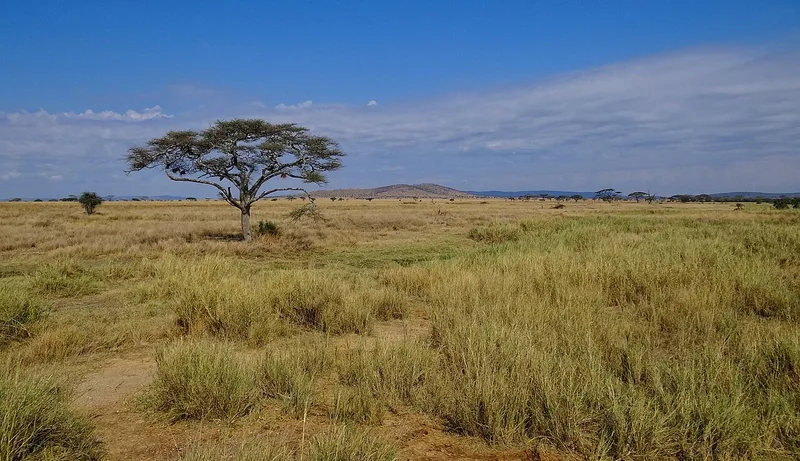
Overview
The Serengeti National Park is a large national park in northern Tanzania that stretches over . It is located in eastern Mara Region and northeastern Simiyu Region and contains over of virgin savanna. The park was established in 1940.
The Serengeti is well known for the largest annual animal migration in the world of over 1.5 million blue wildebeest and 250,000 zebra along with smaller herds of Thomson's gazelle and eland. The national park is also home to the largest lion population in Africa. It is under threat from deforestation, population growth and ranching.
Etymology
The name "Serengeti" is an approximation of the word siringet used by the Maasai people for the area, which means "the place where the land runs on forever".
History
In 1930, an area of was designated as a game reserve in southern and eastern Serengeti. In the 1930s, the government of Tanganyika established a system of national parks compliant with the Convention Relative to the Preservation of Fauna and Flora in their Natural State. The area became a national park in 1940. It was granted strict protection in 1948 when the Serengeti National Park Board of Trustees was formed to administer the national park. The government restricted the movements of the resident Maasai people, and the park boundaries were finalized in 1951. In 1959, an area of was split off in the eastern part of the national park and re-established as Ngorongoro Conservation Area intended to accommodate the traditional land use interests of the Maasai people in a multiple land use area. In 1981, the Serengeti National Park covered , which was less than half of the Serengeti.
From Wikipedia (CC BY-SA 4.0).