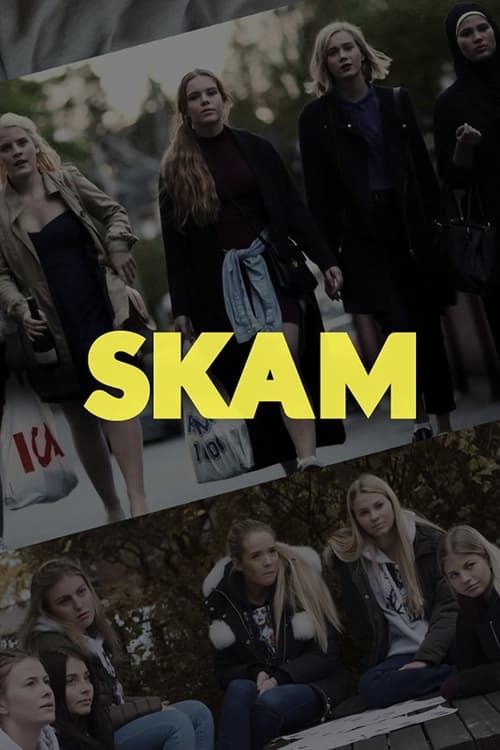
Skam (stylized as SKAM; Norwegian pronunciation: [skɑm]; English: Shame) is a Norwegian teen drama streaming television series about the daily life of teenagers at the Hartvig Nissen School, a gymnasium in the wealthy borough of Frogner in West End Oslo and Norway's oldest high school for girls. It was produced by NRK P3, which is part of the Norwegian public broadcaster NRK.
Despite no promotion ahead of its 2015 launch, Skam broke viewership records. Its premiere episode is among the most-watched episodes in NRK's history, and by the middle of season two, it was responsible for half of NRK's traffic. With season three, it broke all streaming records in Norway, along with viewership records in neighboring countries Denmark, Finland and Sweden, and attracted an active international fanbase on social media, where fans promoted translations.
The series ended with its fourth season in 2017, reportedly due to high production stress.
Contents
Hartvig Nissen School
The series focuses on the daily life of teenagers at the Hartvig Nissen School (Hartvig Nissens skole), a gymnasium (preparatory high school) located in the Frogner borough in Oslo's West End, with the address Niels Juels gate (Niels Juel Street) 56. It is Norway's oldest high school for girls and is informally and widely known simply as "Nissen". Originally named Nissen's Girls' School, it was founded by Hartvig Nissen in 1849 as a private, progressive girls' school which was owned by its headmasters and which served the higher bourgeoisie. The school was described in the British House of Commons in 1907 as "the pioneer of higher girls' schools in Norway." It was both the first higher school and the first higher education institution (through its former affiliated teachers college) in Norway which admitted girls and women. The girls' school gradually became a co-educational school from the mid 1950s, after four boys were admitted in 1955 alongside hundreds of girls. Its alumni include many famous individuals and two members of the Norwegian royal family. The then relatively new progressive girls' school is also featured in the 1862 play Love's Comedy by Henrik Ibsen.
Premise
Skam follows a new main character each season. While airing, a new clip, conversation, or social media post was published in real-time on the NRK website on a daily basis. Each season has a focus on particular topics that range from relationship difficulties, identity, eating disorders, sexual assault, homosexuality, mental health issues, religion, and forbidden love.
At the start of a week, a clip, conversation or social media post is posted on the Skam website. New material is posted on a daily basis, with the content unified and combined into one full episode on Fridays. The main character differs from season to season, and the fictional characters have social media profiles where viewers can follow their activities. The show allows public interaction over the duration of the episode. The format has since been used in other NRK P3 series, Blank and Lovleg.
Characters
The following are characters in Skam.
1In season one, David Stakston was credited as playing a character called David, though his name was never spoken in the show. This could be the character Magnus or Stakston was playing a different student. Stakston also makes an uncredited appearance in the last episode of season two.
2In season three, Mikael appears uncredited in a video Isak finds on the Internet of Even.
Central cast
Lisa Teige as Eva Kviig Mohn (born 2 June 1999) is the main character in the first season. When we first meet Eva, she recently started dating Jonas, who just ended a relationship with Eva's best friend Ingrid. Her relationship with Jonas is complicated and she finds it hard to trust him, eventually leading her to cheat on him and ultimately leading to their breakup at the end of season one. Eva lives at home with a busy mom and starts at the Hartvig Nissen school ("Nissen") in 2015 together with her friends and former classmates Jonas, Ingrid, Sara and Isak. Losing her former best friends Ingrid and Sara due to her relationship to Jonas, she starts up new friendships with Noora, Chris, Vilde and Sana at Nissen. After season one, Eva is mostly shown as an outgoing and promiscuous party-girl.
Josefine Frida Pettersen as Noora Amalie Sætre (born 6 April 1999) is the main character in the second season. Noora is shown as a confident, smart and helpful character in seasons one and two. In the second season, it is however revealed that she has some insecurities after all. She lives with two roommates and does not have contact with her parents. Unlike her friends Eva, Chris and Vilde, Noora is not into drinking or hooking up with guys. When the school's playboy William continues to flirt with her despite several rejections, she eventually gets interested in him, but due to her prejudices against him, she finds it hard to accept. They end up in a relationship at the end of season two. In seasons three and four, Noora faces complications in her relationship with William.
Tarjei Sandvik Moe as Isak Valtersen (born 21 June 1999) is the main character in the third season. Isak is a close friend of both Eva and Jonas in season one. At the end of the season, Noora and Eva find gay pornography on Isak's phone, raising suspicions about his sexual orientation. Season three follows Isak's struggles to accept his sexuality. He meets Even, and the two quickly fall in love and begin to secretly see each other. However, Isak unknowingly pushes Even (who has bipolar disorder) away by revealing that he does not want to be around people with mental disorders, due to traumatizing experiences with Isak's own mentally ill mother. Isak decides to come out to his best friends and tell them about Even. His friends help him getting back together with Even and afterwards to better understand and accept Even's bipolar disorder. In season four, Isak is shown as much happier, as he lives comfortably and publicly in a relationship with Even.
Iman Meskini as Sana Bakkoush (born 24 December 1999) is the main character in the fourth season. Sana's biggest struggle throughout the series is to live the traditional Muslim lifestyle and the traditional Norwegian gymnasium-lifestyle at the same time. Sana is shown as decisive and eloquent, but faces constant prejudices from her classmates, her parents and people she meets on the street, which sometimes leads Sana to take irrational decisions. This peaks when Sana anonymously cyberbullies her classmate Sara, who wants to exclude Sana from their russefeiring-squad. Unlike Eva, Noora and Isak, she has a close relationship with her family. In season 4, she falls in love with Yousef, who she initially thinks is a Muslim, but turns out not to be. After initial attempts to distance herself from him, they appear to grow closer later in the season.
Main cast
Marlon Valdés Langeland as Jonas Noah Vasquez (born 20 December 1999), Eva's boyfriend in the first season. He is also Isak's best friend and a classmate of all the main characters.
Ulrikke Falch as Vilde Hellerud Lien (born 13 July 1999), the naive fourth member of the main girl squad. She is the enthusiastic initiator of russefeiring, revy and other social events for the squad.
Ina Svenningdal as Christina "Chris" Berg (born 6 January 1999), the amusing fifth member of the girl squad. She usually avoids most conflicts and emotionally deep conversations.
Thomas Hayes as William Magnusson (born 10 January 1997), the flirt and eventually boyfriend of Noora in the second season. He is two years older than the main cast, but also studies at Nissen in the first two seasons.
Carl Martin Eggesbø as Eskild Tryggvasson (born 19 August 1995), the roommate of Noora in season two and four, and of Isak's in season three.
Henrik Holm as Even Bech Næsheim (born 12 February 1997), the love affair and eventual boyfriend of Isak. Even is diagnosed with bipolar disorder at some point prior to season 3.
David Stakston as Magnus Fossbakken (born 30 October 1999), Isak's awkward friend and classmate. In the fourth season he is in a relationship with Vilde.
Sacha Kleber Nyiligira as Mahdi Disi (born 19 January 1999), Isak's friend and classmate. Member of the boys squad.
Cengiz Al as Yousef Acar (born 21 September 1997), the atheist love interest of Sana and a former classmate of Even.
Recurring cast
Herman Tømmeraas as Christoffer "Penetrator-Chris" Schistad (born 2 April 1997), the on-and-off love interest of Eva through all four seasons. He is also classmate and best friend of William.
Cecilie Martinsen as Ingrid Theis Gaupseth (born 23 February 1999), Jonas's girlfriend and Eva's best friend prior to season one. Ingrid is a member of the russefeiring-squad "Pepsi Max", which often rivals the main characters' squad.
Kristina Ødegaard as Sara Nørstelien (born 12 July 1999), Ingrid's best friend and leader of the "Pepsi Max" squad. Sara dates Isak in the second season.
Rakel Øfsti Nesje as Linn Larsen Hansen (born 1 January 1996), the introverted roommate of Eskild and Noora/Isak.
Simo Mohamed Elhbabi as Elias Bakkoush (born 5 March 1997), Sana's older brother and Yousef's best friend and former classmate.
Episodes
Season 1
The first clip from season 1 was made available on Tuesday, 22 September 2015, with the combined clips during the week premiering as a full episode on Friday, 25 September 2015. The season consists of 11 episodes; the main character is Eva Mohn. The storyline deals with Eva's difficult relationship with her boyfriend Jonas and the themes of loneliness, identity, belonging and friendship.
Season 2
The first clip from season 2 was made available on Monday, 29 February 2016, with the combined clips during the week premiering as a full episode on Friday, 4 March 2016. The season consists of 12 episodes; the main character is Noora Amalie Sætre. The season is about her relationship with William and deals with issues of friendship, feminism, eating disorders, self-image, violence, sexual violence and the contemporaneous refugee crisis in relation to Norwegian democracy.
Season 3
The first clip from season 3 was made available on Sunday, 2 October 2016, with the combined clips during the week premiering as a full episode on Friday, 7 October 2016. The season consists of 10 episodes; the main character is Isak Valtersen. The season deals with Isak's burgeoning relationship with Even Bech Næsheim and is principally a coming out story that deals with issues of love, sexual identity, authenticity, mental illness, religion and friendship.
NRK TV and NRK P3 used different titles for 7 of the season 3 episodes.
Season 4
The first clip from season 4 was made available on Monday, 10 April 2017, with the combined clips during the week premiering as a full episode on Friday, 14 April 2017. The season consisted of 10 episodes, and the main character is Sana Bakkoush. The season deals with the Islamic religion, forbidden love, cyberbullying, friendship, and the Norwegian russ celebratory period.
The series finale episode switches character clip-to-clip, focusing on short stories by characters not given their own, full season. The episode deals with parental depression, love rejection, jealousy, friendship, mutual relationship support, and fear of abandonment.
Production
Julie Andem created Skam. In an interview with Rushprint in April 2016, Andem discussed production of the series. Originally developed for 16-year-old girls, Andem made use of the "NABC" production model ("Needs/Approach/Benefit/Competition"), and instead of collecting information from a vast amount of sources, she had extensive, hours-long interviews with a single representative to uncover what needs that specific target audience had in order to cover that story. In contrast to American shows, which were the primary competition for shows attracting attention from teenagers, Andem stated that she had one advantage; knowing who the audience were and what culture they grew up in. One major area of exploration Andem found through research was pressure; she stated that "the pressure to perform is very high for this target audience. They strive to perform in so many ways. That's fine, and it doesn't necessarily have to be dangerous or unhealthy. But what is unhealthy is that many feel like they can't live up to the demands, and therefore feel that they failed. They are comparing themselves to each other, not themselves. And then a thought occurred: How to get them to let go of the pressure through a series like Skam". Andem wanted the show to be a combination of social realism, soap opera, and sitcom, transitioning between the genres as the scenes switch, for example from the comical scenes of a doctor's office to the make-out scenes on the stairs. She admitted it did not always work, saying that one particular scene change in episode 5 of season 1 from the stairs to the doctor's office was "a dramatic jump", and elaborated that "in a later scene, I told the photographer that we maybe should try to go a little closer. But we didn't get the humor, so: fuckit, we'll shoot sitcom-ish and blend the genres."
Andem created nine characters, without any backstory. Everyone was supposed to be able to lead a season, and the show was going to switch character season-to-season. 1,200 people auditioned for the roles in the first round of casting. As production started, Andem wrote scripts for the shows, and there was no improvisation. "A lot of people think much of the show is improvised. It's not. A lot is written for the actors. And before and after a scene, I'll wait for a while before I say thank you and let them play a little in the scene. If a scene doesn't work, we'll fix it and see what in the script doesn't work." Production had a short deadline, with scripts written in three days, one-and-a-half days to shoot, and four-to-five days to edit. "The plan must be there, and we just have to finish through". The series' use of real-time was planned from early on, and Andem wrote the series in episodic format, although the content also had to work for daily releases, including a cliffhanger ending in each scene. Andem read the comments for each day, and looked for feedback from the audience on how to end each season while still keeping her original plans in some way.
Distribution
In Norway, the series is available on the radio channel NRK P3's website, and on the web television solution NRK TV. The weekly episodes are also aired on Fridays on TV channel NRK3. The series has been licensed to air as a Nordvision co-production by public service broadcasters in other Nordic countries, specifically:
In Denmark, the series is shown by DR on the DR TV streaming service and aired on TV channel DR3 since December 2016.
In Finland, the series is shown by Yle on the Yle Areena streaming service since December 2016.
In Iceland, the series is shown by RÚV on both its streaming service and television channel.
In Sweden, the series is shown by SVT on the SVT Play streaming service since December 2016.
Reception
Skam received critical acclaim and significant recognition for its portrayal of sexual abuse in the second season and homosexuality in the third. The series was also praised for its contributions to promote Norwegian language and culture internationally, as well as for its unique distribution format, adopting a new strategy of real-time, high-engagement, snippet-based distribution rather than rigidity and television schedules. It received multiple Norwegian awards throughout its run, being honored for its dramatic narrative, innovative storytelling format, writing, directing, and actors' performances.
Norway and Nordic countries
In Norway, on average, about 192,000 viewers watched the first season, with the first episode being one of the most viewed of all time on NRK TV online. In the first week of June 2016, streaming of Skam was responsible for over half of the traffic on NRK TV. Following the release of the third-season finale, NRK stated that the second season had an average audience of 531,000, while the third season broke all streaming records on its NRK TV service with an average audience of 789,000 people. The trailer for the fourth season, released on 7 April 2017, was watched by 900,000 people within four days. During the start of the fourth season, 1.2 million unique users had visited Skam's website, and the first episode had been watched by 317,000 people. NRK P3 editorial chief Håkon Moslet told Verdens Gang that "We see that there is high traffic and high interest for season 4. Since the end of the season we have seen a pattern around viewer interest. We lie high in the first week and towards the end of the season when the drama kicks in." In May 2017, NRK published a report on 2016 viewing statistics, writing that the third season broke both the streaming record for a series on NRK TV and for streaming of any series in Norway.
An October 2016 Aftenposten report detailed that Skam had become popular in Sweden, with "well over 5000" viewers with Swedish IP addresses watching the episodes, not counting the individual clips. A later report from Verdens Gang in January 2017 stated that Skam had "broken all records" in Sweden, with over 25 million plays on SVT Play. Following the series' licensing deal for broadcasting in Denmark, the series broke records in January 2017, with the show's first episode scoring 560,000 viewers on DR TV. In Finland, the first episode had more than 130,000 views by the end of February 2017, two and half months after its release, described by Yle audience researcher Anne Hyvärilä as "quite exceptional".
Skam has received critical acclaim. The newspaper NATT&DAG selected it as the best TV series of 2015. In its second season, Kripos, Norway's National Criminal Investigation Service, praised the series' handling of sexual abuse, including the girls' encouraging the victim, Noora, to go to the emergency room to explain the situation and gather evidence of the abuse, and Noora confronting her abuser with relevant laws he has broken to prevent the sharing of photographs showing her naked. The National Center for Prevention of Sexual Assault also praised the portrayal, adding that they wish for the series to become a syllabus in schools. In the third season, Martine Lunder Brenne of Verdens Gang praised the theme of homosexuality and wrote that "I praise it first and foremost because young homosexual people, both in and outside the closet, finally get some long-awaited and modern role models. It doesn't matter if it's a character in a fictional drama – right now, Skam is Norway's coolest show". In the fourth season, Christopher Pahle of Dagbladet praised a conversation about religion, writing: "two young people, with Muslim backgrounds, have a reflected, respectful and enlightening conversation about religion without arguing or taking it to the trenches. Think about that. They pick flowers and dribble a ball, and even if they don't necessarily convince each other, that's not the purpose either. The point is that they understand each other".
International success
Starting with season three, the show attracted an international audience, and NRK was therefore heavily asked to add English subtitles to the Skam episodes online. The requests were declined due to the license for the music presented throughout the series being restricted to a Norwegian audience, and that easy availability outside Norway would violate the terms of NRK's license agreements. An attorney for NRK elaborated that YouTube videos featuring more than 50% original Skam content would be automatically removed. When denied official subtitling, fans started making their own translations of the episodes into several world languages, greatly expanding the online fanbase. Norwegian viewers were quick to share translated clips quickly after availability through Google Drive, and also started blogs to cover additional material and language courses to explain Norwegian slang.
By the end of 2016, Skam had been trending globally several times on Twitter and Tumblr, and its Facebook, Instagram and Vine presence grew rapidly. On social media, fandoms developed creative paintings, screensavers, phone covers, and fan videos. Filming locations, including Sagene Church, and the Hartvig Nissen school, were visited by fans, and the actors were receiving worldwide attention. After being featured in an episode in the third season, Gabrielle's song "5 fine frøkner" saw a 3,018 percent increase in listening on Spotify, with over 13 million streams and, at one point, rising to eighth place on the Swedish top music rankings. Its social media popularity continued into its fourth season in April 2017, with over 20,000 tweets containing #skamseason4 registered in 24 hours at the time of season four's first clip, a substantial portion of which originated from the United States.
In January 2017, Skam was geoblocked for foreign viewers. NRK attorney Kari Anne Lang-Ree stated that "NRK has a right to publish content to the Norwegian audience and foreign countries. The music industry is reacting to the fact that many international viewers are listening to music despite NRK not having international licensing deals. NRK takes the concerns from the music industry seriously. We are in dialogue with [the music industry] to find a solution". NRK stated that "We want to thank our international fans and followers who have embraced SKAM. We are blown away by your dedication – it is something we never expected. That is why it hurts to tell you guys that due to a necessary clarification with the music right holders, SKAM will until further notice not be available outside Norway. We are working hard to figure out how to solve this issue so that the fans can continue to enjoy SKAM from where they are". When the fourth season premiered in April, the geoblock was removed for Nordic countries.
Scholarship
SKAM has been the subject of numerous academic studies. Vilde Schanke Sundet argues that the real-time quality of shows like SKAM help broadcasters to reconnect with younger audiences, and has examined viewers motives for engaging with the community online. Other scholars, such as Tore Rye Andersen and Sara Tanderup Linkis, analyse the narrative effect of what Ruth Page calls "real-time narration", while Jill Walker Rettberg analysed the use of social media narrative to include the viewer in a "we-narrative", a collective narration that emphasises the group above the individual.
Other media
Adaptations
In December 2016, Simon Fuller's XIX Entertainment production company signed a deal with NRK to produce an American version of the series, then-titled Shame. Development of the series continued in the following months, with a title change to SKAM Austin, casting calls taking place, and the announcement that Austin would air on Facebook's "Facebook Watch" original video platform and on the original's series network, NRK. It premiered in April 2018 and has been renewed for a second season.
In April 2017, the Danish theatre Aveny-T was reported to have acquired exclusive rights to produce a stage version of Skam. Four different plays will be made, one for each season, with the first show having taken place in Copenhagen on 15 September 2017, and the remaining three plays produced once a year through the year 2020.
In September 2017, French entertainment website AlloCiné reported on the imminent production of a French remake of the series.
In October 2017, Variety and The Hollywood Reporter reported that local adaptations of Skam would be produced in five European countries; Germany, France, Italy, Spain and the Netherlands. NRK CEO Thor Gjermund Eriksen said in a statement that "We are very excited about the tremendous interest that Skam/Shame has generated outside of Norway. The creators of Skam aimed to help 16-year-old-girls strengthen their self-esteem through dismantling taboos, making them aware of interpersonal mechanisms and showing them the benefits of confronting their fears. This is a vision we are proud to bring to other countries". Variety notes that each local production will be required to do its own local research into the dilemmas and dreams of its teenagers, rather than copying the original Norwegian production.
In October 2018, Belgium began airing its own adaptation.
On 3 April 2019, the educational Swedish broadcasting channel UR began broadcasting the first seasons of Druck (as Skam Deutschland), Skam España, and Skam France.
In April 2024. a Croatian remake was announced, marking the first Eastern European adaptation of the series. It was premiered on 27 October 2024.
Books
In September 2018, Julie Andem announced on her Instagram account that, in coordination with Norwegian book publishing company Armada Forlag, four Skam books, one for each season of the series, would be released to the public, including original, unedited manuscripts, featuring scenes that were never filmed, lines that were later cut, as well as Andem's personal comments and thoughts. The first book, focusing on season one, was made available for purchase on the day of the announcement, on Monday, 3 September 2018. In the press release from Armada Forlag, Andem said that "Releasing these unedited scripts, including typos and nerd comments, is right at the edge of my comfort zone", while adding that "I hope people think it's fun to read the scripts, and that maybe someone gets inspired to write themselves". Jonas Forsang, chairman of Armada Forlag, said that "This is not just TV-history, this is major literature". Norwegian press company Aftenposten noted at the time that the timeline for the release of the three remaining books was unclear.
A few days later, Andem signed a book contract with Swedish publishing company Salomonsson Agency, which included rights for the agency to distribute the Skam books outside of Norway. CEO Julia Angelin told Verdens Gang that "We are incredibly proud to be working with the genius Julie Andem. She has changed the entire Scandinavian culture", and added that "It will be incredibly fun to build her career as an author with this unique project. We have only seen the beginning". The report from Verdens Gang also stated that the first book had been sold "at record tempo" since its release just three days earlier, and that all four Skam books will be released before the 2018 Christmas holiday period. Andem told the publication that "The Skam fans are, as I've expressed before, 'the coolest fanbase on earth'. And they are always very enthusiastic and thankful. That is nice and moving". A later update to the same article clarified that the book had "already" been distributed to Finland and Sweden, without details of further distribution. Website Books From Norway, which provides English-language information on Norwegian literature, states that rights for international book release have also been sold to Denmark through the Høst & Søn agency, Italy through the Giunti agency, Poland through the Rebis agency, and Russia through the Popcorn Books agency, though the website does not specify release dates.