Overview
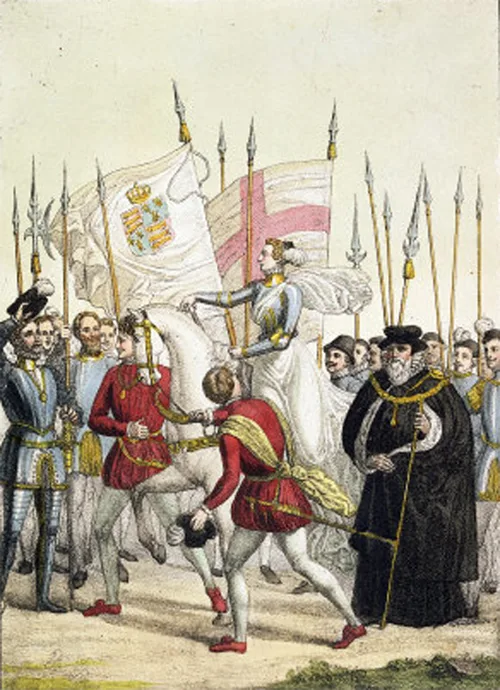
The Speech to the Troops at Tilbury was delivered on 9 August Old Style (19 August New Style) 1588 by Queen Elizabeth I of England to the land forces earlier assembled at Tilbury in Essex in preparation for repelling the expected invasion by the Spanish Armada.
Before the speech the Armada had been driven from the Strait of Dover in the Battle of Gravelines eleven days earlier, and had by then rounded Scotland on its way home, but troops were still held at ready in case the Spanish army of Alexander Farnese, Duke of Parma, might yet attempt to invade from Dunkirk; two days later they were discharged. On the day of the speech, the Queen left her bodyguard before Tilbury Fort and went among her subjects with an escort of six men. Lord Ormonde walked ahead with the Sword of State; he was followed by a page leading the Queen's charger and another bearing her silver helmet on a cushion; then came the Queen herself, in white with a silver cuirass and mounted on a grey gelding. She was flanked on horseback by her lieutenant general the Earl of Leicester on the right, and on the left by the Earl of Essex, her Master of the Horse. Sir John Norreys brought up the rear.
First version
The version that is most widely considered to be authentic was found in a letter from Leonel Sharp to the Duke of Buckingham. Sharp had been attached to the Earl of Leicester at Tilbury during the threatened invasion of the Armada and he later became chaplain to Buckingham. Sharp wrote: "The queen the next morning rode through all the squadrons of her army as armed Pallas attended by noble footmen, Leicester, Essex, and Norris, then lord marshal, and divers other great lords. Where she made an excellent oration to her army, which the next day after her departure, I was commanded to redeliver all the army together, to keep a public fast". He also claimed: "No man hath it but myself, and such as I have given it to". It was published in 1654 in a collection titled Cabala, Mysteries of State. A late sixteenth- or early seventeenth-century copy of this speech (with minor variants to the published version) exists in the Harleian Collection of the British Library.
Authenticity
The speech's veracity was accepted by the historian J. E. Neale in an article, 'The Sayings of Queen Elizabeth': "I see no serious reason for rejecting the speech. ...
From Wikipedia (CC BY-SA 4.0).