




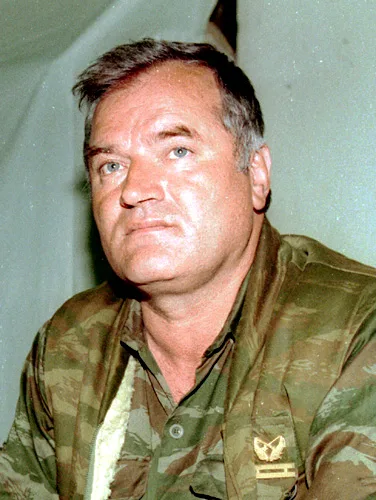
The Srebrenica massacre, also known as the Srebrenica genocide, was the July 1995 genocidal killing of more than 8,000 Bosniak men and boys in and around the town of Srebrenica during the Bosnian War. It was mainly perpetrated by units of the Bosnian Serb Army of Republika Srpska under Ratko Mladić, though the Serb paramilitary unit Scorpions also participated. In addition, 25,000 to 30,000 Bosniaks, mainly women and children, were abused and forcibly moved out of Srebrenica. The massacre constitutes the first legally recognised genocide in Europe since the end of World War II.
Before the massacre, the United Nations (UN) had declared the besieged enclave of Srebrenica a "safe area" under its protection. A UN Protection Force contingent of 370 lightly armed Dutch soldiers failed to deter the town's capture and subsequent massacre. On 13 July, peacekeepers handed over some 5,000 Muslims sheltering at the Dutch base in exchange for the release of 14 Dutch peacekeepers held by the Bosnian Serbs.
A list of people missing or killed during the massacre contains 8,372 names. The Research and Documentation Center in Sarajevo established that 83% of those killed were civilians. As of 2020, nearly 7,000 genocide victims had been identified through DNA analysis of body parts recovered from mass graves. Some Serbs have claimed the massacre was retaliation for civilian casualties inflicted on Bosnian Serbs by Bosniak soldiers from Srebrenica under the command of Naser Orić. These 'revenge' claims have been rejected and condemned by the International Criminal Tribunal for the former Yugoslavia (ICTY) and the UN.
The Appeals Chamber of the ICTY (in 2004) and the International Court of Justice (in 2007) have ruled the Srebrenica massacre constituted genocide. In 2002, the government of the Netherlands resigned, citing its inability to prevent the massacre. In 2013, 2014 and 2019, the Dutch state was found liable by its supreme court and the Hague district court, of failing to prevent more than 300 deaths. In 2013, Serbian president Tomislav Nikolić apologised for "the crime" of Srebrenica but refused to call it genocide.
In 2005, then UN Secretary-General Kofi Annan described the massacre as "a terrible crime – the worst on European soil since the Second World War", and in May 2024, the UN designated 11 July as the annual International Day of Reflection and Commemoration of the 1995 Genocide in Srebrenica.
Contents
Background
Conflict in Eastern Bosnia and Herzegovina
The Socialist Republic of Bosnia and Herzegovina was inhabited by mainly Muslim Bosniaks (44%), Orthodox Serbs (31%) and Catholic Croats (17%). As the former Yugoslavia began to disintegrate, the republic declared national sovereignty in 1991 and held a referendum for independence in February 1992. The result, which favoured independence, was opposed by Bosnian Serb political representatives, who boycotted the referendum. The Republic of Bosnia and Herzegovina was formally recognised by the European Community in April 1992 and the United Nations in May 1992.
Following the declaration of independence, Bosnian Serb forces, supported by the Serbian government of Slobodan Milošević and the Yugoslav People's Army (JNA), attacked Bosnia and Herzegovina, to secure and unify the territory under Serb control, and create an ethnically homogenous Serb state of Republika Srpska. In the struggle for territorial control, the non-Serb populations from areas under Serbian control, especially the Bosniak population in eastern Bosnia, near the Serbian borders, were subject to ethnic cleansing.
Ethnic cleansing
Srebrenica, and the surrounding Central Podrinje region, had immense strategic importance to the Bosnian Serb leadership. It was the bridge to disconnected parts of the envisioned ethnic state of Republika Srpska. Capturing Srebrenica and eliminating its Muslim population would also undermine the viability of the Bosnian Muslim state.
In 1991, 73% of the population in Srebrenica were Bosnian Muslims and 25% Bosnian Serbs. Tension between Muslims and Serbs intensified in the early 1990s, as the local Serb population were provided with weapons and military equipment distributed by Serb paramilitary groups, the JNA and the Serb Democratic Party (Srpska demokratska stranka, SDS).
By April 1992, Srebrenica had become isolated by Serb forces. On 17 April, the Bosnian Muslim population was given a 24-hour ultimatum to surrender all weapons and leave town. Srebrenica was briefly captured by the Bosnian Serbs and retaken by Bosnian Muslims on 8 May 1992. Nonetheless, the Bosnian Muslims remained surrounded by Serb forces, and cut off from outlying areas. The Naser Orić trial judgment described the situation:
Between April 1992 and March 1993 ... Srebrenica and the villages in the area held by Bosnian Muslims were constantly subjected to Serb military assaults, including artillery attacks, sniper fire ... occasional bombing from aircraft. Each onslaught followed a similar pattern. Serb soldiers and paramilitaries surrounded a Bosnian Muslim village ... called upon the population to surrender their weapons, and then began with indiscriminate shelling and shooting ... they then entered the village ... expelled or killed the population, who offered no significant resistance, and destroyed their homes ... Srebrenica was subjected to indiscriminate shelling from all directions daily. Potočari, in particular, was a daily target ... because it was a sensitive point in the defence line around Srebrenica. Other Bosnian Muslim settlements were routinely attacked as well. All this resulted in a great number of refugees and casualties.
Between April and June 1992, Bosnian Serb forces, with support from the JNA, destroyed 296 predominantly Bosniak villages around Srebrenica, forcibly uprooted 70,000 Bosniaks from their homes and systematically massacred at least 3,166 Bosniaks, including women, children and elderly. In neighbouring Bratunac, Bosniaks were either killed or forced to flee to Srebrenica, resulting in 1,156 deaths. Thousands of Bosniaks were killed in Foča, Zvornik, Cerska and Snagovo.
1992–1993: Struggle for Srebrenica
Over the remainder of 1992, offensives by Bosnian government forces from Srebrenica increased the area under their control. In July 1992 Bosnian forces attacked neighbouring Serb villages in Srebrenica and Bratunac, killing 69. By January 1993 they had linked with Bosniak-held Žepa to the south and Cerska to the west. The Srebrenica enclave had reached its peak size of 900 square kilometres (350 square miles), though it was never linked to the main area of Bosnian-government controlled land in the west and remained "a vulnerable island amid Serb-controlled territory". Army of the Republic of Bosnia and Herzegovina (ARBiH) forces under Naser Orić used Srebrenica as a staging ground to attack neighboring Serb villages inflicting many casualties. In 1993, the Serb village of Kravica was attacked by ARBiH, which resulted in Serb civilian casualties. The resistance to the Serb siege of Srebrenica, by the ARBiH under Orić, was seen as a catalyst for the massacre.
Serbs started persecuting Bosniaks in 1992. Serbian propaganda deemed Bosniak resistance to Serb attacks as a ground for revenge. According to French General Philippe Morillon, Commander of the UN Protection Force (UNPROFOR), in testimony at the ICTY in 2004:
Over the next few months, the Serb military captured the villages of Konjević Polje and Cerska, severing the link between Srebrenica and Žepa, and reducing the Srebrenica enclave to 150 square kilometres. Bosniak residents of the outlying areas converged on Srebrenica and its population swelled to between 50,000 and 60,000, about ten times the pre-war population. General Morillon visited Srebrenica in March 1993. The town was overcrowded and siege conditions prevailed. There was almost no running water as the advancing Serb forces had destroyed water supplies; people relied on makeshift generators for electricity. Food, medicine and other essentials were scarce. The conditions rendered Srebrenica a slow death camp. Morillon told panicked residents at a public gathering that the town was under the protection of the UN, and he would never abandon them. During March and April 1993 several thousand Bosniaks were evacuated, under the auspices of the UN High Commissioner for Refugees (UNHCR). The evacuations were opposed by the Bosnian government in Sarajevo, as contributing to the ethnic cleansing of predominantly Bosniak territory.
The Serb authorities remained intent on capturing the enclave. On 13 April 1993, the Serbs told the UNHCR representatives that they would attack the town within two days unless the Bosniaks surrendered and agreed to be evacuated.
1993–1995: Srebrenica "safe area"
On 16 April 1993, the United Nations Security Council passed Resolution 819, which demanded "all parties ... treat Srebrenica and its surroundings as a safe area which should be free from any armed attack or ... hostile act". On 18 April, the first group of UNPROFOR troops arrived in Srebrenica. UNPROFOR deployed Canadian troops to protect it as one of five newly established UN "safe areas". UNPROFOR's presence prevented an all-out assault, though skirmishes and mortar attacks continued.
On 8 May 1993, an agreement was reached for demilitarization of Srebrenica. According to a UN report, General [Sefer] Halilović and General Mladić agreed on measures covering the whole of the Srebrenica enclave and ... Žepa. ... Bosniac forces ... would hand over their weapons, ammunition and mines to UNPROFOR, after which Serb 'heavy weapons and units that constitute a menace to the demilitarised zones ... will be withdrawn.' Unlike the earlier agreement, it stated specifically that Srebrenica was to be considered a 'demilitarised zone', as referred to in the ... Geneva Conventions. Both parties violated the agreement, though two years of relative stability followed the establishment of the enclave. Lieutenant colonel Thom Karremans (the Dutchbat Commander) testified that his personnel were prevented from returning to the enclave by Serb forces, and that equipment and ammunition were prevented from getting in. Bosniaks in Srebrenica complained of attacks by Serb soldiers, while to the Serbs it appeared Bosnian forces were using the "safe area", as a convenient base to launch counter-offensives and UNPROFOR was failing to prevent it. General Sefer Halilović admitted ARBiH helicopters had flown in violation of the no-fly zone and he had dispatched eight helicopters with ammunition for the 28th Division.
Between 1,000 and 2,000 soldiers from the VRS Drina Corps Brigades were deployed around the enclave, equipped with tanks, armoured vehicles, artillery and mortars. The 28th Mountain Division of the ARBiH in the enclave was neither well organised nor equipped, and lacked a firm command structure and communications system. Some of its soldiers carried old hunting rifles or no weapons, few had proper uniforms.
A Security Council mission led by Diego Arria arrived on 25 April 1993 and, in their report to the UN, condemned the Serbs for perpetrating "a slow-motion process of genocide". The mission stated "Serb forces must withdraw to points from which they cannot attack, harass or terrorise the town." Specific instructions from UN Headquarters in New York City stated UNPROFOR should not be too zealous in searching for Bosniak weapons and the Serbs should withdraw their heavy weapons before the Bosniaks disarmed, which the Serbs never did.
Massacre
The two highest-ranking Serb politicians from Bosnia and Herzegovina, Karadžić and Momčilo Krajišnik, both indicted for genocide, were warned by VRS commander Mladić (found guilty of genocide in 2017) that their plans could not be realized without committing genocide. Mladić said at a parliamentary session of 12 May 1992:
People are not little stones or keys in someone's pocket, that can be moved from one place to another just like that. ... Therefore, we cannot precisely arrange for only Serbs to stay in one part of the country while removing others painlessly. I do not know how Mr. Krajišnik and Mr. Karadžić will explain that to the world. That is genocide.
Increasing concentration of refugees in Potočari
By the evening of 11 July, approximately 20,000–25,000 Bosniak refugees from Srebrenica were gathered in Potočari, seeking protection within the UNPROFOR Dutchbat headquarters. Several thousand had pressed inside the compound, while the rest were spread throughout neighbouring factories and fields. Though most were women, children, elderly or disabled, 63 witnesses estimated there were at least 300 men inside the compound and between 600 and 900 in the crowd outside.
Conditions included "little food or water" and sweltering heat. A UNPROFOR Dutchbat officer described the scene:
They were panicked, they were scared, and they were pressing each other against the soldiers, my soldiers, the UN soldiers that tried to calm them. People who fell were trampled on. It was a chaotic situation.
On 12 July, the UN Security Council, in Resolution 1004, expressed concern at the humanitarian situation in Potočari, condemned the offensive by Bosnian Serb forces and demanded immediate withdrawal. On 13 July, the Dutch forces expelled five Bosniak refugees from the compound despite knowing men outside were being killed.
Crimes committed in Potočari
On 12 July, the refugees in the compound could see VRS members setting houses and haystacks on fire. Throughout the afternoon, Serb soldiers mingled in the crowd and summary executions of men occurred. In the morning of 12 July, a witness saw a pile of 20–30 bodies heaped up behind the Transport Building, alongside a tractor-like machine. Another testified he saw a soldier slay a child with a knife, in the middle of a crowd of expellees. He said he saw Serb soldiers execute over 100 Bosniak men behind the Zinc Factory, then load their bodies onto a truck, though the number and nature of the murders contrasted with other evidence in the Trial Record, which indicated killings in Potočari were sporadic in nature. Soldiers were picking people out of the crowd and taking them away. A witness recounted how three brothers – one a child, the others in their teens – were taken out in the night. When the boys' mother went looking for them, she found them naked and with their throats slit.
That night, a Dutchbat medical orderly witnessed two Serb soldiers raping a woman. A survivor, Zarfa Turković, described the horrors: "Two [Serb soldiers] took her legs and raised them in the air, while the third began raping her. Four of them were taking turns on her. People were silent, and no one moved. She was screaming and yelling and begging them to stop. They put a rag into her mouth, and then we just heard silent sobs."
From the morning of 12 July, Serb forces began gathering men and boys from the refugee population in Potočari and holding them in separate locations, and as the refugees began boarding the buses headed north towards Bosniak-held territory, Serb soldiers separated men of military age who were trying to clamber aboard. Occasionally, younger and older men were stopped as well (some as young as 14). These men were taken to a building referred to as the "White House". By the evening of 12 July, Major Franken of Dutchbat heard that no men were arriving with the women and children, at their destination in Kladanj. UNHCR Director of Operations Peter Walsh was dispatched to Srebrenica by Chief of Mission, Damaso Feci, to evaluate what emergency aid could be provided rapidly. Walsh and his team arrived at Gostilj, just outside Srebrenica, in the afternoon only to be turned away by VRS forces. Despite claiming freedom of movement rights, the UNHCR team was not allowed to proceed and forced to head back north to Bijeljina. Throughout, Walsh relayed reports back to UNHCR in Zagreb about the unfolding situation, including witnessing the enforced movement and abuse of Muslim men and boys, and the sound of executions taking place.
Column of Bosniak men
On the evening of 11 July, word spread that able-bodied men should take to the woods, form a column with the ARBiH's 28th Division and attempt a breakthrough towards Bosnian government-held territory in the north. They believed they stood a better chance of surviving by trying to escape, than if they fell into Serb hands. Around 10 pm on 11 July the Division command, with the municipal authorities, took the decision to form a column and attempt to reach government territory around Tuzla. Dehydration, along with lack of sleep and exhaustion were further problems; there was little cohesion or common purpose. Along the way, the column was shelled and ambushed. In severe mental distress, some refugees killed themselves. Others were induced to surrender. Survivors claimed they were attacked with a chemical agent that caused hallucinations, disorientation and strange behaviour. Infiltrators in civilian clothing confused, attacked and killed refugees. Many taken prisoner were killed on the spot. Others were collected and taken to remote locations, for execution.
The attacks broke the column into smaller segments. Only about one third succeeded in crossing the asphalt road between Konjević Polje and Nova Kasaba. This group reached Bosnian government territory on and after 16 July. A second, smaller group (700–800) attempted to escape into Serbia. It is not known how many were intercepted and killed. A third group headed for Žepa; estimates of how many vary between 300 and 850. Pockets of resistance apparently remained behind and engaged Serb forces.
Almost all the 28th Division, 5,500 to 6,000 soldiers, not all armed, gathered in Šušnjari, in the hills north of Srebrenica, along with about 7,000 civilians. They included a few women. Others assembled in the nearby village of Jaglići.
Around midnight, the column started moving along the axis between Konjević Polje and Bratunac. It was preceded by four scouts, 5 km ahead. Members walked one behind the other, following a trail a demining unit had marked with paper to guide them.
The column was led by 50–100 of the best soldiers from each brigade, carrying the best equipment. Elements of the 284th Brigade were followed by the 280th Brigade. Civilians accompanied by other soldiers followed, and at the back was the independent battalion. The command and armed men were at the front, following the deminer unit. Others included political leaders of the enclave, medical staff and families of prominent Srebrenicans. A few women, children and elderly travelled with the column in the woods. The column was 12–15 km long, two and a half hours separating head from tail.
A plan to execute the men
Although Serb forces had long been blamed for the massacre, it was not until 2004—following the Srebrenica Commission's report—that Serb officials acknowledged their forces carried out the mass killing. Their report acknowledged the mass murder of the men and boys was planned, and more than 7,800 were killed.
A concerted effort was made to capture all Bosniak men of military age. In fact, those captured included many boys well below that age, and men years above that age, who remained in the enclave following the take-over of Srebrenica. These men and boys were targeted, regardless of whether they chose to flee to Potočari or join the column. The operation to capture and detain the men was well-organised and comprehensive. The buses which transported women and children, were systematically searched for men.
Mass executions
The amount of planning and high-level coordination invested in killing thousands in a few days, is apparent from the scale and methodical nature in which the executions were carried out.
The VRS took the largest number of prisoners on 13 July, along the Bratunac–Konjević Polje road. Witnesses describe the assembly points, such as the field at Sandići, agricultural warehouses in Kravica, the school in Konjević Polje, the football pitch in Nova Kasaba, Lolići and Luke school. Several thousand people were herded in the field near Sandići and on the Nova Kasaba pitch, where they were searched and put into smaller groups. In a video by journalist Zoran Petrović, a Serb soldier states that at least 3,000–4,000 men gave themselves up on the road. By the late afternoon of 13 July, the total had risen to 6,000 according to intercepted radio communication; the following day, Major Franken of Dutchbat was given the same figure by Colonel Radislav Janković of the Serb army. Many prisoners had been seen in the locations described, by passing convoys taking women and children to Kladanj by bus, while aerial photos provided evidence to confirm this.
One hour after the evacuation of women from Potočari was complete, the Drina Corps staff diverted the buses to the areas in which the men were being held. Colonel Krsmanović, who on 12 July had arranged the buses for the evacuation, ordered the 700 men in Sandići to be collected, and the soldiers guarding them, made them throw their possessions on a heap and hand over valuables. During the afternoon, the group in Sandići was visited by Mladić, who told them they would come to no harm, be treated as prisoners of war, exchanged for other prisoners, and that their families had been escorted to Tuzla in safety. Some men were placed on transports to Bratunac and other locations, while some were marched to warehouses in Kravica. The men gathered on the pitch at Nova Kasaba were forced to hand over belongings. They too received a visit from Mladić during the afternoon of 13 July; on this occasion, he announced that the Bosnian authorities in Tuzla did not want them and so they were to be taken elsewhere. The men in Nova Kasaba were loaded onto buses and trucks and taken to Bratunac, or other locations.
The Bosniak men who had been separated from the women, children and elderly in Potočari, numbering approximately 1,000, were transported to Bratunac and joined by Bosniak men captured from the column. Almost without exception, the thousands of prisoners captured after the take-over were executed. Some were killed individually, or in small groups, by the soldiers who captured them. Most were killed in carefully orchestrated mass executions, commencing on 13 July, just north of Srebrenica.
After the massacre
During the days following the massacre, US spy planes overflew Srebrenica and took photos showing the ground in vast areas around the town had been removed, a sign of mass burials.
On 22 July, the commanding officer of the Zvornik Brigade, Lieutenant Colonel Vinko Pandurević, requested the Drina Corps set up a committee to oversee the exchange of prisoners. He asked for instructions on where the prisoners of war his unit had already captured should be taken and to whom they should be handed over. Approximately 50 wounded captives were taken to the Bratunac hospital. Another group was taken to the Batković camp, and these were mostly exchanged later. On 25 July, the Zvornik Brigade captured 25 more ARBiH soldiers who were taken directly to the camp at Batković, as were 34 ARBiH men captured the following day. Zvornik Brigade reports up until 31 July continue to describe the search for refugees and the capture of small groups of Bosniaks.
Several Bosniaks managed to cross over the River Drina into Serbia at Ljubovija and Bajina Bašta. 38 were returned to RS. Some were taken to the Batković camp, where they were exchanged. The fate of the majority has not been established. Some attempting to cross the Drina drowned.
By 17 July, 201 Bosniak soldiers had arrived in Žepa, exhausted and many with light wounds. By 28 July, another 500 had arrived in Žepa from Srebrenica. After 19 July, small Bosniak groups were hiding in the woods for days and months, trying to reach Tuzla. Numerous refugees found themselves cut off in the area around Mount Udrc. They did not know what to do next or where to go; they managed to stay alive by eating vegetables and snails. The MT Udrc had become a place for ambushing marchers, and the Bosnian Serbs swept through and, according to one survivor, killed many people there.
Meanwhile, the VRS had commenced the process of clearing the bodies from around Srebrenica, Žepa, Kamenica and Snagovo. Work parties and municipal services were deployed to help. In Srebrenica, the refuse that had littered the streets since the departure of the people was collected and burnt, the town disinfected and deloused.
Many people in the part of the column which had not succeeded in passing Kamenica, did not wish to give themselves up and decided to turn back towards Žepa. Others remained where they were, splitting up into smaller groups of no more than ten. Some wandered around for months, either alone or groups of two, four or six men. Once Žepa had succumbed to the Serb pressure, they had to move on once more, either trying to reach Tuzla or crossing the River Drina into Serbia.
Greek volunteers controversy
10 Greek volunteers fought alongside the Serbs in the fall of Srebrenica. They were members of the Greek Volunteer Guard, a contingent of paramilitaries requested by Mladić, as an integral part of the Drina Corps. The volunteers were motivated to support their "Orthodox brothers" in battle. They raised the Greek flag at Srebrenica, at Mladić's request, to honour "the brave Greeks fighting on our side" and Karadžić decorated four. In 2005, Greek deputy Andrianopoulos called for an investigation, Justice Minister Anastasios Papaligouras commissioned an inquiry and in 2011, a judge said there was insufficient evidence to proceed. In 2009, Stavros Vitalis announced the volunteers were suing Takis Michas for libel over allegations in his book Unholy Alliance, which described Greece's support for the Serbs during the war. Insisting the volunteers had simply taken part in the "re-occupation" of Srebrenica, Vitalis was present with Serb officers in "all military operations".
Post-war developments
1995–2000: Indictments and UN Secretary-General's report
In November 1995, Karadžić and Mladić were indicted by the ICTY for their alleged direct responsibility for the war crimes committed against the Bosnian Muslim population of Srebrenica. In 1999, UN Secretary-General Kofi Annan submitted his report on the fall of Srebrenica. He acknowledged the international community as a whole had to accept its share of responsibility, for its response to the ethnic cleansing that culminated in the murder of 7,000 unarmed civilians from the town designated by the Security Council as a "safe area".
2002: Dutch government report
The failure of Dutchbat to protect the enclave became a national trauma in the Netherlands and led to long-running discussions. In 1996, the Dutch government asked the NIOD Institute for War, Holocaust and Genocide Studies to research the events. The report was published in 2002—Srebrenica: a 'safe' area. It concluded the Dutchbat mission was not well considered and well-nigh impossible. The report is often cited; however, the Institute for War and Peace Reporting labelled it "controversial", as "the sheer abundance of information makes it possible for anyone to pluck from it whatever they need to make their point". One author claimed some sources were "unreliable", and only used to support another author's argument. Responding to the report, the Dutch government accepted partial political responsibility for the circumstances in which the massacre happened and the second Kok cabinet resigned.
2002: First Republika Srpska report
In September 2002, the Republika Srpska Office of Relations with the ICTY issued the Report about Case Srebrenica. The document, by Darko Trifunović, was endorsed by leading Bosnian Serb politicians. It concluded that 1,800 Bosnian Muslim soldiers died during fighting and a 100 more from exhaustion. "The number of Muslim soldiers killed by Bosnian Serbs out of personal revenge or lack of knowledge of international law is probably about 100 ... It is important to uncover the names of the perpetrators to accurately and unequivocally establish whether or not these were isolated instances." The report examined the mass graves, claiming they were made for hygiene reasons, questioning the legitimacy of the missing person lists and undermining a key witness' mental health and military history. The International Crisis Group and UN condemned the manipulation of their statements.
2003: Srebrenica Genocide Memorial
In September 2003, former US President Bill Clinton officially opened the Srebrenica Genocide Memorial to honour the victims of the genocide. The total cost was around $6 million. "We must pay tribute to the innocent lives, many of them children who were snuffed out in what must be called genocidal madness", Clinton said.
2004: Second Republika Srpska report and apology
In March 2003, the Human Rights Chamber for Bosnia and Herzegovina directed the Republika Srpska (RS) to conduct a full investigation into the events at Srebrenica, and to report its results by September of that year. The Chamber had no power to implement the directive, after its dissolution in late 2003. The RS published reports in September 2003, which the Human Rights Chamber concluded did not fulfil the RS' obligations. In October 2003, the High Representative, Paddy Ashdown, lamented that "getting the truth from the [Bosnian Serb] government is like extracting rotten teeth". He did, however, welcome a recommendation to form an independent commission to investigate Srebrenica and issue a report within six months.
The Srebrenica Commission, officially named the Commission for Investigation of the Events in and around Srebrenica between 10 and 19 July 1995, was established in December 2003, and submitted its final report on 4 June 2004, and then an addendum in October 2004, after delayed information had been supplied. The report acknowledged men and boys were killed by Bosnian Serbs, citing a provisional figure of 7,800. Because of "limited time" and the need to "maximize resources", the commission "accepted the historical background and the facts stated in the second-instance judgment Prosecutor v. Radislav Krstić, when the ICTY convicted him for 'assisting and supporting genocide' in Srebrenica".
The findings remain disputed by Serb nationalists, who claim it was pressured by the High Representative, given the earlier RS government report which exonerated the Serbs was dismissed. Nevertheless, Dragan Čavić, the president of Republika Srpska, acknowledged in a televised address that Serb forces killed several thousand civilians in violation of international law, and asserted that Srebrenica was a dark chapter in Serb history. On 10 November 2004, the government of Republika Srpska issued an official apology. The statement came after a government review of the report. "The report makes it clear that enormous crimes were committed in the area of Srebrenica in July 1995. The Bosnian Serb Government shares the pain of the families of the Srebrenica victims, is truly sorry and apologises for the tragedy", the Bosnian Serb government said.
After a request by Ashdown, the RS established a working group to implement the recommendations of the report by the Srebrenica Commission. The group was to analyze the documentation in the report's confidential annexes and identify all possible perpetrators who were officials in RS institutions. A report on 1 April 2005 identified 892 such persons still employed by the RS, and the information was provided to the State Prosecutor of Bosnia and Herzegovina, with the understanding names would not be made public until official proceedings opened. On 4 October 2005, the working group said they had identified 25,083 people who were involved in the massacre, including 19,473 members of Bosnian Serb armed forces that actively gave orders or directly took part.
2005: Release of Scorpions massacre video
On 1 June 2005, video evidence was introduced at the Slobodan Milošević trial to testify to the involvement of police from Serbia in the massacre. The video, the only undestroyed copy of 20 which had previously been available for rental in the Serbian town of Šid, was submitted to the ICTY by Nataša Kandić, director of the Belgrade-based Humanitarian Law Center.
The video shows an Orthodox priest blessing members of a Serbian unit known as the Scorpions. Later these soldiers are shown physically abusing civilians. The civilians were later identified as four minors as young as 16 and two men in their early twenties. The footage shows the execution of four of them and them lying dead in a field. The soldiers later order the two remaining captives to take the dead bodies into a nearby barn, after completing this, they are also killed.
The video caused outrage in Serbia. Following its showing, the Serbian government arrested some former soldiers identified on it. The event was covered by the Danas newspaper, and radio and television station B92. Nura Alispahić, mother of 16-year-old Azmir Alispahić, saw her son's execution on television. She said she was already aware of his death and had been told his body was burned following the execution; his remains were among those buried in Potočari in 2003. The executions took place on 16–17 July, in Trnovo, about 30 minutes from the Scorpions' base near Sarajevo.
On 10 April 2007, a special war crimes court in Belgrade convicted four former members of the Scorpions of war crimes, but concluded that the killings were isolated war crimes and that there was insufficient evidence to tie them to the Srebrenica genocide or to endorse allegations that the Scorpions were acting under the authority of the Serbian Interior Ministry (MUP).
2005: 10th anniversary
In June 2005, the United States House of Representatives passed a resolution commemorating the 10th anniversary, by 370 to 1 (Ron Paul). It stated the "innocent people executed at Srebrenica ... should be solemnly remembered and honored; the policies ... implemented by Serb forces ... meet the terms ... in ... the Convention on the Prevention and Punishment of the Crime of Genocide." Missouri passed a resolution recognising the genocide and St. Louis issued a proclamation declaring 11 July Srebrenica Remembrance Day.
In his message to the commemoration, UN Secretary-General Kofi Annan paid tribute to the victims of "a terrible crime – the worst on European soil since the Second World War", on a date "marked as a grim reminder of man's inhumanity to man". He said the "first duty of the international community was to uncover and confront the full truth about what happened, a hard truth for those who serve the UN because great nations failed to respond adequately. There should have been stronger military forces in place, and a stronger will to use them". Annan added that the UN bore its share of responsibility, having made serious errors of judgement, "rooted in a philosophy of impartiality and non-violence which, however admirable, was unsuited to the conflict in Bosnia; because of that the tragedy of Srebrenica would haunt the UN's history forever". Bosnian Serb police found bombs at the memorial site, just days before the ceremony, when more than 50,000 people, including international politicians, were to attend. The bombs would have caused widespread loss of life.
2006: Further mass graves and list of participants
By 2006, 42 mass graves had been uncovered. 2,070 victims had been identified, while body parts in 7,000 bags awaited identification. In August 2006 over 1,000 body parts were exhumed from a mass grave in Kamenica.
In August 2006, Sarajevan newspaper Oslobođenje published a list of 892 Bosnian Serbs who had allegedly participated in the massacre and believed to still be employed by state institutions. They were listed among 28,000 Bosnian Serbs reported to have taken part by a Republika Srpska report. The list had been withheld from publication with the report, by the chief prosecutor of the Bosnian War Crimes Chamber, Marinko Jurčević who claimed "publishing this information might jeopardise the ongoing investigations".
In December 2006, the Dutch government awarded the Dutch UN peacekeepers an insignia because they believed they "deserved recognition for their behaviour in difficult circumstances", noting the limited mandate and ill-equipped mission. However, survivors and relatives called it a "humiliating decision" and responded with protest rallies in The Hague, Assen and Sarajevo.
2007–08: Arrests of Tolimir and Karadžić
In May 2007, former Bosnian Serb general Zdravko Tolimir was apprehended by police from Serbia and Republika Srpska. He was turned over to NATO forces at the Banja Luka International Airport where he was read the ICTY indictment and arrested. Mladić's deputy in charge of intelligence and security, and a key commander, Tolimir is believed to have been an organiser of the network protecting Mladić, helping him elude justice. Tolimir—"Chemical Zdravko"—is infamous for requesting the use of chemical weapons and proposing military strikes against refugees at Žepa. In June 2007, he was turned over to the ICTY. Radovan Karadžić, with similar charges, was arrested in Belgrade in 2008, after 13 years on the run, and brought before Belgrade's War Crimes Court.
2009: EU Parliament resolution
On 15 January 2009, the European Parliament voted in favour of a resolution calling for recognition of 11 July as a day for EU commemoration of the genocide. Bosnian Serb politicians rejected it, stating such a commemoration is unacceptable to the Republika Srpska.
2010 and 2013: Serbia's official apologies
In 2010, the Serbian Parliament passed a resolution condemning the massacre, and apologizing for Serbia not doing more to prevent it. The motion was passed narrowly with 127 out of 250 MPs voting in favour, with 173 legislators present. The Socialist Party of Serbia, formerly under Slobodan Milošević and under new leadership, voted for. Opposition parties claimed the text was "shameful", either stating the wording was too strong or too weak. Some victims' relatives were unhappy with the apology, as it did not use the word 'genocide', but rather pointed at the Bosnian genocide case ruling. President Boris Tadić said the declaration is the highest expression of patriotism and it represents distancing from the crimes. Sulejman Tihić, former Bosniak member of the Presidency of Bosnia and Herzegovina, stated that Bosnia and Herzegovina must adopt a similar resolution condemning crimes against Serbs and Croats. In April 2013, President Tomislav Nikolić stated: "I kneel and ask for forgiveness for Serbia for the crime committed in Srebrenica. I apologise for the crimes committed by any individual in the name of our state and our people."
2010: Second Republika Srpska report revision
On 21 April 2010, the government of Milorad Dodik, the prime minister of Republika Srpska, initiated a revision of the 2004 report saying the numbers killed were exaggerated and the report was manipulated by a former peace envoy. The Office of the High Representative responded by saying: "The Republika Srpska government should reconsider its conclusions and align itself with the facts and legal requirements and act accordingly, rather than inflicting emotional distress on the survivors, torture history and denigrate the public image of the country". On 12 July 2010, at the 15th anniversary, Milorad Dodik said he acknowledged the killings, but did not regard what happened as genocide.
2011: Arrest of Mladić
In May 2011, Mladić was arrested in Lazarevo, Serbia after remaining at large for 16 years, sheltered by Serbian and Bosnian Serb security forces and family. His capture was considered to be a pre-condition for Serbia obtaining candidate status for EU membership.
2015: Russia vetoes UN resolution
In July 2015, Russia vetoed a United Nations Security Council resolution that would have condemned the massacre as a genocide. It was intended to mark the 20th anniversary. China, Nigeria, Angola and Venezuela abstained and the remaining 10 members voted in favour. The veto was praised by Serbian President Tomislav Nikolić who said Russia had "prevented an attempt of smearing the entire Serbian nation as genocidal" and proven itself as a true and honest friend.
2024: International Day of Commemoration
In May 2024, 11 July was designated as the annual International Day of Reflection and Commemoration of the 1995 Genocide in Srebrenica by United Nations General Assembly Resolution 78/282.
The UN resolution, which was sponsored by Germany and Rwanda, was passed with 84 countries voting for the resolution, 68 abstaining, and 19 voting against. Politico described Serbia launching a "full-blown diplomatic offensive" to block the initiative, with Serbian leaders staging multiple press conferences and visiting the UN headquarters to meet with key stakeholders to try to sway the vote.
Victims
The Bosnian Book of the Dead documented 8,331 victims killed in the massacre. The figure includes 1,416 soldiers who were taken as prisoners of war, or 17%, meaning that 83% killed were civilians. Of the 8,331, 5,113 were from Srebrenica, 1,766 from Bratunac, 900 from Vlasenica, 437 from Zvornik and 115 from Rogatica/Žepa.
As of July 2020 the International Commission on Missing Persons (ICMP) had identified 6,993 persons missing from the fall of Srebrenica, mostly through analysing DNA profiles extracted from exhumed remains and matching them to profiles of relatives of the missing. The ICMP estimates total deaths was just over 8,000.
Legal proceedings
International Criminal Tribunal for the former Yugoslavia
In 1993, the UN Security Council established the International Criminal Tribunal for the former Yugoslavia (ICTY) to try those responsible for violations of international humanitarian law, including genocide.
General Radislav Krstić, who led the assault alongside Mladić, was convicted in 2001 of aiding and abetting genocide and received a sentence of 35 years. Colonel Vidoje Blagojević received 18 years for crimes against humanity. Krstić was the first European to be convicted of genocide since the Nuremberg trials, and only the third person convicted under the 1948 Genocide Convention. The ICTY's final ruling against Krstić, legally recognized the Srebrenica massacre, as an act of genocide:
By seeking to eliminate a part of the Bosnian Muslims, the Bosnian Serb forces committed genocide. They targeted for extinction the 40,000 Bosnian Muslims living in Srebrenica, a group which was emblematic of the Bosnian Muslims in general. They stripped all the male Muslim prisoners, military and civilian, elderly and young, of their personal belongings and identification, and deliberately and methodically killed them solely on the basis of their identity.
Milošević was accused of genocide, or complicity in genocide, including in Srebrenica, but died in 2006 during his trial. In June 2010, seven senior Serb military and police officers, Vujadin Popović, Ljubiša Beara, Drago Nikolić, Ljubomir Borovčanin, Vinko Pandurević, Radivoje Miletić and Milan Gvero, were found guilty of various crimes, including genocide. The former chief of the general staff of the Yugoslav Army, Momčilo Perišić, was sentenced to 27 years for aiding and abetting murder, because he provided salaries, ammunition, staff and fuel to the VRS officers. However, the evidence proved Perišić's inability to impose binding orders on Mladić. Zdravko Tolimir, a former general in the Army of the Republika Srpska, was accused of participating in the "criminal enterprise to remove the Muslim population" from Srebrenica and Žepa. He was convicted of genocide and sentenced to life imprisonment in 2012.
Radovan Karadžić and Ratko Mladić were indicted for genocide, and complicity in genocide, including in Srebrenica. The trial of Radovan Karadžić began in 2010, and in 2016 he was convicted of genocide in Srebrenica and other crimes; he was ultimately sentenced to life imprisonment. In 2017, the ICTY found Mladić guilty on 10 counts of war crimes, crimes against humanity and genocide, and sentenced him to life in prison. As the top military officer with command responsibility, Mladić was deemed responsible for the Srebrenica massacre.
International Court of Justice
The Srebrenica genocide was the core issue of the landmark Bosnian genocide case at the International Court of Justice (ICJ) through which Bosnia and Herzegovina accused Serbia and Montenegro of genocide. The ICJ presented its judgement in February 2007, which concurred with ICTY's recognition of the Srebrenica massacre as genocide. It cleared Serbia of direct involvement, but ruled that Belgrade breached international law by failing to prevent the genocide, and failing to try or transfer the persons accused to the ICTY, under its obligations in the Genocide Convention, particularly in respect of Mladić. Citing national security, Serbia obtained permission from the ICTY to keep parts of its military archives out of the public eye during Milošević's trial. This may have decisively affected the ICJ's judgement in the lawsuit against Serbia, as the archives were not on the ICTY's public record – although the ICJ could have, but did not, subpoena the documents. The Chief prosecutor's office, rejected allegations there was a deal with Belgrade to conceal documents from the ICJ case.
National courts
On 10 April 2007, a Serbian war crimes court sentenced four members of the Scorpions paramilitary group to a total of 58 years in prison for the execution of six Bosniaks during the Srebrenica massacre.
Guilty of war crimes
Pera Petrašević – sentenced to 13 years
Branislav Medić – sentenced to 15 years
Aleksandar Medić – sentenced to five years
Acquitted
Aleksandar Vukov
The Kravica case was an important trial before the Court of Bosnia and Herzegovina; 11 men were accused of genocide. In July 2008, after a two-year trial, the court found seven of them guilty of genocide for their role in Srebrenica, including the deaths of 1,000 Bosniak men in a single day. Men trying to escape were told they would be kept safe if they surrendered. Instead, they were transported to an agricultural cooperative in Kravica, and executed.
Guilty of genocide
Milenko Trifunović (commander of the 3rd "Skelani" Platoon, part of the 2nd Special Police Šekovići Squad) – sentenced to 42 years.
Brano Džinić (special police force officer of the 2nd Special Police Šekovići Squad) – sentenced to 42 years.
Slobodan Jakovljević (special police force member of the 3rd "Skelani" Platoon) – sentenced to 40 years.
Branislav Medan (special police force member of the 3rd "Skelani" Platoon) – sentenced to 40 years.
Petar Mitrović (special police force member of the 3rd "Skelani" Platoon) – sentenced to 38 years.
Analyses
Role of Bosnian forces
In response to the suggestion Bosniak forces in Srebrenica made no adequate attempt to defend the town, a report by the UN Secretary-General delivered to the United Nations General Assembly in 1999 states:
... military experts ... were largely in agreement that the Bosniaks could not have defended Srebrenica for long ... Many have accused the Bosniak forces of withdrawing from the enclave as the Serb forces advanced on the day of its fall. However ... the Dutchbat Commander urged the Bosniaks to withdraw from defensive positions south of Srebrenica town—the direction from which the Serbs were advancing ... because he believed that NATO aircraft would soon be launching widespread air strikes against the advancing Serbs.
A third accusation levelled at the Bosniak defenders of Srebrenica is that they provoked the Serb offensive by attacking out of that safe area ... there is no credible evidence to support it. Dutchbat personnel on the ground at the time assessed that the few "raids" the Bosniaks mounted out of Srebrenica were of little or no military significance. These raids were often organised in order to gather food, as the Serbs had refused access for humanitarian convoys into the enclave. Even Serb sources ... acknowledged that the Bosniak forces in Srebrenica posed no significant military threat to them. The biggest attack the Bosniaks launched out of Srebrenica ... appears to have been the raid on the village of Višnjica, on 26 June 1995, in which several houses were burned, up to four Serbs were killed and approximately 100 sheep were stolen. In contrast, the Serbs overran the enclave two weeks later, driving tens of thousands from their homes, and summarily executing thousands of men and boys. The Serbs repeatedly exaggerated the extent of the raids out of Srebrenica as a pretext for the prosecution of a central war aim: to create a geographically contiguous and ethnically pure territory along the Drina, while freeing their troops to fight in other parts of the country. The extent to which this pretext was accepted at face value by international actors and observers reflected the prism of "moral equivalency" through which the conflict in Bosnia was viewed by too many for too long.
Disputed Serb casualties
Serbs suffered casualties during military forays led by Naser Orić. The controversy over the nature and number of casualties came to a head in 2005. According to Human Rights Watch, the ultra-nationalist Serbian Radical Party "launched an aggressive campaign to prove that Muslims had committed crimes against thousands of Serbs in the area" which "was intended to diminish the significance of the July 1995 crime." A briefing by the ICTY Office of the Prosecutor (OTP) from July 2005 noted Serb deaths in the region alleged by Serbian authorities had increased from 1,400 to 3,500, a figure the OTP stated does, "not reflect the reality." The briefing cited previous accounts:
The Republika Srpska's Commission for War Crimes gave the number of Serb victims as 995; 520 in Bratunac and 475 in Srebrenica.
The Chronicle of Our Graves by Milivoje Ivanišević, president of the Belgrade Centre for Investigating Crimes Committed against the Serbs, estimated around 1,200.
For the Honourable Cross and Golden Freedom, a book published by the RS Ministry of Interior, referred to 641 Serb victims
The accuracy of these numbers is challenged: the OTP noted that although Ivanišević's book estimated around 1,200 Serbs were killed, personal details were only available for 624. The validity of labeling some casualties as "victims" is also challenged: studies have found a significant majority of military, compared to civilian casualties. This is in line with the nature of the conflict—Serb casualties died in raids by Bosniak forces on outlying villages used as military outposts for attacks on Srebrenica. For example, Kravica was attacked by Bosniak forces on Orthodox Christmas Day, 7 January 1993. Some Serb sources, such as Ivanišević, allege the village's 353 inhabitants were "virtually completely destroyed". In fact, VRS' own records state 46 Serbs died, while the OTP's investigation also found 43 people were killed. Nevertheless, the event continues to be cited by Serb sources as the key example of crimes committed by Bosniak forces around Srebrenica. As for casualties in Kravica, Šiljković, Bjelovac, Fakovići and Sikirić, the judgement states that the prosecution failed to present convincing evidence the Bosnian forces were responsible, because the Serb forces used artillery in the fighting in those villages. In the case of Bjelovac, Serbs even used warplanes. Another analysis was by the Research and Documentation Center in Sarajevo, a non-partisan institution, whose data have been evaluated by international experts. Its review found Serb casualties in the Bratunac municipality amounted to 119 civilians and 424 soldiers. It established that, although the 383 Serb victims buried in the Bratunac military cemetery are presented as casualties of ARBiH units from Srebrenica, 139, about a third, had fought and died elsewhere.
Lack of military logic
During Radislav Krstić's trial, the prosecution's military advisor, Richard Butler, pointed out that by carrying out a mass execution, the Serb Army deprived themselves of an extremely valuable bargaining counter. Butler suggested that they would have had far more to gain had they taken the men in Potočari as prisoners of war, under the supervision of the International Committee of the Red Cross and UN troops. It might then have been possible to enter into an exchange deal or they might have been able to force political concessions. Based on this reasoning, the ensuing mass murder defied military explanation.
Dutchbat
Brigadier General Hagrup Haukland was UNPROFOR's commander of the sector in which the killings started on 11 July, when he was on vacation. His subordinate, Colonel Brantz, phoned Haukland twice on 9 July about the crisis. Confusion within Haukland's staff has been attributed in part, to him being slow to return to his place of work. The 2002 report Srebrenica: a 'safe' area, and a military advisor, said "The cadres consisted of clans of Norwegian, Pakistani and Dutch military that were incapable of adequate mutual cooperation." The report did not assign any blame to Haukland for the massacre. In 2005 an unnamed officer on Haukland's staff, disputed the claim by Haukland and Norway's Chief of Defence, Arne Solli, that the attack was a surprise. The officer said "We knew early on that the Serbs were amassing their forces around Srebrenica. At the end of June, Haukland informed the headquarters at Sarajevo again and again...". In 2006 it was reported Haukland regularly informed Sollie about...Haukland's sector, and when Haukland departed Bosnia on his vacation to Norway, they travelled on the same plane.
In 2010, John Sheehan, NATO's Supreme Allied Commander Atlantic (1994–97), told the US Senate that the Dutch had "made a conscious effort to socialise their military...it includes open homosexuality", claiming gay soldiers could result in events like Srebrenica. He claimed his opinion was shared by Dutch military leadership, mentioning "Hankman Berman", who Sheehan said had told him the presence of gay soldiers had contributed to the disaster. General Henk van den Breemen denied saying this and called Sheehan's comments "total nonsense"; the Dutch authorities described them as "disgraceful" and "unworthy of a soldier". Sheehan apologised to Dutch military officials and blamed instead "the rules of engagement...developed by a political system with conflicting priorities and an ambivalent understanding of how to use the military."
Criticism of the UN Special Representative
The Dutch government report from 2002, Srebrenica: a 'safe' area, criticised the choice of Thorvald Stoltenberg as a mediator. In 2005, Professor Arne Johan Vetlesen said, "Thorvald Stoltenberg's co-responsibility in Srebrenica boils down to the fact that, over three years as a top mediator, he helped to create a climate—diplomatically, politically and indirectly militarily—that was such that Mladić calculated correctly, when he figured he could do exactly as he wanted with Srebrenica's Muslim population".
Denial
Scepticism has ranged from challenging judicial recognition of the killings as genocide, to the denial of a massacre having taken place. The finding of genocide by the ICJ and ICTY has been disputed on evidential and theoretical grounds. The number of the dead has been questioned as has the nature of their deaths. It has been alleged that considerably fewer than 8,000 were killed and/or that most died in battle, rather than execution. It has been claimed the interpretation of "genocide" is refuted by the survival of the women and children.
In the Radislav Krstić judgment, the Appeals Chamber found:
The decision not to kill the women or children may be explained by the Bosnian Serbs' sensitivity to public opinion. In contrast to the killing of the captured military men, such an action could not easily be kept secret, or disguised as a military operation, and so carried an increased risk of attracting international censure… The international attention focused on Srebrenica, combined with the presence of UN troops in the area, prevented those members of the VRS Main Staff who devised the genocidal plan from putting it into action in the most direct and efficient way. Constrained by the circumstances, they adopted the method which would allow them to implement the genocidal design while minimizing the risk of retribution."
Moreover, as the trial itself had emphasized, the description of those killed by the VRS as being "men of military age" was itself a "misnomer" as included were "boys and elderly men normally considered to be outside that range".
During the war, Milošević had effective control of most Serbian media. Following its end, denial of Serbian responsibility for the killings was widespread among Serbians. Sonja Biserko and Edina Bečirević, have pointed to a culture of denial of the genocide in Serbian society.