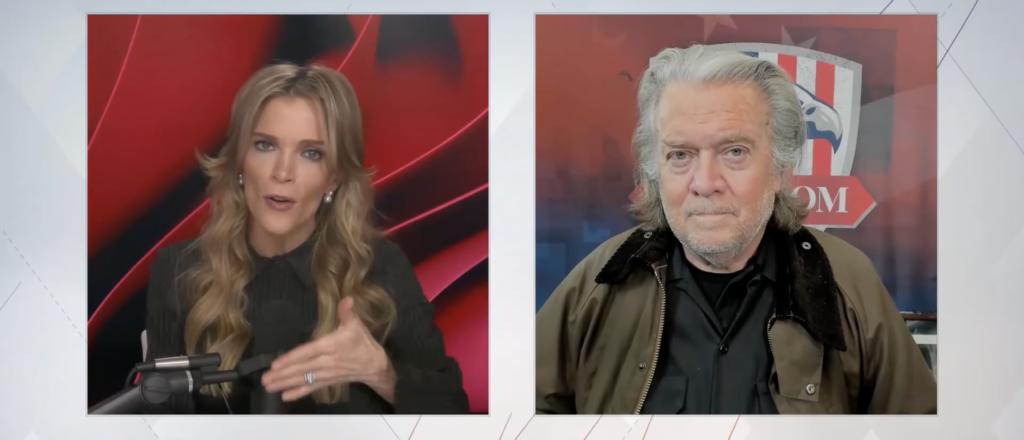
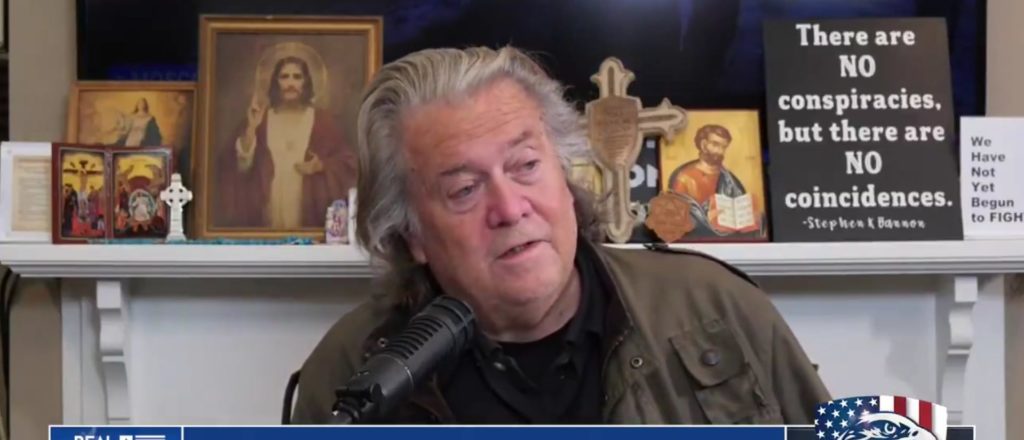
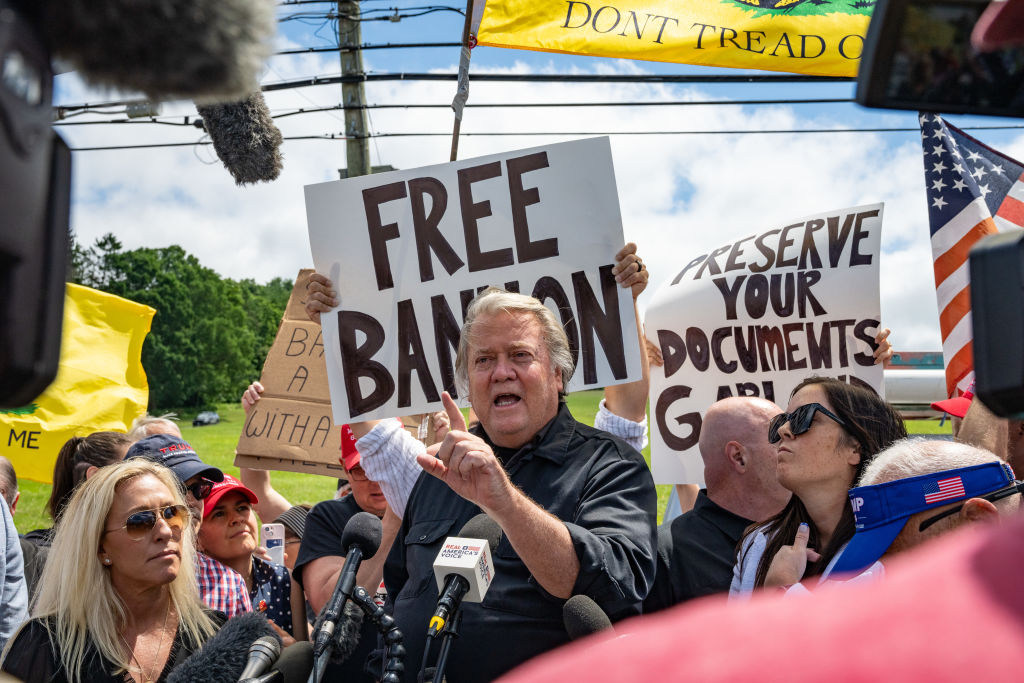
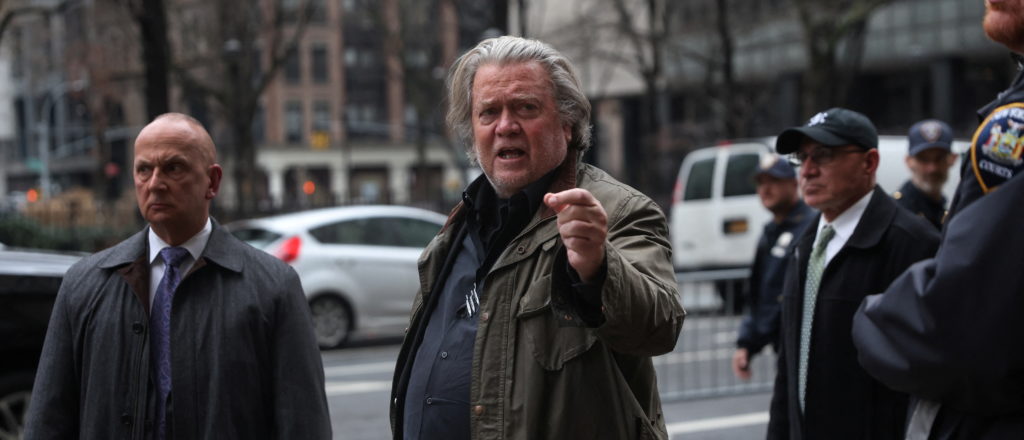
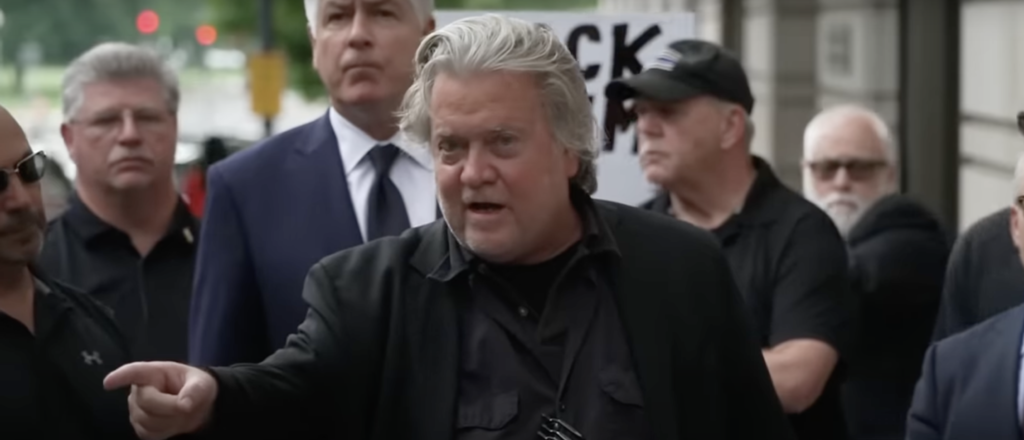
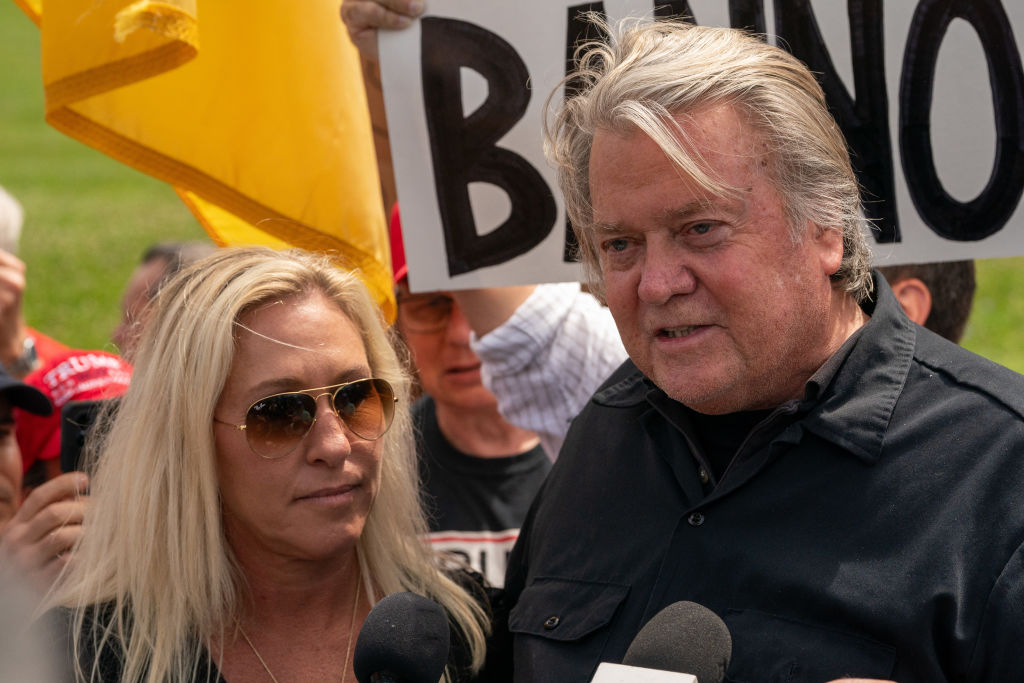
Stephen Kevin Bannon (born November 27, 1953) is an American media executive, Republican political strategist, pundit and former investment banker. He served as the White House's chief strategist for the first seven months of President Donald Trump's first administration before Trump fired him. He is a former executive chairman of Breitbart News. Since 2019, Bannon has hosted the War Room podcast.
Bannon was an officer in the United States Navy between 1977 and 1983, then worked for two years at Goldman Sachs as an investment banker. In 1993, he became acting director of the research project Biosphere 2. He was an executive producer on 18 Hollywood films from 1991 to 2016. In 2007, he co-founded Breitbart News, a website which he described in 2016 as "the platform for the alt-right". In the mid-2010s, Bannon was a vice president of Cambridge Analytica, a firm that collected data on millions of Facebook users, without their informed consent, for use in Trump's campaign and Brexit, in some cases spreading fake news. Later knowledge of this data breach prompted the Facebook–Cambridge Analytica data scandal.
In 2016, Bannon became the chief executive officer or CEO of Trump's 2016 presidential campaign and was appointed chief strategist and senior counselor to the president following Trump's election. As chief strategist, Bannon urged Trump toward an anti-establishment platform and clashed frequently with other Republicans as well as fellow staff members Reince Priebus and Jared Kushner. He left eight months later and rejoined Breitbart. In 2018, after his criticism of Trump's children was reported in Michael Wolff's book Fire and Fury, he was disavowed by President Donald Trump and left Breitbart. After leaving the White House, Bannon opposed the Republican Party establishment and supported insurgent candidates in Republican primary elections. Bannon's reputation as a strategist was questioned when former Alabama Supreme Court chief justice Roy Moore, despite Bannon's support, lost the 2017 United States Senate election in Alabama. Bannon had declared his intention to become "the infrastructure, globally, for the global populist movement". Accordingly, he has supported national populist conservative political movements around the world, including creating a network of far-right groups in Europe. Bannon advised Jeffrey Epstein, the financer and convicted child sex offender, on media relations just prior to his arrest on sex trafficking charges and death in prison in 2019.
In 2020, Bannon and others were arrested on federal charges of conspiracy to commit mail fraud and money laundering connected to the We Build the Wall fundraising campaign. According to the indictment, the defendants promised contributions would go to building a U.S.–Mexico border wall, but instead enriched themselves. Bannon pleaded not guilty. Trump pardoned Bannon, sparing him from a federal trial, but did not pardon his codefendants. Federal pardons do not cover state offenses, and in 2022, Bannon was charged in New York state court with fraud, money laundering, and conspiracy in connection with the campaign. In February 2025, Bannon pleaded guilty to fraud and was sentenced to three years of conditional discharge.
Bannon refused to comply with a subpoena from the January 6 House select committee, so was indicted by a federal grand jury on criminal charges of contempt of Congress. In July 2022, he was convicted and sentenced to four months in prison and a $6,500 fine. After losing his appeal to the U.S. Supreme Court, Bannon surrendered to a federal prison in Danbury, Connecticut, where he was imprisoned from July to October 2024.
Contents
Early life and education
Stephen Kevin Bannon was born November 27, 1953, in Norfolk, Virginia, to Doris (née Herr), a homemaker, and Martin J. Bannon Jr., who worked as an AT&T telephone lineman and as a middle manager. He grew up in a working-class family that was pro-Kennedy and pro-union Democrat. He is of Irish and German descent. Much of his mother's side of the family settled in the Baltimore area. Bannon graduated from Benedictine College Preparatory, a private, Catholic, military high school in Richmond, Virginia, in 1971, and then attended Virginia Tech, where he served as the president of the student government association. During the summers he worked at a local junkyard.
In 1976, he graduated from Virginia Tech College of Architecture and Urban Studies with a bachelor's degree in urban planning. While serving in the navy, he earned a master's degree in national security studies in 1983 from Georgetown University School of Foreign Service. In 1985, Bannon earned a Master of Business Administration degree with honors from Harvard Business School.
Career
U.S. Navy
Bannon was an officer in the United States Navy from 1977 to 1983; he served on the destroyer USS Paul F. Foster as a surface warfare officer in the Pacific Fleet, and afterwards as a special assistant to the chief of naval operations at the Pentagon. Bannon's job at the Pentagon was, among other things, handling messages between senior officers and writing reports about the state of the Navy fleet worldwide. While at the Pentagon, Bannon attended Georgetown University at night and obtained his master's degree in national security studies.
In 1980, Bannon was deployed to the Persian Gulf to assist with Operation Eagle Claw during the Iran hostage crisis. In a 2015 interview, Bannon said that the mission's failure marked a turning point in his political worldview from largely apolitical to strongly Reaganite, which was further reinforced by the September 11 attacks. He recounted,"I wasn't political until I got into the service and saw how badly Jimmy Carter fucked things up. I became a huge Reagan admirer. Still am. But what turned me against the whole establishment was coming back from running companies in Asia in 2008 and seeing that [George W.] Bush had fucked up as badly as Carter. The whole country was a disaster."
Investment banking
After his military service, Bannon worked at Goldman Sachs as an investment banker in the Mergers and Acquisitions Department. In 1987, he relocated from New York to Los Angeles, to assist Goldman in expanding their presence in the entertainment industry. He stayed in this position with Goldman in Los Angeles for two years, and left with the title of vice president.
Media and investing
In 1990, Bannon and several colleagues from Goldman Sachs launched their own company Bannon & Co., a boutique investment bank specializing in media. In one of Bannon & Co.'s transactions, the firm represented Westinghouse Electric, which wanted to sell Castle Rock Entertainment. Bannon negotiated a sale of Castle Rock to Turner Broadcasting System, which was owned by Ted Turner at the time. Instead of a full adviser's fee, Bannon & Co. accepted a financial stake in five television shows, including Seinfeld, which was in its third season. Bannon still receives cash residuals each time Seinfeld is aired. In 1998, Société Générale purchased Bannon & Co.
Earth science
In 1993, while still managing Bannon & Co., Bannon became acting director of the earth science research project Biosphere 2 in Oracle, Arizona. Under Bannon, the closed-system experiment project shifted emphasis from researching human space exploration and colonization toward the scientific study of earth's environment, pollution, and climate change. He left the project in 1995.
Entertainment and media
In the 1990s, Bannon ventured into entertainment and media and became a Hollywood film and media executive producer. Bannon produced 18 films, including Sean Penn's drama The Indian Runner (1991), and Julie Taymor's film Titus (1999). Bannon became a partner with entertainment industry executive Jeff Kwatinetz at film and television management company The Firm, Inc., where he served in 2002 and 2003.
In 2004, Bannon made a documentary about Ronald Reagan, In the Face of Evil. While making and screening the film, Bannon met Reagan's War author Peter Schweizer and publisher Andrew Breitbart, who described him as the Leni Riefenstahl of the Tea Party movement. Other films Bannon financed and produced include Fire from the Heartland: The Awakening of the Conservative Woman (2010), The Undefeated (2011), and Occupy Unmasked (2012).
In 2006, Bannon persuaded Goldman Sachs to invest in a company known as Internet Gaming Entertainment. Following a lawsuit, the company rebranded as Affinity Media, and Bannon took over as CEO. From 2007 through 2011, Bannon was the chair and CEO of Affinity Media.
In 2007, Bannon wrote an eight-page treatment for another documentary, Destroying the Great Satan: The Rise of Islamic Fascism in America. The outline states, "although driven by the 'best intentions,' institutions such as the media, the Jewish community and government agencies were appeasing jihadists aiming to create an Islamic republic." In 2011, Bannon spoke at the Liberty Restoration Foundation in Orlando, Florida, about the 2008 financial crisis, the Troubled Assets Relief Program, and their impact in the origins of the Tea Party movement, and his films Generation Zero (2010) and The Undefeated.
In 2007, Bannon was a founding board member of Breitbart News, a far-right news, opinion and commentary website. Philip Elliott and Zeke J. Miller of Time have said that the site has "pushed racist, sexist, xenophobic and antisemitic material into the vein of the alternative right". Bannon said that Breitbart's ideological mix included libertarians, Zionists, the conservative gay community, same-sex marriage opponents, economic nationalists, populists, as well as the alt-right, with the alt-right comprising a very small proportion overall. Conceding the alt-right holds views with "racial and anti-Semitic overtones", Bannon said he has zero tolerance for such views.
Government Accountability Institute
Bannon was executive chair and co-founder of the Government Accountability Institute, a tax-exempt 501(c)(3) organization where he helped orchestrate the publication of Breitbart News senior Editor-at-large Peter Schweizer's book Clinton Cash, from its founding in 2012 until his departure in August 2016. The organization creates indictments against politicians using the deep web, tax filings, flight logs, and foreign government documents and then forwards their findings to the media. The organization is registered as nonpartisan but it mainly investigates alleged corruption, crony capitalism, and misuse of taxpayer money within the Democratic Party. The group has spread conspiracy theories about Hillary Clinton and Joe Biden. For the years 2012 through 2015, he received between $81,000 and $100,000 each year; the organization reported that Bannon worked an average of 30 hours per week for the organization.
Cambridge Analytica
Bannon served as vice president of the board of Cambridge Analytica, a data-analytics firm owned largely by the Mercer family, who also co-owns Breitbart News; the firm allegedly used illegal tactics to target American voters in the 2016 election. According to former Analytica employee Christopher Wylie, Bannon oversaw the collection of Facebook data which was used to target American voters. Wylie who helped with creation of the company referred to the company as a "psychological warfare tool". Bannon was paid more than $125,000 for his work at Cambridge Analytica. Bannon's stake in Cambridge Analytica was estimated at $1–5 million, but he sold his stake in the company once he joined the Trump administration in April 2017.
The Movement
In 2017, Bannon founded the Movement, a populist organization which frequently promotes right wing populist groups in Europe which are against the EU government and political system in Europe. The group is also known for its opposition to George Soros's Open Society Foundations, Bannon has referred to Soros as "evil but brilliant". As of 2018, the organization employed 10 full-time staff members. Mischaël Modrikamen, the leader of the Belgian People's Party, serves as executive director. The organization has received praise from figures like Prime Minister Viktor Orbán and Italian Eurosceptic party M5S leader Luigi Di Maio.
Working for Donald Trump
Donald Trump 2016 presidential campaign
On August 17, 2016, with 88 days until the 2016 presidential election, Bannon was appointed chief executive of Donald Trump's presidential campaign. Bannon left Breitbart, the Government Accountability Institute and Cambridge Analytica, to take the job. Shortly after he had assumed the chief executive role, the chairman of the Trump campaign, Paul Manafort, was dismissed.
On November 13, following Donald Trump's election to the presidency, Bannon was appointed chief strategist and senior counselor to the president-elect. His appointment drew opposition from the Anti-Defamation League (ADL), the Council on American–Islamic Relations, the Southern Poverty Law Center, Democratic Senate minority leader Harry Reid, and some Republican strategists because of statements in Breitbart News that were alleged to be racist or antisemitic. However, a number of prominent politically conservative Jews defended Bannon against the allegations of antisemitism, including Ben Shapiro, David Horowitz, Pamela Geller, Bernard Marcus of the Republican Jewish Coalition, Morton Klein, the Zionist Organization of America, and Rabbi Shmuley Boteach.
Alan Dershowitz at first defended Bannon, saying there was no evidence he was antisemitic, but then in a later piece stated that Bannon had made bigoted statements against Muslims, women, and others. The ADL stated "We are not aware of any anti-Semitic statements from Bannon." Bannon had referred to French National Front (now National Rally) politician Marion Maréchal-Le Pen as "the new rising star".
On November 15, 2016, U.S. representative David Cicilline of Rhode Island released a letter to Trump signed by 169 Democratic House representatives urging the president-elect to rescind his appointment of Bannon. The letter stated that appointing Bannon "sends a disturbing message about what kind of president Donald Trump wants to be", because his "ties to the White Nationalist movement have been well documented"; it went on to present several examples of Breitbart News's alleged xenophobia. Bannon denied being a white nationalist and said, rather, that he was an "economic nationalist".
On November 18, during his first interview not conducted by Breitbart Media since the 2016 presidential election, Bannon remarked on some criticisms made about him, saying, "Darkness is good: Dick Cheney. Darth Vader. Satan. That's power. It only helps us when they get it wrong. When they're blind to who we are and what we're doing." The quote was published widely in the media.
Trump's first administration
In 2018, Michael Lewis published a quote ascribed to Bannon, made while the transition team for Trump was supposed to be preparing for the next administration, and The Guardian used it twice in the title of an excerpt from the 2018 Lewis book The Fifth Risk. The book examined the difference between the transition preparations provided by the administration that was exiting and what did or did not occur, and it revealed a profound lack of preparedness and concern, as expressed in the quote.
At the end of January 2017, in a departure from the previous format of the National Security Council (NSC), the holder of Bannon's position, along with that of the chief of staff, were designated by presidential memorandum as regular attendees to the NSC's Principals Committee, a Cabinet-level senior inter-agency forum for considering national security issues. The enacted arrangement was criticized by several members of previous administrations and was called "stone cold crazy" by Susan E. Rice, Barack Obama's last national security adviser. In response, White House press secretary Sean Spicer pointed to Bannon's seven years experience as a Navy officer in justifying his presence on the committee.
Bannon never attended an NSC principals meeting. He and Jared Kushner created a body named the Strategic Initiatives Group within the NSC. The Strategic Initiatives Group never got off the ground, and members like Sebastian Gorka failed to obtain the security clearance necessary for work on national security issues. Bannon also attempted to include Michael Pillsbury to the group.
Upon his inauguration, Trump appointed Bannon to be his chief strategist, a newly created position. The title made him a counselor to the president, nearly equivalent in authority to the chief of staff. As a staff member in the Executive Office of the President, the position did not require Senate confirmation. Breitbart News editor Julia Hahn followed Bannon to the White House, where she was appointed as Bannon's aide, as well as special assistant to President Trump.
In an interview with The Hollywood Reporter in the aftermath of the 2016 election, Bannon analogized his influence with Trump to that of "Thomas Cromwell in the court of the Tudors".
Post–White House career
Departure from the White House
Bannon's employment in the White House ended on August 18, 2017, less than a week after the August 11–12, 2017, Charlottesville Unite the Right rally which degenerated into violence and acrimony. Whereas members of both political parties condemned the hatred and violence of white nationalists, neo-Nazis and alt-right activists, The New York Times noted that Trump "was the only national political figure to spread blame for the 'hatred, bigotry and violence' that resulted in the death of one person to 'many sides'." The decision to blame "many sides" was reported to have come from Bannon. The NAACP released a statement saying that while they "acknowledge and appreciate President Trump's disavowment of the hatred which has resulted in a loss of life today", they called on Trump "to take the tangible step to remove Steve Bannon – a well-known white supremacist leader – from his team of advisers". The statement further described Bannon as a "symbol of white nationalism" who "energized that sentiment" through his position within the White House.
Some sources stated that White House chief of staff John F. Kelly asked Bannon on August 18, 2017, to submit his immediate resignation in lieu of being fired. Bannon, however, stated he was not fired but rather submitted his two-week resignation notice on August 4, 2017. He reminded The Weekly Standard that he had joined then-presidential candidate Trump's campaign on August 14, 2016, and said he'd "always planned on spending one year", but that he stayed a few more days due to the Unite the Right rally in Charlottesville, Virginia.
In an official statement, White House press secretary Sarah Huckabee Sanders said: "John Kelly and Steve Bannon have mutually agreed today would be Steve's last day. We are grateful for his service and wish him the best." The same day, Breitbart News announced that Bannon would return to the site as executive chairman. Several weeks after his departure it was reported that Trump still called Bannon using his personal cell phone and was only calling when chief of staff Kelly was not around. The Washington Post reported in October 2017 that Trump and Bannon remained in regular contact.
In January 2018, upon the publication of Michael Wolff's book Fire and Fury: Inside the Trump White House, which attributed many controversial and inflammatory statements to Bannon, Bannon and Trump became estranged and were widely seen as enemies. The book quoted Bannon as saying that Ivanka Trump was "as dumb as a brick"; that the meeting among Donald Trump Jr., Jared Kushner, Paul Manafort, and agents of Russia was "treasonous"; and that Special Prosecutor Robert Mueller would cause Donald Trump Jr. to "crack like an egg on live television". Bannon also warned that investigators would likely uncover money laundering involving Jared Kushner and his family business loans from Deutsche Bank.
Republican Senate primaries
Bannon has made efforts to unseat incumbent Republican members of Congress he deemed to be insufficiently supportive of Trump's agenda. In October 2017, Bannon said he planned to sponsor primary challenges against six of the seven incumbent Republican senators in the 2018 elections. He said he had two requirements for a candidate to earn his support: they must pledge to vote against Mitch McConnell as Senate majority leader and to end the Senate filibuster. Bannon used his group Citizens of the American Republic to aid him in his efforts to help keep Republican control of the House of Representatives in the 2018 election. The group is a dark money organization; Bannon declined to "describe his donors or how much money the group has raised".
Bannon received credit for helping Roy Moore defeat incumbent senator Luther Strange in the September Republican primary for the 2017 special Alabama Senate election, despite Trump's having endorsed Strange. After nine women alleged sexual misconduct, Bannon doubled down on his support for the candidate, raising doubt about the veracity of the accusations. When Ivanka Trump condemned Moore's campaign in Alabama, saying "there's a special place in hell for people who prey on children", Bannon responded, "What about the allegations about her dad and that 13-year-old?", in reference to a woman who accused Trump and sex offender Jeffrey Epstein of raping her at that age.
In what had been considered a safe Republican seat, Moore lost the election on December 12, 2017. Bannon's reputation as a political strategist was subsequently questioned by Republican commentators.
Work abroad
After leaving the White House in August 2017, Bannon declared his intention to become "the infrastructure, globally, for the global populist movement". He toured Europe to speak at events with various far-right political parties there, in a bid to build a network of right-wing populist-nationalist parties aspiring to government. Bannon visited the Dutch Party for Freedom, the Freedom Party of Austria in October 2017, the UK Conservative Party in December 2017, the Swiss People's Party in March 2018, the UK Independence Party, the Flemish Vlaams Belang, the Belgian People's Party, Alternative for Germany in March 2018, France's National Front (now the National Rally) in March 2018, the Italian League, the Brothers of Italy in September 2018, Hungary's Fidesz in March 2018, the Sweden Democrats in March 2018, the Polish Law and Justice in September 2018, Spain's Vox in July 2018, the Finns Party in July 2018, the pan-European identitarian movement in March 2018, Republika Srpska's Alliance of Independent Social Democrats in August 2018, the Five Star Movement in May 2019, and the Israeli Likud. Bannon believes that these movements – along with Japan's Shinzo Abe, India's Narendra Modi, Russia's Vladimir Putin, Saudi Arabia's Mohammad bin Salman, China's Xi Jinping, Turkey's Recep Tayyip Erdoğan, and Trump, as well as similar leaders in Egypt, the Philippines, Poland, and South Korea – are part of a global shift towards nationalism.
Bannon's attempt to build a network of far-right parties in Europe had only limited success; while he appeared at events with the French National Rally's Marine Le Pen and the Italian League's Matteo Salvini, the Sweden Democrats said that it had "no interest" in Bannon's initiative, the Flemish Vlaams Belang called it "poorly organized", and the Alternative for Germany cited divergent views among the parties. Right-wing populist parties did not achieve a surge in support in the 2019 European Parliament elections. The Atlantic cited a number of factors inhibiting Bannon's project, including differing national and ideological views among the European far right and U.S.-skeptical views held by some parties of the European extreme right. Bannon met with Tino Chrupalla and pledged to support the AfD in their campaign for the 2019 Saxony state election.
Bannon supports the Dignitatis Humanae Institute, a right-wing Catholic organization in Italy formerly based in what was previously Trisulti Charterhouse; Bannon drafted a leadership course curriculum for the group to train conservative Catholic political activists. In 2018, Bannon announced that he planned to establish a right-wing academy on the site, with the support of Benjamin Harnwell, a British associate of Bannon's who underwrote the project and aimed to create a "gladiator school for culture warriors". However, in 2019, the group's rights to use the former monastery were revoked by the Italian government because it determined that the lessee Dignitatis Humanae Institute failed to meet several criteria to operate the monastery and failed in its obligation to pay a "concession fee" as well as maintenance and security expenses.
Treatment of colleagues
In an interview with Frontline, former writer for Breitbart News Ben Shapiro said that he tried to avoid interacting with Bannon due to a fear of being on his bad side. Shapiro also recalled Bannon yelling and cursing at people at Breitbart News. Some who worked with Bannon described him as "egomaniacal" and "purely Machiavellian". Other former staffers at Breitbart who spoke to Politico said that Bannon would degrade employees by mocking their intelligence and would imply they were "expendable, low-life creatures". Several employees who left Breitbart alleged that when they attempted to find employment outside of Breitbart, Bannon attempted to sabotage them. However, other employees praised Bannon's leadership describing him as a generous, loyal, caring, and supportive. Many described Bannon as someone who would pay out of his own pocket for personal expenses.
In his memoir, White House senior adviser Jared Kushner recalled having an abrasive relationship with Bannon and two occasions in which Bannon threatened him, including one in which he threatened to 'break Kushner in half' after he accused Bannon of leaking to the press. Also in his memoir Kushner writes "Bannon single-handedly caused more problems for me than anyone else in my time in Washington. He probably leaked and lied about me more than everyone else combined. He played dirty and dragged me into the mud of the Russia investigation".
He only paid part of the $850,000 legal bill charged by Davidoff, Hutcher & Citron LLP, who represented him in the case for contempt of Congress for his defiance of the January 6 committee subpoena and in the case for the "We Build the Wall" fraud scheme. The law firm sued Bannon, and in July 2023, he was ordered to pay the remaining balance.
Connection to Jeffrey Epstein
According to Michael Wolff, Bannon was introduced to Jeffrey Epstein in 2017 and Epstein introduced Bannon to some of his friends. Bannon also worked with Ehud Barak and attorney Reid Weingarten to attempt to reform Epstein's public image. Later reports showed Bannon reportedly prepped Epstein for an interview with 60 Minutes that ultimately never occurred. Bannon confirmed that he did tape 15 hours of interviews with Epstein but denied that he was coaching him for further interviews and that the footage was for an unannounced documentary on Epstein. While Netflix documentary Jeffrey Epstein: Filthy Rich was under production, Bannon proposed a documentary, to be funded by Epstein, that would counter the claims made by Netflix and defend Epstein. Bannon proposed filming on Little Saint James, Epstein's private island which he had used as a base for underage sex trafficking. Epstein additionally made travel arrangements for Bannon, reserving a charter jet to fly Bannon to the United Kingdom to speak at the Oxford Union.
In December 2025, the House Oversight Committee released email and text messages between Bannon and Epstein. The two had discussed in 2019 using a Kovel agreement, a legal maneuver, to extend attorney-client privilege to Bannon, allowing him to join Epstein's legal team, despite Bannon not being a lawyer. The proposed agreement would allow Bannon to withhold documentary footage of Epstein he had produced. Bannon and Epstein further discussed a potential project to improve Epstein's reputation following the publication of a 2018 Miami Herald article investigating Epstein's sexual trafficking of minors. The proposed project would focus on publicizing positive aspects about Epstein's personal life. Epstein said that the goal of the project was "to humanize the monster." Bannon described negative media coverage of Epstein as a "sophisticated op". Photographs were also released of Bannon socializing with Epstein. Bannon privately described public scrutiny of Epstein as a "crazed jihad" and advised Epstein on how to avoid legal repercussions for his crimes.
In 2026, documents were released that included thousands of text messages between Bannon and Epstein, particularly from 2018 and 2019. The messages showed the two discussing efforts to influence international geopolitics, including shaping European coalitions, increasing pressure on China, and forging business ties in the Middle East. Epstein offered Bannon the use of a Paris apartment, a Palm Beach house, and his plane on multiple occasions; the two dined together frequently. Bannon provided media training to Epstein as part of work on a documentary and coached him as he faced increasing media scrutiny in early 2019. Bannon did not immediately respond to requests for comment. Bannon sought support from Epstein in his effort to build a global right-wing populist movement. Bannon discussed with Epstein his plans to remove Pope Francis as leader of the Catholic Church because of Francis' perceived opposition to nationalist political parties. Epstein additionally introduced Bannon to Noam Chomsky.
Criminal prosecutions
Bannon was charged with misdemeanor domestic violence, battery, and dissuading a witness in early January 1996 after his then-wife, Mary Piccard, accused Bannon of domestic abuse. The Santa Monica Police Department crime report states that after Piccard called 911, an officer arrived at their home and observed red marks on Piccard's wrist and neck. The charges were later dropped when Piccard did not appear in court. In her divorce filing, Piccard stated her absence was due to threats made against her by Bannon and his lawyer: Bannon, she said, told her, "if I went to court, he and his attorney would make sure that I would be the one who was guilty." She said that Bannon's lawyer also threatened her, telling her that if Mr. Bannon went to jail, she "would have no money and no way to support the children". Bannon's lawyer denied pressuring Piccard not to testify.
On August 20, 2020, a federal grand jury indictment was unsealed against Bannon and three others, charging them with conspiracy to commit wire fraud and money laundering. Each charge has a maximum penalty of 20 years in prison upon conviction. Federal prosecutors of the U.S. Attorney's Office for the Southern District of New York allege that Bannon, United States Air Force veteran Brian Kolfage and the two other defendants used funds received from the We Build the Wall fundraising campaign, marketed to support the building of a border wall between the U.S. and Mexico, in a way which was "inconsistent" with how they were advertised for use to the public. According to the indictment, donations were collected through a GoFundMe campaign that was launched in December 2018. Bannon promoted the project until the day before the indictment, saying "You've been the leader of this, assisting President Trump in building this wall in these tough areas" in his War Room: Pandemic podcast.
Federal prosecutors allege that Bannon and the three other men conspired to use a non-profit group run by Bannon, and a shell company controlled by one of the other defendants, to make payments to themselves, despite promises to donors that their contributions would go to build a wall. Prosecutors also alleged that Bannon received more than $1 million in connection with the plan, some of which was paid to Kolfage in secret and some of which Bannon and two other defendants allegedly used for personal expenses ranging from paying off credit cards to personal travel. Prosecutors stated that they plan to seize the assets of Bannon's non-profit Citizens of the American Republic, as well as other organizations "politically aligned with [Donald] Trump".
Social media bans
During the November 5, 2020, edition of his webcast, Bannon called for the beheadings of Anthony Fauci, the government's top infectious diseases expert, and FBI director Christopher Wray. Bannon said that if it were up to him, after beheading Fauci and Wray, "I'd put the heads on pikes" and display them outside the White House "as a warning to bureaucrats" who dared oppose Trump. By the end of the day, Facebook and YouTube had deleted the video from their platforms, and Twitter had permanently banned his account for glorifying violence. Mailchimp also disabled Bannon's email newsletter. The next day, Bannon was dropped by a lawyer who had been defending him against federal charges of fraud.
On January 9, 2021, Rudy Giuliani appeared on War Room, accusing Democrats of stealing the recent presidential election and blaming them for the storming of the Capitol. Hours later, YouTube removed both the podcast channel and another one called "Trump at War – A Film by Stephen K. Bannon", citing a "violation of YouTube's Terms of Service".
Political ideology
Bannon has described himself as a populist and nationalist.
Lebanese-American author Nassim Nicholas Taleb, neoreactionary blogger Curtis Yarvin and conservative intellectual Michael Anton have been pointed out as three of the main influences in Steve Bannon's political thinking. Political theorist and philosopher Edmund Burke has also been described as a major influence on Bannon's ideological outlook. According to The Guardian in January 2018, Bannon's ideology is similar to that of Stephen Miller, Tucker Carlson, Benny Johnson, Raheem Kassam and Matthew Boyle, the latter two having been protégés of Bannon at Breitbart.
Despite being arrested on federal charges of conspiracy to commit mail fraud and money laundering in connection with the We Build the Wall fundraising campaign in August 2020, in an interview, Bannon told journalist Michael Lewis in February 2018, "We got elected on Drain the Swamp, Lock Her Up, Build a Wall. This was pure anger. Anger and fear is what gets people to the polls." He added, "The Democrats don't matter. The real opposition is the media. And the way to deal with them is to flood the zone with shit."
Individual issues
A self-described economic nationalist, Bannon advocates for reductions in immigration and restrictions on free trade with China and Mexico. He has been described as a white nationalist but rejects the description. He generally believes in reducing the size of the federal bureaucracy, declaring at the Conservative Political Action Conference he favored the "deconstruction of the administrative state".
In May 2025, Bannon voiced opposition to a bipartisan proposal that would expand anti-BDS laws punishing the boycott of Israel.
Bannon was a strong opponent of the Paris climate agreement. During his time in the Trump administration, he successfully persuaded Donald Trump to withdraw from it.
Bannon favors reducing immigration, both legal and illegal immigration, to the U.S. and asserts that immigration threatens national sovereignty. Bannon has suggested that too many Silicon Valley chief executives are Asian or South Asian, and that this undermines "civic society". In a 2015 radio appearance, Bannon expressed opposition to resettling any refugees of the Syrian Civil War in the U.S. In a 2016 radio appearance, Bannon asserted that illegal immigration was "horrific" but that legal immigration was "the beating heart of this problem"; that levels of legal immigration to the U.S. were "scary"; and that legal immigrants had "kinda overwhelmed the country". On his podcast, Bannon emphasized the need for "MAGA shock troops" to actively support Donald Trump's plans for mass deportations. He envisions these loyalists not only participating in street-level actions but also embedding within the Trump administration to ensure the comprehensive removal of undocumented immigrants.
Bannon was the chairman of We Build the Wall, an organization involved in the construction of the proposed expansion of the Mexico–United States barrier.
Bannon often describes himself as an economic nationalist, criticizing crony capitalism, Austrian economics, and the objectivist capitalism of Ayn Rand. He also generally considers himself a free-market capitalist, however in May 2025 Steve Bannon described his team as being Neo-Brandeisians and advocated in favor of Lina Khan's administration of the FTC. He is also considered to be a market fundamentalist. Bannon favors raising federal income taxes to 44 percent for those earning incomes over $5 million a year as a way to pay for middle class tax cuts. He also supports significantly increasing spending on infrastructure, describing himself as "the guy pushing a trillion-dollar infrastructure plan".
Overview and influences
Bannon's ideology was the subject of the book War for Eternity by Benjamin R. Teitelbaum, where his thinking is described as combining elements of a radical version of traditionalism with paleoconservatism and other more standard American conservative beliefs. Bannon's political and economic views have been described by others as nationalist, and right-wing populist. He self-identifies as a conservative. He rejects allegations that he is a white nationalist.
At a party congress in March 2018, Bannon gave members of the French right-wing populist National Front (NF) what has been described as a "populist pep talk". He advised party members to "Let them call you racist, let them call you xenophobes, let them call you nativists. Wear it like a badge of honor. Because every day, we get stronger and they get weaker...History is on our side and will bring us victory." Bannon's remarks brought the members to their feet. Critics expressed concern that Bannon was "normalizing racism".
Bannon was influenced by Fourth Turning theory, outlined in Neil Howe's and William Strauss's The Fourth Turning: An American Prophecy, one of Bannon's favorite books. The theory proposes, "populism, nationalism and state-run authoritarianism would soon be on the rise, not just in America but around the world. [...Once one strips] away the extraneous accidents and technology, you are left with only a limited number of social moods, which tend to recur in a fixed order", and cyclically. The book was major influence on Bannon's film Generation Zero.
According to Bannon's former friends, he was particularly influenced by the Hindu scripture Bhagavad Gita and the ancient Chinese military treatise The Art of War. Bannon has also cited the Russian neo-fascist Alexander Dugin, who promotes a Russian nationalist variant of traditionalism called Eurasianism, and described himself as a fan of Dugin's book, The Fourth Political Theory. However, Bannon has urged Dugin to abandon his anti-American and Sinophile views. Bannon has also described Brazilian traditionalist thinker Olavo de Carvalho as "one of the great conservative intellectuals in the world".
Bannon is an admirer of paleoconservative commentator Pat Buchanan. Bannon's favorite columnist is academic Walter Russell Mead. In a 2014 speech to a Vatican conference, Bannon made a passing reference to Julius Evola, a twentieth-century, Nazi-linked Italian writer who influenced Benito Mussolini's Italian Fascism and promoted the Traditionalist School, described by a New York Times writer as "a worldview popular in far-right and alternative religious circles that believes progress and equality are poisonous illusions." Bannon's interest in the ideas of the Traditionalist School was driven by Evola's book Revolt Against the Modern World, and Guénon's books Man and His Becoming According to the Vedanta and The Crisis of the Modern World. In March 2016, Bannon stated he appreciates "any piece that mentions Evola". In referring to the associated views of Vladimir Putin, who is influenced by Evola follower Dugin, Bannon stated "We, the Judeo-Christian West, really have to look at what he's talking about as far as Traditionalism goes — particularly the sense of where it supports the underpinnings of nationalism." He has likewise quoted French anti-Enlightenment writer Charles Maurras approvingly to a French diplomat. Bannon has also repeatedly referenced the controversial French novel The Camp of the Saints (1973) by Jean Raspail, which depicts Third World immigration destroying Western civilization. He has embraced what BBC News describes as Savitri Devi's "account of history as a cyclical battle between good and evil". Bannon told an interviewer in 2018 that he is "fascinated by Mussolini", noting: "He was clearly loved by women. He was a guy's guy. He has all that virility. He also had amazing fashion sense, right, that whole thing with the uniforms." A former Breitbart writer wrote that Bannon said in 2015 that alt-right publication American Renaissance was "fighting the same fight" as him. Bannon has expressed admiration for German Conservative Revolutionary philosopher Martin Heidegger, praising his "ideas on the subject of being".
Personal life
Bannon has been married and divorced three times. He has three adult daughters. His first marriage was to Cathleen Suzanne Houff. Bannon and Houff had a daughter, Maureen, in 1988 and subsequently divorced.
Bannon's second marriage was to Mary Louise Piccard, a former investment banker, whom he married in April 1995. Their twin daughters were born three days after the wedding. Piccard filed for dissolution of their marriage in 1997.
During their divorce proceedings, Piccard alleged that Bannon had made antisemitic remarks about her choice of schools, saying he did not want to send his children to the Archer School for Girls because there were too many Jews at the school, and Jews raise their children to be "whiny brats". Bannon's spokesperson denied the accusation, noting that he had chosen to send both his children to the Archer School.
Bannon's third marriage was to model Diane Clohesy; they married in 2006 and divorced in 2009.
His brother, Chris Bannon, is a TV producer.
Bannon is a self-described Traditionalist Catholic.
Filmography
Bannon has been a producer, writer, director or actor on the following films and documentaries: