Filming
Production began on location in Chicago in April 1983, then moved to Los Angeles for 45 days, and finally two weeks at a soap factory in Wilmington, with additional filming taking place at Universal Studios. Shooting wrapped on August 18, 1983. All 10 days of filming in Chicago were exteriors at night, on locations that included platforms of elevated subway lines and the depths of Lower Wacker Drive. For Hill, the subways and their look was crucial to the world of the film and represented one of three modes of transportation—the other two being cars and motorcycles.
While shooting in Chicago, the production was plagued by inclement weather that included rain, hail, snow, and a combination of all three. The subway scenes were filmed on location in Chicago at many locations, including LaSalle Street (Blue line), Lake Street (Green line), Sheridan Road (Red, Purple lines), and Belmont Avenue (Red, Brown, and Purple lines). The Damen Avenue stop (Blue line, at Damen, North, and Milwaukee Avenues) was used.
Production designer John Vallone and his team constructed an elevated train line on the backlot of Universal Studios that perfectly matched the ones in Chicago. The film crew tarped-in the New Street and Brownstone street sets to double for the Richmond District setting, completely covering them so that night scenes could be filmed during the day. This tarp measured 1,240 feet long by 220 feet wide over both sets, and cost $1.2 million to construct. However, this presented unusual problems. The sound of the tarp flapping in the wind interfered with the actors’ dialogue. Birds who had nested in the tarp provided their own noisy interruptions.
The exterior of the Richmond Theater where Ellen Aim sings at the beginning of the film was shot on the backlot, with the interior done in the Wiltern Theater in Los Angeles for two weeks. The Ardmore Police roadblock was filmed near 6th Street in East Los Angeles, near the flood basin. Although three districts are seen, the city has a total of five districts: the Richmond, the Strip, the Battery, the Cliffside, and the Bayside. An additional district, Ardmore, also appears in the film, but it may be a separate municipality as it is not prefaced with "the".
The production employed 500 extras to play the citizens of the Richmond District. Cinematographer Andrew Laszlo shot the film with very low light, giving the images a stark, "low-tech" quality. The choreography for the two songs Ellen Aim sings and the one by the Sorels was done by Jeffrey Hornaday. The lighting for these concert scenes were done by Mark Brickman, who also lit concerts for Bruce Springsteen and Pink Floyd. In addition, 12 1950 and 1951 model Studebakers were used as police cars. More than 50 motorcycles and their drivers were featured as the Bombers, and were chosen from 200 members of real Los Angeles-based clubs like The Crusaders and The Heathens.
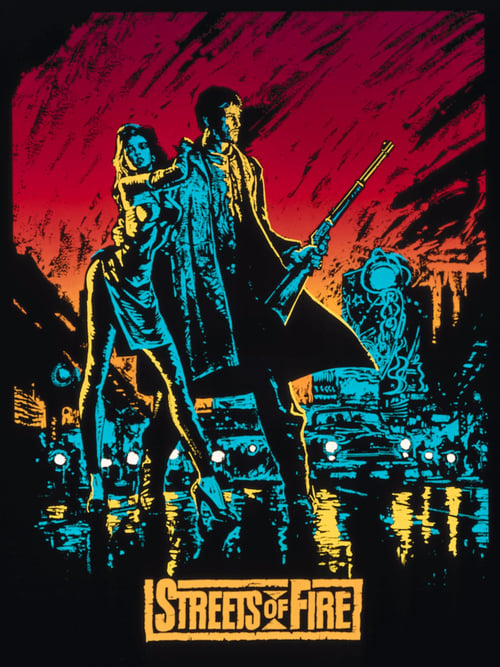
According to Laszlo, the film's style was dictated by the story. The Richmond's look was very soft and the colors did not call attention to themselves. The light in The Battery was contrasting and harsh, with vivid colors. Argyle prints and plaids are used in the Parkside District, and neon lights color the Strip.
Hill later said he felt "humbled" by the shoot:
I think I thought I could handle things. Didn't know how to shoot music. Music had been important in my films, it was usually post production. This was tough stuff to shoot. I already had a great respect for people like Minnelli. I just couldn't seem to work it out without just putting up multiple cameras and shooting an awful lot of film... I later realized or talked to people about this and MGM in the old days everybody was on contract and they would rehearse for weeks. We don't get that. We would stage it and shoot it. We got the songs a lot of times just a few days before we shoot. We only get the final song. The structural advantage of the old studio system we didn't have. It made a very inefficient shoot. I don't think there was any other way to do it given the circumstances.
Due to the choreography and setups in between takes of every scene, the climactic four-minute showdown between Cody and Raven Shaddock (Dafoe) took a considerable time to shoot. Paré estimated it as four weeks:
Willem and I shot that for two weeks, and then Walter shot it for another two week with the stunt guys. That whole scene was a Walter thing. He had to do something like that, especially after what he had done in Hard Times (1975).
Michael Paré later recalled:
You gotta realize that, out of the whole cast, nobody was over thirty. Diane Lane was, I think, eighteen. It was an enormous Hollywood production. My manager had me hire a limousine to pick me up at home and take me to work. I was like, "Jesus, this is incredible. This is... Hollywood. The real Hollywood. The Hollywood they make movies about." ... It was scary. And Walter isn't the kind of guy who works well with kids. He's a cowboy. He's like John Ford. "Don't ask me how to act! I'm a director!" (Laughs)
Paré also said he had troubles with Rick Moranis:
Rick Moranis drove me out of my mind. There's this whole wave of insult comedy. In the real world, if someone insults you a couple of times, you can smack them. Or punch them. You can't do that on a movie set. And these comedians walk around, and they can say whatever they want. I'm just not that handy with that. Comedians are a special breed. They can antagonize you and say whatever they...want, and you can't do anything to stop them...He's this weird looking little guy who couldn't get laid in a whore house with a fistful of fifties. He would imitate me. The first thing he says to me is "Do you just act cool, or are you really cool?" That was the first sentence out of his mouth to me in Joel Silver's office. And I was like, "Oh...this is not going to go well." But he was one of Joel's dear friends, and he ended up making a bunch of movies for Disney. I just wasn't that sharp. I wasn't ready for that kind of crap.
Paré said that the original draft of the script had Tom Cody kill Raven with a knife. "Walter really liked the idea because it had Tom Cody winning at all costs." However, this was changed to a fair fight to ensure a PG rating.
Paré did not always work well with Hill:
I think Walter is a writer at heart. Writers aren't always that good at communicating in person. He's also a tough son-of-a-bitch. He's like a cowboy. His director's chair was made out of leather and on the back of it read "Lone Wolf". He used to frequent gun clubs and he wasn't a very delicate guy...We were doing a love scene. When they said "We need to loop the love scene." I really freaked out. I had never done a love scene before...I really needed help to get through it. I panicked, and Joel Silver, called Walter and somehow persuaded him to come over and direct me through the ADR. Streets of Fire was a big picture for me, and I was overwhelmed. I think that bothered Walter. I think he thought that I was a needy guy. He was used to working with actors who had experience like Nick Nolte or David Carradine. I've always wondered why Walter has never wanted to work with me again. I think he was too much of gentlemen to tell me that I was too needy at the time.
E. G. Daily, who played Baby Doll, says it was "a very frustrating thing for me" to not sing in the film "Because Diane Lane was singing, and I remember thinking 'Ah!' It was so frustrating for me. It was painful. Because I wanted to be on that stage singing with those guys...But back then I always played those quirky characters. I didn't get those fancy leads. I got those best friend of the leads, quirky, funny characters. Hookers with a heart of gold. Weirdos."
Gross and Hill met with the editors on the weekends and looked at footage. Gross recalls that about five weeks into the 14-week shoot:
I turned to Walter and said "This movie is somewhat weirder than we thought...We just didn't anticipate what the combination of elements was going to be. We had a very conscious design concept of the movie, but I think we didn't fully grasp how strong it would be, in terms of the combination of elements. In a way, I think Streets of Fire was about expanding The Warriors concept to a bigger stage. But when expanding it to a bigger scale, it changed. The movie's bigness of size—compositionally—changed the meaning of things and made it more of a fairy tale...The Warriors, it was bewoven with a unique sense of realism. The fact that they made a deal with real gangs to be extras in the film. There was a true Godardian dialectic going on between artifice and reality. It's a very real-world film, in some respects, but it's very artificial at the same time... We did that again, but we put the emphasis on the artifice. And we didn't fully...I want to say we had too much integrity. We went further with that, perhaps, than we should have. I don't know. I can't put everything together about what didn't work, but the most damaging thing is that we didn't have the right actor for Tom Cody. Maybe if we'd had Tom Cruise, we might have had a success. But our commitment to be stylized was thorough and conscious and maybe too extreme for the mainstream audience.
Gross also wrote that "there was a chance of something great, but early fundamental disappointment with key personnel (in that case the star, Michael Paré) steeled all of us to face the chance that it might not turn out that way."






.jpg?width=400)


