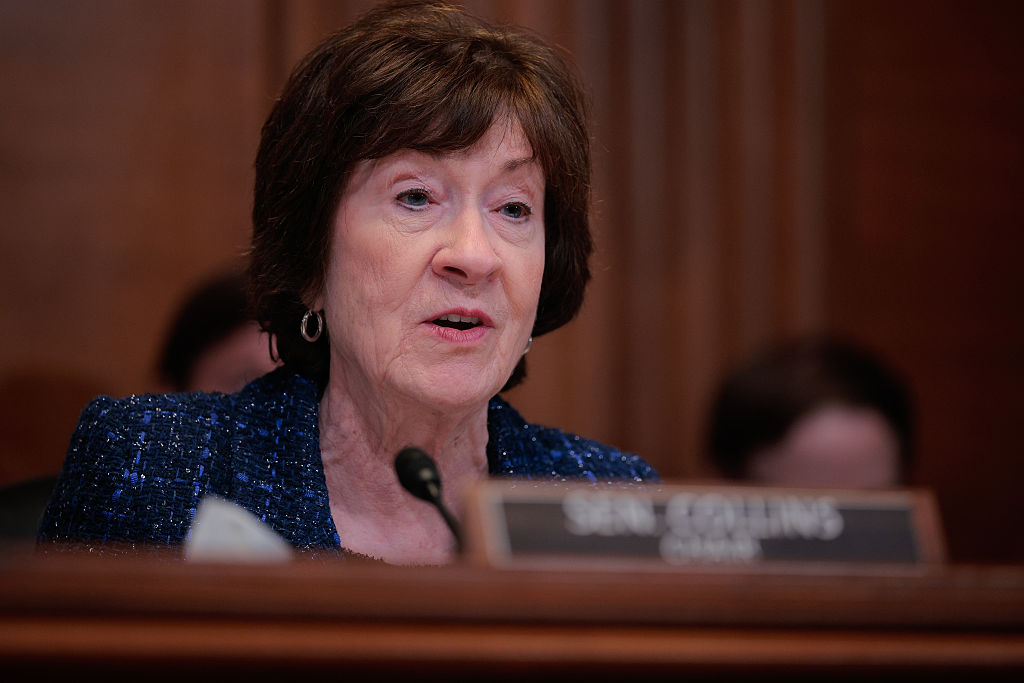
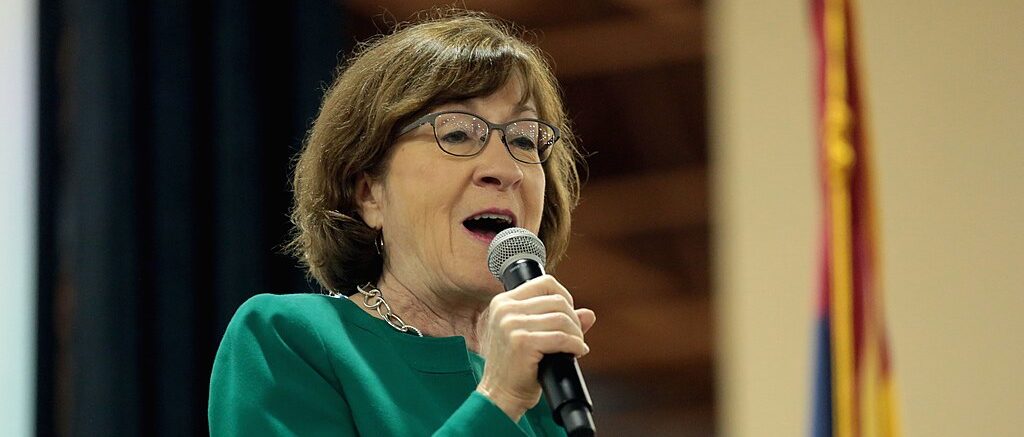
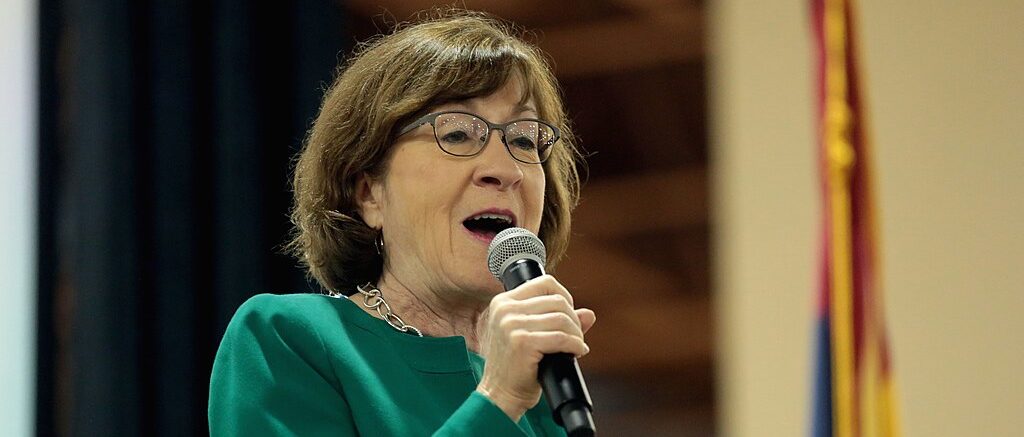
Susan Margaret Collins (born December 7, 1952) is an American politician serving as the senior United States senator for Maine since 1997. A member of the Republican Party, she is Maine's longest-serving member of Congress and the longest-serving Republican woman in the Senate. Collins has chaired the Senate Appropriations Committee since 2025.
Born in Caribou, Maine, Collins is a graduate of St. Lawrence University in Canton, New York. Beginning her career as a staff assistant for Senator William Cohen in 1975, she became staff director of the Oversight of Government Management Subcommittee of the Committee on Governmental Affairs in 1981. Governor John R. McKernan Jr. then appointed her commissioner of the Maine Department of Professional and Financial Regulation in 1987. In 1992 President George H. W. Bush appointed her director of the Small Business Administration's regional office in Boston. Collins became a deputy state treasurer in the office of the treasurer and receiver-general of Massachusetts in 1993. After moving back to Maine in 1994, she became the Republican nominee for governor of Maine in the 1994 general election. She was the first female major-party nominee for the post, finishing third in a four-way race with 23% of the vote. After her bid, she became the founding director of the Center for Family Business at Husson University in Bangor, Maine.
Collins was first elected to the Senate in 1996 and has been reelected every six years since. She chaired the Senate Special Committee on Aging from 2015 to 2021 and the Senate Committee on Homeland Security and Governmental Affairs from 2003 to 2007. Collins is the dean of Maine's congressional delegation, and was the only New England Republican in the 116th, 117th, 118th, and 119th Congresses. Along with Dave McCormick of Pennsylvania, Collins is one of only two Republicans to represent a Northeastern state in the Senate. Collins is the longest-serving Republican woman in the Senate, and since 2019, the only Republican holding statewide office in Maine.
Generally seen as a moderate Republican, Collins is often a pivotal vote in the Senate. She was one of three Republicans to vote against a partial repeal of the Affordable Care Act. She was the sole Republican to vote against confirming Amy Coney Barrett to the Supreme Court and one of three to vote to confirm Ketanji Brown Jackson.
As a pro-choice Republican, Collins drew scrutiny for her vote to confirm Brett Kavanaugh, who joined the majority opinion in Dobbs v. Jackson Women's Health Organization, which overturned Roe v. Wade. In 2021, Collins became the longest-serving Republican female senator in history, surpassing Margaret Chase Smith, who held the same Senate seat. In procedural issues, she has maintained her support for the 60-vote Senate threshold, arguing for bipartisan compromise and preserving the filibuster.
During the impeachment trial of Bill Clinton, Collins was one of the few Republican senators who voted to acquit him on both charges. During the first impeachment trial of Donald Trump, Collins joined most other Senate Republicans in voting to acquit on both charges. In his second impeachment trial, she was one of seven Republicans to vote to convict Trump of incitement of insurrection.
Contents
Early life and education
One of six children, Collins was born in Caribou, Maine, where her family operates a lumber business established by her great-great-great-grandfather, Samuel W. Collins, in 1844. Her parents, Patricia (née McGuigan) and Donald Collins (1925–2018), each served as mayor of Caribou. Her father, a decorated veteran of World War II, also served in the Maine legislature, with one term in the House, and four in the Senate. Her uncle, Samuel W. Collins Jr., sat on the Maine Supreme Judicial Court from 1988 to 1994 and served in the Maine Senate from 1973 to 1984. Her family owns S. W. Collins, a lumberyard and hardware store chain in northern Maine; her brother Samuel serves as president of S. W. Collins.
Collins attended Caribou High School, where she was president of the student council. During her senior year of high school in 1971, she was chosen to participate in the U.S. Senate Youth Program, through which she visited Washington, D.C., for the first time and had a two-hour conversation with Maine's first female United States Senator, Margaret Chase Smith, also a Republican. Collins is the first program delegate elected to the Senate and holds the seat once held by Smith. After graduating from high school, she continued her education at St. Lawrence University in Canton, New York. Like her father, she was elected to the Phi Beta Kappa national academic honor society. She graduated from St. Lawrence magna cum laude with a bachelor's degree in government in 1975.
Early political career
Following graduation, Collins worked as a legislative assistant to U.S. Representative and later U.S. Senator William Cohen from 1975 to 1987. She was staff director of the Oversight of Government Management Subcommittee on the United States Senate Committee on Homeland Security and Governmental Affairs from 1981 to 1987.
In 1987, Collins joined the cabinet of Governor John R. McKernan Jr. as Commissioner of the Department of Professional and Financial Regulation. President George H. W. Bush appointed her the New England regional director for the Small Business Administration in 1992. After briefly serving in this post until the 1992 presidential election, which Bill Clinton won, she moved to Massachusetts and became Deputy State Treasurer of Massachusetts under Joe Malone in 1993.
Returning to Maine, Collins won an eight-way Republican primary in the 1994 gubernatorial election, becoming the first woman nominated by a major party for governor of Maine. Collins had considered leaving the crowded gubernatorial race to seek election to Maine's 2nd congressional district, with incumbent Republican Olympia Snowe seeking election to the U.S. Senate, but ultimately chose to stay in the gubernatorial race. During the campaign, she received little support from Republican leaders and was criticized by conservative groups for her more liberal views on social issues. She lost the general election, receiving 23% of the vote and placing third behind Democrat Joseph E. Brennan and the winner, independent candidate Angus King.
In December 1994, Collins became the founding executive director of the Richard E. Dyke Center for Family Business at Husson College. She served in this post until 1996, when she announced her candidacy for the U.S. Senate seat being vacated by her former boss, William Cohen, who retired to become United States Secretary of Defense under President Bill Clinton. With Cohen's public endorsement, she won a difficult four-way primary and faced Brennan in the general election, a partial rematch of the 1994 gubernatorial race. She defeated Brennan, 49% to 44%.
U.S. Senate
Elections
Collins was elected to the Senate in 1996. During the campaign she pledged that, if elected, she would serve only two terms.
Collins was reelected in 2002 over State Senator Chellie Pingree, 58.4% to 41.6%, in 2008 over Representative Tom Allen, 61.5% to 38.5%, and in 2014 over Shenna Bellows, 68.5% to 31.5%. In each of those campaigns, she carried every county in Maine.
In 2020, Collins was challenged by Democratic State House Speaker Sara Gideon. The hotly contested race became the most expensive in Maine history, with Collins spending $23 million and Gideon nearly $48 million. The race also had national implications, as defeating Collins was a key part of the Democrats' strategy to achieve a Senate majority. Despite trailing Gideon in every public poll of the race, Collins defeated Gideon by a decisive margin.
In 2009, Collins was called one of "the last survivors of a once common species of moderate Northeastern Republican". She is considered a centrist Republican and an influential player in the Senate.
Although she shared a centrist ideology with Maine's former senator, Olympia Snowe, Collins is considered a "half-turn more conservative" than Snowe. She was consistently endorsed by the Human Rights Campaign, a major LGBT rights organization, until 2020. She supported John McCain in the 2008 presidential election. She became the state's senior senator in 2013 when Snowe left the Senate and was replaced by independent Angus King, who defeated Collins in the 1994 governor election.
In the 2026 election, Collins was set to face Democratic nominee Graham Platner after he won the primary, but on July 7, Politico published an article in which Platner was accused of rape by a former girlfriend; this resulted in the withdrawal of numerous endorsements, and although he denied the allegation, Platner withdrew from the race on July 10. The state Democrats nominated Troy Jackson, a former President of the Maine Senate, to replace Platner on the ballot.
Between January 2025 and May 2026, almost 100 out-of-state billionaires and their spouses donated almost $10 million, a third of all donations, to Collins's campaign and Political action committees supporting her election. Around $9 million went to Pine Tree Results PAC, a Super PAC whose donors are wealthy individuals, corporations, and dark money nonprofit organizations.
Tenure
In the 1990s, Collins played an important role during the Senate's impeachment trial of Bill Clinton when she and Snowe sponsored a motion that would have allowed the Senate to vote separately on the charges and the sentence. The motion failed, and Snowe and Collins voted to acquit, believing that while Clinton had committed perjury, that was not grounds for removal from office.
In 1997, the Senate adopted a broader investigation into White House and congressional campaign fund-raising practices than Senate Republicans initially wanted. Collins said there were "a number of allegations that may or may not be illegal, but they may be improper."
In 2001, Collins authored a measure that granted the United States Secretary of Education authority to grant waivers that would relieve reservists and members of the National Guard from making federal student loan payments during active duty and grant the same privileges to victims and families of those affected by the September 11 attacks. The bill passed the Senate and House in December 2001.
In 2002, the Senate overwhelmingly approved the creation of the Department of Homeland Security while a Democratic effort to remove the bill's provisions fell short on a 52-to-47 vote that came after President George W. Bush lobbied against the vote. Collins and other senators said that Senate and House Republicans, as well as the White House, had given them an "ironclad promise" to essentially rescind provisions in the first spending bill to pass Congress the following year.
In 2004, Collins was one of the primary sponsors of legislation overhauling the U.S. intelligence community by creating a new post, Director of National Intelligence, to oversee budgets and most assets of the spy agencies, and mandating that federal agencies establish minimum standards for states pertaining to issuing driver's licenses and birth certificates along with directing the United States Department of Homeland Security to form standards for ID used to board airplanes. The bill passed in the House and Senate in December. Collins said, "This was the most difficult bill to bring from conception to birth that I can imagine being involved with. But that makes the victory doubly satisfying." Bush signed the bill, formally known as the Intelligence Reform and Terrorism Prevention Act, on December 17, 2004.
Committee assignments
Collins's committee assignments for the 119th Congress are as follows:
Committee on Appropriations (chair)
In addition to the below, as chair, Collins is an ex officio member of all subcommittees.
Subcommittee on Agriculture, Rural Development, Food and Drug Administration, and Related Agencies
Subcommittee on Commerce, Justice, Science, and Related Agencies
Subcommittee on Defense
Subcommittee on Military Construction, Veterans Affairs, and Related Agencies
Subcommittee on Transportation, Housing and Urban Development, and Related Agencies
Committee on Health, Education, Labor, and Pensions
Subcommittee on Primary Health and Retirement Security
Select Committee on Intelligence
Caucus memberships
Afterschool Caucuses
Republican Main Street Partnership
Congressional Coalition on Adoption
Senate Taiwan Caucus
Political positions
Collins has been described as a moderate Republican and a centrist, having voted with her party 59% of the time from 1997 to 2016. She voted with her party more often, about 87% of the time, in 2017, at the beginning of the Trump administration.
In 2013, Collins sided with Obama's position 75.9% of the time, one of only two Republicans to vote with him more than 70% of the time. As of January 2021, according to FiveThirtyEight, she had voted with Trump's positions about 65% of the time, the lowest among all Republican senators. During Trump's presidency she voted with the Republican majority on party-line votes much more often than during Obama's presidency. According to FiveThirtyEight, as of January 2023, she had voted with Biden's position about 67% of the time.
Collins voted to acquit Trump of all charges at his first impeachment trial. She said she did not think Trump's request that the Ukrainian President announce an investigation into Joe Biden met the "high bar" for "removing a duly elected president". She said Trump had "learned from this case" and "will be much more cautious in the future." Shortly after his acquittal, Trump fired witnesses in the impeachment inquiry. In the following months, he fired inspectors general of the State Department and the intelligence community. Collins criticized the firing, provoking a retaliatory response from Trump.
On February 13, 2021, Collins was one of the seven Republican senators who voted to convict Trump in his second impeachment trial. On May 27, 2021, along with five other Republicans and all present Democrats, she voted to establish a bipartisan commission to investigate the Capitol attack. She had amended the bill in the hopes of drawing sufficient Republicans to support it, but the vote failed for lack of 60 required "yes" votes to prevent a filibuster.
In 2023, the Lugar Center ranked Collins first among senators for bipartisanship.
Abortion
In a May 1997 interview, Collins said she supported a proposal by Tom Daschle to ban all abortions after the fetus is capable of living outside the womb except to save the life of the woman or protect her from physical injury. Of an alternative measure proposed by Rick Santorum that would ban partial-birth abortion, Collins said it "ignores cases in the medical literature involving women with very serious physical health problems".
Collins is one of two Republican U.S. Senators, along with Lisa Murkowski, who describe themselves as pro-choice, or pro-abortion rights, and supported Roe v. Wade.
According to HuffPost, Collins has repeatedly voted to confirm judges who have signaled opposition to abortion rights. She has defended these votes by citing her support for both of Obama's Supreme Court appointments. She voted to confirm Brett Kavanaugh to the U.S. Supreme Court, saying she did not believe he would overturn Roe. She said she felt "vindication" in 2018 when Kavanaugh voted with the court's four Democratic-appointed justices and Chief Justice John Roberts not to hear cases against Planned Parenthood from Kansas and Louisiana, although Planned Parenthood disagreed with her assessment of the situation. In 2020, Collins faced renewed criticism of her vote by progressive groups when Kavanaugh said states should be permitted to severely reduce access to and availability of abortion in his dissent in June Medical Services LLC v Russo.
In 2021, Collins was one of three Republican senators to decline to sign an amicus brief supporting an anti-abortion Mississippi law banning abortion after 15 weeks of pregnancy. She faced renewed criticism after Kavanaugh voted with the majority, in a 5–4 vote, to reject an emergency petition to block a Texas law banning abortion after six weeks of pregnancy; the law went into effect while facing continued challenges in the courts. Responding to the legislation and criticism, Collins denounced the Texas anti-abortion law as "extreme, inhumane, and unconstitutional" and said she supports the Roe precedent as the "law of the land".
In 2022, Collins received additional criticism for her support of Kavanaugh after a leaked draft of the Supreme Court opinion in Dobbs v. Jackson Women's Health Organization indicated the Court would overturn Roe v. Wade, with Kavanaugh breaking with his statements that Roe was "settled law". She called the police after protesters wrote a chalk message in front of her home due to her votes to confirm justices involved in the draft ruling. Police said the chalk message was non-threatening and did not constitute a crime.
Economy
In 2004, Collins expressed concerns about how the Bush administration wanted to implement its proposed plan to cut taxes. She cited deficit concerns as a reason for opposing the plan, but ultimately voted in favor of the Bush tax cuts in 2003 and for their extension in 2006. Collins was one of just three Republican lawmakers to vote for the American Recovery and Reinvestment Act, prompting heated criticism from the right for crossing party lines.
In December 2017, Collins voted to pass the 2017 Republican tax plan. The bill greatly reduces corporate taxes while reducing taxes for some individuals and increasing them for others by removing some popular deductions. The bill also repeals Affordable Care Act's individual mandate, leaving thirteen million Americans uninsured and raising premiums by an estimated additional 10% per year. After the vote, Collins said she received assurances from congressional leaders that they would pass legislation intended to mitigate some of the adverse effects of the individual mandate's repeal. When asked how she could vote for a bill that would increase the deficit by an estimated $1 trillion (over ten years) after having railed against the deficit during the Obama administration, Collins insisted that it would not increase the deficit. She said she had been advised in this determination by economists Glenn Hubbard, Larry Lindsey, and Douglas Holtz-Eakin. Conservative columnist Jennifer Rubin wrote that Hubbard and Holtz-Eakin denied saying the plan would not increase the deficit.
After voting for the tax plan, Collins became the top recipient of political donations from private equity firms. Blackstone chief executive Steven Schwarzman donated $2 million to Collins's PAC, and Ken Griffin of the hedge fund Citadel donated $1.5 million.
Along with all other Senate and House Republicans, Collins voted against the American Rescue Plan Act of 2021. On September 30, 2021, she was one of 15 Senate Republicans to join all Democrats and both Independents to approve a temporary spending bill to continue government funding and avoid a government shutdown. On October 7, 2021, she voted with 10 other Republicans and all members of the Democratic caucus to break the filibuster on raising the debt ceiling. She voted with all Republicans against the legislation to raise the debt ceiling.
Environment
In 2008, Collins joined the bipartisan Gang of 20, which sought to break a deadlock on a bill allowing offshore drilling that would devote billions in proceeds to renewable energy development.
In February 2017, Collins was the only Republican to vote against undoing an Obama administration rule that required coal mining companies to avoid contaminating local waterways. She was the only Republican to vote against the confirmation of Scott Pruitt, and later Andrew Wheeler, to lead the Environmental Protection Agency. That same year, Collins voted for the Tax Cuts and Jobs Act, allowing oil drilling in the Arctic National Wildlife Refuge after unsuccessfully attempting to remove that part of the bill.
As of 2022, Collins has a lifetime score of 60% from the League of Conservation Voters, the highest of any incumbent Senate Republican.
Foreign policy and national security
In 2002, Collins voted in favor of the Iraq War Resolution authorizing President Bush to go to war against Iraq. In November 2007, she was one of four Republicans to vote for a Democratic proposal of $50 billion that would condition further spending on a timeline for withdrawing troops, mandating that a withdrawal begin 30 days after the bill was enacted as part of a goal of removing all U.S. troops in Iraq by December 15, 2008. The bill failed to get the 60 votes needed to overcome a filibuster. In April 2008, Collins and Senators Ben Nelson and Evan Bayh met with Bush's advisor on Iraq and Afghanistan, Douglas Lute, and expressed support for a prohibition on spending for major reconstruction projects, the proposal requiring Iraqis to pay for its security forces to be trained and equipped and reimburse the American military for the estimated $153 million a month the military spent on fueling in combat operations in Iraq. Collins said after the meeting that while the administration did not have a view entirely similar to the senators', it at least seemed open to their proposal. In June 2014, while growing violence erupted in Iraq under the leadership of Prime Minister Nouri al-Maliki, Collins said the violence would have been slower had a residual NATO force been present in Iraq and that the question was whether airstrikes were effective.
In September 2009, Collins said she was unsure whether sending more American troops to Afghanistan would help end the Afghanistan War, but cited the need for "more American civilians to help build up institutions" and growth of the Afghan army. In 2010, she called for the removal of Arnold Fields as Special Inspector General for Afghanistan Reconstruction, citing his repeated expressing of concern for the SIGAR and his disappointment with the Obama administration's "ongoing failure to take decisive action". In August 2017, Collins commended Trump for providing clarity after years of the U.S. lacking a "clear focus and defined strategy" with respect to Afghanistan and said he made the case that the Afghan government must participate "in defending its people, ending havens for terrorists, and curtailing corruption".
Before Obama met President of China Xi Jinping at an informal retreat in June 2013, Collins co-sponsored legislation to authorize the Commerce Department to investigate whether currency manipulation is a form of subsidization. In April 2018, she said the U.S. needed "a more nuanced approach" in dealing with China but gave Trump "credit for levying these tariffs against the Chinese, with whom we've talked for a decade about their unfair trade practices and their theft of intellectual property from American firms", adding that while the U.S. needed to toughen its stance against China, it would need to do this in a manner that did not create "a trade war and retaliation that will end up with our European and Asian competitors getting business that otherwise would have come to American farmers".
Gun policy
Collins voted for the Manchin–Toomey bill to amend federal law to expand background checks for gun purchases. She voted against a ban on high-capacity (more than ten rounds) magazines. In 2014 she received a "C" grade on gun rights from the NRA Political Victory Fund, rising to a "B" rating in 2020. She received a D− from Gun Owners of America in 2012.
In 2018, Collins co-sponsored the NICS Denial Notification Act, legislation developed in the aftermath of the Stoneman Douglas High School shooting that would require federal authorities to inform states within a day after a person failing the National Instant Criminal Background Check System attempted to buy a firearm.
In February 2019, Collins supported the Terrorist Firearms Prevention Act, legislation enabling the attorney general to deny the sale of a firearm to people on the no-fly list or selectee list. It passed the House but failed to advance in the Senate.
In 2022, Collins became one of ten Republican senators to support a bipartisan agreement on gun control, which included a red flag provision, a support for state crisis intervention orders, funding for school safety resources, stronger background checks for buyers under the age of 21, and penalties for straw purchases.
Health care
In May 2017, Collins was one of six senators to introduce the Medicaid Coverage for Addiction Recovery Expansion Act, legislation that would allow treatment facilities with up to 40 beds reimbursement by Medicaid for 60 consecutive days of inpatient services and serve as a modification of the Medicaid Institutions for Mental Disease law, which authorized Medicaid coverage for only those facilities with 16 or fewer beds.
Though she voted against the Affordable Care Act (Obamacare), Collins (along with fellow Republicans John McCain and Lisa Murkowski) voted against an unsuccessful "skinny repeal" attempt in July 2017. Later that year, she voted with Republican senators to repeal the individual mandate of the ACA. The absence of the individual mandate weakened the ACA's legal stability, leading the Trump administration in 2020 to seek to have the ACA ruled unconstitutional by the courts (in a 5–4 Supreme Court decision in 2012, Chief Justice Roberts upheld the ACA by citing the individual mandate). The ACA remained intact, despite the lack of the individual mandate, following a 7-2 Supreme Court decision to reject a challenge to the law.
In December 2017, Collins was one of nine senators to sign a letter to Senate Majority Leader Mitch McConnell and Minority Leader Chuck Schumer describing opioid use as a nonpartisan issue that was "ravaging communities in every state and preys upon individuals and families regardless of party affiliation" and requesting that they "make every effort to ensure that new, substantial and sustained funding for the opioid epidemic is included in any legislative package".
In April 2019, Collins cosponsored the Protecting Jessica Grubb's Legacy Act, legislation that authorized the sharing of the medical records of patients being treated for substance use disorder among healthcare providers if the patient provided the information. Cosponsor Shelley Moore Capito said the bill also prevented medical providers from unintentionally providing opioids to individuals in recovery.
Immigration
In 2007, Collins voted against the bipartisan McCain-Kennedy comprehensive immigration reform proposal, which would have given undocumented immigrants (including those brought into the United States as minors) a pathway to citizenship if they met certain requirements, while also substantially increasing border enforcement. In 2010, she voted against the DREAM Act. In 2013, Collins was one of 14 Republicans to vote in favor of a comprehensive immigration bill that included border security and a pathway to citizenship for undocumented immigrants. She opposed Obama's decision to achieve immigration reform through executive action, which gave deportation relief to as many as five million undocumented immigrants through Deferred Action for Childhood Arrivals (DACA).
In 2017, Collins opposed Trump's executive order to ban entry to the U.S. by citizens of seven Muslim-majority countries, saying, "The worldwide refugee ban set forth in the executive order is overly broad and implementing it will be immediately problematic." In 2019, she introduced bipartisan legislation to oppose Trump's declaration emergency at the southern border in order to build a wall. She was one of a dozen Republicans who broke with their party, joining all Democrats, to vote for the resolution rejecting the emergency declaration. In September 2019, she again voted with 10 other Republicans to overturn Trump's emergency declaration on the border.
Animal welfare
In 2023, Collins was a signatory to a letter opposing the inclusion of the Ending Agricultural Trade Suppression (EATS) Act in the Farm Bill, leading to praise from animal welfare advocates. The EATS act would have overturned state-level animal protection laws in agriculture.
LGBTQ policy
In 2004, Collins was one of six Republicans who voted against the Federal Marriage Amendment, a proposed amendment to the U.S. Constitution that would ban same-sex marriage. She voted in favor of the Don't Ask, Don't Tell Repeal Act of 2010 and was the primary Republican sponsor of the repeal effort. In 2015, she was one of 11 Republican senators to vote to give Social Security benefits to same-sex couples in states where same-sex marriage was not yet recognized.
In 2017 and 2019, Collins co-sponsored bills with Democratic senators to prevent Trump from banning transgender people from the United States military and prohibit anti-LGBT housing discrimination. She was the only Republican co-sponsor of the Equality Act, which aims to comprehensively prohibit LGBT discrimination. In February 2021, Collins announced she would no longer co-sponsor the bill over amendments that were not made.
In 2021, Collins was one of 49 senators to vote for an amendment to the American Rescue Plan Act of 2021, which aimed to defund schools allowing transgender students to compete in sports. In 2025, she signed a referendum petition for her state that would bar transgender students from girls' sports teams and from using women's changing rooms and bathrooms.
The Human Rights Campaign (HRC), which rates politicians' support for LGBT issues, gave Collins a score of 85% during the 114th Congress (2015–17), and a score of 33% during the 115th Congress (2017–19). She received a 49% score in the 116th Congress. In 2020, the HRC endorsed an opponent of Collins for the first time since 1996, citing her votes for judicial nominees, particularly Brett Kavanaugh. In 2022, Collins was one of 12 Republicans in the Senate voting to advance and pass the Respect for Marriage Act, legislation intended to codify same-sex marriage rights into federal law.
Net neutrality
Collins strongly supports FCC Open Internet Order 2010. After former Federal Communications Commission chairman Ajit Pai repealed net neutrality regulations in 2017, Collins and Senator Angus King announced they would support a bipartisan enactment of the Congressional Review Act to reverse the FCC's decision. In another statement, Collins argued that net neutrality regulations would help rural communities obtain access to the internet and that the regulations strengthened consumer privacy protections, citing the Facebook–Cambridge Analytica data scandal for failing to protect consumers' privacy.
United States Postal Service
In 2006, Collins sponsored the Postal Accountability and Enhancement Act, which passed the Senate unanimously. It requires the USPS to prepay 50 years' worth of employee health and retirement benefits.
Honors and awards
The United States Chamber of Commerce awarded Collins the 2013 Spirit of Enterprise Award for her support of its positions.
On May 7, 2014, The National Journal recognized Collins as the senator with "perfect attendance", noting that she had not missed a single vote since her election to the Senate in 1997.
In 2014, Elle magazine named Collins one of its "10 Most Powerful Women in D.C".
Collins received the Publius Award from the Center for the Study of the Presidency and Congress on March 12, 2014.
The Veterans of Foreign Wars gave Collins its 2017 Congressional Award, which is annually given to one member of Congress for their significant legislative contributions on behalf of military veterans.
In 2022, Collins received the Academy of Achievement's Golden Plate Award.
In December 2024, Susan Collins was included on the BBC's 100 Women list.
Personal life
Collins is married to Thomas Daffron, a lobbyist who worked as chief operating officer at Jefferson Consulting Group in Washington, D.C., from 2006 to 2016; he consulted on Collins's 1996, 2002 and 2008 Senate campaigns. Daffron and Collins married on August 11, 2012, at the Gray Memorial United Methodist Church in Caribou, Maine. Collins is Catholic.
In 2026, Collins revealed that she had been diagnosed with an essential tremor.