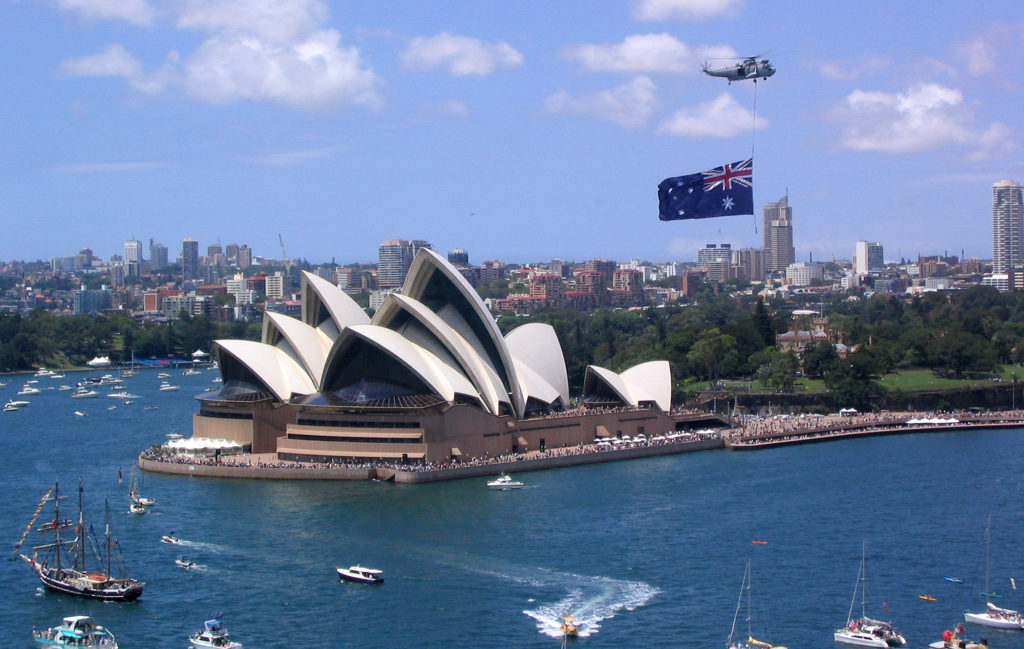
The Sydney Opera House is a multi-venue performing arts centre in Sydney, New South Wales, Australia. Located on the foreshore of Sydney Harbour, it is widely regarded as one of the world's most famous and distinctive buildings, and a masterpiece of 20th-century architecture.
Designed by Danish architect Jørn Utzon and completed by an Australian architectural team headed by Peter Hall, the building was formally opened by Queen Elizabeth II on 20 October 1973, 16 years after Utzon's 1957 selection as winner of an international design competition. The Government of New South Wales, led by the premier, Joseph Cahill, authorised work to begin in 1958 with Utzon directing construction. The government's decision to build Utzon's design is often overshadowed by circumstances that followed, including cost and scheduling overruns as well as the architect's ultimate resignation.
The building and its surrounds occupy the whole of Bennelong Point on Sydney Harbour, between Sydney Cove and Farm Cove, adjacent to the Sydney central business district and the Royal Botanic Garden, and near to the Sydney Harbour Bridge.
The building comprises multiple performance venues, which together host over 1,800 performances annually, attended by more than 1.4 million people. Performances are presented by numerous performing artists, with many resident companies such as Opera Australia, the Sydney Theatre Company and the Sydney Symphony Orchestra. As one of the most popular visitor attractions in Australia, the site is visited by more than ten million people annually, and approximately 350,000 visitors take a guided tour of the building each year. The building is managed by the Sydney Opera House Trust, an agency of the New South Wales State Government.
In 2007, the Sydney Opera House became a UNESCO World Heritage Site, having been listed on the (now defunct) Register of the National Estate since 1980, the National Trust of Australia register since 1983, the City of Sydney Heritage Inventory since 2000, the New South Wales State Heritage Register since 2003, and the Australian National Heritage List since 2005. The Opera House was also a finalist in the New 7 Wonders of the World campaign list.
Contents
Description
The facility features a modern expressionist design, with a series of large precast concrete "shells", each composed of sections of a sphere of 75.2 metres (246 ft 8.6 in) radius, forming the roofs of the structure, set on a monumental podium. The building covers 1.8 hectares (4.4 acres) of land and is 183 m (600 ft) long and 120 m (394 ft) wide at its widest point. It is supported on 588 concrete piers sunk as much as 25 m (82 ft) below sea level. The highest roof point is 67 metres above sea-level which is the same height as that of a 22-storey building. The roof is made of 2,194 pre-cast concrete sections, which weigh up to 15 tonnes each.
Although the roof structures are commonly referred to as "shells" (as in this article), they are precast concrete panels supported by precast concrete ribs, not shells in a strictly structural sense. Though the shells appear uniformly white from a distance, they actually feature a subtle chevron pattern composed of 1,056,006 tiles in two colours: glossy white and matte cream. The tiles were manufactured by the Swedish company Höganäs AB which generally produced stoneware tiles for the paper-mill industry.
Apart from the tile of the shells and the glass curtain walls of the foyer spaces, the building's exterior is largely clad with aggregate panels composed of pink granite quarried at Tarana. Significant interior surface treatments also include off-form concrete, Australian white birch plywood supplied from Wauchope in northern New South Wales, and brush box glulam.
Performance venues and facilities
The Sydney Opera House includes a number of performance venues:
Concert Hall: With 2,679 seats, the home of the Sydney Symphony Orchestra and used by a large number of other concert presenters. It contains the Sydney Opera House Grand Organ, the largest mechanical tracker action organ in the world, with over 10,000 pipes.
Joan Sutherland Theatre: A proscenium theatre with 1,507 seats, the Sydney home of Opera Australia and The Australian Ballet. Until 17 October 2012 it was known as the Opera Theatre.
Drama Theatre: A proscenium theatre with 544 seats, used by the Sydney Theatre Company and other dance and theatrical presenters.
Playhouse: A non-proscenium end-stage theatre with 398 seats.
Studio: A flexible space with 280 permanent seats (some of which can be folded up) and a maximum capacity of 400, depending on configuration.
Utzon Room: A small multi-purpose venue for parties, corporate functions and small productions (such as chamber music performances).
Yallamundi Rooms: A function space hosting up to 400 people, often used for weddings or business conferences.
Outdoor Forecourt: A flexible open-air venue with a wide range of configuration options, including the possibility of utilising the Monumental Steps as audience seating, used for a range of community events and major outdoor performances.
History
Origins of the project
Planning began in the late 1940s when Eugene Goossens, the Chief Conductor of the Sydney Symphony Orchestra and Director of the New South Wales State Conservatorium of Music, lobbied for a suitable venue for opera and orchestral performance. The Sydney Symphony Orchestra's performance home, the Sydney Town Hall, was not considered large enough. By 1954, Goossens succeeded in gaining the support of New South Wales Premier Joseph Cahill, who called for designs for a dedicated opera house. It was also Goossens who insisted that Bennelong Point be the site: Cahill had wanted it to be on or near Wynyard railway station in the northwest of the central business district.
An international design competition with a grand prize of 5,000 Australian pounds was launched by Cahill on 13 September 1955 and received 233 entries, representing architects from 32 countries. The criteria specified a large hall seating 3,000 and a small hall for 1,200 people, each to be designed for different uses, including full-scale operas, orchestral and choral concerts, mass meetings, lectures, ballet performances, and other presentations.
The jury for the competition were: Professor Henry Ashworth (University of Sydney), Cobden Parkes (New South Wales Government Architect); Professor Leslie Martin (Professor of Architecture of Cambridge University and architect of Royal Festival Hall 1951) and Finnish-American architect Eero Saarinen.
The winner, announced in Sydney on 29 January 1957, was Danish architect Jørn Utzon. Saarinen selected Utzon's distinctive design from a final cut of 30 finalists. Utzon's design was inspired by natural shapes, most notably those of bird wings, clouds, shells, walnuts, rivers and palm leaves.
The runner-up was a Philadelphia-based team assembled by Robert Geddes and George Qualls, both teaching at the University of Pennsylvania School of Design. They brought together a band of Penn faculty and friends from Philadelphia architectural offices, including Melvin Brecher, Warren Cunningham, Joseph Marzella, Walter Wiseman, and Leon Loschetter. Geddes, Brecher, Qualls, and Cunningham went on to found the firm GBQC Architects.
Utzon first visited Sydney on 29 July 1957 along with Erik Andersson who had worked on the competition scheme, to help establish and supervise the developing project. They arrived with a new model of the scheme that was presented at a public meeting Sydney Town Hall on 7 August 1957. They departed Sydney on August 22 headed for Tokyo, planning to return to Sydney in March 1958. His office moved to Palm Beach, Sydney in February 1963.
Design development and construction timeline
The Fort Macquarie Tram Depot, occupying the site on the original Fort Macquarie at the time of these plans, was demolished in 1958 and construction began in March 1959. The Opera House was built in four stages: stage I (1957–1959) was planning out the building; stage II (1959–1963) consisted of building the upper podium; stage III (1963–1967) the construction of the outer shells, based upon the image of whales breaching the water; stage IV (1967–1973) interior design and construction.
Stage I started on 2 March 1959 with the construction firm Civil & Civic, monitored by the engineers Ove Arup & Partners. The government had pushed for work to begin early, fearing that funding, or public opinion, might turn against them. But Utzon had still not completed the final designs. Major structural issues still remained unresolved. By 23 January 1961, work was running 47 weeks behind, mainly because of unexpected difficulties (inclement weather, unexpected difficulty diverting stormwater, construction beginning before proper construction drawings had been prepared, changes of original contract documents). Work on the podium was finally completed in February 1963. The forced early start led to significant later problems, not least of which was that the podium columns were not strong enough to support the roof structure, and had to be re-built.
The shells of the competition entry were originally of undefined geometry, but, early in the design process, the "shells" were perceived as a series of parabolas supported by precast concrete ribs. However, Ove Arup & Partners were unable to find an acceptable solution to constructing them. The formwork for using in-situ concrete would have been prohibitively expensive, and, because there was no repetition in any of the roof forms, the construction of precast concrete for each individual section would possibly have been even more expensive.
From 1957 to 1963, the design team went through at least 12 iterations of the form of the shells trying to find an economically acceptable form (including schemes with parabolas, circular ribs and ellipsoids) before a workable solution was completed.
The design work on the shells involved one of the earliest uses of computers in structural analysis, to understand the complex forces to which the shells would be subjected. The computer system was also used in the assembly of the arches. The pins in the arches were surveyed at the end of each day, and the information was entered into the computer so the next arch could be properly placed the following day.
Utzon and his resignation
Before the Sydney Opera House competition, Jørn Utzon had won seven of the 18 competitions he had entered but had never seen any of his designs built. Utzon's submitted concept for the Sydney Opera House was almost universally admired and considered groundbreaking. The Assessors Report of January 1957 stated:
The drawings submitted for this scheme are simple to the point of being diagrammatic. Nevertheless, as we have returned again and again to the study of these drawings, we are convinced that they present a concept of an Opera House which is capable of becoming one of the great buildings of the world.
For the first stage, Utzon worked successfully with the rest of the design team and the client, but, as the project progressed, the Cahill government insisted on progressive revisions. They also did not fully appreciate the costs or work involved in design and construction. Tensions between the client and the design team grew further when an early start to construction was demanded despite an incomplete design. This resulted in a continuing series of delays and setbacks while various technical engineering issues were being refined. The building was unique, and the problems with the design issues and cost increases were exacerbated by commencement of work before the completion of the final plans.
After the 1965 election of the Liberal Party, with Robert Askin becoming Premier of New South Wales, the relationship of client, architect, engineers and contractors became increasingly tense. Askin had been a "vocal critic of the project prior to gaining office." His new Minister for Public Works, Davis Hughes, was even less sympathetic. Elizabeth Farrelly, an Australian architecture critic, wrote that:
at an election night dinner party in Mosman, Hughes' daughter Sue Burgoyne boasted that her father would soon sack Utzon. Hughes had no interest in art, architecture or aesthetics. A fraud, as well as a philistine, he had been exposed before Parliament and dumped as Country Party leader for 19 years of falsely claiming a university degree. The Opera House gave Hughes a second chance. For him, as for Utzon, it was all about control; about the triumph of homegrown mediocrity over foreign genius.
Differences ensued. One of the first was that Utzon believed the clients should receive information on all aspects of the design and construction through his practice, while the clients wanted a system (notably drawn in sketch form by Davis Hughes) where architect, contractors, and engineers each reported to the client directly and separately. This had great implications for procurement methods and cost control, with Utzon wishing to negotiate contracts with chosen suppliers (such as Ralph Symonds for the plywood interiors) and the New South Wales government insisting contracts be put out to tender.
Opening
The Sydney Opera House was formally opened by Queen Elizabeth II, on 20 October 1973. A large crowd attended. The opening was televised and included fireworks and a performance of Beethoven's Symphony No. 9.
It is frequently erroneously claimed that Utzon was not invited to the opening and his name was not mentioned at the ceremony. Utzon was in fact invited, but he declined in order to avoid the controversy over his dismissal overshadowing the event; and while the Queen's speech did not mention Utzon (or any other involved architect), Premier Askin did credit him.
Reconciliation with Utzon; building refurbishment
In the late 1990s, the Sydney Opera House Trust resumed communication with Utzon in an attempt to effect a reconciliation and to secure his involvement in future changes to the building. In 1999, he was appointed by the trust as a design consultant for future work.
In 2004, the first interior space rebuilt to an Utzon design was opened and renamed "The Utzon Room" in his honour. It contains an original Utzon tapestry (14.00 × 3.70 metres) called Homage to Carl Philipp Emanuel Bach. In April 2007, he proposed a major reconstruction of the Opera Theatre, as it was then known. Utzon died on 29 November 2008, having never returned to Australia to see the completed Opera House.
A state memorial service, attended by Utzon's son Jan and daughter Lin, was held in the Concert Hall on 25 March 2009 featuring performances, readings and recollections from prominent figures in the Australian performing arts scene.
Refurbished Western Foyer and accessibility improvements were commissioned on 17 November 2009, the largest building project completed since Utzon was re-engaged in 1999. Designed by Utzon and his son Jan, the project provided improved ticketing, toilet and cloaking facilities. New escalators and a public lift enabled enhanced access for the disabled and families with prams. The prominent paralympian athlete Louise Sauvage was announced as the building's "accessibility ambassador" to advise on further improvements to aid people with disabilities.
In 2013, a 60-metre long artwork by artist Reg Mombassa was unveiled at the Sydney Opera House. The Gumscape, Road and Creatures triptych was commissioned by the Sydney Opera House to cover the scaffolding concealing refurbishment building work.
On 29 March 2016, an original 1959 tapestry by Le Corbusier (2.18 × 3.55 metres), commissioned by Utzon to be hung in the Sydney Opera House and called Les Dés Sont Jetés (The Dice Are Cast), was finally unveiled in situ after being owned by the Utzon family and held at their home in Denmark for over 50 years. The tapestry was bought at auction by the Sydney Opera House in June 2015. It now hangs in the building's Western Foyer and is accessible to the public.
Architectural design role of Peter Hall
After the resignation of Utzon, the Minister for Public Works, Davis Hughes, and the Government Architect, Ted Farmer, organised a team to bring the Sydney Opera House to completion. The architectural work was divided between three appointees who became the Hall, Todd, Littlemore partnership. David Littlemore would manage construction supervision, Lionel Todd contract documentation, while the crucial role of design became the responsibility of Peter Hall.
Hall completed a combined arts and architecture degree at Sydney University. Upon graduation a travel scholarship enabled him to spend twelve months in Europe during which time he visited Utzon in Hellebæk. Returning to Sydney, Hall worked for the Government Architect, a branch of the NSW Public Works Department. While there he established himself as a talented design architect with a number of court and university buildings, including the Goldstein Hall at the University of New South Wales, which won the Sir John Sulman Medal in 1964.
Hall resigned from the Government Architects office in early 1966 to pursue his own practice. When approached to take on the design role, (after at least two prominent Sydney architects had declined), Hall spoke with Utzon by phone before accepting the position. Utzon reportedly told Hall: he (Hall) would not be able to finish the job and the Government would have to invite him back. Hall also sought the advice of others, including architect Don Gazzard who warned him acceptance would be a bad career move as the project would "never be his own".
Hall agreed to accept the role on the condition there was no possibility of Utzon returning. Even so, his appointment did not go down well with many of his fellow architects who considered that no one but Utzon should complete the Sydney Opera House. Upon Utzon's dismissal, a rally of protest had marched to Bennelong Point. A petition was also circulated, including in the Government Architects office. Peter Hall was one of the many who had signed the petition that called for Utzon's reinstatement.
When Hall agreed to the design role and was appointed in April 1966, he imagined he would find the design and documentation for the Stage III well advanced. What he found was an enormous amount of work ahead of him with many aspects completely unresolved by Utzon in relation to seating capacity, acoustics and structure. In addition Hall found the project had proceeded for nine years without the development of a concise client brief. To bring himself up to speed, Hall investigated concert and opera venues overseas and engaged stage consultant Ben Schlange and acoustic consultant Wilhelm Jordan, while establishing his team. In consultation with all the potential building users, the first Review of Program was completed in January 1967. The most significant conclusion reached by Hall was that concert and opera were incompatible in the same hall. Although Utzon had sketched ideas using plywood for the great enclosing glass walls, their structural viability was unresolved when Hall took on the design role. With the ability to delegate tasks and effectively coordinate the work of consultants, Hall guided the project for over five years until the opening day in 1973.
Iraq war protest
In 2003, the Opera House was vandalised by Dave Burgess and Will Saunders with red paint saying "No War" in an act of protest against the Iraq War.
Performance firsts
During the construction phase, lunchtime performances were often arranged for the workers, with American vocalist Paul Robeson the first artist to perform, in 1960.
Various performances were presented prior to the official opening:
The first solo piano recital was in the Concert Hall on 10 April 1973, played by Romola Costantino to an invited audience.
The first performance of an opera was Larry Sitsky's The Fall of the House of Usher (1965), to a libretto by Mary Durack, in a double-bill with Dalgerie by James Penberthy, conducted by Rex Hobcroft; it took place on 25 July 1973.
The first opera to be performed in what was then known as the Opera Theatre was Sergei Prokofiev's War and Peace, on 28 September 1973, conducted by the Australian Opera's Music Director, Edward Downes and produced by Sam Wanamaker. It had been intended that Peter Sculthorpe's work Rites of Passage would have this honour, but it was not ready on time. Rites of Passage was premiered a year later, on 27 September 1974.
The first public concert in the Concert Hall took place on 5 September 1973. It was an all-Wagner orchestral concert performed by the Sydney Symphony Orchestra, conducted by Charles Mackerras and with Birgit Nilsson as the soprano soloist. The first music played was the Prelude to Die Meistersinger von Nürnberg. The concert closed with the Immolation Scene from Götterdämmerung.
After the opening:
The first violin and piano recital was given by Wanda Wiłkomirska, with pianist Geoffrey Parsons.
Public and commemorative events
In 1993, Constantine Koukias was commissioned by the Sydney Opera House Trust in association with REM Theatre to compose Icon, a large-scale music theatre piece for the 20th anniversary of the Sydney Opera House.
During the 2000 Summer Olympics, the venue served as the focal point for the triathlon events. The event had a 1.5 km (0.9 mi) swimming loop at Farm Cove, along with competitions in the neighbouring Royal Botanical Gardens for the cycling and running portions of the event.
In 2006, tiles from the Sydney Opera House were added to the facade of the Tribune Tower in Chicago.
Since 2013, a group of residents from the nearby Bennelong Apartments, calling themselves the Sydney Opera House Concerned Citizens Group, have been campaigning against Forecourt Concerts on the grounds that they exceed noise levels outlined in the development approval (DA). In February 2017 the Department of Planning and & Environment handed down a $15,000 fine to the Sydney Opera House for breach of allowed noise levels at a concert held in November 2015. However, the DA was amended in 2016 to allow an increase in noise levels in the forecourt by 5 decibels. The residents opposing the concerts contend that a new DA should have been filed rather than an amendment.
The Sydney Opera House sails formed a graphic projection-screen in a lightshow mounted in connection with the International Fleet Review in Sydney Harbour on 5 October 2013.
On 31 December 2013, the venue's 40th anniversary year, a New Year fireworks display was mounted for the first time in a decade. The Sydney Opera House hosted an event, 'the biggest blind date' on Friday 21 February 2014 that won an historic Guinness World Record. The longest continuous serving employee was commemorated on 27 June 2018, for 50 years of service.
On 14 June 2019, a state memorial service for former Australian Prime Minister Bob Hawke was held at the Sydney Opera House.
Controversies
The Opera House chief executive Louise Herron clashed with Sydney radio commentator Alan Jones on 5 October 2018. Jones called for her sacking for refusing to allow Racing NSW to use the Opera House sails to advertise The Everest horse race. Within hours, NSW Premier Gladys Berejiklian overruled Herron. Two days later, Prime Minister Scott Morrison supported the decision, calling the Opera House "the biggest billboard Sydney has". The NSW Labor Party leader, Luke Foley, and senior federal Labor frontbencher Anthony Albanese had supported the proposal. The political view was not supported by significant public opinion, with a petition against the advertising collecting over 298,000 names by 9 October 2018. 235,000 printed petition documents were presented to the NSW Parliament in the morning. A survey conducted on 8 October by market research firm Micromex found that 81% of those surveyed were not supportive of the premier's direction.
Coronation controversy
In 2023, the New South Wales Government scrapped plans to light the sails of the Sydney Opera House in honour of the coronation of King Charles. State Premier Chris Minns argued that the sails had been lit up too often and was costing significant taxpayer money, stating that the cost was somewhere between eighty and one hundred thousand dollars.
Notable performances
1960 – The first person to perform at the Sydney Opera House was Paul Robeson – he sang "Ol' Man River" to the construction workers as they ate lunch.
1973 – Sergei Prokofiev's War and Peace, on 28 September 1973.
1974 – Opera singer Joan Sutherland performed for the first time in the theatre that would be named for her.
1977 – Sammy Davis Junior played at the Sydney Opera House on April 9.
1978 – Irish rockers Thin Lizzy played a free concert on the steps, which was recorded and released as Thin Lizzy Live at Sydney Harbour '78.
1980 – Arnold Schwarzenegger won his final body-building title there.
1987 – Pope John Paul II gave a speech in the Concert Hall during his visit to Australia.
1990 – Nelson Mandela addressed a crowd of 40,000 and attended a choral performance of Nkosi Sikelel' iAfrica ("God Bless Africa").
1995 – Bernard Shaw's Saint Joan: starring Jacqueline McKenzie in the title role of Joan of Arc.
1996 – Crowded House played their record-breaking Farewell to the World concert on the steps.
2000 – Swimmer Samantha Riley stands on top of one of the Concert Hall's shells with the Olympic Torch, before sending the flame on its final journey to light the cauldron at Stadium Australia.
2003 – Pulitzer Prize winning play Proof by David Auburn, starring Jacqueline McKenzie and Barry Otto.
Awards
RAIA Merit Award, 1974
Meritorious Lighting Award of the Illuminating Engineering Society of Australia, 1974
RAIA Civic Design Award, 1980
RAIA Commemorative Award, Jørn Utzon – Sydney Opera House, 1992
National Award for Enduring Architecture, 2003
New South Wales Enduring Architecture Award, 2003
NSW Architecture Medallion, 2023 (Renewal by Ashton Raggatt McDougall)
Greenway Award for Heritage, 2023 (NSW)
John Verge Award for Interior Architecture, 2023 (NSW)
Emil Sodersten Award for Interior Architecture, 2023
Lachlan Macquarie Award for Heritage, 2023