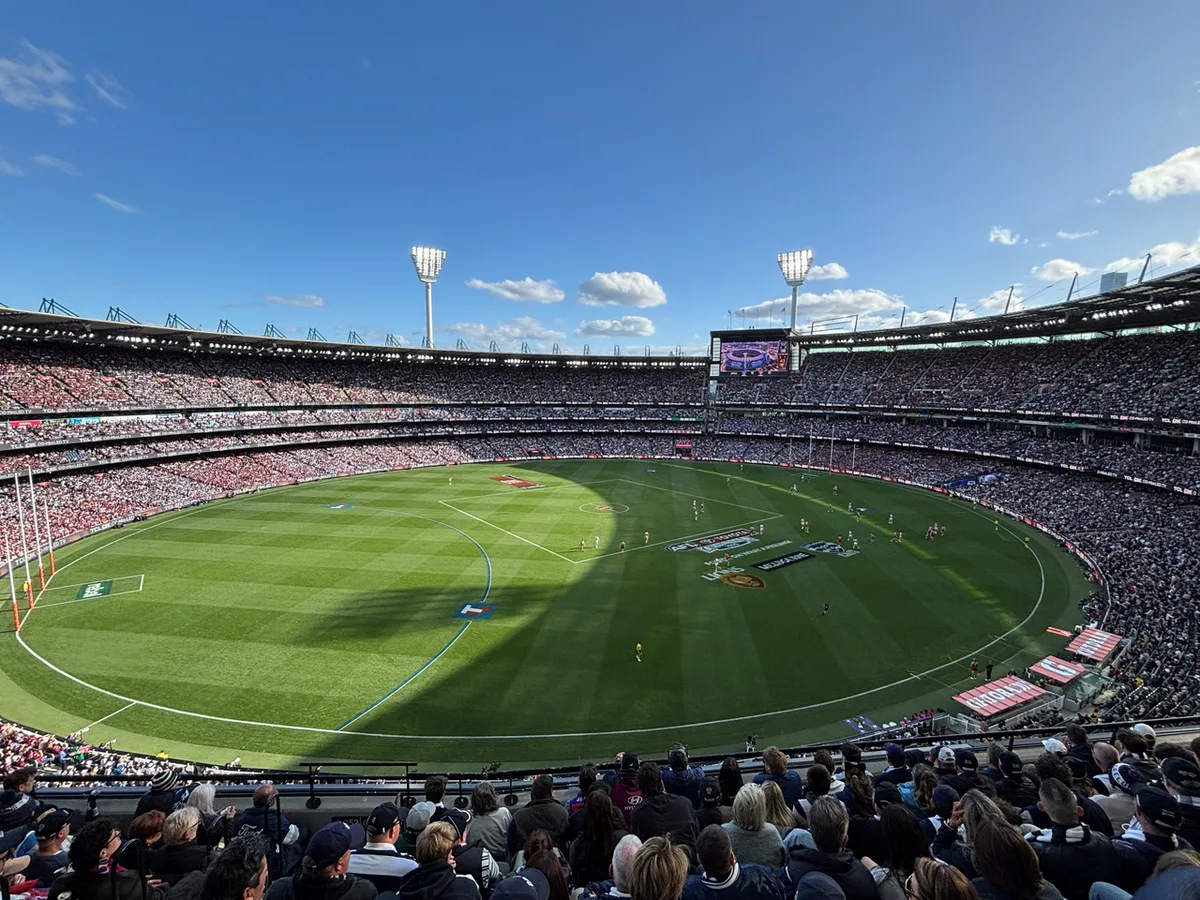
The Sydney Swans are an Australian rules football club based in Sydney, New South Wales. The men's team competes in the Australian Football League (AFL), and the women's team in the AFL Women's (AFLW). The Swans also field a reserves men's team in the Victorian Football League (VFL). The Sydney Swans Academy, consisting of the club's best junior development signings, contests Division 2 of the men's and women's underage national championships and the Talent League.
The club's origins trace back to 21 March 1873, when a meeting was held at the Clarendon Hotel in South Melbourne to establish a junior football club, to be called the South Melbourne Football Club. The club commenced playing in 1874 at its home ground, Lakeside Oval in Albert Park. Playing as South Melbourne, it participated in the Victorian Football Association (VFA) competition from 1878. In 1880 the club merged with the Albert Park Football Club, adopting the latter's red and white colours. The club joined the breakaway Victorian Football League (VFL) as a founding member in 1897.
Originally known as the "Bloods" in reference to the red colour used on players' guernseys, the Swan emblem was adopted in 1933 after a journalist at the time referred to them using the moniker following a large influx of Western Australian players. In 1982, it became the first professional Australian football club to permanently relocate interstate (from Victoria to New South Wales). Initially playing in Sydney as "The Swans", it was given its current name in 1983.
The club has a rivalry with the Greater Western Sydney Giants, with whom they contest the Sydney Derby. Their headquarters and training facilities are located in the Moore Park sporting precinct, with offices and indoor training at the Royal Hall of Industries and outdoor sessions conducted on the adjacent Tramway Oval and Sydney Cricket Ground, the latter being the site of the club's senior men's team home matches since 1982. The Swans have won five VFL/AFL premierships including 1909, 1918, and 1933, before experiencing a 72-year premiership drought—the longest of any team in the competition's history. This premiership drought ended with the 2005 premiership, which was later followed by another title in 2012. Their five premierships are supplemented by fourteen grand final defeats, the most recent of which came in 2024. According to Roy Morgan statistics, the Swans are one of the most supported clubs in the AFL with more than a million fans in 2021; it has also been the most supported club in the league for the past nineteen years consecutively, dating back to 2006.
Contents
History
Origins: 1873–1876
The club's origins trace back to 21 March 1873, when a meeting was held at the Clarendon Hotel in South Melbourne for the purpose of establishing a junior football club, to be called the South Melbourne Football Club.
According to club historians, it was incorporated at the Temperance Hall, Napier Street at Emerald Hill 19 June 1874. It was first known as "Cecil Football Club" (after Cecil Street, South Melbourne, one of the early thoroughfares), but adopted the name "South Melbourne Football Club" four weeks later on 15 July. The club was based at Lake Oval alongside the lake in Albert Park, also home of the South Melbourne Cricket Club.
While one of the early favourites to win, South Melbourne were a notable exclusion from the Challenge Cup competitions of the 1870s with entry to this competition strictly limited to clubs playing under the Melbourne Football Club's rules. The club's lack of adherence to the Victorian Rules (and insistence on playing by its own rules) resulted in some controversial early wins. This, along with ability to regularly field a full senior team, may have contributed to its absence during the football season competition begun in the 1870s. Throughout this period South Melbourne, along with neighbouring Cup member club Albert Park FC, had experimented with rugby football rules which in May 1874 had advocated strongly for their widespread adoption in Victoria; however, this did not meet favour with the more powerful clubs in the colony.
Despite not being part of the big league of clubs, South Melbourne by the mid-1870s is recorded to have enough senior players to field two teams of twenty and played matches against non-Cup clubs during this time against nearby clubs including Fawkner Park, Elwood, West Melbourne, Southern Rifles in 1875 and Sandridge Alma, St Kilda Alma, Victoria Parade, and Williamstown in 1876 among others. Many of this group of clubs most of which had primarily juniors had also begun to discuss starting their own cup competition.
South was one of Victoria's most prolific touring clubs. Seeking more regular senior competition in 1876 South Melbourne also went on one of its first regional tours playing against newly formed clubs at Beechworth, Blackwood, Taradale and Ballarat.
VFA era: 1877–1896
South Melbourne was a junior foundation club of the Victorian Football Association in 1877, and attained senior status in 1879.
In 1880, South Melbourne amalgamated with the nearby Albert-park Football Club, which had a senior football history dating back to May 1867 (Albert-park had, in fact, been known as South Melbourne during its first year of existence). Following the amalgamation, the club retained the name South Melbourne, and adopted the club's now familiar red and white colours from Albert-park. Nicknamed the "Southerners", the team was more colourfully known as the "Bloods", in reference to the bright red diagonal sash on their white jumpers The colourful epithet the "Bloodstained Angels" was also in use. Following the 1880 amalgamation it became the strongest in metropolitan Melbourne.
Over its first decade as an amalgamated club, South Melbourne won five VFA premierships – in 1881, 1885 (undefeated) and three-in-a-row in 1888, 1889 and 1890 – and was runner-up to the provincial Geelong Football Club in 1880, 1883 and 1886. The 1886 season was notable for its 4 September match against Geelong, which generated unprecedented public interest as both clubs had entered the match undefeated.
The club was the second Victorian club to visit New South Wales in 1883 travelling to Newcastle where it also defeated the Northern Districts League by a goal before travelling to Sydney where it defeated Sydney by just a single goal in front of a large crowd at the Sydney Cricket Ground and East Sydney Football Club by a goal in front of 600 spectators.
In May 1889, the Swans lost narrowly to a touring Maori team from New Zealand.
At the end of the 1896 season, Collingwood and South Melbourne finished equal at the top of the VFA's premiership ladder with records of 14–3–1, requiring a playoff match to determine the season's premiership; this was the first time this had occurred in VFA history. The match took place on 3 October 1896 at the East Melbourne Cricket Ground. Collingwood won the match, six goals to five, in front of an estimated crowd of 12,000.
This grand final would be the last match South Melbourne would play in the VFA, as the following season they would be one of eight founding clubs forming the breakaway Victorian Football League joining St Kilda, Essendon, Fitzroy, Melbourne, Geelong, Carlton and Collingwood.
VFL entry: 1897–1909
South Melbourne was one of the original founding clubs of the Victorian Football League that was formed in 1897.
Premiership success: 1909–1945
The club had early success and won three VFL premierships in 1909, 1918 and 1933.
However, they were the subject of some off-field difficulties, and the late 1920s, the South Melbourne Districts Football Club donated 40 guineas to South Melbourne to stop them from folding. The Districts also often provided assistance payments to players when needed.
In 1932, the red sash on the guernsey was replaced with a red "V".
The club was at its most successful in the 1930s, when key recruits from both Victoria and interstate led to a string of appearances in the finals, including four successive grand final appearances from 1933 to 1936, albeit with only one premiership in 1933. The collection of players recruited from interstate in 1932/1933 became known as South Melbourne's "Foreign Legion".
On grand final eve, 1935, as the Swans prepared to take on Collingwood, star full-forward Bob Pratt was clipped by a truck moments after stepping off a tram and subsequently missed the match for South. Ironically, the truck driver was a South Melbourne supporter.
It was during this period that the team became known as the Swans. The nickname, which was suggested by a Herald and Weekly Times artist in 1933, was inspired by the number of Western Australians in the team (the black swan being the state emblem of Western Australia), and was formally adopted by the club before the following season 1934. The name stuck, in part due to the club's association with nearby Albert Park and Lake, also known for its swans (although there are no longer any non-native white swans and only black, indigenous swans in the lake).
After several years with only limited success, South Melbourne next reached the grand final in 1945. The match, played against Carlton, was to become known colloquially as "the Bloodbath", due to the player brawl that overshadowed the match, with a total of 9 players being reported by the umpires. Carlton won the match by 28 points, and from then on, South Melbourne struggled for many years.
Struggling times: 1946–1981
Following the end of the second world war, South Melbourne consistently struggled, as their traditional inner-city recruiting district largely emptied as a result of demographic shifts. The club missed the finals in 1946 and continued to fall such that by 1950 they were second-last on the ladder. They narrowly missed the finals in 1952, but from 1953 to 1969, they never finished any higher than eighth on the ladder. By the 1960s it was clear that South Melbourne's financial resources would not be capable of allowing them to compete in the growing market for country and interstate players, and their own local zone was never strong enough to compensate for this. The introduction of country zoning failed to help, as the Riverina Football League proved to be one of the least profitable zones.
Between 1945 and 1981, South Melbourne made the finals only twice: under legendary coach Norm Smith, South Melbourne finished fourth in 1970, but lost the first semi-final; and, in 1977, the club finished fifth under coach Ian Stewart, but lost the elimination final. In that time, they "won" three wooden spoons. Between Round 7, 1972 and Round 13, 1973, the team lost 29 consecutive games. By the end of the 1970s, South Melbourne were saddled with massive debts after struggling for such a long period of time.
A VFL club for Sydney
The first football clubs in Sydney of any code were established in 1865 with two Australian rules football clubs named the Sydney FC and the Australian FC. The president of Sydney FC was cricket player and administrator Richard Driver, who between 1857 and 1865 had come into contact with cricketer and football pioneer Tom Wills numerous times in Sydney and Melbourne. The public road today situated outside the western walls of the SCG and Sydney Football Stadium is named Driver Avenue in his honour. The two clubs in 1865 played their matches on Hyde Park in the city. Both clubs were defunct after just two seasons and over the remainder of the 19th century the code had a sporadic existence in Sydney.
The VFL had been actively seeking an audience in Sydney since its first exhibition match in 1903 drew 20,000 people. For more than three quarters of a century, it had strategically scheduled matches in Sydney and through the Australian National Football Council – had allocated a significant share of its marketing budget to developing the code in Sydney, showcasing interstate tournaments and encouraging its clubs to play against the state representative side. At one point, it even attempted to negotiate a hybrid code with rugby league. However interest in the code in Sydney remained the poorest in the country (where it was behind three other football codes). In the late 1970s, however, with increasing professionalism of the sport there was an overall increase in national interest in the VFL competition.
In 1976, Melbourne journalist Jim Main began to break a story that a leading Melbourne businessman who had relocated to Sydney, Mannie Bongornio, had been meeting with Allen Aylett about luring a VFL club to Sydney. The idea began to gain traction and in 1977, Ron Barassi proposed the VFL setting up a club in Sydney, which he offered to coach believing that it would help spread the code in the state. Upon becoming league president, Aylett had the league investigate playing Sunday matches at the SCG. The VFL scheduled 2 premiership matches for the Sydney Cricket Ground in 1979. One of them, between the previous year's grand finalists North Melbourne and Hawthorn drew a record 31,395 to the gates. In 1979 the financially struggling Fitzroy Lions conducted a feasibility into the possibility of moving to North Sydney and a proposal was put forward, but was voted down by its board in 1980. To test the market further, the VFL scheduled 4 matches for the SCG in 1980 with an average attendance of 19,000. In April 1980, the VFL stated that its market study showed there was sufficient support for a Sydney team, finding that there was an increase in television ratings in Sydney and sustained attendance at matches and that it intended to have a team in Sydney, possibly as soon as 1982. A 1981 report by Graham Huggins concluded that there was an "untapped market in Sydney which represented an excellent opportunity for the league." The report claimed that 60,000 people in Sydney had stated that they would regularly support the new club and 90% of these supporters would watch VFL on television from Sydney and 80% of these supporters had not attended rugby and 92% believed that Australian rules could become popular in Sydney.
Swans move to Sydney: 1982–1984
In 1982, the club was still technically a Melbourne-based club which played all of its home games at the Sydney Cricket Ground. Its physical "home club" was the "Southern Cross Social Club" at 120a Clovelly Road, Randwick In response to the move, the club's sponsors, Bond Corporation pulled out and the club was left without a major backer. At a major launch in Sydney, Aylett vindicated the league's decision, announcing it had signed a new sponsor, Ward Transport, and that on-field success for the Swans would soon follow. The Swans experienced success in the 1982 Escort Championships with 1,000 supporters packing out the Chevron Hotel ballroom in King Cross in response to the win, however Channel Seven did not broadcast the match in Sydney.
The club won their first official Sydney home game against Melbourne in front of 15,764.
On 2 June 1982, it dropped the name "South Melbourne", officially becoming "the Swans" for the rest of the season. The name change, however, did not endear either the Sydney media or the Sydney public, and after successive games at home, began to draw as few as 10,000. Despite just missing the finals, and some good wins at home and respectable home crowds against league leaders Carlton and Richmond, the lack of success and cold reception in Sydney led to the lustre quickly leaving the league's glamour team. It was officially renamed the "Sydney Swans" in 1983.
In 1983 average crowds in Sydney continued to plummet to 12,000 and Swans supporter packages dropped to as low as 100 members (well short of the 20,000 average crowds predicted by the VFL's 1980 Hennessy Report). Television ratings and sponsorship revenue in Sydney were also far below the league's expectations.
Operating at a loss well short of the VFL's predicted $750,000 a year profit poor financial performance continued to drown the club in 1984, with the club flagging pay cuts to its players in order to survive. Coach Ricky Quade resigned and caretaker coach Bob Hammond, despite showing some promise, was unable to turn the club's poor performance around. In order to keep the club solvent during this time, the VFL began to write loans to the Swans that the club would have been unable to pay off on its own. The Swans were the league's most reliant on sponsorship and subsidies from the VFL to stay solvent and meet player payments due to its continued poor crowds, public apathy and poor TV ratings.
Edelsten era and privatisation: 1985–1987
On 31 July 1985, for what was thought to be $6.3 million, Geoffrey Edelsten "bought" the Swans; in reality it was $2.9 million in cash with funding and other payments spread over five years. Edelsten resigned as chairman in less than twelve months, but had already made his mark. He immediately recruited former Geelong coach Tom Hafey. Hafey, in turn, used his knowledge of Geelong's contracts to recruit David Bolton, Bernard Toohey and Greg Williams, who would all form a key part of the Sydney side, at a league-determined total fee of $240,000 (less than the $500,000 Geelong demanded and even the $300,000 Sydney offered). The likes of Gerard Healy, Merv Neagle and Paul Morwood were also poached from other clubs, and failed approaches were made to Simon Madden, Terry Daniher, Andrew Bews and Maurice Rioli.
During the Edelsten years, the Swans were seen by the Sydney public as a flamboyant, flashy club, typified by the style of its spearhead, Warwick Capper, his long bright blond mullet and bright pink boots made him unmissable on the field and his pink Lamborghini, penchant for girlfriends who were fashion models and his general showy eccentricity made him notorious off the field – all somewhat fashionable in the 1980s. During Capper's peak years, the Swans had made successive finals appearances for the first time since relocating. His consistently spectacular aerial exploits earned him the Mark of the Year award in 1987 while his goalkicking efforts (amassing 103 goals in 1987) made him runner up in the Coleman Medal two years running. The Swans' successive finals appearances saw crowds during this time peak at an average of around 25,000 per game. Edelsten also introduced the "Swanettes", becoming the sole such American-style cheerleading group among VFL teams following the disbandment of Carlton's Blue Birds in 1986. The Swanettes did not get much performance time, owing to the short intervals between quarters of play in the VFL and the lack of space in which they might perform while other activities take place on the field. The Swanettes were rapidly discontinued. During the Edelsten era, the club's owner and the private company Westec are reported to have sunk more than $10 million in additional private capital to keep the club afloat.
When the Southern Cross club went bankrupt in 1987, the club relocated to the newly built Sydney Football Stadium.
In 1987, the Swans scored 201 points against the West Coast Eagles and the following week scored 236 points against the Essendon Football Club. Both games were at the SCG. The Swans remain one of only two clubs to have scored consecutive team tallies above 200 points, the only other being Geelong in 1992. However, this was followed by several heavy losses, including defeat by Hawthorn by 99 points in the Qualifying Final and by 76 points against Melbourne in the First Semi-final.
Dark times: 1988–1994
The club's form was to slump in the following year. Losses were in the millions. It was obvious to most that the Swans were struggling financially, though the owners, Sydney Rules Pty Ltd a subsidiary of Powerplay International Ltd were not selling. In early 1988 the company advised the Australian Securities Exchange to cease trading its shares as it could not continue to trade until it had offloaded the Swans. A Canberra consortium including the ACTAFL initially proposed to buy the failed club and shift it to Canberra, however the VFL claimed this was too extreme a move. The league compromised and along with Aylett, who had denied Canberra a licence in 1981, proposed that the Swans play away games in the ACT with a dual aim of giving the club a sustainable supporter base and helping resurrect the code in the ACT which had lost enormous ground to rugby league since the introduction of the Canberra Raiders. However the VFL blocked the move feeling that the club would lose its identity if it were to play matches in Canberra.
By mid year the VFL had revoked the Swans licence and took over ownership of the club, after an investigation under VFL CEO Ross Oakley determined that it was unable to continue operating. However, there were no buyers. On 6 May 1988 the VFL paid Powerplay just $10 to transfer ownership of the club in an attempt to keep it afloat until a buyer could be found. The VFL would wait months for the club to regain financial security. The VFL had reported that it needed to find a buyer willing to pay at least $4 million in order to make the club financially viable in the medium to long term. In the meantime, the league had secured a sponsor which helped underwrite the club until the sale.
At the end of 1988 the VFL re-tendered the Swans licence and a group of financial backers including Mike Willesee, Basil Sellers, Peter Weinert and Craig Kimberley, purchased the licence and bankrolled the club.
Morale at the side plummeted as players were asked to take pay cuts. Coach Tom Hafey was sacked by the club in 1988 after a player-led rebellion at his tough training methods (unusual in the semi-professional days of that era). The Willesee consortia appointed Col Kinnear as the new coach.
Capper was sold to the Brisbane Bears for AUD$400,000 in a desperate attempt to improve the club's finances. Instead, it only led to disastrous on-field performances. Instead of a 100-goal-a-season forward, Sydney's goalkicking was led by Bernard Toohey (usually a defender) with 29 in 1989, then Jim West with 34 in 1990. Players left the club in droves, including Brownlow Medalist Greg Williams, Bernard Toohey and Barry Mitchell. The careers of stars such as Dennis Carroll, David Bolton, Ian Roberts, Tony Morwood and David Murphy wound down, while promising young players like Jamie Lawson, Robert Teal and Paul Bryce had their careers cut short by injury.
Tony Lockett and grand final return: 1995–2001
A big coup for the club was recruitment of St Kilda Football Club champion Tony "Plugger" Lockett in 1995. Lockett became a cult figure in Sydney, with an instant impact and along with the Super League war in the dominant rival rugby league football code in Australia, helped the Swans to become a powerhouse Sydney icon.
1995 would be Barassi's last year in charge. The Swans won eight games – as many as they did in the previous three seasons combined – and finished with a percentage of over 100. They were also one of only two teams to defeat the all-conquering Carlton side of that year. Captain Paul Kelly won the League's highest individual honour, the Brownlow Medal. Barassi left an improving team, a club in a much better state than he found them.
Former Hawthorn player Rodney Eade took over the reins in 1996 and after a slow start (they lost their first two games of the season), turned the club around into powerful force. The Swans ended the minor round on top of the premiership table with 16 wins, 5 losses and 1 draw. In the finals, the Swans won one of the most thrilling AFL preliminary finals in history after Plugger Lockett kicked a behind after the siren to win the game. The Swans lost the grand final to North Melbourne, which had been their first appearance in a grand final since 1945. The game was played in front of 93,102 at the MCG.
The Swans then made the finals for four of the next five full years that Rodney Eade was in charge. In 1998 they finished 3rd on the AFL ladder; despite beating St Kilda in their first final the Swans were then beaten by eventual premiers Adelaide in the semi-final at the SCG.
The 1999 season was a largely uneventful year for the club, the only real highlight being Tony Lockett kicking his record-breaking 1300th goal against Collingwood in Round 10. The 1999 season ended with a 69-point mauling at the hands of minor premiers Essendon.
After missing the finals in 2000, the Swans rebounded to finish 7th in 2001, but were beaten by Hawthorn by 55 points in their elimination final at Colonial Stadium.
Rebuilding and finals return: 2002–2004
Former Swans favourite son Paul Roos was appointed caretaker coach midway through the 2002 season, replacing Rodney Eade who was removed after Round 12. Roos won six of the remaining 10 games that year (including the last four of the season) and was installed as the permanent coach from the 2003 season onwards, despite rumours that Sydney had nearly concluded a deal with Terry Wallace.
Roos continued a record as a successful coach with the Swans for the eight full seasons that would follow.
A new home ground at Stadium Australia provided increased capacity over the SCG. The Swans' first game played at the stadium in Round 9, 2002 against Essendon attracted 54,169 spectators. The Sydney Swans v Collingwood match on 23 August 2003 set an attendance record for the largest crowd to watch an AFL game outside of Victoria with an official attendance of 72,393 and was the largest home and away AFL crowd at any stadium for 2003. A preliminary final against the Brisbane Lions in 2003 attracted 71,019 people. The Swans lost all three of those significant matches.
2004 saw an average year for Sydney, however one highlight was when they ended St Kilda's undefeated start to the season in Round 11. The match was notable for Leo Barry's effort in nullifying the impact of St Kilda full-forward and eventual Coleman Medallist Fraser Gehrig, whom Barry restricted to only two possessions for the entire match.
Sydney was able to recruit another St Kilda export in the Lockett mould, Barry Hall. There were obvious parallels to the signing of Lockett (a powerful, tough forward from St Kilda with questions over his discipline and attitude), which left Hall with much to live up to. He flourished in his new surroundings and eventually became a cult figure and club leader in his own right.
As the new century dawned, Sydney implemented a policy of giving up high order draft picks in exchange for players who struggled at other clubs. It was during this era that the Swans picked up the likes of Paul Williams, Barry Hall, Craig Bolton, Darren Jolly, Ted Richards, Peter Everitt, Martin Mattner, Rhyce Shaw, Shane Mumford, Ben McGlynn and Mitch Morton, amongst others, and giving up higher order draft picks meant the Swans missed out on the likes of Daniel Motlop, Nick Dal Santo, James Kelly, Courtenay Dempsey and Sam Lonergan who went to Port Adelaide, St Kilda, Geelong and the latter two to Essendon respectively. This policy is said to have paid off in the Roos era, as they implemented a strict culture of discipline at the club.
Premiership glory: 2005
In 2005, the Swans came under enormous public scrutiny, even from AFL CEO Andrew Demetriou, for their unorthodox, "boring" defense-oriented tactics that included tightly controlling the tempo of the game and starving the opposition of possession (in fact, seven teams that season had their lowest possession total while playing against the Swans). Swans coach Paul Roos maintained that playing contested football was the style used by all recent Premiership-winning teams, and felt that it was ironic that the much criticised strategy proved ultimately successful.
After finishing third during the regular season, the Swans lost the second qualifying final against the West Coast Eagles at Subiaco Oval on 2 September by 10.5 (65) to 10.9 (69). This dropped them into a semi-final against the Geelong Cats at the SCG on 9 September, and the Swans trailed the Cats 31–53 before Nick Davis kicked four consecutive goals, with the last one a matter of seconds before the siren, to win the game for Sydney by 7.14 (56) to 7.11 (53). In the first preliminary final at the MCG on 16 September against St Kilda, the Swans used a seven-goal blitz in 11 minutes of the fourth quarter to overturn an 8-point deficit and overrun the Saints by 15.6 (96) to 9.11 (65).
The Swans faced the Eagles in a rematch in the AFL Grand Final on 24 September 2005, and this time, they prevailed by four points, final score 8.10 (58) to West Coast's 7.12 (54). In the last few minutes, the Sydney defence held strong, with Leo Barry marking the ball just before the siren to stop the Eagles' final desperate shot at goal. The Premiership was the Swans' first in 72 years and their first since being based in Sydney.
On 30 September 2005, a ticker tape parade down Sydney's George Street was held in honour of the Swans' achievements, which ended with a rally at Sydney Town Hall, where Lord Mayor Clover Moore presented the team with the key to the city. The flag of the Swans also flew on top of the Sydney Harbour Bridge during the week; the same flag was later given to Premier of Western Australia Geoff Gallop to fly on top of the state legislature in Perth as part of the friendly wager between Gallop and Premier of New South Wales Morris Iemma.
Off the field the Grand Final success instigated moves to make the club sustainable in the long term and capitalise on the success to grow the code in the state. The Greater Sydney Australian Football Foundation Limited was formed, which would later become the Sydney Swans Foundation aimed initially at raising $5 million in funds to develop the Swans and the code in New South Wales. The Foundation has raised millions since its inception and helped keep the Swans sustainable in Sydney.
Grand final loss: 2006
As reigning premiers, the Sydney Swans started the 2006 season slowly, losing three of their first four games, including in round one to an Essendon side that would finish near the bottom of the ladder with only three wins and a draw, and finish with the worst defensive record of any side for the season (Sydney, conversely, had the best defensive record of any side).
The 2006 AFL Grand Final was contested between the Sydney Swans and West Coast Eagles at the Melbourne Cricket Ground on 30 September 2006. The West Coast Eagles avenged their 2005 Grand Final defeat by beating the Sydney Swans by one point, only the fourth one-point grand final margin in the competition's history.
The rivalry between the Sydney Swans and West Coast Eagles has become one of the modern rivalries. The six games between the two sides (from the start of the 2005 finals to the first round of 2007 inclusive) were decided by a combined margin of 13 points. Four of those six games were finals and 2 grand finals.
Finals goal: 2007–2010
Sydney finished the 2007 home and away season in 7th place, and advanced to the finals, where they faced and were defeated by Collingwood by 38 points in the elimination final. It was their earliest exit from the finals since 2001 and was a culmination of a mostly disappointing season, as only victories against lesser teams saw them through to a fifth consecutive finals campaign.
The conclusion of the 2007 trade saw the loss of Adam Schneider and Sean Dempster to St Kilda, the delisting of Simon Phillips, Jonathan Simpkin and Luke Vogels, and the gain of Henry Playfair from Geelong and Martin Mattner from Adelaide.
The Swans spent the middle part of the 2008 season inside the top four, however a late form slump which yielded only three wins in the last nine rounds saw the Swans drop to sixth at the conclusion of the 2008 regular season. Having qualified for the finals for a sixth consecutive season, the Swans defeated North Melbourne in the elimination final before losing to the Western Bulldogs the following week.
2009 saw the club register only eight victories as they failed to reach the finals for the first time since 2002, finishing 12th with a percentage of below 100% for the first time since 1994. Barry Hall, Leo Barry, Jared Crouch, Michael O'Loughlin, Amon Buchanan and Darren Jolly all departed at the conclusion of the season, with Mark Seaby, Daniel Bradshaw and Shane Mumford, among others, joining the club during the trade period.
The 2010 season saw Sydney return to the finals by virtue of a fifth-place finish at the end of the regular season. The club defeated Carlton by five points in the elimination final before losing to the Western Bulldogs in the semi-finals for the second time in three seasons. The loss signalled the end of the Swans coaching career of Paul Roos as well as that of the playing career of Brett Kirk.
John Longmire era: 2011–2024
Former North Melbourne premiership-winning forward John Longmire took over as coach of the Swans as part of a succession plan initiated by Paul Roos in 2009 prior to the beginning of the 2011 season.
He led the club to a seventh-place finish at the end of the regular season, therefore qualifying for the finals for the 13th time in the past 16 seasons. The Swans defeated St Kilda in an elimination final at Docklands Stadium before losing to Hawthorn in the semi-finals the following week.
It was during the regular season that the Swans caused the upset of the season, defeating the star-studded Geelong Cats on its home ground, Skilled Stadium, where the home tenant had won its past 29 games in succession, and its past two matches at the ground by a combined margin of 336 points, in Round 23. It was the Swans' first win over the Cats since 2006 and its first win at the ground since Round 8, 1999. The Swans were also the only team to defeat the West Coast Eagles at Patersons Stadium during the regular season. The Swans' victory over Geelong was overshadowed by the news that co-captain Jarrad McVeigh's baby daughter had died in the week leading up to the match, forcing him to miss that match.
The 2012 season began for the Swans with the inaugural Sydney Derby against AFL newcomers Greater Western Sydney. After an even and physical first half, Sydney went on to win by 63 points. Subsequent wins over Fremantle, Port Adelaide, North Melbourne and Hawthorn saw the Swans sit second behind West Coast on percentage after Round 5, but the Swans would proceed to lose three of their next four matches before embarking on a nine-match winning streak between Rounds 10 and 19 inclusive. The Swans eventually finished the regular season in third place after losing three of their final four matches, all against their fellow top-four rivals (Collingwood, Hawthorn and Geelong in Rounds 20, 22 and 23 respectively).
The Swans defeated Adelaide by 29 points in their qualifying final at AAMI Stadium, thus earning a week off and a home preliminary final, where they then defeated Collingwood by 26 points to qualify for their first grand final since 2006, ending an eleven-match losing streak against the Magpies in the process.
In the grand final, the Swans defeated Hawthorn by ten points in front of 99,683 people at the MCG, with Nick Malceski kicking a snap goal with 34 seconds left to seal the Swans' fifth premiership and first since 2005. Ryan O'Keefe was named the Norm Smith Medallist and the Swans' best player in September.
Dean Cox era: 2025–
Former West Coast, six-time All-Australian, premiership-winning ruckman Dean Cox was appointed the 45th head coach of the Sydney Swans ahead of the 2025 AFL season. At a press conference in December 2024, Cox flagged improvements to defence and contested work, which he described as "really poor" in the 2024 Grand Final. He also confirmed that key defender Tom McCartin had trained as a forward during much of the preseason. The club conducted a seven-and-a-half-hour review of the Grand Final loss, including one hour devoted to the opening minute of the match. Cox reinforced his approach of "challenging" the playing group with back-to-back 2 km time trials in February.
The early stages of the 2025 season were affected by an expanded injury list, including key players Callum Mills, Errol Gulden, Brodie Grundy, Tom Papley, Logan McDonald, and six other players. The Swans lost in Opening Round at the SCG to Hawthorn by 20 points, with Cox acknowledging post-match that he had "gotten some things wrong." The following week, Sydney lost at home once again, this time by 4 points to Brisbane in a Grand Final rematch.
The first win during the Cox era came in Round 2, with a 3-point victory over Fremantle at Optus Stadium. After a bye, the Swans defeated North Melbourne by 63 points in Round 4, but lost during Gather Round to Collingwood by 31 points. Media sources described Sydney's second-quarter performance as "unacceptable," with the team recording a pressure rating of 139 amid a run of Collingwood goals.
Extended conceding runs continued throughout the season, including Round 7 against Gold Coast (12 goals to none), Round 11 against Melbourne (12 goals to 6), Round 12 (12 goals to none) and Round 20 against GWS (11 goals to none). In Round 10, the Swans contested their annual Marn Grook Game against Carlton, regaining a first-quarter lead in the final term to win by 16 points.
Sydney suffered its largest home defeat since 1998 in Round 12, losing 90 points to Adelaide at the SCG on 31 May. Cox described the performance as "unacceptable and embarrassing," adding:"For a team that played desperate, uncompromising, ruthless football, and that (tonight) was far from it, so we need to strip it back and get to work real quick."Fans engaged in bronx cheering during the second quarter, which commentator Anthony Hudson called "Humiliating," while Adelaide's Wayne Milera labelled the Swans "a bit of a rabble," for which the Adelaide Football Club later apologised.
Club identity
The club's on-field nickname, the Swans, was suggested by a Herald and Weekly Times artist in 1933 in reference to the number of Western Australians in the team (the black swan being the state emblem of Western Australia). It was formally adopted by the club before the following season of 1934. The name is also thought to refer to the population of black swans in the Albert Park Lake, near the team's original home ground, South Melbourne Cricket Ground. The Chicago Swans are affiliated with the club and share a similar logo.
Uniforms
The jumper is white with a red back and a red yoke with a silhouette of the Sydney Opera House at the point of the yoke. The Opera House design was first used at the start of the 1987 season, replacing the traditional red "V" on white design. Until 1991, the back of the jumper was white with the yoke only extending to the back of the shoulders and each side of the jumper had a red vertical stripe. The current predominantly red design appeared at the start of the 1992 season. The club's major sponsor is QBE Insurance. In 2004 the club added the initials 'SMFC' in white lettering at the back of the collar to honour the club's past as South Melbourne Football Club. The move was welcomed by Melbourne-based fans. From 2011 to 2021, the clash guernsey was a predominantly white version of the home guernsey similar to the original Opera House guernsey design, including a white back, but was rarely used, since the two Queensland clubs (the Brisbane Lions and Gold Coast Suns) and cross town rivals GWS Giants are the only clubs with which there is a clash. As of 2023 in addition to being used in games in Victoria unless there is a clash, the red "V" is used as a clash guernsey against Gold Coast and Brisbane.
Nike is the current manufacturer of the Swans' apparel. Previous manufacturers were Puma (from mid-1990s to 2009) and ISC (2010 to 2020).
Club song
In the 1930s, the South Melbourne Swans song was an adaptation of "Springtime in the Rockies." A newspaper article from 1932 also documents that the club sang themed parodies of "Mademoiselle from Armentières" and "You Will Remember Vienna", the theme from the film Viennese Nights.
In 1951, "Cheer, Cheer Red and the White" was officially adopted. The melody originated from the "Victory March" fight song of the Notre Dame Fighting Irish, which Australian audiences had heard in the 1940 film Knute Rockne, All American.
The encouraging phrase "Up there, Cazaly", referring to South Melbourne player Roy Cazaly, was first used by club fans in the 1920s before entering the Australian lexicon in general, especially after World War II. This later inspired the 1979 Mike Brady song "Up There Cazaly" which is today associated with Australian rules football in general and performed at every Grand Final. In 1982, when the Swans relocated to Sydney, the official club song was changed to a rewritten version entitled "Up There for Sydney." This was used intermittently until the mid-1990s, when "Cheer, Cheer the Red and the White" was reinstated. It remains the club song to this day.
In March 2021, the "Cheer, Cheer" lyrics were changed from "while our loyal sons are marching" to "while our loyal Swans are marching" in order to be inclusive of the AFLW team.
Home ground and training base
The club's original home ground was Lakeside Oval, when they were known as the South Melbourne Football Club
from 1879 until 1981.
Since the 2016 AFL season, the Swans have played all their home games at the Sydney Cricket Ground, a 48,000 capacity venue located in inner-east suburb of Moore Park. The venue has been home to Swans home games since the club's relocation to Sydney in 1982. In the years 2002–2015, the Swans played between three and four home matches per season and most home finals matches at Stadium Australia (commercially known as ANZ Stadium), an 80,000 capacity stadium located in the west of the city. During the first five years at the ground average crowds were high, but issues with the surface as well as fan and player disengagement resulted in the club ending its association with the venue.
The club also trains on the SCG during the season and had its indoor training facilities and offices located within the stadium. During the off-season, when the ground is configured for cricket, the Swans train on the adjacent Tramway Oval (previously known as Lakeside Oval) also located within the Moore Park precinct. The oval is located less than one hundred metres from the SCG and since undergoing a redevelopment in 2018/19, has the same dimensions as the Docklands Stadium in Melbourne. The Swans NEAFL/reserves team have played some home matches at the oval, which has grassed hills and standing areas for several hundred spectators.
In October 2018 the club announced it would shift all offices and indoor training facilities to Moore Park's Royal Hall of Industries sometime in the early-to-mid 2020s, after announcing a $55 million deal with the New South Wales Government to redevelop the Hall. The club pulled out of the agreement in April 2020 due to the financial implications of the COVID-19 pandemic. In August 2021, the Swans announced it had re-negotiated a lease with the government to immediately commence the project. The facility provides indoor training facilities and administration for the Swans AFL, VFL and AFLW teams. The club began moving into the facility in December 2022. It was formally opened by the Prime Minister and New South Wales Premier in June 2023. The facility includes an indoor training field, gym, wet recovery area, medical amenities, a retail store, commercial kitchen, media studio, auditorium, learning centre, office space and a rooftop terrace, while the newly built adjoining building includes an international standard multi-purpose indoor sports court.
Rivalries
Greater Western Sydney
The introduction of the GWS Giants to the AFL in 2012 resulted in the formation of the Sydney Derby. The Swans compete against their cross-city rivals twice every season. The best performed player from every derby match is awarded the Brett Kirk Medal.
Initially, the rivalry was a one-sided affair in favour of the Swans, who won 8 of the first 9 derbies. However, it has become more competitive in recent years, with the Giants winning 5 of the 7 most recent derbies. The Swans have also played the Giants in four finals matches, losing three of them.
West Coast Eagles
The Swans developed a famous modern rivalry against the Perth-based West Coast Eagles between 2005 and 2007, when six consecutive games between the two teams, including two qualifying finals and two grand finals, were decided by less than a goal. The rivalry was highlighted by Sydney's four-point win against West Coast in the 2005 Grand Final, and West Coast's one-point win against Sydney in the 2006 Grand Final.
Hawthorn
The rivalry with Hawthorn has been more recent, mostly defined by two grand finals (2012 and 2014). The Swans beat Hawthorn in 2012 by 10 points to claim their fifth premiership. The rivalry grew in 2013, when Hawthorn forward Lance Franklin transferred to the Swans as a free agent on a nine-year, $10 million deal. In 2014, the Swans finished minor premiers and were favourites to win the grand final, however were defeated by 63 points. Both teams have had close games since their grand final encounters, with their matches often finishing within single digit margins.
Men's team
Women's team
The Sydney Swans women's team was founded for the 2016 exhibition series; however, they did not bid for AFLW entry until 2022. Following the granting of an official AFLW license, the team made its debut in 2022 AFL Women's season 7.
It was the most supported in the AFLW in 2022 (S7) with 7,757 members. Despite finishing last in its debut season, the women's team had the 4th highest average home attendance in the league, with 3,773 playing out of the North Sydney Oval and Henson Park.
Reserves team
The Sydney reserves are the reserves side of the club, playing in the Victorian Football League since 2021.
History
South Melbourne Juniors was formed by the South Melbourne Football Club on 29 March 1900, joining the Metropolitan Junior Football Association (MJFA).
In 1919, the Victorian Junior Football League (VFL) was formed, with the Leopold Football Club operating as South Melbourne's affiliate. At the end of the 1924 season, Leopold was replaced by the South Melbourne Second Eighteen.
The side competed in the VFL seconds (which later became the AFL reserves) until the competition's demise at the end of 1999, even after the move Sydney in 1982. The team enjoyed little success in the reserves competition, with its best performances in losing grand finals in 1927, 1956, 1980 and 1995.
In 2000, the Sydney reserves – known as the Redbacks – joined the Sydney AFL competition, but was so dominant in the lower competition that it withdrew prior to the finals series because the club felt the difference in standard was too greatly in favour of the Swans. Between 2001 and 2002, the Swans affiliated themselves with the Port Melbourne Football Club in the VFL, sending most of its reserves players there, while also retaining the Redbacks in the Sydney AFL as a junior development team. From 2003, the Sydney reserves recombined to a single team, which contested the higher standard AFL Canberra, winning four consecutive premierships between 2005 and 2008.
In 2011 the Swans reserves team joined the newly established North East Australian Football League with the rest of the AFL Canberra competition. The side often played as a curtain raiser to senior AFL games. The side never won a premiership, eliminated in the Eastern Conference Grand Finals in 2011 and 2012; then losing the overall NEAFL grand final five times: 2013, 2014, 2016, 2017 and 2018.
Following the disbandment of the NEAFL in 2020, the Sydney reserves have competed in the Victorian Football League.
Sydney Swans Academy
The Sydney Swans Academy consists of the club's junior development signings. It was formed in 2010 as one of two in Sydney including the GWS Giants Academy and one of four Northern Academies including the Brisbane Lions Academy and Gold Coast Suns Academy.
72 spread staff across 9 facilities manage 550 selected underage players from age 10 up with regional hubs in Illawarra, Central Coast, Newcastle, Port Macquarie and Northern Rivers.
The men's and women's U16 and U18 teams have contested Division 2 of the men's and women's underage championships since 2017.
The Swans Academy also joined the Talent League in 2019.
Corporate
Governance
The AFL Commission owns the majority stake in the club and elects seven of the nine members of its board with the two remaining being elected by the club members.
Administration
Directors:
Andrew Pridham chairman (2013–present)
Andrew Ireland
Sam Mostyn
Robert Morgan
Greg Paramor
Darren Steinberg
Leo Barry
Alexandra Goodfellow
Brian Tyson
CEOs:
Matthew Pavlich (2025–current)
Andrew Ireland (2009–2018)
Myles Baron-Hay (2004–2009)
Phil Mullen
Colin Seery
Kelvin Templeton
Jordan Sembel
Sponsors
As of November 2023, the club's sponsors are:
realestate.com.au
Volkswagen
Nike
Qatar Airways
HSBC
Carsales
Origin Energy
Channel 7
Independent Reserve
Transport for NSW
Fiserv
McDonalds
Office of Responsible Gambling
Sydney Children's Hospitals Foundation
Supported charities
Wally Jackson Research Fund
Sydney Australian Football Foundation (SAFF)
Supporter base
Although a large majority of the existing fan base strongly objected to the relocation of the club from South Melbourne, the Sydney Swans have built a large following in the city they now call home. Attendances and memberships in Sydney grew dramatically during the Lockett era, helped out by the Super League War plaguing Rugby League. Nevertheless, the Swans continue to have a substantial supporter base in Victoria, with attendances for Swans games in Melbourne being much higher than other non-Victorian teams. In 2024, the Sydney Swans achieved their highest home attendances in club history, with an average of 38,202 fans at each of their 11 home games at the SCG, far surpassing the previous record of 35,818 that was set back in 1997. The club also reached a new membership record of 73,757 as of September 2024, 12.9% more than their previous record of 65,332, set one year earlier in 2023.
Aboriginal actress and dancer Lillian Crombie founded the First Nations supporters club, the Black Swans.
According to Roy Morgan Research, the club has been the most supported club among all AFL supporters in every year since 2004.
The club also has an official Sydney LGBTQIA+ supporter group, Rainbow Swans.
Legend:
Premiers Grand Finalist Finals Wooden spoon
Club honour boards
Team of the century
Sydney announced its team of the century on 8 August 2003:
Achievements
Records
Most games – Adam Goodes (372)
Most goals – Bob Pratt (681)
Most goals in match – Tony Lockett (16), Round 19, 1995 v Fitzroy at Western Oval
Most goals in a season – Bob Pratt (150) in 1934
Most games coached – John Longmire (300)
Highest score – 36.20 (236) vs Essendon 11.7 (73), Round 17, 1987
Lowest score – South Melbourne 0.5 (5) vs Carlton 3.6 (24), Round 8, 1899
Lowest score since 1919 – South Melbourne 1.9 (15) vs Geelong 8.9 (57), Round 16, 1964
Highest losing score – South Melbourne 24.10 (154) vs Melbourne 24.23 (167), Round 1, 1979
Lowest winning score – South Melbourne 2.3 (15) vs Melbourne 1.7 (13), Round 6, 1898
Lowest winning score since 1919 – South Melbourne 4.15 (39) vs Fitzroy 4.12 (36), Round 4, 1919
Since 1920 – South Melbourne 5.11 (41) vs St. Kilda 5.9 (39), Round 16, 1948
Greatest Winning Margin
As South Melbourne – (171 points) – South Melbourne 29.15 (189) vs St. Kilda 2.6 (18), Round 12, 1919
As Sydney Swans – (171 points) – Sydney Swans 31.19 (205) vs West Coast Eagles 5.4 (34), Round 15, 2023
Activism
Same-sex marriage
During the Australian Marriage Law Postal Survey, Sydney Swans supported the Yes vote.
Voice to Parliament
Sydney Swans is a supporter of the Voice to Parliament.