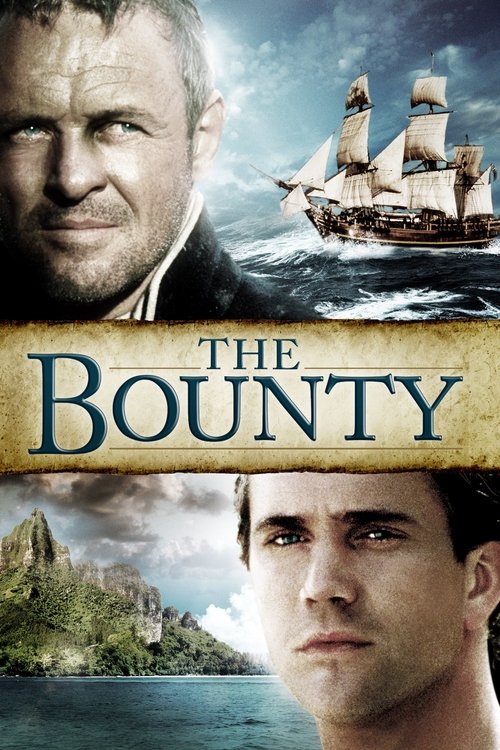
Development
The film was originally a longstanding project of director David Lean and his frequent collaborator, Robert Bolt. They started working on a script in Bora Bora in October 1977. Lean and Bolt planned to make two films, one named The Lawbreakers that would deal with the voyage out to Tahiti and the subsequent mutiny, and the second named The Long Arm, which would be a study of the journey and the mutineers after the mutiny, as well as the admiralty's response in sending out the frigate HMS Pandora.
In November 1977, producer Dino De Laurentiis announced he would finance the project and make it after his version of the Hurricane. Phil Kellogg was to produce the films. In December of that year, Paramount announced they would finance and distribute. The intention was to shoot the film in Tahiti, where De Laurentiis had built a large facility for shooting Hurricane, including a brand-new hotel.
While working on the script, Lean directed a documentary, Lost and Found: The Story of Cook's Anchor, about discovering an anchor that belonged to a ship of Captain James Cook. In August 1978, Lean said he expected each film to cost $25 million. "With the high brow critics you're as good as dead if you spend that sort of money on a film", he said. "For that kind of money, the argument runs, anyone should be able to make a good picture. Which is absolute rubbish." A replica of The Bounty was built in New Zealand. A script was finished by November 1978.
Bernard Williams became attached as producer. He says Lean and De Laurentiis assumed both films could be made for $40 million in total, but Williams budgeted The Lawbreakers alone at $40 million. De Laurentiis decided he could not afford to proceed. "Dino is no longer behind the project", said Kellogg in November, adding "The first script is finished and the second is underway. I expect the pictures to go in about a year by now and we'll make them back to back."
On 12 April 1979, Bolt suffered a massive heart attack, followed by a stroke two days later, with the second script incomplete. In August 1979, Anthony Hopkins announced Lean had asked him to play William Bligh. The producers looked at making the project as a seven-part TV series. Paramount were interested but decided to pull out after two months feeling the project was too "masculine" and lacked female interest. Lean tried to interest Sam Spiegel who persuaded the director to make just the one film. Lean had a go at the script himself.
Lean was ultimately forced to abandon the project after overseeing casting and the construction of the Bounty replica which cost $4 million. In June 1981 the producer was trying to sell the replica. "It was three years' work wasted", said Lean later. "And the sad part is, it was the best script I've ever had. It was really a cracker it would have made a marvellous film. But after all that work they pulled the rug from under me." De Laurentiis did not want to lose the millions he had already put into the project—$2 million in development costs plus the cost of the ship—and looked for another director.
Roger Donaldson was an Australian who had forged a career as director in New Zealand with Sleeping Dogs and Smash Palace. The latter was the first New Zealand film to obtain a distributor in the US. Donaldson said he met with De Laurentiis to discuss filming Conan the Destroyer, the sequel to Conan the Barbarian. Donaldson worked on a new script for that film. "Some time during that period I mentioned that I thought The Bounty sounded like an interesting project", Donaldson said. "Well, when I finished with the Conan script, he didn't really like it so I figured, well, I'm finished with Dino."
Di Laurentiis then offered Donaldson The Bounty despite not having seen any of the director's films and the fact that his biggest budget to date had been $1 million. (De Laurentiis later said he gave Donaldson the job on the basis of Smash Palace.) "Making the movie was something that, initially, I wasn't sure I wanted to do", said Donaldson. "I thought it might be perceived as some sort of a remake. But I looked at it and decided I'd do it as long as I could do something completely on my own, not a remake at all, but based much more on fact—something to set the record straight." "I saw it as an intense personal drama about two friends who have a tragic and violent falling out—a drama in which your sympathies change as events change", Donaldson said. "When you leave the movie, I hope that deep down you feel that you've understood a relationship between two men."