


Filming and locations
Principal photography began August 14, 1972. Although the film is set in Washington, D.C., many interior scenes were shot in New York City. The MacNeil residence interiors were filmed at CECO Studios in Manhattan, with Karras's confrontation with his uncle, shot at Goldwater Memorial Hospital, now the site of Cornell Tech, on Roosevelt Island in the East River between Manhattan and Queens; the scenes with Karras's mother in the hospital were filmed at Bellevue. The scene where Father Karras listens to the tapes of Regan was filmed in the basement of Fordham University's Keating Hall, where O'Malley was an assistant professor of theology.
The film's opening sequences were filmed in and near Mosul, Iraq, at a time when the US and Iraq did not have diplomatic relations; Warner Bros. feared that Friedkin and his crew might not be able to return. He negotiated filming arrangements directly with local officials of the ruling Ba'ath Party, who required that he hire local workers as crew and teach filmmaking to interested residents. The archaeological dig site shown is Hatra, south-west of Mosul. Temperatures during the days reached 130 °F (54 °C), limiting shooting to dawn and dusk.
The exterior of the MacNeil house was a family home on 36th and Prospect streets in Washington. A mansard roof was added to account for the attic scene. The neighboring stairs were padded with a half-inch (13 mm) of rubber for Karras's death. The house was set back slightly from the steps, so the crew built an eastward extension with a false front to allow the stunt double playing Karras to fall directly down.
Many Georgetown locations, on and off-campus, were used. Burstyn's first scene, where she lectures the protesters, was shot on the steps of Healy Hall; she is also seen walking down the steps of Lauinger Library. Other scenes used the interiors of Dahlgren Chapel and the university president's office, used as the archbishop's office. One scene was filmed in The Tombs, a popular local pub.
The exorcism scenes were challenging to film. Friedkin wanted the bedroom set to be cold enough to see the actors' breath, as described in the novel. A $50,000 ($284,000 in 2024) refrigeration system was installed to cool the set to −20 °F (−29 °C). Since the set lighting warmed the air, it remained cold enough to film for only three minutes at a time. Due to frequent breakdowns, only five shots could be finished each day; the complete scene, filmed in script order, took a month to complete.
It was easier to film some of the other supernatural manifestations, such as the bed rocking and the curtains blowing since the walls and ceiling of the set were capable of being moved to accommodate a camera. After the scene where the ceiling cracks it was replaced with one attached to the walls, requiring a hole be cut in it for the rig to go through when Regan levitates, the most challenging shot in the sequence. The 80-pound (36 kg) Blair wore a bodysuit under her nightgown with attached hooks for monofilament wires.
Roizman had filmed similar scenes before, painting the wires to match the background so they would not show. This was difficult on The Exorcist because of the changes in background. "We had to practically paint them frame by frame", he said. While most directors would have been satisfied to smooth out the scene in post-production, Friedkin wanted it done in longer takes.
Friedkin did not want any scenes in the movie to have "any kind of spooky lights that you typically saw in horror films", so all the light in the bedroom comes from a visible source. The room's color scheme also suggested black and white film, with gray taupe walls, Regan's bedding a neutral beige, and the priests in black. According to Roizman, white would have been too dominant. "In toning everything down like this, the only real color in the room became the skin tones", he said.
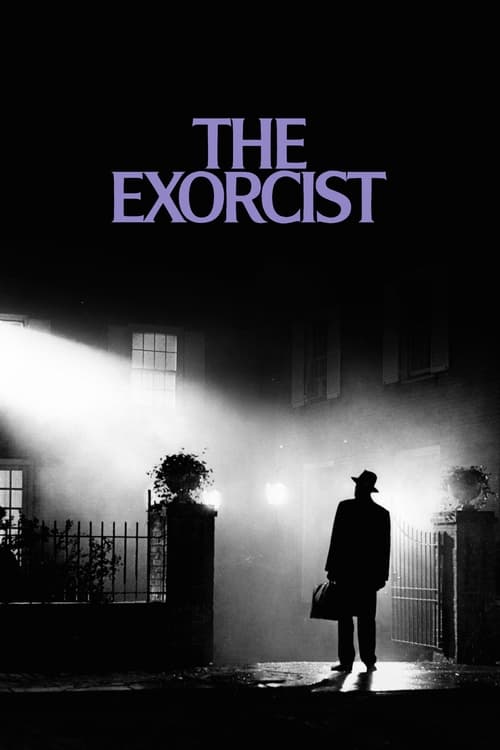
Father Merrin's arrival scene was filmed on Max von Sydow's first day on set. The scene where he steps out of a cab and stands in front of the MacNeil residence, silhouetted in a misty streetlamp's glow and staring up at a beam of light from a bedroom window, is one of the most famous scenes in the movie, used for film posters and home media release covers. It was inspired by René Magritte's 1954 painting Empire of Light. Friedkin wanted to evoke visually the language Blatty used in the novel for this scene, likening Merrin to "a melancholy traveler frozen in time", standing next to a streetlight in the fog when he gets out of the cab.
He gave the crew a full day to light the scene, using mainly arc lights and tripod-mounted Troupers, and boosting the brightness of the existing streetlamps. Roizman said this was the most difficult of all the film's nighttime exterior shots. To get the beam of light the way Friedkin wanted it, the crew had to take the window frame out of the facade they had attached to the house for filming, put it behind the window and then put the spotlight in between the window and frame. As they were shooting, Roizman said, the wind picked up, making it hard to hold the fog effect. By working quickly, he and the camera crew were able to get the shot, with Friedkin finding the first take satisfactory.
The scenes where the possessed Regan's head rotates so she appears to be looking directly backward drew notice from audiences and critics. "All I can tell you is that the way you think I did it is not the way we did it", Friedkin told Castle of Frankenstein at the time. Like the film's other special effects, it was performed live. A life-size animated dummy of Regan was built.
Critic Mark Kermode says the scene's impact results from the audience not expecting it so soon after the crucifix scene. He believes its recurrence during the exorcism was added on set since it is in neither the novel nor the screenplay. Blatty had argued against it, telling Friedkin "supernatural doesn't mean impossible". Friedkin inserted a shot of Karras, suggesting the scene might just be a hallucination. When audiences reacted strongly, Blatty said Friedkin "prov[ed] me an idiot once again".
Makeup artist Dick Smith built the latex dummy with help from effects supervisor Marcel Vercoutere. They tested its realism by putting it in the front seat of a taxicab and, when enough people were looking, turning the head. It was so realistic that Blair felt uncomfortable in its presence. They had given the dummy's face the capability to move and appear to speak, adding a condom so its throat would bulge. A tube was added for simulated breathing, which produced the requisite clouds of vapor.
While filming the scene where the possessed Regan masturbates with a crucifix, Dietz and Friedkin had "this long discussion about the right way to jerk off and I showed him why a woman has to churn her wrist [more than a man does]." At the time Friedkin said that the scene's power over audiences came from its unusual combination of sex and religion. To many viewers it lasted much longer than its 50 seconds. He had filmed much more, but ultimately decided that it was about "how much [he] could take".
The scene's power, Kermode writes, comes from Friedkin's head-on approach, centering it on a brightly lit screen, punctuating the thrusts with a stabbing sound. Blatty pleaded with Friedkin to stop "destroying the film"; Friedkin responded that the scene would be one of the film's biggest draws. When it turned out that it was, Blatty found it "terribly depressing".
The angiography scene, in which a needle spurts blood from Regan's neck, caused audiences the most discomfort, according to Blatty, who himself never watched it. Friedkin, too, has found its depiction of "[m]edical science impinging upon the innocence of this little girl" disturbs audiences the most, more than any of the film's possession scenes. It has been criticized as "unappetizing", the film's "most needless scene", and "revolting". British comedian Graeme Garden, who has a medical degree, agreed the scene was "genuinely disturbing"; in his review for the New Scientist, he called it "irresponsible".
Critic John Kenneth Muir wrote in Horror Films of the 1970s that the scene draws its power by merely recording what occurs and not adding anything. "It looks, sounds and feels totally real ... For a time, it is medicine that possesses Regan, not the Devil". In a 2021 article in History of the Human Sciences, Amy C. Chambers of Manchester Metropolitan University makes a similar observation.
Finnish media professor Frans Ilkka Mäyrä notes how the scientific suggests the spiritual here as "the violent movements and noises of arteriographic machinery reach diabolical dimensions" Kermode likens it to torture, "horribly sexual in its execution".
Medical professionals have described the scene, which was not in the novel but was added to the film to reflect changes in technology, as a realistic depiction of the procedure. It is also of historical interest, as radiologists were increasingly using a more distant artery instead of the carotid for the puncture. It has also been described as the most realistic depiction of a medical procedure in a popular film. In his 2012 commentary on the DVD release of the 2000 cut, Friedkin claimed that the scene was used in radiological training film for years afterward.
Stuntwoman Ann Miles performed the spider-walk scene after two weeks' practice. Special effects supervisor Marcel Vercoutere had designed a special harness, but Miles did not need it due to her college gymnastic experience. Over Blatty's objection, Friedkin cut the scene just prior to the premiere, believing it came too early in the film. Whether the scene had been shot at all was debated by fans for years afterwards. Friedkin denied having done so until Kermode found the footage in the Warner Bros. archives in the mid-1990s while researching his book on the film. It was restored in the 2000 director's cut, albeit with a "muddy, grainy" look that one critic said made the scene seem superfluous, using an added shot showing Regan with blood flowing from her mouth.
Miles was not credited. Websites devoted to the film in the early 21st century gave credit to Sylvia Hager after the 2000 re-release. This confusion may have arisen from Vercourtere's website, where he credited her and described the harness he had designed. He said the scene was cut because the harness could not be erased in post-production. According to Miles, Hager, her lighting double, could not do the scene even with the harness, which Vercourtere had hoped to market afterwards. Since Miles was able to do the spider walk without it, she believes he left her out of his account for commercial reasons. The misidentification, Miles said in 2018, cost her jobs afterwards since some producers believed she was falsely taking credit for Hager's work. Since then, with the intercession of SAG, she has been properly credited.
Smith, the makeup artist, created some key special effects, particularly to make von Sydow look 30 years older in facial close-ups. Many viewers did not realize he was made up at all; critic Pauline Kael, in her generally unfavorable The New Yorker review, called it "one of the most convincing aging jobs I've ever seen". It took four hours to apply the makeup every morning. Friedkin speculated that if there was a regular Academy Award for makeup, Smith would have received it.
For the look of the possessed Regan, Friedkin and Smith drew inspiration from the crucifix scene. If she had injured herself masturbating with it, they reasoned, it was likely that under Pazuzu's control she might also have deliberately scourged her face. "[So we] decided to have the makeup grow out of self-inflicted wounds to the face that become gangrenous so that there was an organic reason for the change in her facial features, which might certainly be demonic possession, or self-immolation", Friedkin later explained. Blair wore green contact lenses meant to give her eyes a bestial appearance. A latex stomach was built for the scene where the words "HELP ME" appear on the possessed Regan's body. The letters were scratched in, and then heated to make them disappear. This was reversed in post-production so the letters seemed to appear.