Development
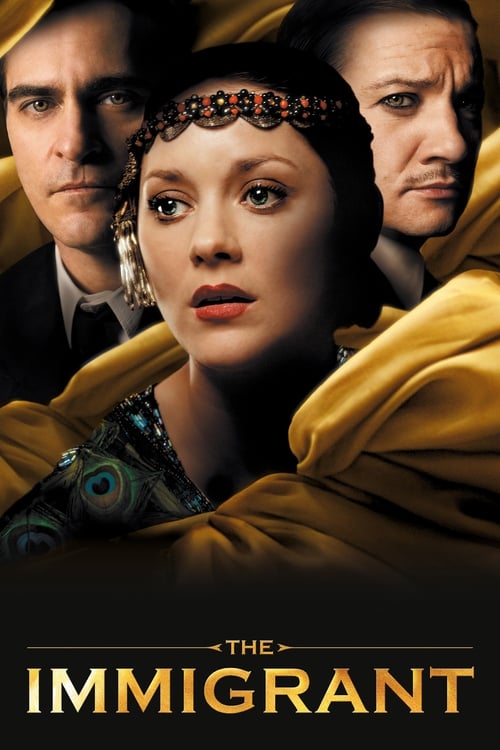
On May 31, 2011, Deadline reported that James Gray would direct the film, then-titled Low Life, about a woman attempting to emigrate from Poland to New York, starring Marion Cotillard and Joaquin Phoenix, and that Jeremy Renner was in talks to play the third lead. The working titles for the film were Low Life, American Dream, and The Nightingale, before changing for the last time to The Immigrant shortly before the film's premiere at the 2013 Cannes Film Festival.
Gray said that The Immigrant is "80% based on the recollections from my grandparents, who came to the United States in 1923", and he described it as "my most personal and autobiographical film to date". Gray co-wrote the screenplay with Richard Menello, it was one of his last screenplays before his death in March 2013, shortly before the film's Cannes premiere.
The Immigrant was Gray's first film with a female protagonist. Gray wrote the film for Cotillard and Phoenix. He stated that if they did not want to do the film, he was not sure he would have made it. Gray had previously worked with Phoenix in The Yards (2000), We Own the Night (2007), and Two Lovers (2008).
In 2010, Gray collaborated with Cotillard's then-partner, Guillaume Canet, on the screenplay for Blood Ties (2013), Canet's first film in English that Gray helped translate the dialogue. Gray met Cotillard by chance without knowing that she was Canet's partner, during a dinner at a restaurant in Paris to discuss Blood Ties. Gray and Cotillard then got into an argument about an actor that Cotillard loved and Gray found overrated, so Cotillard threw a piece of bread at Gray's head, and when she said she thought Gray was a "jerk", he immediately liked her as a result. Gray did not know who Cotillard was, as he had small children at the time and did not go to the movies, it was his wife who later told him that Cotillard was an actress and had won an Oscar, but he thought Cotillard looked like Pola Negri, the Polish actress of silent films, so he wrote the film for her, without ever seeing her on screen, knowing that her face was exactly the one he was looking for. Gray said he later watched all of Cotillard's films that he could find, and then he knew he had to write something for her.
When Gray was trying to think of a movie for Cotillard, he was talking to his brother, who found journals from their grandfather who ran a saloon on the Lower East Side in New York in the 1920s, after he came from Kiev, and there were all these "low lives" frequenting the place. One of them was described by Gray as "a enigmatic, screwed-up, manipulative pimp who used to go to Ellis Island and cruise for women who came to the country by themselves." According to Gray, in the 1920s women trying to get into the U.S. by themselves were not let in specifically because they were targets for prostitution, but through bribery, canny pimps would get around these rules. And so a movie idea was born. Gray said that he had never seen a movie on that subject. "Lower East Side, Ellis Island, pimps; it seemed very vivid to me. So I said, 'that sounds perfect,'" he told. However, getting Cotillard on board wasn't as easy as he'd hoped. Gray sent the screenplay to Cotillard, but then had to wait seven days for an answer after she had promised to read the script over a weekend. "Well, Sunday came and went and it was like getting a colonoscopy over a week," he said of the agonizing wait for an answer.
Gray wrote around 20 pages of dialogue in Polish. Cotillard had to learn Polish to take on the role and speak English with a credible Polish accent. She had only two months to learn her Polish dialogue. After directing Cotillard in The Immigrant, Gray stated that she is the best actor he has ever worked with.