Development
Series creator Chris Savino grew up as the ninth of ten children, having five sisters and four brothers. Throughout his childhood, he had been fascinated by comic strips and cartoons, and since he was the quiet one among his siblings, he would frequently sneak away to read or draw comics in a style that mimicked the ones he read in newspapers. By his senior year at Dondero High School, Savino learned about careers in the animation industry and immersed himself in every animation book that he could find at his local libraries. In 1990, Savino received word that Big House Blues, a cartoon that he had viewed at an animation festival earlier that year, had been picked up for a full series in the form of The Ren & Stimpy Show. In response to the news, he mailed a letter and some drawings to its creator, John Kricfalusi, which secured him an opportunity to join that series' staff.
In 2013, Savino was introduced to the Nickelodeon Animated Shorts Program by executive Jenna Boyd. He was presented the opportunity to pitch three ideas as a 2+1⁄2-minute short for the program, out of which one would be picked. The executives selected his idea that involved a big family, which was about a male rabbit with twenty-five sisters dealing with the chaos of living among an extensively large immediate family. Savino had decided to make the characters rabbits because he had come fresh off the production of Kick Buttowski: Suburban Daredevil, which had an all-human cast, and knew that standards and practices are typically more restrictive with human characters, which gave him the desire to explore more extreme physical humor that is generally accepted with animal-based cartoons; he also considered making the characters mice when one staff member took issue with the rabbits. After presenting his pitch, Boyd advised Savino to consider making the characters human, deeming that to make it more likely to get his pitch sold. Boyd's advice inspired Savino to base the series on his own experiences growing up in a large family, so he retooled his concept art of the short's protagonist (at the time named Warren, a reference to rabbit warrens) so it depicted a human and pared down his 25 sisters to ten, which he deemed to be much more manageable and biologically believable from a human standpoint and used it as a reflection of his experiences growing up in a family of ten. The idea of the Loud family being rabbits became reused as Lincoln's dream in the Season 3 episode "White Hare".
While the series was primarily inspired by Savino's experiences growing up in a large family, it was never intended to be autobiographical on his part; to reflect this, Savino characterized Lincoln as the polar opposite of him, stating that "Lincoln’s the type of kid who always has a plan" and that "if there’s something that he wants, and he knows that he has 10 siblings who are basically obstacles, then he’s going to do what it takes to get what he wants." Many of the writers, particularly those who had siblings themselves, would give inputs on things that happened to them as kids, which then blossomed into the premises for episodes of the show. During development, the writing staff took heavy inspiration from The Brady Bunch due to its similar focus on the chaos held by a large family and the heart shared by all of its members, as well as animated series such as Hey Arnold!, The Simpsons and Daria due to their use of young characters "who were allowed to be more flawed and real than their live-action counterparts" within the main cast.
Savino named the main characters and other core elements in the series after various things in his life. His five sisters became the inspirations for Lori, Luan, Lynn, Lana, and Lisa; Lola and Luna were named after two dachshunds that were owned by Savino and his mother-in-law, respectively; Lucy and Lily were two names that Savino and his wife had intended to use in the event that they had daughters; Leni was named after Lennie Small from Of Mice and Men; and Lincoln was named after E Lincoln Avenue, the street that Savino grew up on as a child. The short had always been titled "The Loud House", though its name was originally only in reference to the chaotic nature of a family of that size; a Nickelodeon employee named Scott Kreamer suggested that the family's name be Loud, which Savino caught onto, thinking it was a clever idea since it would give the siblings alliterative names. The siblings having an alliterative naming theme was further inspired by writer Karla Sakas Shropshire, who grew up with three siblings, all having names beginning with K. The Loud family's pets, Charles, Cliff, Geo and Walt, were named after Charles M. Schulz, Cliff Sterrett, George Herriman, and Walt Kelly— the creators of the comic strips Peanuts, Polly and Her Pals, Krazy Kat, and Pogo, respectively— which Savino has cited as some of his biggest influences on the series. The Loud family's street, Franklin Avenue, was named after Benjamin Franklin Elementary School, which Savino attended as a child. The city the series takes place in, Royal Woods, had its name derived partially from Savino's hometown of Royal Oak, and partially from Huntington Woods, the hometown of story editor and later showrunner Michael Rubiner.
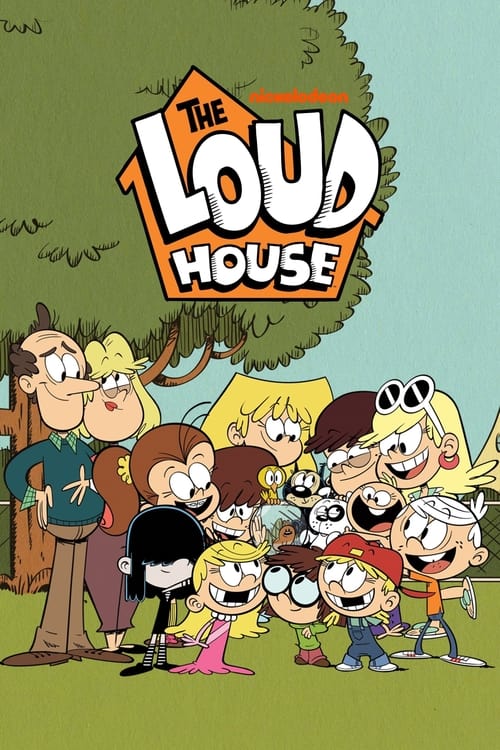
Newspaper comic strips have served as major influences on the show's characters and animation. Savino opted to make the series resemble a comic strip as an homage to the ones that he enjoyed growing up. Do do this, he employed tactics such as keeping the camera at eye level so focus could remain on the characters in order to extract as much humor from them as possible, using a limited color palette for the backgrounds (which were given a paper texture) and plenty of spot black and shadows, giving the characters' wardrobes their own signature colors, and frequent use of fight clouds, onomatopoeic bursts, and other comic tropes. Knowing that the series' large cast would prove difficult to animate by means of traditional hand-drawn animation, Savino pushed to use Toon Boom Harmony to animate the show for ease on the animators.
Savino's original pitch was approved for pilot production on January 30, 2014. In June 2014, Nickelodeon announced that The Loud House had been picked up for a season of 13 episodes. The episode order was later increased to 26. On May 25, 2016, Nickelodeon announced that the series had been picked up for a second season of 14 episodes later increased to 26. On October 19, 2016, the series had been picked up for a third season of 26 episodes.
Episodes are produced at Nickelodeon Animation Studio in Burbank, California, USA and animated by Canadian studio Jam Filled Entertainment.
On February 12, 2026, series writer Kevin Sullivan announced that the series was no longer in production. He later clarified the series was not canceled but that the production team was awaiting word from the executives. Production of the ninth season has ended; those episodes were broken up into multiple seasons by Nickelodeon.