




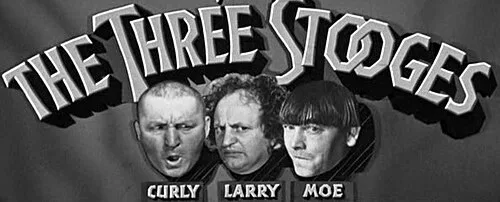
The Three Stooges were an American vaudeville and comedy troupe active from 1922 until 1970, best remembered for their 190 short-subject films by Columbia Pictures. Their hallmark styles were physical, farce, and slapstick comedy. Six Stooges appeared over the act's run, with only three working at any given time. The two constants were Moe Howard and Larry Fine. The "third stooge" was played in turn by Shemp Howard, Curly Howard, Shemp again, Joe Besser, and "Curly Joe" DeRita.
The act began in 1922 as part of a vaudeville comedy act consisting originally of Ted Healy and Moe Howard. Over time, they were joined by Moe's brother, Shemp Howard, and then Larry Fine. The troupe became known as "Ted Healy and His Stooges" ("stooges" being a show-business term for on-stage assistants). The foursome appeared in one feature film, Soup to Nuts, before Shemp left to pursue a solo career. He was replaced by his and Moe's younger brother, Jerome "Curly" Howard, in 1932. Two years later, after appearing in several movies, the trio left Healy and signed on to appear in their own short-subject comedies for Columbia Pictures, now billed as "The Three Stooges". From 1934 to 1946, Moe, Larry, and Curly starred in more than 90 short comedies for Columbia.
Curly suffered a debilitating stroke in May 1946. Shemp returned, reconstituting the original lineup, until his death of a heart attack on November 22, 1955, three years and ten months after Curly's death of a cerebral hemorrhage. Film actor Joe Palma stood in (shot from behind to obscure his face) to complete four Shemp-era shorts under contract. The procedure of disguising one actor as another outside of stunt shots became known as the "fake Shemp". Columbia contract player Joe Besser joined as the third Stooge for two years (1956–1958), departing in 1958 to nurse his ill wife after Columbia terminated its shorts division. The studio then released all the shorts via Screen Gems, Columbia's television studio and distribution unit. Screen Gems then syndicated the shorts to television, whereupon the Stooges became one of the most popular comedy acts of the early 1960s.
Comic actor Joe DeRita became "Curly Joe" in 1958, replacing Besser for a new series of full-length theatrical films. With intense television exposure in the United States, the act regained momentum throughout the 1960s as popular kids' fare, until Larry's paralyzing stroke in the midst of filming a pilot for a Three Stooges TV series in January 1970. He died in January 1975 after a further series of strokes. Attempts were made in 1970 and 1975 to revive the act with longtime supporting actor Emil Sitka in Fine's role, but they were each cut short—the first by a movie deal falling through and Moe's wife persuading him to retire, the second by Moe's death.
Contents
History
Ted Healy and His Stooges (1922–1934)
The Three Stooges began in 1922 as part of a raucous vaudeville act called "Ted Healy and His Stooges". The act was also known as "Ted Healy and His Southern Gentlemen" and "Ted Healy and His Racketeers". Moe Howard joined Healy's act in 1922, and his brother Shemp Howard came aboard a few months later. After several shifts and changes in the Stooges membership, violinist-comedian Larry Fine also joined the group sometime between 1925 and 1928. In the act, lead comedian Healy would attempt to sing or tell jokes while his noisy assistants would keep interrupting him, causing Healy to retaliate with verbal and physical abuse.
In 1930, Ted Healy and His Stooges (plus comedian Fred Sanborn) appeared in Soup to Nuts, their first Hollywood feature film, released by Fox Film Corporation. The film was not a critical success, but the Stooges' performances were singled out as memorable, leading Fox to offer the trio a contract, minus Healy. This enraged Healy, who told studio executives the Stooges were his employees, whereupon the offer was withdrawn. Howard, Fine, and Howard learned of the offer and subsequent withdrawal, and left Healy to form their own act (billed as "Howard, Fine & Howard" or "Three Lost Souls"). The act quickly took off with a tour of the theater circuit. Healy attempted to stop the new act with legal action, claiming that they were using his copyrighted material. Accounts exist of Healy threatening to bomb theaters if Howard, Fine, and Howard ever performed there, which worried Shemp so much that he almost left the act; reportedly, only a pay raise kept him on board.
Healy tried to save his act by hiring replacement stooges, but they were inexperienced and not as well-received as their predecessors. Healy reached a new agreement with his former Stooges in 1932, with Moe now acting as business manager, and they were booked in a production of Jacob J. Shubert's The Passing Show of 1932. During rehearsals, Healy received a more lucrative offer and found a loophole in his contract allowing him to leave the production. Shemp, fed up with Healy's abrasiveness, bad temper, and heavy drinking, decided to quit the act and toured in his own comedy revue for several months.
Shemp had been working for the Vitaphone studio in Brooklyn, New York since 1931. He first appeared in movie comedies playing small roles and bits in the Roscoe Arbuckle shorts, and gradually worked his way up to star comedian. Shemp stayed with Vitaphone through 1937.
Columbia years (1934–1958)
In 1934, the trio—now officially named "The Three Stooges"—contracted with Columbia Pictures for a series of two-reel comedy short subjects. Moe wrote in his autobiography that they each received $600 per week (equal to $14,440 today) on a one-year contract with a renewable option; in the Ted Okuda–Edward Watz book The Columbia Comedy Shorts, the Stooges are said to have received $1,000 among them for their first Columbia effort, Woman Haters (1934), and then signed a term contract for $7,500 per film (equal to $180,504 today), to be divided among the trio.
Within their first year at Columbia, theater bookings for the Stooges films took off. Columbia Pictures president Harry Cohn was able to use the Stooges as leverage, as the demand for their films was so great that he eventually refused to supply exhibitors with the trio's shorts unless they also agreed to book some of the studio's mediocre B movies. Cohn also saw to it that the Stooges remained unaware of their popularity. During their 23 years at Columbia, the Stooges were never completely aware of their drawing power. Their contracts with the studio included an open option that had to be renewed yearly, and Cohn would tell them that the short subjects were in decline, which was not a complete fabrication (Cohn's yearly mantra was "the market for comedy shorts is dying out, fellas").
The Stooges thought that their days were numbered and would sweat it out each year, with Cohn renewing their contract at the last moment. This deception kept the insecure Stooges unaware of their true value, resulting in them having second thoughts about asking for a better contract without a yearly option. Cohn's scare tactics worked for all 23 years that the Stooges were at Columbia; the team never once asked for or received a salary increase.
After they stopped making the shorts in December 1957, Moe learned of Cohn's tactics, what a valuable commodity the Stooges had been for the studio, and how many millions more the act could have earned. Columbia offered theater owners an entire program of two-reel comedies (15–25 titles annually) featuring such stars as Buster Keaton, Andy Clyde, Charley Chase, and Hugh Herbert, but the Stooge shorts were the most popular of all.
The Stooges' release schedule was eight short subjects per year, filmed within a 40-week period; for the remaining 12 weeks, they were free to pursue other employment, time that was either spent with their families or touring the country with their live act. The Stooges appeared in 190 film shorts and five features while at Columbia, outlasting every one of their contemporaries employed in the short-film genre. Del Lord directed more than three dozen Stooge films, Jules White directed dozens more, and his brother Jack White directed several under the pseudonym "Preston Black". Silent-comedy star Charley Chase also shared directorial responsibilities with Lord and White.
Renewed popularity with Joe DeRita (1958–1970)
After Besser's departure, Moe and Larry began looking for potential replacements. Larry suggested former Ted Healy stooge Paul "Mousie" Garner, but based on his tryout performance, Moe later remarked that he was "completely unacceptable." Weeks later, Larry came across burlesque performer Joe DeRita, who had starred in his own series of shorts at Columbia back in the 1940s, and thought he would be a good fit.
The early days of television provided movie studios a place to unload a backlog of short films that they thought no longer marketable, and the Stooge films seemed perfect for the burgeoning genre. ABC had even expressed interest as far back as 1949, purchasing exclusive rights to 30 of the trio's shorts and commissioning a pilot for a potential series, Jerks of All Trades. However, the success of television revivals for such names as Laurel and Hardy, Woody Woodpecker, Popeye, Tom and Jerry, and the Our Gang series in the late 1950s led Columbia to cash in again on the Stooges. In September 1958, Columbia's television subsidiary Screen Gems offered a package consisting of 78 Stooge shorts (primarily from the Curly era), which were well received.
An additional 40 shorts hit the market in April 1959. By September 1959, all 190 Stooge shorts were airing regularly. With so many films available for broadcast, daily television airings provided heavy exposure aimed squarely at children. Parents who had grown up seeing the same films in the theaters began to watch alongside their children.
After the Curly-era shorts were found to be the most popular, Moe suggested that DeRita shave his head to accentuate his slight resemblance to Curly Howard. He adopted first a crew cut and later a completely shaven head, thus becoming "Curly Joe". Howard, Fine, and DeRita found themselves in great demand for personal appearances and guest shots on television. DeRita made his first nationwide appearance with the Stooges on Sunday, January 11, 1959, on the Steve Allen variety show on NBC; the Stooges re-created their "Stand-In" sketch, with Moe and Larry making a western movie and Curly Joe (who did not speak) as the hapless double who takes all the punishment.
Columbia, which was still releasing Stooge shorts to theaters, cashed in on the Stooges' spectacular show-business comeback by signing the team for new feature-length films. The first, Have Rocket, Will Travel (1959), was produced by the Stooges' agent, Harry Romm. The second got off the ground when Columbia's New York office asked Jules White to prepare a new Three Stooges feature film for theaters. The result was Stop! Look! and Laugh!, released in 1960. "The Original Three Stooges" were seen entirely in old short-subject extracts with Curly Howard, and new footage was filmed with ventriloquist Paul Winchell and animal act The Marquis Chimps.
Final years (1970–1975)
In late 1969, Howard, Fine, and DeRita began production on another half-hour pilot, this time for a syndicated 39-episode TV series titled Kook's Tour, a combination travelogue-sitcom that had the "retired" Stooges traveling to various parts of the world with the episodes filmed on location. On January 9, 1970, during production of the pilot, Larry suffered a paralyzing stroke, ending his acting career along with plans for the television series. The pilot was unfinished and several key shots were missing, but producer Norman Maurer edited the available footage and made the pilot a 52-minute special that was released to the home-movie and Cartrivision videocassette home-video markets in 1973. It is the last film in which the Stooges appeared and the last known performance of the team.
Following Larry Fine's stroke, plans were made for Emil Sitka (a longtime "straight man" in the Stooges films) to replace him in a new feature film, written by Moe Howard's grandson, Jeffrey Scott [Maurer], titled Make Love, Not War. Moe Howard, Joe DeRita, and Emil Sitka were cast as POWs in a World War II Japanese prison camp, plotting an escape with fellow prisoners. The film would have been a departure from typical Stooge fare, with dark-edged humor and scenes of war violence, but insufficient funding prevented production from advancing beyond the script stage.
Also in 1970, Joe DeRita recruited vaudeville veterans Frank Mitchell and Mousie Garner to tour as The New Three Stooges. Garner had worked with Ted Healy as one of his "replacement stooges" decades earlier and was briefly considered as Joe Besser's replacement in 1958. Mitchell had appeared in two of the Stooges' short subjects in 1953, and had been part of the knockabout team of Mitchell and Durant. The act fared poorly, with minimal bookings. In 1973, DeRita performed as the comic in a burlesque revival show in Las Vegas. By this time, Moe's wife had prevailed on him to retire from performing slapstick due to his age. For the next several years, Moe appeared regularly on talk shows and did speaking engagements at colleges and universities, while DeRita quietly retired.
Larry suffered another stroke in mid-December 1974, and another one in January 1975, even more severe. After slipping into a coma, he died a week later from a cerebral hemorrhage on January 24, 1975.
Shortly after Larry's death, the Stooges were scheduled to co-star in the R-rated comedy Blazing Stewardesses, featuring Moe and Curly Joe with Emil Sitka in the middle spot as Harry, Larry's brother. The team was signed and publicity shots were taken, but one week prior to March's filming date, Moe was diagnosed with lung cancer and the Stooges had to back out; he died on May 4, 1975. Producer Sam Sherman briefly considered having former Stooge Joe Besser appear in his place, but ultimately decided against it. Another veteran comedy team, The Ritz Brothers, Harry and Jimmy, replaced the Stooges and performed much of their own schtick, including the precision dance routine first seen in Sing, Baby, Sing (1936), co-starring original Stooge leader Ted Healy.
Legacy and perspective
Over 60 years since their last short film was released, the Three Stooges remain popular. Their films have never left American television since first appearing in 1958. Authors Ted Okuda and Edward Watz assess the Stooges as hard-working comedians who were never critics' favorites, a durable act that endured several personnel changes in careers that would have permanently sidelined a less persistent act. They would not have lasted as long as they did as a unit without Moe Howard's guiding hand.
Okuda and Watz's book The Columbia Comedy Shorts puts the Stooges' act in critical perspective:
Many scholarly studies of motion-picture comedy have overlooked the Three Stooges entirely – and not without valid reasoning. Aesthetically, the Stooges violated every rule that constitutes "good" comedic style. Their characters lacked the emotional depth of Charlie Chaplin and Harry Langdon; they were never as witty or subtle as Buster Keaton. They were not disciplined enough to sustain lengthy comic sequences; far too often, they were willing to suspend what little narrative structure their pictures possessed in order to insert a number of gratuitous jokes. Nearly every premise they have employed (spoofs of Westerns, horror films, costume melodramas) has been done to better effect by other comedians. And yet, in spite of the overwhelming artistic odds against them, they were responsible for some of the finest comedies ever made. Their humor was the most undistilled form of low comedy; they were not great innovators, but as quick-laugh practitioners, they place second to none. If public taste is any criterion, the Stooges have been the reigning kings of comedy for over 50 years.
Beginning in the 1980s, the Stooges finally began to receive critical recognition. The release of nearly all their films on DVD by 2010 allowed critics of Joe Besser and Joe DeRita—often the recipients of significant fan backlash—to appreciate both men's unique styles of comedy. The DVD market has also allowed fans to view the entire Stooge film corpus as distinct periods in their long career, rather than unfairly comparing one Stooge to another (the Curly vs. Shemp debate continues to this day, with Joe Besser not even mentioned in the same breath).
The team appeared in 220 films, but authors Okuda and Watz agree that their series of 190 two-reel comedies for Columbia is their enduring legacy. In 1984, American television personality Steve Allen said, "Although they never achieved widespread critical acclaim, they did succeed in accomplishing what they had always intended to do: They made people laugh."
Social commentary, satire, and use of language
Although the Three Stooges' slapstick comedy was primarily arranged around basic plots dealing with mundane issues of daily life, a number of their shorts featured social commentary or satire. They were often antiheroical commentators on class divisions and economic hardships of the Great Depression in the United States. They were usually under- or unemployed and sometimes homeless or living in shanty towns.
The language used by the Three Stooges was more slang-laden than that of typical feature films of the period and deliberately affected a lower-class status with use of crude terms, ethnic mannerisms, and inside jokes.
An example is the use of the initials A.K. for big shots and pretentious people. A.K. was an inside joke which stood for Alte Kocker (an elderly person who is defecating), a Yiddish idiom that means an old man or woman of diminished capacity who can no longer do things they used to do.
Much of the seeming "gibberish" that the Stooges sometimes spoke was actually the Yiddish language of their Jewish ancestry. The most famous example occurs 15 minutes into the 1938 short Mutts to You. Moe and Larry were impersonating Chinese laundrymen in an attempt to fool the local cop. While being questioned, Larry says "Ech bin a China Boychic from Slobatkya-Gebernya hak mir nisht Ken Tshaynik and I don't mean Efsher". This translates as "I'm a China boy from Slobatkya Gebernya [a made-up area in eastern Russia], so stop annoying me and I don't mean maybe."
A third "in-Yiddish" joke is in the episode Pardon My Scotch, when the liquor supplier prepares to consume the Stooges' volatile concoction, and they wish him well in a triad pattern saying "Over the river," "Skip the gutter," and concluding with "Ver geharget," a Yiddish expression meaning "get killed" or "drop dead".
One important area of political commentary was in the area of the rise of totalitarianism in Europe, notably in the directly satirical You Nazty Spy! and I'll Never Heil Again, both released before United States' entry into World War II, despite an industry Production Code that advocated avoiding social and political issues and the negative portrayal of foreign countries.
Lineups on film
Filmography
The Three Stooges appeared in 220 films through their career. Of those, 190 short films were made for Columbia Pictures, for which the trio are best known today. Their first Columbia film, Woman Haters, premiered on May 5, 1934. Their contract was extended each year until the final one expired on December 31, 1957. Columbia continued to release the Stooge shorts filmed in 1957; the final release, Sappy Bull Fighters, premiered on June 4, 1959.
Three feature-length Columbia releases were actually packages of older Columbia shorts. Columbia Laff Hour (introduced in 1956) was a random assortment that included the Stooges among other Columbia comedians like Andy Clyde, Hugh Herbert, and Vera Vague; the content and length varied from one theater to the next. Three Stooges Fun-O-Rama (introduced in 1959) was an all-Stooges show capitalizing on their TV fame, again with shorts chosen at random for individual theaters. The Three Stooges Follies (1974) was similar to Laff Hour, with a trio of Stooge comedies augmented by Buster Keaton and Vera Vague shorts, a Batman serial chapter, and a Kate Smith musical.
C3 Entertainment, Inc.
In 1959, Comedy III Productions (later, C3 Entertainment) was formed by Moe, Larry, and Joe DeRita to manage all business and merchandise transactions. Now controlled by DeRita's heirs, it has diversified into a brand-management company licensing personality rights to various nostalgia acts, including the Stooges.
Television
A handful of Three Stooges shorts first aired on television in 1949, on the ABC network. By 1958, Screen Gems packaged 78 shorts for national syndication; the package was gradually enlarged to encompass the entire library of 190 shorts. In 1959, KTTV in Los Angeles purchased the Three Stooges films for air, but by the early 1970s, rival station KTLA began airing the Stooges films, keeping them in the schedule until early 1994. The Family Channel ran the shorts as part of their Stooge TV block from February 19, 1996, to January 2, 1998. In the late 1990s, AMC had held the rights to the Three Stooges shorts, originally airing them under a programming block called "Stooges Playhouse". In 1999, it was replaced with a program called N.Y.UK (New Yuk University of Knuckleheads), which starred actor/comedian Leslie Nielsen. The program would show three random Stooge shorts. Nielsen hosts the program as a college instructor, known as the Professor of Stoogelogy, who teaches to the students lectures on the Three Stooges before the Stooges' shorts air. The block aired several shorts often grouped by a theme, such as similar schtick used in different films. Although the block was discontinued after AMC revamped their format in 2002, the network still ran Stooges shorts occasionally. The AMC run ended when Spike TV (now Paramount Network) picked them up in 2004, airing them in their Stooges Slap-Happy Hour every Saturday and Sunday mornings. On June 6, 2005, the network began running the Stooges Slap-Happy as a one-hour summer comedy block, which ended on September 2, 2005. By 2007, the network had discontinued the block. Although Spike did air Stooges shorts for a brief time after the block was canceled, as of late April 2008, the Stooges had disappeared from the network's schedule entirely. The Three Stooges returned on December 31, 2009, on AMC, starting with the "Countdown with the Stooges" New Year's Eve marathon. AMC planned to put several episodes on their website in 2010. As of 2009 AMC still airs The Three Stooges every weekday midnights and mornings. Also as of 2022 AMC's other sister channel BBC America also airs The Three Stooges on midnights each weekday. The "Stooges" shorts were best known in Chicago as a part of a half-hour, late-afternoon show on WGN-TV hosted by Bob Bell as "Andy Starr" in the 1960s. In the 1990s, Stooges films were aired as part of The Koz Zone movie segment on Chicago television.
Since the 2000s, Columbia and its television division's successor, Sony Pictures Television, has preferred to license the Stooges shorts to cable networks, which left the films off local broadcast TV for several years until they were licensed to nationally broadcast classic TV networks. The last time the Stooges were offered in traditional broadcast syndication was in 1999, when Columbia TriStar Television Distribution put together a new package of 130 half-hour episodes compiling the shorts into themed installments, with new interstitial material created by Evolution Media and voiced by Jeff Bennett (in a similar fashion to the Screen Gems Network, a syndicated block of classic television series also offered around the same time by CTTD with Evolution's involvement).
Home media
Between 1980 and 1985, Columbia Pictures Home Entertainment and RCA/Columbia Pictures Home Video released 13 Three Stooges volumes in various formats. The original 13 volume titles were later reissued on VHS by its successor, Columbia TriStar Home Video, between 1993 and 1996, with a DVD reissue between 2000 and 2004.
The Three Stooges Collection
On October 30, 2007, Sony Pictures Home Entertainment released a two-disc DVD set titled The Three Stooges Collection, Volume One: 1934–1936. The set contains shorts from the first three years the Stooges worked at Columbia Pictures, marking the first time that all 19 shorts were released in their original theatrical order to DVD. Additionally, every short was remastered in high definition, a first for the Stooge films. Previous DVD releases were based on themes (wartime, history, work, etc.), and sold poorly.
The chronological series proved successful, and Sony wasted little time preparing the next set for release. Volume Two: 1937–1939 was released on May 27, 2008, followed by Volume Three: 1940–1942 three months later on August 26, 2008. Demand exceeded supply, proving to Sony that they had a hit on their hands. In response, Volume Four: 1943–1945 was released on October 7, 2008, a mere two months after its predecessor. Volume Four, and Volume Five: 1946–1948 was belatedly released on March 17, 2009, after delays during the Great Recession. Volume Five is the first in the series to feature Shemp Howard with the Stooges and the final volume to feature Curly Howard. Volume Six: 1949–1951 was released June 16, 2009, and Volume Seven: 1952–1954 was released on November 10, 2009. Volume Seven included 3-D glasses for the two shorts: Spooks! and Pardon My Backfire. As of 2013, the three-dimensional versions of the two shorts in this volume have been removed. Volume Eight: 1955–1959 was released on June 1, 2010. This was the final volume of the Stooges collection, bringing the series to a close. Volume Eight comprised three discs, and was the only volume to feature Joe Besser and the final volume to feature Shemp Howard. With the release of the eighth volume, for the first time in history, all 190 Three Stooges short subjects had become available to the public, uncut and unedited.
Two years later, on June 5, 2012, these discs were reissued in a DVD boxed set entitled The Three Stooges: The Ultimate Collection—now with a ninth volume (three discs) entitled Rare Treasures from the Columbia Picture Vault. This volume is not available separately, and comprises two feature films and three cartoons featuring all three Stooges, and also some of their solo work (14 shorts featuring Shemp Howard, 10 shorts featuring Joe Besser, and four shorts featuring Joe DeRita). The 2012 Ultimate Collection consists of all 8 individual original boxsets as they sold before, plus the 3 bonus discs, housed in a thin cardboard box with embossed artwork. On October 18, 2016, The Three Stooges: The Complete DVD Collection was released. It had all the DVDs from volumes 1 through 8 but it did not include the "Rare Treasures from the Columbia Picture Vault" discs. The packaging is much smaller as all 17 of the original discs are stacked on a spindle. All eight volumes are also available on iTunes. On June 15, 2020, iTunes released The Three Stooges: The Complete Series, which features all 190 shorts in an entire collection.
Music
Several instrumental tunes were played over the opening credits of the short features. The most commonly used were:
The verse portion of the Civil War–era song "Listen to the Mockingbird", played in a comical way, complete with sounds of birds and such. It was first used in Pardon My Scotch, their ninth short film, in 1935. (Prior to this, the opening theme varied and was typically connected to the storyline in some way.)
"Three Blind Mice", beginning in 1939, was a slow but straightforward presentation (dubbed the "sliding strings" version), often breaking into a "jazzy" style before ending. In mid-1942, a faster version was used, featuring accordion.
The Columbia short Woman Haters was done completely in rhyme, mostly recited (not sung), in rhythm with a Jazz-age underscore running throughout the film, but with some key lines sung. It was sixth in a Musical Novelties short-subject series, and appropriated its musical score from the first five films. The memorable "My Life, My Love, My All", was originally "At Last!" from the film Um-Pa.
"Swinging the Alphabet" from Violent Is the Word for Curly is perhaps the best-known song performed by the Stooges on film.
The Stooges broke into a three-part harmonized version of "Tears" ("You'll Never Know Just What Tears Are") in Horses' Collars, A Ducking They Did Go (where the melody was sung by Bud Jamison), and Half Shot Shooters. The song, written by Moe, Larry, Shemp, and one-time Ted Healy Stooge Fred Sanborn, first appeared in the 1930 feature film Soup to Nuts.
The "Lucia Sextet" (Chi mi frena in tal momento?), from the opera Lucia di Lammermoor by Gaetano Donizetti (announced by Larry as "the Sextet from Lucy") is played on a record player and lip-synched by the Stooges in Micro-Phonies. The same melody reappears in Squareheads of the Round Table as the tune of "Oh, Elaine, Can You Come Out Tonight?". Micro-Phonies also includes the Johann Strauss II waltz "Voices of Spring" ("Frühlingsstimmen") Op. 410. Another Strauss waltz, "The Blue Danube", is featured in Ants in the Pantry and Punch Drunks.
Museum
Gary Lassin, grandnephew-in-law of Larry Fine, opened the Stoogeum in 2004 in Spring House, Pennsylvania, 25 miles (40 km) north of Philadelphia. It features three floors of exhibits and an 85-seat theater. Peter Seely, editor of the book Stoogeology: Essays on the Three Stooges, said that the Stoogeum has "more stuff than I even imagined existed." Some 2,500 people visit it yearly, many during the annual Three Stooges Fan Club gathering in April.
In other media
Comic books
Over the years, several Three Stooges comics were produced.
St. John Publications published the first Three Stooges comics in 1949 with two issues, then again in 1953–54 with seven issues. Shemp Howard is the Third Stooge in these issues.
Dell Comics published a Three Stooges series first as one-shots in their Four Color Comics line for five issues, then gave them a numbered series for four more issues (#6–9). With #10, the title would be published by Gold Key Comics. Under Gold Key, the series lasted through issue #55 in 1972.
Gold Key Comics then published a series called The Little Stooges (seven issues, 1972–74) with story and art by Norman Maurer, Moe's son-in-law. This series featured the adventures of three fictional sons of the Three Stooges, as sort of modern-day teen-age versions of the characters.
Eclipse Comics published the Three-D Three Stooges series (three issues, 1986–1987), which reprinted stories from the St. John Publications series.
Malibu Comics did two one-shot comics, reprinting stories from the Gold Key Comics in 1989 and 1991.
Eternity Comics published a one-shot comic book called The Three Stooges in 3-D in 1991, reprinting four stories from the Gold Key series.
Bluewater Comics issued a biographical comic in 2011, which followed the lives and careers of the group.
American Mythology Production publishes comics in 2017 which shows the Three Stooges in the modern times. In 2021, American Mythology announced it was launching two new books: The Three Stooges Thru The Ages and The Robonic Stooges. Both new series are written by S.A. Check and Jordan Gershowitz.
Phonograph records
Beginning in 1959, the Three Stooges began appearing in a series of novelty records. Their first recording was a 45 rpm single of the title song from Have Rocket, Will Travel. The trio released additional singles and LPs on the Golden, Peter Pan, and Coral labels, mixing comedy adventure albums and off-beat renditions of children's songs and stories. Their final recording was the 1966 Yogi Bear and the Three Stooges Meet the Mad, Mad, Mad Dr. No-No, which incorporated the Three Stooges into the cast of the Yogi Bear cartoons.
Radio
Sirius XM Radio aired a special about the Stooges hosted by Tom Bergeron on Friday, July 31, 2009, at 2:00 pm on the Sirius Howard 101 channel. Bergeron had conducted the interviews at the age of 16 when he was still in high school in 1971. The television host had the tapes in storage for many years and was convinced on air during an interview with Howard Stern to bring them in and turn them into a special.
After finding "the lost tapes", Bergeron brought them into Stern's production studio. He stated that the tapes were so old that the tapes with the Larry Fine interviews began to shred as Stern's radio engineers ran them on their tape players. They really had only one shot, but the tapes were saved.
"The Lost Stooges Tapes" was hosted by Tom Bergeron, with modern commentary on the almost 40-year-old interviews that he had conducted with Larry Fine and Moe Howard. At the times of these interviews, Moe was still living at home, while Larry had suffered a stroke and was living in a senior citizen's home.
Television
In addition to the unsuccessful television series pilots Jerks of All Trades, The Three Stooges Scrapbook, and the incomplete Kook's Tour, the Stooges appeared in an animated series, The New Three Stooges, which ran from 1965 to 1966. This series featured a mix of 41 live-action segments that were used as wraparounds to 156 animated Stooges shorts. The New Three Stooges became the only regularly scheduled television show for the Stooges. Unlike other films shorts that aired on television, like the Looney Tunes, Tom and Jerry, and Popeye, the film shorts of the Stooges never had a regularly scheduled national television program in which to air. When Columbia/Screen Gems licensed the film library to television, the shorts aired in any fashion the local stations chose (examples: late-night "filler" material between the end of the late movie and the channel's sign-off time; in "marathon" sessions running shorts back-to-back for one, one-and-a-half, or two hours; etc.) By the 1970s, some local stations showed a Columbia short and a New Three Stooges cartoon in the same broadcast.
Another animated series also produced by Hanna-Barbera, titled The Robonic Stooges, originally seen as a featured segment on The Skatebirds (CBS, 1977–1978), featuring Moe, Larry, and Curly (voiced by Paul Winchell, Joe Baker, and Frank Welker, respectively) as bionic cartoon superheroes with extendable limbs, similar to the later Inspector Gadget. The Robonic Stooges later aired as a separate half-hour series, retitled The Three Robonic Stooges (each half-hour featured two segments of The Three Robonic Stooges and one segment of Woofer & Whimper, Dog Detectives, the latter re-edited from episodes of Clue Club, an earlier Hanna-Barbera cartoon series).
On June 9, 2015, C3 Entertainment announced it is partnering with London-based production company Cake Entertainment and animation house Titmouse, Inc. to produce a new animated Three Stooges series, consisting of 52 11-minute episodes. Christy Karacas (co-creator of Superjail!) directed the pilot episode, with Earl and Robert Benjamin, Chris Prynoski, Tom van Waveren, and Edward Galton executive producing. The series was to be launched to potential buyers at the market of the Annecy International Animated Film Festival.
In the October 13, 1967, "Who's Afraid of Mother Goose?" episode of ABC's World-of-Disney-like anthology series Off to See the Wizard, the Three Stooges made a short appearance as "the three men in a tub".
Film
The Three Stooges (in their Curly Joe period) made a brief cameo appearance as airport firemen in the 1963 film It's a Mad, Mad, Mad, Mad World. An epic comedy with an all-star cast, this film contains many cameo appearances by famous comedians.
A film featuring the Three Stooges, titled The Three Stooges, started production on March 14, 2011, with 20th Century Fox and was directed by the Farrelly brothers. The film had been in what one critic has dubbed "development hell". The Farrellys, who wanted to make the film since 1996, said that they were not going to do a biopic or remake, but instead new Three Stooges episodes set in the present day. The film is broken up into three continuous episodes that revolves around the Stooges characters.
Casting the title characters proved difficult for the studio. Originally slated were Sean Penn to play Larry, Benicio del Toro to play Moe, and Jim Carrey to play Curly. Both Penn and del Toro left the project, but returned while no official confirmation had been made about Jim Carrey. When del Toro was interviewed on MTV News for The Wolfman, he spoke about playing Moe. He was later asked who was going to play Larry and Curly in the film and commented that he still thought that Sean Penn and Jim Carrey were going to play them, though he added, "Nothing is for sure yet."
A story in The Hollywood Reporter stated that Will Sasso would play Curly in the upcoming comedy and that Hank Azaria was the frontrunner to play Moe. Sasso was ultimately cast as Curly; Sean Hayes of Will & Grace was cast as Larry Fine, while Chris Diamantopoulos was cast as Moe. Jane Lynch later joined the cast, playing a nun. The film was released on April 13, 2012, and grossed over $54 million worldwide. The film received mixed reviews, but Diamantopoulos, Hayes, and Sasso were praised for their performances as Moe, Larry, and Curly.
On May 7, 2015, a sequel was announced, with Sean Hayes, Chris Diamantopoulos, and Will Sasso all reprising their roles. Cameron Fay has been hired to write the script. Production was scheduled to begin in 2018.
On February 3, 2016, C3 announced a new comedy/adventure film titled The Three Little Stooges. It was to star Gordy De StJeor, Liam Dow, and Luke Clark as 12-year-old versions of Moe, Larry, and Curly. The first film, which set the foundation for future films and television spin-offs, was set to begin production in November 2017, and was expected to be released in 2018. The screenplay was written by Harris Goldberg, with Sean McNamara set to direct. The film's budget is $5.8 million. On July 19, 2017, C3 began seeking crowdfunding to pay for a portion of the budget. In August 2017, they exceeded their minimum goal of $50,000.
Video games
In 1984, Gottlieb released an arcade game featuring the Stooges trying to find three kidnapped brides.
Later in 1987, game developer Cinemaware released a successful Three Stooges computer game, available for Apple IIGS, Amiga, Commodore 64, MS-DOS, and Nintendo Entertainment System. Based on the Stooges earning money by doing odd jobs to prevent the foreclosure of an orphanage, it incorporated audio from the original films and was popular enough to be reissued for the Game Boy Advance in 2002, and for PlayStation in 2004.
The Three Stooges also have a slot-game adaptation created by Realtime Gaming.
VCR game
A VCR game was released by Pressman Toy Corporation in 1986, which used a number of classic Stooges clips.
In foreign languages
In most other languages, the Three Stooges are known by some corresponding variant of their English name. In Chinese, however, the trio is known idiomatically as Sānge Chòu Píjiàng (三個臭皮匠) or Huóbǎo Sānrénzǔ (活寶三人組). Sānge Chòu Píjiàng, literally "Three Smelly Shoemakers", which derives from a saying in the Romance of the Three Kingdoms: Sāngè chòu píjiàng shèngguò yīgè Zhūgě Liàng (三個臭皮匠, 勝過一個諸葛亮) or "Three smelly shoemakers (are enough to) overcome one Zhuge Liang [a hero of the story]", i.e. three inferior people can overpower a superior person when they combine their strength. Huóbǎo Sānrénzǔ translates as "Trio of Buffoons". Likewise in Japanese they are known as San Baka Taishō (三ばか大将) meaning "Three Idiot Generals" or "Three Baka Generals".
In Spanish, they are known as Los tres chiflados or, roughly, "The Three Crackpots". In French and German usage, the name of the trio is partially translated as Les Trois Stooges (though the French version of the movie adaptation used a fully translated name, "Les Trois Corniauds") and Die drei Stooges respectively. In Italy they are known as I tre marmittoni. In Thai, the trio is known as 3 สมุนจอมป่วน (RTGS: Sam Samun Chom Puan, pronounced [sǎːm sāmǔn t͡ɕɔ̄ːm pùa̯n]) or 3 พี่น้องจอมยุ่ง (RTGS: Sam Phi Nong Chom Yung, pronounced [sǎːm pʰîː nɔ́ːŋ t͡ɕɔ̄ːm jûŋ]). In Portuguese, they are known as Os Três Patetas in Brazil, and Os Três Estarolas in Portugal, estarola being a direct translation of "stooge", while pateta being more related to "goofy". In Persian the trio are dubbed as "سه کله پوک". In Turkish, they are dubbed as Üç Ahbap Çavuş ("The Three Cronies").
Awards and nominations
Their Men in Black (1934 film) received the comedy nomination Academy Award for Best Live Action Short Film.
In 1993, the Three Stooges won the MTV Lifetime Achievement Award.
They received a star on the Hollywood Walk of Fame at 1560 Vine Street on August 30, 1983.