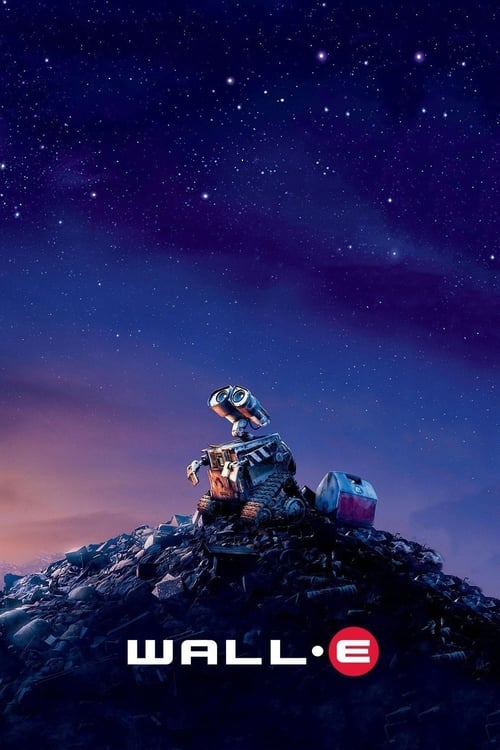
Critical response
The American Film Institute named WALL-E as one of the best films of 2008; the jury rationale states:
WALL-E proves to this generation and beyond that the film medium's only true boundaries are the human imagination. Writer/director Andrew Stanton and his team have created a classic screen character from a metal trash compactor who rides to the rescue of a planet buried in the debris that embodies the broken promise of American life. Not since Chaplin's "Little Tramp" has so much story—so much emotion—been conveyed without words. When hope arrives in the form of a seedling, the film blossoms into one of the great screen romances as two robots remind audiences of the beating heart in all of us that yearns for humanity—and love—in the darkest of landscapes.
On the review aggregator website Rotten Tomatoes, 95% of 258 critics' reviews are positive, with an average rating of 8.9/10. The website's consensus reads: "Wall-E's stellar visuals testify once again to Pixar's ingenuity, while its charming star will captivate younger viewers—and its timely story offers thought-provoking subtext." At Metacritic, which assigns a normalized rating to reviews from mainstream critics, the film has an average score of 95 out of 100 based on 39 reviews, indicating "universal acclaim". Audiences polled by CinemaScore gave the film an average rating of "A" on an A+ to F scale.
IndieWire named WALL-E the third-best film of the year based on their annual survey of 100 film critics, while Movie City News shows that WALL-E appeared in 162 different top 10 lists, out of 286 different critics lists surveyed, the most mentions on a top 10 list of any film released in 2008.
Richard Corliss of Time named WALL-E his favorite film of 2008 (and later of the decade), noting the film succeeded in "connect[ing] with a huge audience" despite the main characters' lack of speech and "emotional signifiers like a mouth, eyebrows, shoulders, [and] elbows". It "evoke[d] the splendor of the movie past" and he also compared WALL-E and EVE's relationship to the chemistry of Spencer Tracy and Katharine Hepburn. Other critics who named WALL-E their favorite film of 2008 included Tom Charity of CNN, Michael Phillips of the Chicago Tribune, Lisa Schwarzbaum of Entertainment Weekly, A. O. Scott of The New York Times, Christopher Orr of The New Republic, Ty Burr and Wesley Morris of The Boston Globe, Joe Morgenstern of The Wall Street Journal, and Anthony Lane of The New Yorker.
Todd McCarthy of Variety called the film "Pixar's ninth consecutive wonder", saying it was imaginative yet straightforward. He said it pushed the boundaries of animation by balancing esoteric ideas with more immediately accessible ones, and that the main difference between the film and other science fiction projects rooted in an apocalypse was its optimism. Kirk Honeycutt of The Hollywood Reporter declared that WALL-E surpassed the achievements of Pixar's previous eight features and was probably their most original film to date. He said it had the "heart, soul, spirit and romance" of the best silent films. Honeycutt said the film's definitive stroke of brilliance was in using a mix of archive film footage and computer graphics to trigger WALL-E's romantic leanings. He praised Burtt's sound design, saying "If there is such a thing as an aural sleight of hand, this is it."
Roger Ebert of the Chicago Sun-Times named WALL-E "an enthralling animated film, a visual wonderment, and a decent science-fiction story" and said the scarcity of dialogue would allow it to "cross language barriers" in a manner appropriate to the global theme, and noted it would appeal to adults and children. He praised the animation, describing the color palette as "bright and cheerful … and a little bit realistic", and that Pixar managed to generate a "curious" regard for the WALL-E, comparing his "rusty and hard-working and plucky" design favorably to more obvious attempts at creating "lovable" lead characters. He said WALL-E was concerned with ideas rather than spectacle, saying it would trigger stimulating "little thoughts for the younger viewers." He named it as one of his twenty favorite films of 2008 and argued it was "the best science-fiction movie in years".
The film was interpreted as tackling a topical, ecologically-minded agenda, though McCarthy said it did so with a lightness of touch that granted the viewer the ability to accept or ignore the message. Kyle Smith of the New York Post, wrote that by depicting future humans as "a flabby mass of peabrained idiots who are literally too fat to walk", WALL-E was darker and more cynical than any major Disney feature film he could recall. He compared the humans to the patrons of Disney's theme parks and resorts, adding, "I'm also not sure I've ever seen a major corporation spend so much money to issue an insult to its customers." Maura Judkis of U.S. News & World Report questioned whether this depiction of "frighteningly obese humans" would resonate with children and make them prefer to "play outside rather than in front of the computer, to avoid a similar fate".
A few notable critics have argued that the film is vastly overrated, claiming it failed to "live up to such blinding, high-wattage enthusiasm", and that there were "chasms of boredom watching it", in particular "the second and third acts spiraled into the expected". Other labels included "preachy" and "too long". Child reviews sent into CBBC were mixed, some citing boredom and an inadequate storyline.
Several conservative commentators criticized the film. Shannen W. Coffin of National Review said that WALL-E is "leftist propaganda about the evils of mankind". Greg Pollowitz of National Review called the film "a 90-minute lecture on the dangers of over consumption, big corporations, and the destruction of the environment". Jonah Goldberg said that while the film was "fascinating and at-times brilliant", he added that it is also "Malthusian fear mongering". Glenn Beck said that "I can't wait to teach my kids how we've destroyed the Earth … Pixar is teaching. I can't wait. You know if your kid has ever come home and said, 'Dad, how come we use so much styrofoam,' oh, this is the movie for you."
Patrick J. Ford of The American Conservative said WALL-E's conservative critics missed lessons in the film that he felt appealed to traditional conservatism. He argued that the mass consumerism in the film was not shown to be a product of big business, but of too close a tie between big business and big government: "The government unilaterally provided its citizens with everything they needed, and this lack of variety led to Earth's downfall." Responding to Coffin's claim that the film points out the evils of mankind, Ford argued the only evils depicted were those that resulted from losing touch with our own humanity and that fundamental conservative representations such as the farm, the nuclear family unit, and "wholesome entertainment" were seen as "beautiful and desirable." by the human characters. He concluded, "By steering conservative families away from WALL-E, these commentators are doing their readers a great disservice."
Director Terry Gilliam praised the film as "A stunning bit of work. The scenes on what was left of planet Earth are just so beautiful: one of the great silent movies. And the most stunning artwork! It says more about ecology and society than any live-action film—all the people on their loungers floating around, brilliant stuff. Their social comment was so smart and right on the button."
Archaeologists have commented on the themes of human evolution that the film explores. Ben Marwick has written how the character of WALL-E resembles an archaeologist with his methodical collection and classification of quotidian human artefacts. He is shown facing a typological dilemma of classifying a spork as either a fork or spoon, and his nostalgic interest in the human past further demonstrated by his attachment to repeated viewings of the 1969 film Hello, Dolly!. Marwick notes that the film features major human evolutionary transitions such as obligate bipedalism (captain of the spaceship struggles with the autopilot to gain control of the vessel) and the invention of agriculture, as part of watershed moments in the story of the film. According to Marwick, one prominent message of the film "appears to be that the envelopment by technology that the humans in WALL-E experience paradoxically results in physical and cultural devolution." Scholars such as Ian Tattersall and Steve Jones have similarly discussed scenarios where elements of modern technology (such as medicine) may have caused human evolution to slow or stop.
In 2021, WALL-E became the second Pixar feature film (after Toy Story), as well as the second animated film in the 21st century after Shrek, to be selected for preservation in the United States National Film Registry by the Library of Congress as being "culturally, historically, or aesthetically significant".