Overview
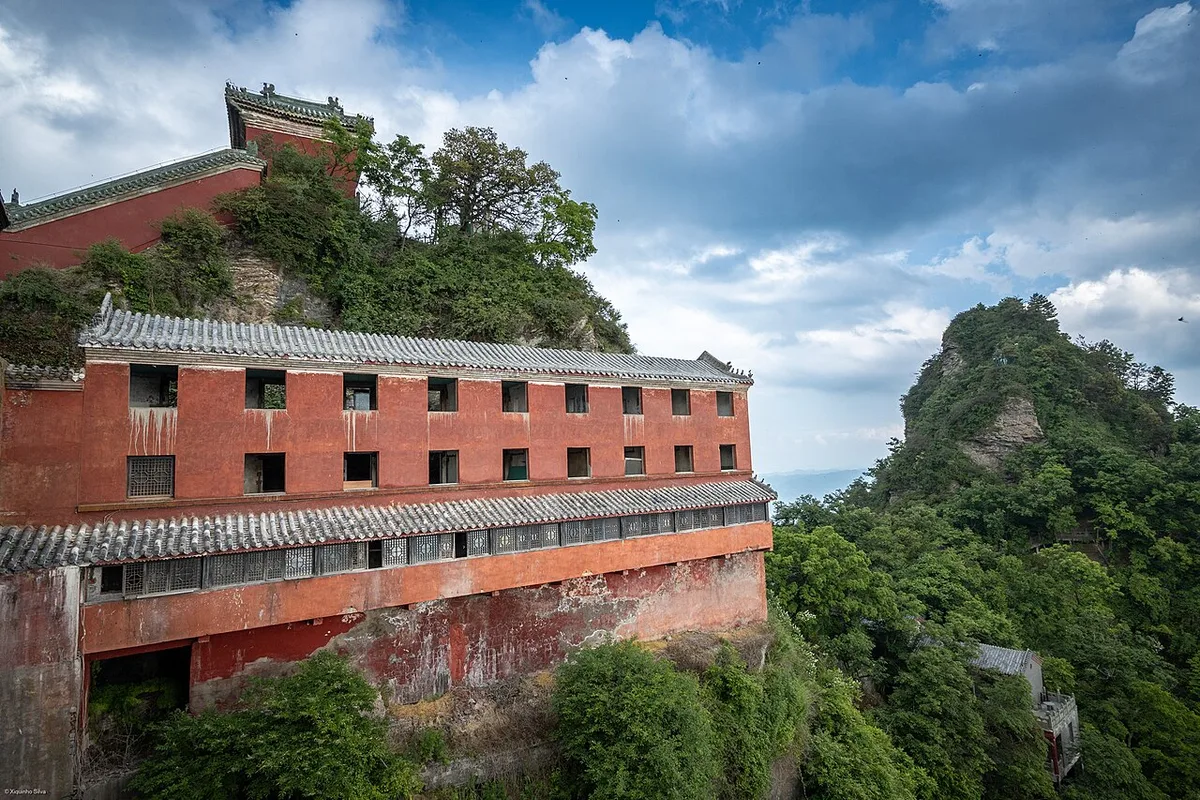
The Wudang Mountains are a mountain range in the northwestern part of Hubei, China. They are home to a famous complex of Taoist temples and monasteries associated with the Lord of the North, Xuantian Shangdi. The Wudang Mountains are renowned for the practice of Tai chi and Taoism as the Taoist counterpart to the Shaolin Monastery, which is affiliated with Chinese Chán Buddhism. The Wudang Mountains are one of the "Four Sacred Mountains of Taoism" in China, an important destination for Taoist pilgrimages. The monasteries such as the Wudang Garden were made a UNESCO World Heritage Site in 1994 because of their religious significance and architectural achievement.
Geography
On Chinese maps, the name "Wudangshan" is applied both to the entire mountain range (which runs east-west along the southern edge of the Han River, crossing several county-level divisions of Shiyan), and to the group of peaks located within Wudangshan subdistrict of Danjiangkou, Shiyan. It is the latter specific area which is known as a Taoist center.
Modern maps show the elevation of the highest of the peaks in the Wudang Shan "proper" as 1612 meters; however, the entire Wudangshan range has somewhat higher elevations elsewhere.
Some consider the Wudang Mountains to be a "branch" of the Daba Mountains range, which is a major mountain system in western Hubei, Shaanxi, Chongqing and Sichuan.
From Wikipedia (CC BY-SA 4.0).