Yale University is a private Ivy League research university in New Haven, Connecticut, United States. Founded in 1701, Yale is the third-oldest institution of higher education in the United States. It is one of the nine colonial colleges chartered before the American Revolution.
Yale was established as the Collegiate School in 1701 by Congregationalist clergy of the Connecticut Colony. Originally focused on theology and sacred languages, the school's curriculum expanded to include humanities and sciences by the time of the American Revolution. In the 19th century, the college expanded to include graduate and professional instruction, awarding the first PhD in the United States in 1861 and organizing as a university in 1887. It is one of the founding members of the Association of American Universities. Yale's faculty and student populations grew rapidly after 1890 due to the expansion of the physical campus and its scientific research programs.
Yale is organized into fifteen constituent schools, including the original undergraduate college, the Yale Graduate School of Arts and Sciences, and Yale Law School. While the university is governed by the Yale Corporation, each school's faculty oversees its curriculum and degree programs. In addition to a central campus in downtown New Haven, the university owns athletic facilities in western New Haven, a campus in West Haven, and forests and nature preserves throughout New England. As of 2025, Yale's endowment was valued at $44.1 billion, making it the second-largest among all educational institutions and the second-largest among private universities. The Yale University Library, serving all constituent schools, holds more than 15 million volumes and is the third-largest academic library in the United States. Student athletes compete in intercollegiate sports as the Yale Bulldogs in the NCAA Division I Ivy League conference.
As of October 2025, 72 Nobel laureates, 5 Fields medalists, 4 Abel Prize laureates, and 3 Turing Award winners have been affiliated with Yale University. Yale alumni include 5 U.S. presidents, 10 Founding Fathers, 19 U.S. Supreme Court justices, 31 living billionaires, 54 college founders and presidents, as well as numerous heads of state, cabinet members, and governors. The university’s community also includes hundreds of members of Congress, U.S. diplomats, 99 MacArthur Fellows, 263 Rhodes Scholars, 123 Marshall Scholars, 81 Gates Cambridge Scholars, 102 Guggenheim Fellows, and 9 Mitchell Scholars. Current Yale faculty include 73 members of the National Academy of Sciences, 55 members of the National Academy of Medicine, 8 members of the National Academy of Engineering, and 200 members of the American Academy of Arts and Sciences. The university is also one of the largest producers of Oscar, Emmy, and Grammy winners. Over 200 Yale alumni have competed in the Olympic games and have won over 110 medals (including 55 gold).
Contents
History
Early history of Yale College
Yale traces its beginnings to "An Act for Liberty to Erect a Collegiate School", a would-be charter passed in New Haven by the General Court of the Colony of Connecticut on October 9, 1701. The act aimed to establish an institution for the education of ministers and lay leaders. Soon after, a group of ten Congregational ministers, Samuel Andrew, Thomas Buckingham, Israel Chauncy, Samuel Mather (nephew of Increase Mather), the Rev. James Noyes II (son of James Noyes), James Pierpont, Abraham Pierson, Noadiah Russell, Joseph Webb, and Timothy Woodbridge, all Harvard alumni, met in the study of the Reverend Samuel Russell, in Branford, to donate books to form the school's library. The group, led by James Pierpont, is now known as the "Founders".
Known from its origin as the "Collegiate School", the institution opened in the home of its first rector, Abraham Pierson, who is considered Yale's first president. Pierson lived in Killingworth. In 1702, Nathaniel Chauncey became the first person to attain a degree, having it conferred solely by oral examination by Pierson and Russell. The school moved to Saybrook in 1707 after Pierson's death, when the first treasurer of Yale, Nathaniel Lynde, donated land and a building. Although the deed required the school to remain in Saybrook, the trustees voted in 1716 to move it to New Haven, which had outbid several other communities for the right to host it.
Meanwhile, there was a rift forming at Harvard between its sixth president, Increase Mather, and the rest of the Harvard clergy, whom Mather viewed as increasingly liberal, ecclesiastically lax, and overly broad in Church polity. The feud caused the Mathers to champion the Collegiate School in the hope it would maintain the Puritan religious orthodoxy in a way Harvard had not. The Reverend Jason Haven, minister at the First Church and Parish in Dedham, Massachusetts, had been considered for the presidency on account of his orthodox theology and "Neatness dignity and purity of Style [which] surpass those of all that have been mentioned", but was passed over due to his "very Valetudinary and infirm State of Health".
In 1718, at the behest of either Rector Samuel Andrew or the colony's Governor Gurdon Saltonstall, Cotton Mather contacted the Boston-born businessman Elihu Yale to ask for money to construct a new building for the college. Through the persuasion of Jeremiah Dummer, Yale, who had made a fortune in Madras while working for the East India Company as the first president of Fort St. George, donated nine bales of goods, which were sold for more than £560, a substantial sum of money. Cotton Mather suggested the school change its name to "Yale College".
19th century
The Yale Report of 1828 was a dogmatic defense of the Latin and Greek curriculum against critics who wanted more courses in modern languages, math and science. Unlike higher education in Europe, there was no national curriculum for U.S. colleges and universities. In the competition for students and financial support, college leaders strove to keep current with demands for innovation. At the same time, they realized a significant portion of students and prospective students demanded a classical background. The report meant the classics would not be abandoned. During this period, institutions experimented with changes in the curriculum, often resulting in a dual-track curriculum. In the decentralized environment of U.S. higher education, balancing change with tradition was a common challenge. A group of professors at Yale and New Haven Congregationalist ministers articulated a conservative response to the changes brought by Victorian culture. They concentrated on developing a person possessed of religious values strong enough to sufficiently resist temptations from within, yet flexible enough to adjust to the "isms" (professionalism, materialism, individualism, and consumerism) tempting them from without. William Graham Sumner, professor from 1872 to 1909, taught in the emerging disciplines of economics and sociology to overflowing classrooms. Sumner bested President Noah Porter, who disliked the social sciences and wanted Yale to lock into its traditions of classical education. Porter objected to Sumner's use of a textbook by Herbert Spencer that espoused agnostic materialism because it might harm students.
Until 1887, the legal name of the university was "The President and Fellows of Yale College, in New Haven". In 1887, under an act passed by the Connecticut General Assembly, Yale was renamed "Yale University".
The Revolutionary War soldier Nathan Hale (Yale 1773) was the archetype of the Yale ideal in the early 19th century: a manly yet aristocratic scholar, well-versed in knowledge and sports, and a patriot who "regretted" that he "had but one life to lose" for his country. Western painter Frederic Remington (Yale 1900) was an artist whose heroes gloried in the combat and tests of strength in the Wild West. The fictional, turn-of-the-20th-century Yale man Frank Merriwell embodied this same heroic ideal without racial prejudice, and his fictional successor Dink Stover in the novel Stover at Yale (1912) questioned the business mentality that had become prevalent at the school. Increasingly students turned to athletic stars as their heroes, especially since winning the big game became the goal of the student body, the alumni, and the team itself.
20th century
Milton Winternitz led the Yale School of Medicine as its dean from 1920 to 1935. Dedicated to the new scientific medicine established in Germany, he was equally fervent about "social medicine" and the study of humans in their environment. He established the "Yale System" of teaching, with few lectures and fewer exams, and strengthened the full-time faculty system; he created the graduate-level Yale School of Nursing and the psychiatry department and built new buildings. Progress toward his plans for an Institute of Human Relations, envisioned as a refuge where social scientists would collaborate with biological scientists in a holistic study of humankind, lasted only a few years before resentful antisemitic colleagues drove him to resign.
Before World War II, most elite university faculties counted among their numbers few, if any, Jews, blacks, women, or other minorities; Yale was no exception. By 1980, this condition had been altered dramatically, as numerous members of those groups held faculty positions. Almost all members of the Faculty of Arts and Sciences—and some members of other faculties—teach undergraduate courses, more than 2,000 of which are offered annually.
In 1793, Lucinda Foote passed the entrance exams for Yale College, but was rejected by the president on the basis of her gender. Women studied at Yale from 1892, in graduate-level programs at the Yale Graduate School of Arts and Sciences. The first seven women to earn PhDs received their degrees in 1894: Elizabeth Deering Hanscom, Cornelia H. B. Rogers, Sara Bulkley Rogers, Margaretta Palmer, Mary Augusta Scott, Laura Johnson Wylie, and Charlotte Fitch Roberts. There is a portrait of them in Sterling Memorial Library, painted by Brenda Zlamany.
In 1966, Yale began discussions with its sister school Vassar College about merging to foster coeducation at the undergraduate level. Vassar, then all-female and part of the Seven Sisters—elite higher education schools that served as sister institutions to the Ivy League when nearly all Ivy League institutions still only admitted men—tentatively accepted, but then declined the invitation. Both schools introduced coeducation independently in 1969. Amy Solomon was the first woman to register as a Yale undergraduate; she was the first woman at Yale to join an undergraduate society, St. Anthony Hall. The undergraduate class of 1973 was the first to have women starting from freshman year; all undergraduate women were housed in Vanderbilt Hall.
21st century
In 2006, Yale and Peking University (PKU) established a joint undergraduate program in Beijing, an exchange program allowing Yale students to spend a semester living and studying with PKU honor students. In July 2012, the Yale University-PKU Program ended due to weak participation.
In 2007 outgoing Yale President Rick Levin characterized Yale's institutional priorities: "First, among the nation's finest research universities, Yale is distinctively committed to excellence in undergraduate education. Second, in our graduate and professional schools, as well as in Yale College, we are committed to the education of leaders."
Also in 2007, the university purchased the 137-acre (0.55 km2) former Bayer campus in West Haven and Orange, Connecticut, including 17 buildings. The Yale West Campus focuses on biotechnology, pharmaceuticals and other life sciences research.
In 2009, former British Prime Minister Tony Blair picked Yale as one location—the others being Britain's Durham University and Universiti Teknologi Mara—for the Tony Blair Faith Foundation's United States Faith and Globalization Initiative. As of 2009, former Mexican President Ernesto Zedillo was the director of the Yale Center for the Study of Globalization and teaches an undergraduate seminar, "Debating Globalization". As of 2009, former presidential candidate and DNC chair Howard Dean taught a residential college seminar, "Understanding Politics and Politicians". Also in 2009, an alliance was formed among Yale, University College London, and both schools' affiliated hospital complexes to conduct research focused on the direct improvement of patient care—a field known as translational medicine. President Richard Levin noted that Yale has hundreds of other partnerships across the world, but "no existing collaboration matches the scale of the new partnership with UCL". In August 2013, a new partnership with the National University of Singapore led to the opening of Yale-NUS College in Singapore, a joint effort to create a new liberal arts college in Asia featuring a curriculum including Western and Asian traditions.
In 2017, having been suggested for decades, Yale University renamed Calhoun College, named for slave owner, anti-abolitionist, and white supremacist Vice President John C. Calhoun. It is now Hopper College, after Grace Hopper.
Administration and organization
Leadership
The President and Fellows of Yale College, also known as the Yale Corporation, or board of trustees, is the governing body of the university and consists of thirteen standing committees with separate responsibilities outlined in the by-laws. The corporation has 19 members: three ex officio members, ten successor trustees, and six elected alumni fellows. The university has three major academic components: Yale College (the undergraduate program), the Graduate School of Arts and Sciences, and the twelve professional schools.
The Yale Provost's Office and similar executive positions have launched several women into prominent university executive positions. In 1977, Provost Hanna Holborn Gray was appointed interim president of Yale and later went on to become president of the University of Chicago, being the first woman to hold either position at each respective school. In 1994, Provost Judith Rodin became the first permanent female president of an Ivy League institution at the University of Pennsylvania. In 2002, Provost Alison Richard became the vice-chancellor of the University of Cambridge. In 2003, the dean of the Divinity School, Rebecca Chopp, was appointed president of Colgate University and later went on to serve as the president of Swarthmore College in 2009, and then the first female chancellor of the University of Denver in 2014. In 2004, Provost Dr. Susan Hockfield became the president of the Massachusetts Institute of Technology. In 2004, Dean of the Nursing school, Catherine Gilliss, was appointed the dean of Duke University's School of Nursing and vice chancellor for nursing affairs. In 2007, Deputy Provost H. Kim Bottomly was named president of Wellesley College.
Similar examples for men who have served in Yale leadership positions can also be found. In 2004, Dean of Yale College Richard H. Brodhead was appointed as the president of Duke University. In 2008, Provost Andrew Hamilton was confirmed to be the vice chancellor of the University of Oxford.
Staff and labor unions
Yale University staff are represented by several different unions. Clerical and technical workers are represented by Local 34, and service and maintenance workers are represented by Local 35, both of the same union affiliate UNITE HERE. Unlike similar institutions, Yale has consistently refused to recognize its graduate student union, Local 33 (another affiliate of UNITE HERE), citing claims that the union's elections were undemocratic and how graduate students are not employees; the move to not recognize the union has been criticized by the American Federation of Teachers. In addition, officers of the Yale University Police Department are represented by the Yale Police Benevolent Association, which affiliated in 2005 with the Connecticut Organization for Public Safety Employees. Yale security officers joined the International Union of Security, Police and Fire Professionals of America in late 2010, even though the Yale administration contested the election. In October 2014, after deliberation, Yale security decided to form a new union, the Yale University Security Officers Association, which has since represented the campus security officers.
Yale has a history of difficult and prolonged labor negotiations, often culminating in strikes. There have been at least eight strikes since 1968, and The New York Times wrote that Yale has a reputation as having the worst record of labor tension of any university in the U.S. Moreover, Yale has been accused by the AFL–CIO of failing to treat workers with respect, as well as not renewing contracts with professors over involvement in campus labor issues. Yale has responded to strikes with claims over mediocre union participation and the benefits of their contracts.
Campus
Yale's central campus in downtown New Haven covers 260 acres (1.1 km2) and comprises its main, historic campus and a medical campus adjacent to the Yale–New Haven Hospital. In western New Haven, the university holds 500 acres (2.0 km2) of athletic facilities, including the Yale Golf Course. In 2008, Yale purchased the 17-building, 136-acre (0.55 km2) former Bayer HealthCare complex in West Haven, Connecticut, the buildings of which are now used as laboratory and research space. Yale also owns seven forests in Connecticut, Vermont, and New Hampshire—the largest of which is the 7,840-acre (31.7 km2) Yale-Myers Forest in Connecticut's Quiet Corner—and nature preserves including Horse Island.
Yale is noted for its largely Collegiate Gothic campus as well as several iconic modern buildings commonly discussed in architectural history survey courses: Louis Kahn's Yale Art Gallery and Center for British Art, Eero Saarinen's Ingalls Rink and Ezra Stiles and Morse Colleges, and Paul Rudolph's Art & Architecture Building. Yale also owns and has restored many noteworthy 19th-century mansions along Hillhouse Avenue, which was considered the most beautiful street in America by Charles Dickens when he visited the United States in the 1840s. In 2011, Travel + Leisure listed the Yale campus as one of the most beautiful in the United States. Condé Nast also ranked it as one of the most beautiful in 2025.
Many of Yale's buildings were constructed in the Collegiate Gothic architecture style from 1917 to 1931, financed largely by Edward S. Harkness, including the Yale Drama School. Stone sculpture built into the walls of the buildings portray contemporary college personalities, such as a writer, an athlete, a tea-drinking socialite, and a student who has fallen asleep while reading. Similarly, the decorative friezes on the buildings depict contemporary scenes, like a policemen chasing a robber and arresting a prostitute (on the wall of the Law School), or a student relaxing with a mug of beer and a cigarette. The architect, James Gamble Rogers, faux-aged these buildings by splashing the walls with acid, deliberately breaking their leaded glass windows and repairing them in the style of the Middle Ages, and creating niches for decorative statuary but leaving them empty to simulate loss or theft over the ages. In fact, the buildings merely simulate Middle Ages architecture, for though they appear to be constructed of solid stone blocks in the authentic manner, most actually have steel framing as was commonly used in 1930. One exception is Harkness Tower, 216 feet (66 m) tall, which was originally a free-standing stone structure. It was reinforced in 1964 to allow the installation of the Yale Memorial Carillon.
Notable nonresidential campus buildings
Notable nonresidential campus buildings and landmarks include Battell Chapel, Beinecke Rare Book Library, Harkness Tower, Humanities Quadrangle, Ingalls Rink, Kline Biology Tower, Osborne Memorial Laboratories, Payne Whitney Gymnasium, Peabody Museum of Natural History, Sterling Hall of Medicine, Sterling Law Buildings, Sterling Memorial Library, Woolsey Hall, Yale Center for British Art, Yale University Art Gallery, Yale Art & Architecture Building, and the Paul Mellon Centre for Studies in British Art in London.
Yale's secret society buildings (some of which are called "tombs") were built to be private yet unmistakable. A diversity of architectural styles is represented: Berzelius, Donn Barber in an austere cube with classical detailing (erected in 1908 or 1910); Book and Snake, Louis R. Metcalfe in a Greek Ionic style (erected in 1901); Elihu, architect unknown but built in a Colonial style (constructed on an early 17th-century foundation although the building is from the 18th century); Mace and Chain, in a late colonial, early Victorian style (built in 1823). (Interior moulding is said to have belonged to Benedict Arnold); Manuscript Society, King-lui Wu with Dan Kiley responsible for landscaping and Josef Albers for the brickwork intaglio mural. Building constructed in a mid-century modern style; Scroll and Key, Richard Morris Hunt in a Moorish- or Islamic-inspired Beaux-Arts style (erected 1869–70); Skull and Bones, possibly Alexander Jackson Davis or Henry Austin in an Egypto-Doric style utilizing Brownstone (in 1856 the first wing was completed, in 1903 the second wing, 1911 the Neo-Gothic towers in rear garden were completed); St. Elmo, (former tomb) Kenneth M. Murchison, 1912, designs inspired by Elizabethan manor. Current location, brick colonial; and Wolf's Head, Bertram Grosvenor Goodhue, erected 1923–1924, Collegiate Gothic.
Sustainability
Yale's Office of Sustainability develops and implements sustainability practices at Yale. Yale is committed to reduce its greenhouse gas emissions 10% below 1990 levels by 2020. As part of this commitment, the university allocates renewable energy credits to offset some of the energy used by residential colleges. Eleven campus buildings are candidates for LEED design and certification. Yale was listed as a Campus Sustainability Leader on the Sustainable Endowments Institute's College Sustainability Report Card 2008, and received a "B+" grade overall. Yale is a member of the Ivy Plus Sustainability Consortium, through which it has committed to best-practice sharing and the ongoing exchange of campus sustainability solutions along with other member institutions.
Grove Street Cemetery, New Haven
Marsh Botanical Garden
Yale Sustainable Food Program Farm
Relationship with New Haven
Yale is the largest taxpayer and employer in the City of New Haven, and has often buoyed the city's economy and communities. Yale, however, has consistently opposed paying a tax on its academic property. Yale's Art Galleries, along with many other university resources, are free and openly accessible. Yale also funds the New Haven Promise program, paying full tuition for eligible students from New Haven public schools.
Yale has a complicated relationship with its home city; for example, thousands of students volunteer every year in myriad community organizations, but city officials, who decry Yale's exemption from local property taxes, have long pressed the university to do more to help. Under President Levin, Yale has financially supported many of New Haven's efforts to reinvigorate the city. Evidence suggests that the town and gown relationships are mutually beneficial. Still, the economic power of the university increased dramatically with its financial success amid a decline in the local economy.
The first campus police force was founded at Yale in 1894, when the university contracted city police officers to exclusively cover the campus. Later hired by the university, the officers were originally brought in to quell unrest between students and city residents and curb destructive student behavior.
In the 1970s and 1980s, poverty and violent crime rose in New Haven, dampening Yale's student and faculty recruiting efforts. Between 1990 and 2006, New Haven's crime rate fell by half, helped by a community policing strategy by the New Haven Police and Yale's campus became the safest among peer schools.
In 2004, the national non-profit watchdog group Security on Campus filed a complaint with the U.S. Department of Education, accusing Yale of under-reporting rape and sexual assaults.
Academics
Admissions
Undergraduate admission to Yale College is considered "most selective" by U.S. News. In 2022, Yale accepted 2,234 students to the Class of 2026 out of 50,015 applicants, for an acceptance rate of 4.46%. In 2026, the admission rate for the class of 2030 fell to 4.2% from 4.59% the prior year, with 2,328 students accepted out of a pool of 54,919 applicants (the second largest in Yale's history following the class of 2028). 98% of students graduate within six years. Yale's most selective graduate schools are: the Law School (4%), School of Medicine (5%), Graduate School of Arts and Sciences (5.7% - only for PhD admissions), School of Art (6%), School of Music (10%), School of Architecture (15%), and Divinity School (15%). Yale Divinity School is notable for being the most selective institution for the study of religion in the world.
Through its program of need-based financial aid, Yale commits to meet the full demonstrated financial need of all applicants, and the university is need-blind for both domestic and international applicants. Most financial aid is in the form of grants and scholarships that do not need to be paid back to the university, and the average need-based aid grant for the Class of 2017 was $46,395. 15% of Yale College students are expected to have no parental contribution, and about 50% receive some form of financial aid. About 16% of the Class of 2013 had some form of student loan debt at graduation, with an average debt of $13,000 among borrowers. For 2019, Yale ranked second in enrollment of recipients of the National Merit $2,500 Scholarship (140 scholars).
Half of all Yale undergraduates are women, more than 39% are ethnic minority U.S. citizens (19% are underrepresented minorities), and 10.5% are international students. 55% attended public schools and 45% attended private, religious, or international schools, and 97% of students were in the top 10% of their high school class. Every year, Yale College also admits a small group of non-traditional students through the Eli Whitney Students Program.
Collections
Yale University Library, which holds over 15 million volumes, is the second-largest university collection in the United States after Harvard. The main library, Sterling Memorial Library, contains about 4 million volumes, and other holdings are dispersed at subject and location libraries. For the 2022 fiscal year, the university reported 9,144,904 physical library holdings and 2,784,465 holdings in their digital/electronic collection.
Rare books are found in several Yale collections. The Beinecke Rare Book Library has a large collection of rare books and manuscripts. The Harvey Cushing/John Hay Whitney Medical Library includes important historical medical texts, including an impressive collection of rare books, as well as historical medical instruments. The Lewis Walpole Library contains the largest collection of 18th‑century British literary works. The Elizabethan Club, technically a private organization, makes its Elizabethan folios and first editions available to qualified researchers through Yale.
Yale's museum collections are also of international stature. The Yale University Art Gallery, the country's first university-affiliated art museum, contains more than 200,000 works, including Old Masters and important collections of modern art, in the Swartwout and Kahn buildings. The latter, Louis Kahn's first large-scale American work (1953), was renovated and reopened in December 2006. The Yale Center for British Art, the largest collection of British art outside of the UK, grew from a gift of Paul Mellon and is housed in another Kahn-designed building.
The Peabody Museum of Natural History in New Haven is used by school children and contains research collections in anthropology, archaeology, and the natural environment.
The Yale University Collection of Musical Instruments, affiliated with the Yale School of Music, is perhaps the least-known of Yale's collections because its hours of opening are restricted.
The museums once housed the artifacts brought to the United States from Peru by Yale history professor Hiram Bingham in his Yale-financed expedition to Machu Picchu in 1912—when the removal of such artifacts was legal. The artifacts were restored to Peru in 2012.
Rankings and reputation
The U.S. News & World Report ranked Yale fourth among U.S. national universities for 2025 (tied with Stanford). Niche ranks Yale as the 2nd best university in America. Yale University is accredited by the New England Commission of Higher Education.
Internationally, Yale was ranked 11th in the 2025 Academic Ranking of World Universities.
In 2026, it was ranked 2nd among the world’s top universities by Time magazine and Statista.
Faculty, research, and intellectual traditions
Yale is a member of the Association of American Universities (AAU) and is classified among "R1: Doctoral Universities—Very high research activity". The National Science Foundation ranked Yale 16th among American universities for research and development expenditures in 2024 with $1.52 billion.
Yale's current faculty include 67 members of the National Academy of Sciences, 55 members of the National Academy of Medicine, 8 members of the National Academy of Engineering, and 187 members of the American Academy of Arts and Sciences. The college is, after normalization for institution size, the tenth-largest baccalaureate source of doctoral degree recipients in the United States, and the largest such source within the Ivy League. It also is a top 10 (ranked seventh) baccalaureate source (after normalization for the number of graduates) of some of the most notable scientists (Nobel, Fields, Turing prizes, or membership in National Academy of Sciences, National Academy of Engineering, or National Academy of Medicine).
Yale's English and Comparative Literature departments were part of the New Criticism movement. Of the New Critics, Robert Penn Warren, W.K. Wimsatt, and Cleanth Brooks were all Yale faculty. Later, the Yale Comparative literature department became a center of American deconstruction. Jacques Derrida, the father of deconstruction, taught at the department of comparative literature from the late 1970s to mid-1980s. Several other Yale faculty members were also associated with deconstruction, forming the so-called "Yale school".These included Paul de Man who taught in the departments of comparative literature and French, J. Hillis Miller, Geoffrey Hartman (both taught in the departments of English and comparative literature), and Harold Bloom (English), whose theoretical position was always somewhat specific, and who ultimately took a very different path from the rest of this group. Yale's history department has also originated important intellectual trends. Historians C. Vann Woodward and David Brion Davis are credited with beginning in the 1960s and 1970s an important stream of southern historians; likewise, David Montgomery, a labor historian, advised many of the current generation of labor historians in the country. Yale's Music School and department fostered the growth of Music Theory in the latter half of the 20th century. The Journal of Music Theory was founded there in 1957; Allen Forte and David Lewin were influential teachers and scholars.
Campus life
Yale is a research university, with the majority of its students in the graduate and professional schools. Undergraduates, or Yale College students, come from a variety of ethnic, national, socioeconomic, and personal backgrounds. Of the 2010–2011 freshman class, 10% are non‑U.S. citizens, while 54% went to public high schools. The median family income of Yale students is $192,600, with 57% of students coming from the top 10% highest-earning families and 16% from the bottom 60%.
Residential colleges
Yale's residential college system was established in 1933 by Edward S. Harkness, who admired the social intimacy of Oxford and Cambridge and donated significant funds to found similar colleges at Yale and Harvard. Though Yale's colleges resemble their English precursors organizationally and architecturally, they are dependent entities of Yale College and have limited autonomy. The colleges are led by a head and an academic dean, who reside in the college, and university faculty and affiliates constitute each college's fellowship. Colleges offer their own seminars, social events, and speaking engagements known as "Master's teas", but do not contain programs of study or academic departments. All other undergraduate courses are taught by the Faculty of Arts and Sciences and are open to members of any college.
All undergraduates are members of a college, to which they are assigned before their freshman year, and 85 percent live in the college quadrangle or a college-affiliated dormitory. While the majority of upperclassman live in the colleges, most on-campus freshmen live on the Old Campus, the university's oldest precinct.
While Harkness's original colleges were Georgian Revival or Collegiate Gothic in style, two colleges constructed in the 1960s, Morse and Ezra Stiles Colleges, have modernist designs. All twelve college quadrangles are organized around a courtyard, and each has a dining hall, courtyard, library, common room, and a range of student facilities. The twelve colleges are named for important alumni or significant places in university history. In 2017, the university opened two new colleges near Science Hill.
Since the 1960s, John C. Calhoun's white supremacist beliefs and pro-slavery leadership had prompted calls to rename the college or remove its tributes to Calhoun. The racially motivated church shooting in Charleston, South Carolina, led to renewed calls in the summer of 2015 for Calhoun College, one of 12 residential colleges at the time, to be renamed. In July 2015 students signed a petition calling for the name change. They argued in the petition that—while Calhoun was respected in the 19th century as an "extraordinary American statesman"—he was "one of the most prolific defenders of slavery and white supremacy" in the history of the United States. In August 2015, Yale President Peter Salovey addressed the freshman class of 2019 in which he responded to the racial tensions but explained why the college would not be renamed. He described Calhoun as "a notable political theorist, a vice president to two different U.S. presidents, a secretary of war and of state, and a congressman and senator representing South Carolina". He acknowledged that Calhoun also "believed that the highest forms of civilization depend on involuntary servitude. Not only that, but he also believed that the races he thought to be inferior, black people in particular, ought to be subjected to it for the sake of their own best interests." Student activism about this issue increased in the fall of 2015, and included further protests sparked by controversy surrounding an administrator's comments on the potential positive and negative implications of students who wear Halloween costumes that are culturally sensitive. Campus-wide discussions expanded to include critical discussion of the experiences of women of color on campus, and the realities of racism in undergraduate life. The protests were sensationalized by the media and led to the labelling of some students as being members of Generation Snowflake.
Student organizations
In 2024, Yale had 526 registered undergraduate student organizations, plus hundreds of others for graduate students.
Dwight Hall, an independent, non-profit community service organization, oversees more than 2,000 Yale undergraduates working on more than 70 community service initiatives in New Haven. The Yale College Council runs several agencies that oversee campus-wide activities and student services. The Yale Dramatic Association and Bulldog Productions cater to the theater and film communities, respectively. In addition, the Yale Drama Coalition serves to coordinate between and provide resources for the various Sudler Fund sponsored theater productions which run each weekend. WYBC Yale Radio is the campus's radio station, owned and operated by students. While students used to broadcast on AM and FM frequencies, they now have an Internet-only stream.
The Yale College Council (YCC) serves as the campus's undergraduate student government. All registered student organizations are regulated and funded by a subsidiary organization of the YCC, known as the Undergraduate Organizations Funding Committee (UOFC). The Graduate and Professional Student Senate (GPSS) serves as Yale's graduate and professional student government.
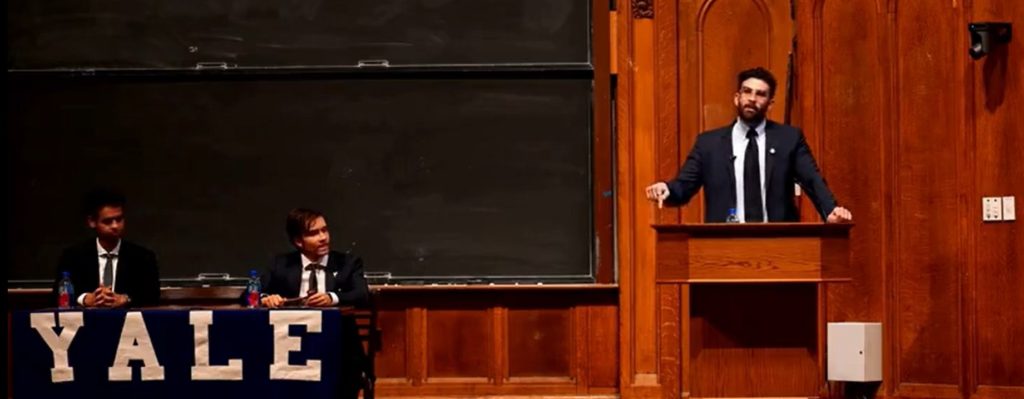
The Yale Political Union (YPU) is a debate society founded in 1934 to host student discussions on a wide variety of topics. It is advised by alumni political leaders such as John Kerry and George Pataki.
The Yale International Relations Association (YIRA) functions as the umbrella organization for the university's top-ranked Model UN team. YIRA also has a Europe-based offshoot, Yale Model Government Europe, other Model UN conferences such as YMUN, YMUN Korea, YMUN Taiwan and Yale Model African Union (YMAU), the Yale Review of International Studies (YRIS), and educational programs such as the Yale International Relations Leadership Institute and Hemispheres.
The campus includes several fraternities and sororities. The campus features at least 18 a cappella groups, the most famous of which is The Whiffenpoofs, which from its founding in 1909 until 2018 was made up solely of senior men.
Student publications
The university hosts a variety of student journals, magazines, and newspapers. The Yale Literary Magazine, founded in February 1836, is the oldest student literary magazine in the United States.
Established in 1872, The Yale Record is the world's oldest college humor magazine. The Yale Journal of Medicine & Law is a biannual magazine that explores the intersection of law and medicine.
Newspapers include the Yale Daily News, which was first published in 1878, and the weekly Yale Herald, which was first published in 1986.
The Yale Globalist is an undergraduate magazine focused on international affairs. The first of four issues published annually is about a specific country, which has been visited by a small group of student reporters. The other three issues are each around topics chosen democratically by the group of student editors.
Traditions
Yale seniors at graduation smash clay pipes underfoot to symbolize passage from their "bright college years", though in recent history the pipes have been replaced with "bubble pipes". ("Bright College Years", the university's alma mater, was penned in 1881 by Henry Durand, Class of 1881, to the tune of Die Wacht am Rhein.) Yale's student tour guides tell visitors that students consider it good luck to rub the toe of the statue of Theodore Dwight Woolsey on Old Campus; however, actual students rarely do so. In the second half of the 20th century Bladderball, a campus-wide game played with a large inflatable ball, became a popular tradition but was banned by administration due to safety concerns. In spite of administration opposition, students revived the game in 2009, 2011, and 2014.
Athletics
Yale supports 35 varsity athletic teams that compete in the Ivy League Conference, the Eastern College Athletic Conference, and the New England Intercollegiate Sailing Association. Yale athletic teams compete intercollegiately at the NCAA Division I level. Like other members of the Ivy League, Yale does not offer athletic scholarships.
Yale has numerous athletic facilities, including the Yale Bowl (the nation's first natural "bowl" stadium, and prototype for such stadiums as the Los Angeles Memorial Coliseum and the Rose Bowl), located at The Walter Camp Field athletic complex, and the Payne Whitney Gymnasium, the second-largest indoor athletic complex in the world.
In 1970, the NCAA banned Yale from participating in all NCAA sports for two years, in reaction to Yale—against the wishes of the NCAA—playing its Jewish center Jack Langer in college games after Langer had played for Team United States at the 1969 Maccabiah Games in Israel with the approval of Yale President Kingman Brewster. The decision impacted 300 Yale students, every Yale student on its sports teams, over the next two years.
In 2016, the men's basketball team won the Ivy League Championship title for the first time in 54 years, earning a spot in the NCAA Division I men's basketball tournament. In the first round of the tournament, the Bulldogs beat the Baylor Bears 79–75 in the school's first-ever tournament win.
In May 2018, the men's lacrosse team defeated the Duke Blue Devils to claim their first-ever NCAA Division I Men's Lacrosse Championship, and were the first Ivy League school to win the title since the Princeton Tigers in 2001.
Yale crew is the oldest collegiate athletic team in America, and won Olympic Games Gold Medal for men's eights in 1924 and 1956. Over 170 Yale alumni have competed in the Olympic games and have won over 110 medals.
The Yale Corinthian Yacht Club, founded in 1881, is the oldest collegiate sailing club in the world. October 21, 2000, marked the dedication of Yale's fourth new boathouse in 157 years of collegiate rowing. The Gilder Boathouse is named to honor former Olympic rower Virginia Gilder '79 and her father Richard Gilder '54, who gave $4 million towards the $7.5 million project. Yale also maintains the Gales Ferry site where the heavyweight men's team trains for the Yale-Harvard Boat Race.
Mental health
Yale has faced significant criticism for its handling of student mental health on campus. Suicidal and depressed students say that Yale forced them to medically withdraw rather than provide them with academic accommodations under the Americans with Disabilities Act, and in 2018 the Ruderman Family Foundation ranked Yale as having the worst mental health policies in the Ivy League.
Students at Yale say that the university's policies force them to hide their depression and avoid seeking help, for fear of being forced to leave. One prominent case was the suicide of Luchang Wang in 2015, who died by suicide after making a Facebook post saying that she needed time to deal with her mental health issues, but could not deal with being forced to medically withdraw for an entire year with an uncertain chance of being readmitted. Wang had previously withdrawn from school due to mental health issues, and was afraid of being forced to withdraw again, as a second readmission attempt would be considerably more difficult for her. A friend of Wang said that she routinely lied to her university therapist to avoid being kicked out, and another student said that many at Yale lie to their counselors as "there's no clear standard established that says exactly what students will get involuntarily hospitalized or withdrawn for." In response, the university convened a commission to evaluate their readmission policies after a mental health withdrawal, renaming the process to "reinstatement", eliminating the $50 reapplication fee, and giving students 5–6 more days to make their decision on a mental health withdrawal.
For students that do seek help, waitlists for therapy can be months long, with individual counselling sessions only 30 minutes in length. In 2022, after a Washington Post article about their medical withdrawal policies, the school increased the number of mental health clinicians on campus from 51 to 60 as well as promised further changes. In 2023, after a lawsuit was filed against the school for what the plaintiffs described as discrimination, the university changed the name of a "medical withdrawal" to a "medical leave of absence" saying that the "leave of absence" terminology would allow students to remain on Yale's insurance while away from the school. The new policy also allowed for students on a leave of absence to participate in extracurricular clubs and visit campus, something a student on medical withdrawal was banned from doing. A representative of Yale also said that the criticism of their policies "misrepresents our efforts and unwavering commitment to supporting our students, whose well-being and success are our primary focus" and that "the mental health of our students is a very, very high priority."
Notable people
Benefactors
Yale has had many financial supporters, but some stand out by the magnitude or timeliness of their contributions. Among those who have made large donations commemorated at the university are: Elihu Yale, Jeremiah Dummer, the Vanderbilt family, the Harkness family (Edward, Anna, and William), the Beinecke family (Edwin, Frederick, and Walter), John William Sterling, Payne Whitney, Joseph Earl Sheffield, Paul Mellon, Charles B. G. Murphy, Joseph Tsai, William K. Lanman, and Stephen Schwarzman. The Yale Class of 1954, led by Richard Gilder, donated $70 million in commemoration of their 50th reunion. Charles B. Johnson, a 1954 graduate of Yale College, pledged a $250 million gift in 2013 to support the construction of two new residential colleges. The colleges have been named respectively in honor of Pauli Murray and Benjamin Franklin. A $100 million contribution by Stephen Adams enabled the Yale School of Music to become tuition-free and the Adams Center for Musical Arts to be built, while a $150 million contribution by David Geffen enabled the Yale School of Drama (renamed the David Geffen School of Drama at Yale) to become tuition-free as well.
Notable alumni
Yale has many distinguished alumni, in both the public and private sectors. According to 2020 data, around 71% of undergraduates join the workforce, while 17% attend graduate or professional schools. Yale graduates have been recipients of 263 Rhodes Scholarships, 123 Marshall Scholarships, 67 Truman Scholarships, 21 Churchill Scholarships, and 9 Mitchell Scholarships. The university is the 2nd largest producer of Fulbright Scholars, with 1,244 in its history and 89 MacArthur Fellows. The U.S. Department of State Bureau of Educational and Cultural Affairs ranked Yale fifth among research institutions producing the most 2020–2021 Fulbright Scholars. 31 living billionaires are alumni.
One of the most popular undergraduate majors is political science, with many alumni going on to serve in government and politics. Former presidents who attended for undergrad include William Howard Taft, George H. W. Bush, and George W. Bush, while former presidents Gerald Ford and Bill Clinton attended Yale Law School. Among vice presidents, influential antebellum era politician John C. Calhoun graduated from Yale, while JD Vance graduated from Yale Law School. Former world leaders include Italian prime minister Mario Monti, Turkish prime minister Tansu Çiller, South Korean prime minister Lee Hong-koo, Mexican president Ernesto Zedillo, German president Karl Carstens, Philippine president José Paciano Laurel, Latvian president Valdis Zatlers, Taiwanese premier Jiang Yi-huah, and Malawian president Peter Mutharika, among others. Prominent royals who graduated are Crown Princess Victoria of Sweden and Olympia Bonaparte, Princess Napoléon.
Alumni have had considerable presence in U.S. government in all three branches. On the U.S. Supreme Court, 19 justices have been alumni, including current Associate Justices Sonia Sotomayor, Samuel Alito, Clarence Thomas, and Brett Kavanaugh. Alumni have been U.S. Senators, including current senators Michael Bennet, Richard Blumenthal, Cory Booker, Sherrod Brown, Chris Coons, Amy Klobuchar, Sheldon Whitehouse. Current and former cabinet members include Secretaries of State John Kerry, Hillary Clinton, Cyrus Vance, and Dean Acheson; U.S. Secretaries of the Treasury Oliver Wolcott, Robert Rubin, Nicholas F. Brady, Steven Mnuchin, Janet Yellen, and Scott Bessent; U.S. Attorneys General Nicholas Katzenbach, Edwin Meese, John Ashcroft, and Edward H. Levi; and many others. Peace Corps founder and American diplomat Sargent Shriver and public official and urban planner Robert Moses are Yale alumni.
Yale has produced numerous award-winning authors and influential writers, like Nobel Prize in Literature laureate Sinclair Lewis and Pulitzer Prize winners Stephen Vincent Benét, Thornton Wilder, Doug Wright, and David McCullough. Academy Award winning actors, actresses, and directors include Jodie Foster, Paul Newman, Meryl Streep, Elia Kazan, George Roy Hill, Lupita Nyong'o, Oliver Stone, and Frances McDormand. Alumni from Yale have also made notable contributions to both music and the arts. Leading American composer from the 20th century Charles Ives, Broadway composer Cole Porter, Grammy award winner David Lang, multi-Tony Award winner Composer and Musicologist Maury Yeston, and award-winning jazz pianist and composer Vijay Iyer all hail from Yale. Hugo Boss Prize winner Matthew Barney, American sculptor Richard Serra, painter Kehinde Wiley, MacArthur Fellows and contemporary artists Tschabalala Self, Titus Kaphar, Richard Whitten, and Sarah Sze, Pulitzer Prize winning cartoonist Garry Trudeau, and National Medal of Arts photorealist painter Chuck Close all graduated from Yale. Additional alumni include architect and Presidential Medal of Freedom winner Maya Lin, Pritzker Prize winner Norman Foster, and Gateway Arch designer Eero Saarinen. Journalists and pundits include Dick Cavett, Chris Cuomo, Anderson Cooper, William F. Buckley Jr., Blake Hounshell, Nia-Malika Henderson and Fareed Zakaria. Alumni distinguished in academia include literary critic and historian Henry Louis Gates, economists Irving Fischer, Mahbub ul Haq, and Nobel Prize laureate Paul Krugman; Nobel Prize in Physics laureates Ernest Lawrence and Murray Gell-Mann; Fields Medalist John G. Thompson; Human Genome Project leader and National Institutes of Health director Francis S. Collins; brain surgery pioneer Harvey Cushing; computer scientist Grace Hopper; influential mathematician and chemist Josiah Willard Gibbs; National Women's Hall of Fame inductee and biochemist Florence B. Seibert; Turing Award recipient Ron Rivest; inventors Samuel F.B. Morse and Eli Whitney; and Reinhold Niebuhr.