



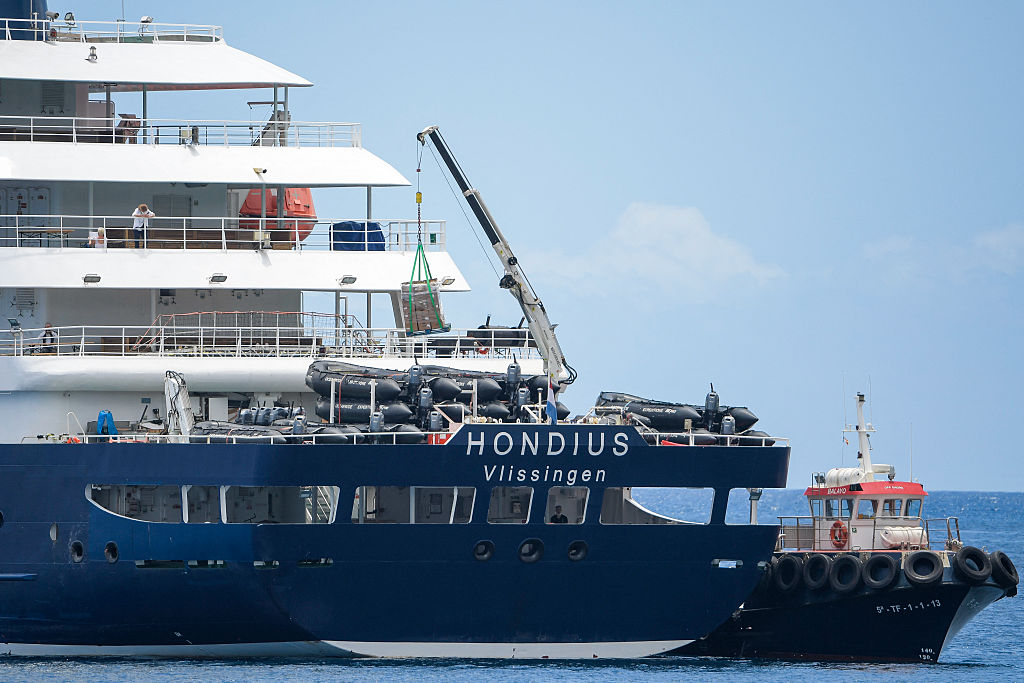
After weeks of fear, quarantines, and international concern, the virus-stricken MV Hondius finally reached shore Sunday morning as passengers began leaving the ship under strict medical supervision in Spain.
According to the New York Post, the Dutch expedition vessel arrived in Tenerife, the largest of Spain’s Canary Islands, around 6:30 a.m. local time after a deadly hantavirus outbreak aboard the ship killed three travelers and triggered a global health response.
More than 140 passengers and crew members started disembarking hours later while health officials worked to prevent any possible spread of the rare Andes strain of hantavirus.
“All the passengers remain asymptomatic,” Spain’s Health Minister Monica Garcia said during a Sunday morning press conference. “The entire operation is proceeding normally.”
Passengers were ordered to leave their luggage behind on the ship and undergo medical screenings before being allowed off in small groups.
Spanish nationals — including 13 passengers and one crew member — were the first evacuated from the vessel.
Images from the scene showed travelers wearing blue medical gowns, surgical caps, and white face masks while carrying belongings in plastic bags as hazmat-suited crews escorted them onto buses.
Spanish authorities said the group would be flown directly to a military hospital in Madrid, where they would remain isolated in single-room quarantine under close supervision.
Health officials stressed the evacuation process was carefully organized to avoid contact between passengers and local residents.
Concern had been growing across the Canary Islands ahead of the ship’s arrival, though the World Health Organization has continued to describe the overall public risk as low.
The United States is also preparing to transport 17 American passengers back home on a repatriation flight.
According to the State Department, the travelers will be taken to the National Quarantine Unit in Nebraska for monitoring and assessment.
British authorities are similarly arranging a flight for UK citizens, who will reportedly face a mandatory 45-day isolation period after returning home.
The cruise nightmare began during the vessel’s 35-day Atlantic expedition, which departed from Argentina on March 20.
Investigators believe an elderly Dutch couple contracted the virus in Argentina before boarding the ship. The husband later died on board after developing severe symptoms.
His wife became ill after leaving the vessel during a stop on Saint Helena Island and later died in South Africa.
A third passenger, a German national, also died.
Three additional passengers from Germany, the Netherlands, and the United Kingdom were evacuated to the Netherlands for treatment, while Swiss authorities confirmed another former passenger tested positive after returning home.
Officials said at least 23 people had already left the cruise and returned to countries around the world before passengers realized they may have been exposed to the virus.
So far, only one of those former passengers is known to have become sick.
Health authorities in the United States are monitoring former passengers in Georgia, California, and Arizona.
Hantavirus is typically spread through rodent urine or droppings, but the Andes strain involved in the outbreak is capable of rare person-to-person transmission through prolonged close contact.
The disease attacks the lungs and can cause severe respiratory failure. Survivors have described the illness as resembling an extreme flu combined with suffocation.
The Centers for Disease Control and Prevention has issued a Level 3 alert tied to the outbreak, though officials continue to emphasize that the overall threat to the public remains low.