



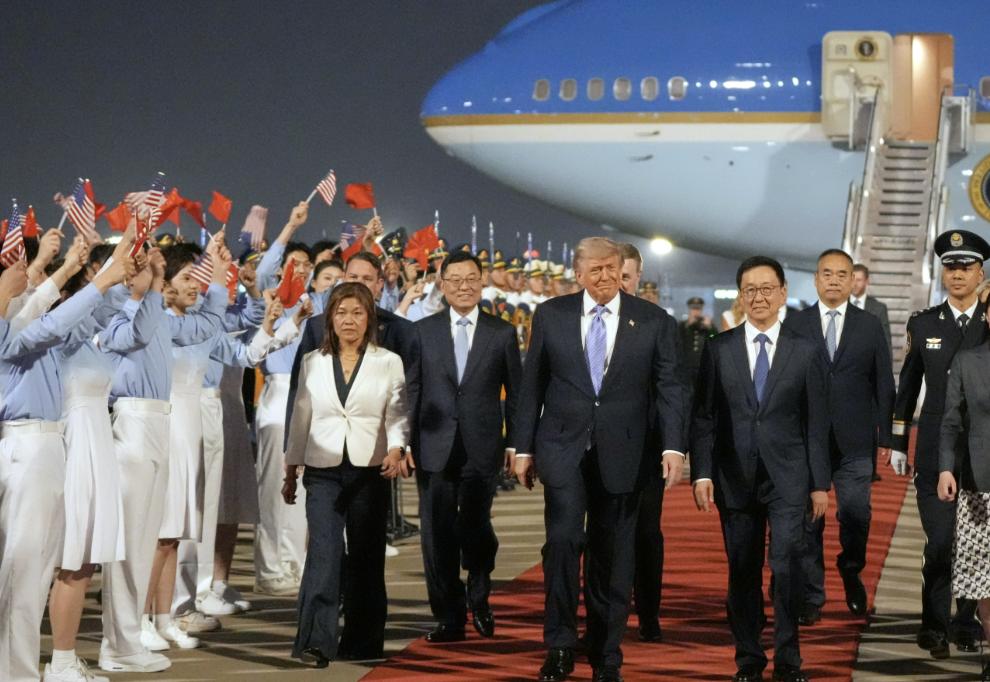
President Donald Trump broke with some of the GOP’s hardest-line immigration voices this week by defending Chinese students studying in the United States and downplaying calls for sweeping restrictions on Chinese-owned farmland.
In an interview with Fox News host Sean Hannity from Beijing, Trump argued that allowing Chinese students into American universities benefits the U.S. and warned that an outright ban would only escalate tensions with China.
“I frankly think that it’s good that people come from other countries and they learn our culture and many of them want to stay here,” Trump said, acknowledging that the position may not sit well with parts of the conservative movement.
Trump framed the issue as one of pragmatism rather than ideology, saying his approach reflects “common sense” more than rigid conservatism.
His comments immediately exposed a divide inside MAGA circles, where concerns over China have become a central issue in recent years. Republicans have increasingly argued that Chinese student visa programs create opportunities for espionage or intellectual property theft tied to the Chinese Communist Party. At the same time, many GOP lawmakers have pushed to ban or sharply restrict Chinese ownership of U.S. farmland, particularly near military installations.
Trump, however, appeared reluctant to support broad crackdowns.
“It’s not that I love it,” Trump said of Chinese ownership of farmland. “You want to see farm prices drop; you want to see farmers lose a lot of money just take that out of the market.”
The president also noted that Chinese entities have owned land in the U.S. for years and pointed out that previous administrations did little to stop it.
That position put him at odds with prominent conservatives, including former Rep. Marjorie Taylor Greene, who publicly rejected Trump’s comments.
“Imagine being an American student and receiving a rejection letter while 500,000 Chinese students get in,” Greene said, according to The New Republic. “And no – it’s not OK for China to buy our farmland.”
Trump’s remarks also sparked a rare point of overlap with some moderate Democrats. Rep. Gabe Vasquez of New Mexico, chairman of the New Democrat Coalition’s Border Security Working Group, said he supports expanding opportunities for international students to study and remain in the U.S.
“I have long supported building America’s workforce by encouraging the best and brightest across the world to come study in the U.S. and build their careers and families here,” Vasquez told Fox News Digital.
Vasquez argued that foreign graduates can help fill labor shortages in industries like healthcare, engineering, manufacturing, and artificial intelligence. Still, his office made clear there is at least one area where he aligns more closely with Republican China hawks than with Trump: Chinese ownership of farmland.
“Food security is national security,” a spokesperson for Vasquez said.
The debate also drew reaction from conservative policy experts. Lora Ries of the Heritage Foundation argued that American universities have become overly dependent on foreign students paying full tuition, especially as many schools struggle financially.
Ries questioned whether universities should continue relying on international enrollment to sustain programs that she said often fail to provide strong career outcomes for American students.
She also warned that Chinese nationals studying in the U.S. may face pressure from the Chinese government, raising broader national security concerns.
Trump’s comments reveal a growing tension within the Republican coalition. While many conservatives favor an aggressive posture toward China across trade, education, and land ownership, Trump appears to be carving out a more transactional approach that prioritizes economic interests and diplomacy over blanket restrictions.
At the same time, his stance could create an unusual opening for bipartisan conversations on parts of immigration policy, particularly around high-skilled international students and workforce development — even as sharp disagreements remain over border security and China’s influence inside the United States.