
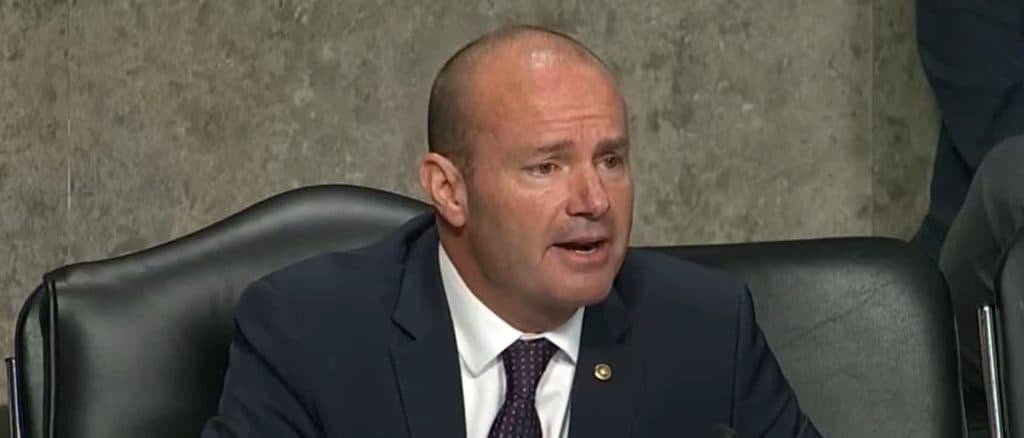
Republican Utah Sen. Mike Lee is introducing legislation seeking to remove regulations plaguing nuclear Energy developers and help the U.S. compete with adversaries in harnessing the power source.
Lee’s Nuclear Energy Innovation and Deployment Act (NEIDA) “modernizes and clarifies” the ability of the Department of Energy (DOE) over nuclear power facilities and aims to speed up the commercialization of the Energy source, according to a one-page summary of the bill shared with the Daily Caller News Foundation. The one-pager notes that the need for “flexible pathways” for nuclear Energy deployment and commercialization is becoming “increasingly urgent” due to China and Russia’s efforts to outpace the U.S. in nuclear power production, as well as anticipated skyrocketing Energydemand partly driven by the artificial intelligence (AI) boom.
Republican Pennsylvania Sen. Dave McCormick is cosponsoring the legislation introduced Tuesday.
“Electricity demand is rising at a pace we haven’t seen in generations. We can meet that demand, or we can fall behind,” Lee, the chair of the Senate Energy Committee, told the Daily Caller News Foundation in a statement. “The biggest obstacle is our inability to build.”
“To meet demand, we must accelerate the development of nuclear Energy by removing regulatory barriers, unlocking federal resources, and creating a path from demonstration to deployment,” the senator added. “Other countries are already preparing their grids for the next generation of technologies. The United States should be doing the same.”
“Pennsylvania is powering America’s future, and surging electricity demand requires reliable Energy,” McCormick said in a statement to the DCNF. “The Nuclear Energy Innovation and Deployment Act will remove regulatory barriers, accelerate next-generation nuclear deployment, and ensure the United States—not China or Russia—leads the global nuclear renaissance.”
“This means affordable baseload power for consumers, stronger Energy security for our nation, and real American Energy dominance,” the senator added.
“Despite significant technological progress, advanced nuclear developers face a persistent ‘valley of death’ between demonstration and commercial deployment — at precisely the moment when rapid deployment is most needed,” the one-pager on the bill states. “Costly and complex regulations, limited pathways for scaled deployment, high capital costs and financing risk, and fuel supply constraints have been longstanding challenges for the U.S. nuclear industry.”
NEIDA would specifically clarify and expand “the DOE’s authority over nuclear facilities and activities conducted under contract with and for the account of DOE, including privately sponsored and reactor demonstration projects,” according to the summary. It would also create a clear pathway, led by the department, to authorize commercial reactor and fuel cycle facilities on federal land or for federal purposes.”
Furthermore, the legislation would direct the Nuclear Regulatory Commission (NRC) to modify current regulations kneecapping the department’s statutory authority regarding the power source.
Representatives from multiple nuclear Energy companies applauded the bill upon its announced introduction.
“The urgency of this moment cannot be overstated,” Liz Muller, CEO of Deep Fission, Inc., told the DCNF in a statement. “Without decisive legislative action, the United States risks ceding ground to foreign state-owned enterprises that are actively exporting reactor technology and expanding their geopolitical influence worldwide.”
“Our competitors are not waiting. They are financing, building, and deploying nuclear infrastructure across the globe locking in long-term relationships and establishing Energy dependencies that will shape the international order for decades,” she emphasized. “The decisions made in this Congress will determine whether the United States leads the global nuclear renaissance or watches it from the sidelines. NEIDA offers a clear and constructive pathway forward.”
“This legislation directly addresses the regulatory ambiguity that has slowed advanced reactor development for decades, codifying DOE’s authority over non-commercial demonstration reactors and establishing the Nuclear Energy Launch Pad as a permanent pathway for companies to test and validate their technology before entering NRC commercial licensing,” Isaiah Taylor, founder and CEO of gas reactor developer Valar Atomics, said in a statement sent to the DCNF.
“Recent momentum across Congress and the Administration continues to reinforce the role of advanced nuclear in meeting growing U.S. Energy demand,” Jacob DeWitte, CEO and co-founder of advanced nuclear reactor designer Oklo, told the DCNF in a statement. “Efforts to build on recent executive actions with longer-term policy support can help create a clearer pathway to deploy new infrastructure and unlock domestic bridge fuel like surplus plutonium.”
Matt Loszak, CEO of Texas-based Aalo Atomics, said in a statement to the DCNF that the Nuclear Energy Launch Pad created by Lee’s legislation “meaningfully expands opportunities for private companies to demonstrate their technologies in partnership with the .”
Terrestrial Energy told the DCNF in a statement the bill is a “logical and much-welcome step for accelerating the expansion of nuclear power in America.”
All content created by the Daily Caller News Foundation, an independent and nonpartisan newswire service, is available without charge to any legitimate news publisher that can provide a large audience. All republished articles must include our logo, our reporter’s byline and their DCNF affiliation. For any questions about our guidelines or partnering with us, please contact [email protected].