
Watching the Orion spacecraft of the Artemis II moonshot deploy its parachutes and glide down to land in the Pacific Ocean gave me the most wonderful feeling of déjà vu. My next feeling was “It’s about time and what took so long!”
To generations inundated with science fiction movies and TV shows, what just happened may seem mundane. But the Artemis program with its goal of landing on the moon in 2028 and – finally – establishing a moon base is the type of exploration that we should have been doing all along. What is frustrating is how long it has taken to reinvigorate NASA to do what it was first put together to do.
And we can thank the Trump-Pence Administration for that. For ordering NASA in 2017 to get back into space exploration and stop wasting time on “climate change.”Obama essentially crippled the agency’s space exploration programs. The Dec. 11, 2017, directive included provisions to partner NASA with private corporations – to get the private sector back into the space business with companies like SpaceX and Blue Origin.
I was in elementary school when Neil Armstrong climbed out of the Apollo 11 lander and stepped onto the moon. I remember watching it live on the local television station (there were no cable or satellite channels), like it was yesterday. I bet that was the case for just about everyone else I grew up with. And whenever any of our manned spacecraft were splashing down in the Pacific, the televisions in our classrooms were all turned on so we could watch it just like what we just watched with Orion.
When I say I grew up with the space program, I mean that literally. I lived in Huntsville, Ala., known as Rocket City, USA – the home of the Marshall Space Flight Center, where NASA engineers and scientists were intimately involved in Apollo and the earlier Mercury and Gemini programs.
In the 1950s, Alabama Sen. John Sparkman, one of the most powerful members of the U.S. Senate, helped transform part of Redstone Arsenal, a quiet little Army base in Huntsville, into the Marshall Space Flight Center. He was the key to bringing Werner von Braun and his coterie of German scientists to Huntsville, where they helped develop our space program starting with the Redstone rocket, which launched our first satellite into orbit, Explorer 1, in 1958, and was our first medium-range ballistic missile.
The parents of everyone I knew in my neighborhood worked as a scientist or an engineer, either for NASA, the Army Missile Command at Redstone Arsenal, or one of the many private engineering contractors that established offices in Huntsville.
I met von Braun when I was 10 years old because my parents were part of the social network of scientists and engineers designing, building, and testing rockets at Marshall. My high school was named for Gus Grissom, one of the three Apollo astronauts who tragically died in 1967 during a test at Cape Canaveral.
One of our neighbors ran the big “Neutral Buoyancy Simulator” at Marshall, a water tank to get astronauts used to working in a gravity-free environment. A lot of famous astronauts used to come over to his house for dinner when they were in Huntsville for training. It was decommissioned in 1997, and a bigger one was built at the Johnson Space Center in Houston instead of Huntsville.
Where is Sen. Sparkman when you need him? Ahh, but now Huntsville hasSpace Command, thanks to President Trump (to infinity and beyond!).
We lived 15 miles from the engine test stands out on the space flight center. The windows in our house would rattle when they tested the huge rocket engines they were building at Marshall.
The fulfillment of our goal of developing a rocket program and putting a man on the moon was one of the greatest achievements of the American spirit and American know-how. It showed what our science, engineering, can-do attitude that comes from our unique culture, and the bravery and determination that was the shared trait of our test pilots and astronauts, can achieve.
But during subsequent administrations, after the shutdown of the space shuttle program, NASA became only a shadow of itself.
The explosion in private development of new rockets and space capabilities, especially since 2017, and the current administration’s latestexecutive order, issued on Dec. 18, 2025, which not only accelerates the return to the moon but also directs the government to encourage a commercial space industry, are very welcome – and long needed – developments.
It means that we are finally over the abandonment of space exploration and are returning with a reinvigorated effort to get us out into the solar system, from the moon to Mars and hopefully, eventually, beyond to places where no man has gone before.
Space really is the final frontier. It’s long past time we got back into taking giant leaps for mankind—just like the one Neil Armstrong, Buzz Aldrin, and Michael Collins took 57 years ago.
Hans von Spakovsky is a Senior Legal Fellow at Advancing American Freedom.
The views and opinions expressed in this commentary are those of the author and do not reflect the official position of the Daily Caller News Foundation.
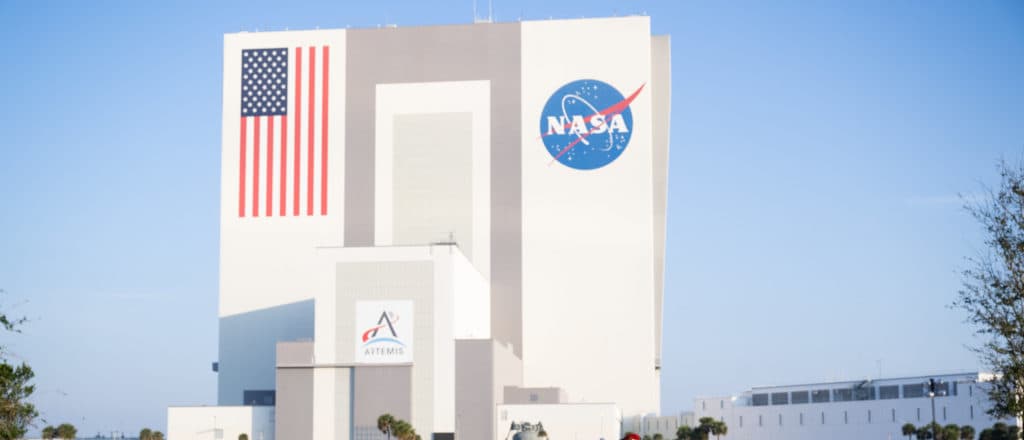
(Featured Image Media Credit: NASA HQ PHOTOS/Creative Commons/Flickr)
All content created by the Daily Caller News Foundation, an independent and nonpartisan newswire service, is available without charge to any legitimate news publisher that can provide a large audience. All republished articles must include our logo, our reporter’s byline and their DCNF affiliation. For any questions about our guidelines or partnering with us, please contact [email protected].