
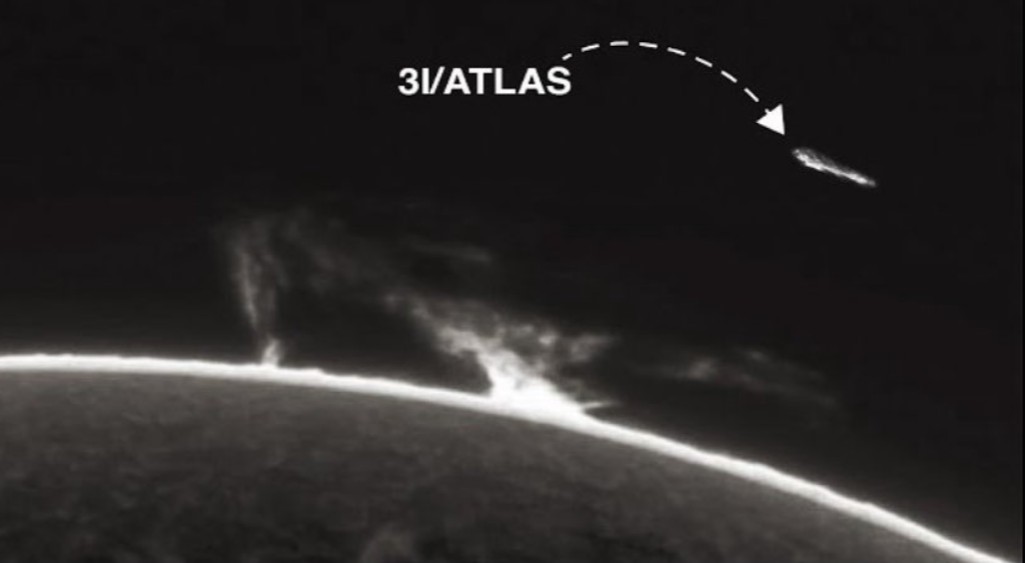
An interstellar object roughly the size of Manhattan has captured scientists’ attention — and one prominent Harvard astrophysicist believes it could be something far beyond natural.
According to the New York Post, the object, known as 3I/ATLAS, recently passed near the Sun and displayed signs of non-gravitational acceleration and appeared “bluer than the Sun,” according to data released by NASA this week. These unusual characteristics could indicate a form of outgassing typical of comets — or, as Harvard’s Avi Loeb has suggested, the signature of alien technology.
“Alternatively, the non-gravitational acceleration might be the technological signature of an internal engine,” Loeb wrote in a Medium post Friday. “This might also explain the report on 3I/ATLAS getting ‘bluer than Sun.’”
“It could potentially be explained by a hot engine or source of artificial light,” he added, while acknowledging it could also have a natural explanation consistent with comet behavior.
NASA’s findings indicate the object experienced a dramatic brightening as it neared the Sun, appearing “distinctly bluer than the Sun,” according to a paper from the U.S. Naval Research Lab. That hue was “very surprising” and differed sharply from earlier observations showing the object shifting from red to green, Loeb said.
3I/ATLAS will make its closest pass to Earth on Dec. 19, at about 167 million miles away — giving scientists their best chance yet to determine whether the visitor is a comet or something more mysterious.
“If we do not observe a massive cloud of gas around 3I/ATLAS in December,” Loeb said, it could point to evidence of a “propulsion system.”
NASA, meanwhile, sought to calm speculation. Acting Administrator Sean Duffy wrote on X that the object is simply the third interstellar comet observed passing through our solar system.
“No aliens. No threat to life here on Earth,” he assured.