




Washington’s latest budget standoff broke just before the damage could deepen, but lawmakers immediately found themselves staring down another deadline.
According to the New York Post, the House of Representatives narrowly approved a $1.2 trillion funding package Tuesday, ending a four-day partial government shutdown and sending the measure to President Donald Trump for his expected signature.
The bill passed by a razor-thin 217–214 vote, reflecting the deep divisions that still define Capitol Hill.
The compromise package had already cleared the Senate late Friday and will keep roughly 97% of federal operations funded through Sept. 30. While the deal carried Trump’s backing, it was far from a party-line vote.
Twenty-one Republicans broke ranks to oppose the measure, while an equal number of Democrats crossed the aisle to support it, delivering a rare bipartisan outcome under intense time pressure.
Even as lawmakers breathed a brief sigh of relief, attention quickly shifted to the next crisis.
Congress now has about 10 days to reach an agreement to fund the Department of Homeland Security before key agencies face a funding lapse on Feb. 13.
Senate Majority Leader John Thune (R-SD) was blunt about the odds.
“We’ve got a very short time frame in which to do this, which I argued against, but the Democrats insisted on a, you know, a two-week window, which, again, I don’t understand the rationale for that,” Thune told reporters ahead of the House vote.
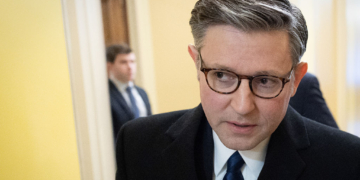
Behind the scenes, House Speaker Mike Johnson (R-La.) spent nearly an hour working over a small bloc of Republican holdouts to push the bill through a critical procedural step moments before final passage.
Much of the GOP resistance centered on the absence of the Safeguard American Voter Eligibility (SAVE) Act, which would require proof of citizenship to vote. Although the House has already passed the measure, Senate Democrats have blocked it with the 60-vote filibuster.
Some Republicans wanted the SAVE Act folded into the funding deal, even if that meant prolonging the shutdown, or at least assurances that Senate leaders would pursue another path forward.
Trump stepped in Monday, urging House Republicans to send him the funding package unchanged to keep the shutdown brief.
The lapse, which began at midnight Saturday, caused relatively limited disruption compared with last fall’s record 43-day shutdown.
Still, the road to this deal was messy. Senate Democrats pressed late demands tied to immigration enforcement following the Jan. 24 shooting of Alex Pretti in Minneapolis, setting off a chain reaction that delayed final action.
The current agreement includes five appropriations bills and a two-week spending patch to keep DHS operating while negotiations continue.
Johnson warned that further delays could have serious consequences.
“What they’ll be shutting down,” he said, “is FEMA operations, as we’re cleaning up on the winter storms and shutting down TSA, which is obviously necessary to keep the country moving through our airports, Coast Guard operations, I mean, so many important functions in the Department of Homeland Security.”
Senate Minority Leader Chuck Schumer (D-NY) has outlined demands ranging from mandatory body cameras to stricter warrant rules, setting the stage for yet another high-stakes clash.


