




The blockade of the Strait of Hormuz by the U.S. and Iran may cause further headaches for consumers due to disruptions in major commodity markets.
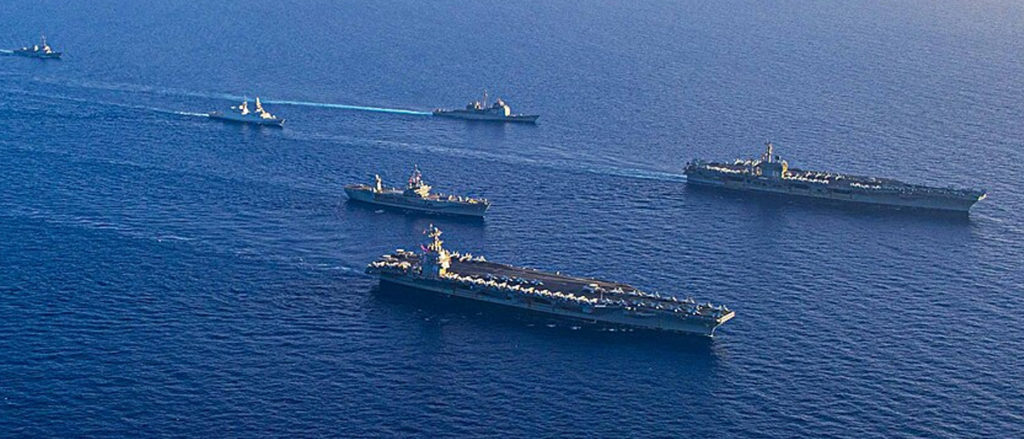
President Donald Trump announced a naval blockade of the Strait of Hormuz would begin Monday, placing further strain on an already challenged economy. Consumers will suffer under rising prices caused by the strait’s blockade, including disruptions to commodities such as fertilizer, sulfur, steel and oil, market analysts told the Daily Caller News Foundation.
“The issue of fertilizer availability, more so than cost, could well be the biggest lingering effect of the war on the global economy,” J.D. Foster, a former senior fellow on the economics of fiscal policy at The Heritage Foundation, told the DCNF.
“A shortage is certain, and so crop yields, especially in the northern hemisphere, are likely to be down this year in areas that lack their own fertilizer production,” Foster said.
E.J. Antoni, chief economist at The Heritage Foundation, told the DCNF that if the price of fertilizer rises too high, developing nations will no longer be able to continue farming, raising the price of food exponentially. Antoni explained that the famine would not touch the United States; however, Americans “will pay more for food.”
Americans would have to spend their “disposable income” on food, Antoni said. Fertilizer prices spiked similarly following Russia’s February 2022 invasion of Ukraine.
“In any event, while it is possible the blockades will continue for a while, it is more likely these are short-term moves to influence US-Iran negotiations,” Foster said. “That leaves open the question whether either blockade will be sustained for long.”
The United States is putting a stop to Iran’s efforts to extort the entire world and its people by holding the Strait of Hormuz hostage,” White House principal deputy press secretary Anna Kelly told the DCNF. “Once the threat posed by Iran’s nuclear ambitions is eliminated and the Strait is open to all traffic, the entire world will be safer and more stable. In the meantime, many ships are diverting to the big, beautiful Gulf of America, where the United States is fully stocked and ready to supply the world with energy and other resources.
David Blackmon, an energy writer and analyst, stated that the oil price increases from this conflict may be permanent. “So much damage has been done now to infrastructure and global flows of oil that it’s baked into the cake,” Blackmon told the DCNF.
“Prices are not going to go back to where they were before February 28,” Blackmon said. “You could end this thing today. Prices are not going to go back.”
Blackmon said that current gas prices do not fully reflect the increase in oil prices that have already taken place. He said that $5 a gallon is possible by the end of April.
Blackmon explained that these price increases will affect the cost of everything in the United States. “Every consumer item is transported to retail outlets on trucks or trains or ships or airplanes that use petroleum fuels,” Blackmon said. “Everything’s going to be impacted, just as it was in 2022 when Joe Biden was president.”
Sulfur, which a variety of industries in the U.S. use, could see price spikes from the blockade as well. “Sulfur is pretty endemic in a lot of a variety of manufacturing processes, so a shortage of sulfur is going to cause shortages of certain items,” Blackmon said. “It’s also used in steel making and even in the manufacture of some high-tech products, televisions and cell phones.”
Foster stated that he believed the blockade will only affect the global economy in the short term. “The good news is that at some point, probably sooner rather than later, the war will be over, oil will flow naturally, gas prices will plummet again,” Foster said.
This view was not shared by everyone the DCNF contacted for this story. “I have a different view than most people have on this … we see people saying in the administration and a lot of commentators saying that, well, as soon as this conflict ends, prices are going to go back to where they were,” Blackmon said. “So barring a recession, we are entering into a new long-term price paradigm.”
The chief economist of the Food and Agriculture Organization of the United Nations (FAO), Máximo Torero, warned during a March 26 press conference that disruptions in the strait could cause global food security risks.
“Farmers are facing a dual cost shock: they have more expensive fertilizers alongside rising fuel costs affecting the entire agricultural value chain, including irrigation and transport,” Torero said. “If the disruption persists for three months or longer, risks escalate significantly, affecting global planting decisions for 2026 and beyond.”
Blackmon said that Southeast Asia will be heavily affected by the war. “Australia is especially vulnerable right now,” Blackmon said. “They’re certainly going to have shortages and have to resort to rationing, especially Australia, which had allowed its own reserves and storage to dwindle to dangerous volumes even before this conflict began. India is in a better position, but still, they’re going to have problems. And Pakistan is somewhere in between those two.”
A leaked Goldman Sachs document stated Southeast Asia was in severe danger of oil shortages, warning that the region could run out of oil completely.
The Iran war has caused inflation to spike, with the consumer price index increasing 0.9% in March, moving the annual inflation rate to 3.3%. Most of the inflation was attributed to a 10.9% spike in energy costs as a result of the war.
A consumer sentiment index from the University of Michigan recorded its lowest reading on record, 47.6, down 10.7% from the month prior due to the Middle East conflict.
A U.S. Central Command press release stated that the blockade would only affect vessels headed to or from Iranian ports, and the U.S. “will not impede freedom of navigation for vessels transiting the Strait of Hormuz to and from non-Iranian ports.”
Meanwhile, the Iranian Regime has its own blockade that only facilitates safe passage of “non-hostile vessels and ships, through coordination with the competent Iranian authorities,” according to a press release by Iran’s state news agency IRNA.
Effectively, the combination of these two blockades means that all maritime traffic is now halted to and from the Strait of Hormuz, with no ships allowed to traverse from either side of the conflict.
“Other places around the world, like Sub-Saharan Africa or many parts of Southeast Asia, and people are simply not going to be able to afford those higher food prices, and they will literally have to do without,” Antoni told the DCNF. “And in the case of the necessity, like food, doing without means death.”
Editor’s note: This story has been updated with comment from the White House.
All content created by the Daily Caller News Foundation, an independent and nonpartisan newswire service, is available without charge to any legitimate news publisher that can provide a large audience. All republished articles must include our logo, our reporter’s byline and their DCNF affiliation. For any questions about our guidelines or partnering with us, please contact [email protected].