




Yaron Segal has, like many thousands of enterprising Israelis, identified a problem.
And like so many in a country driven by technological innovation, he’s established a startup to find a solution.
But he’s not so interested in the payday “exit” that attracts most entrepreneurs in the Startup Nation.
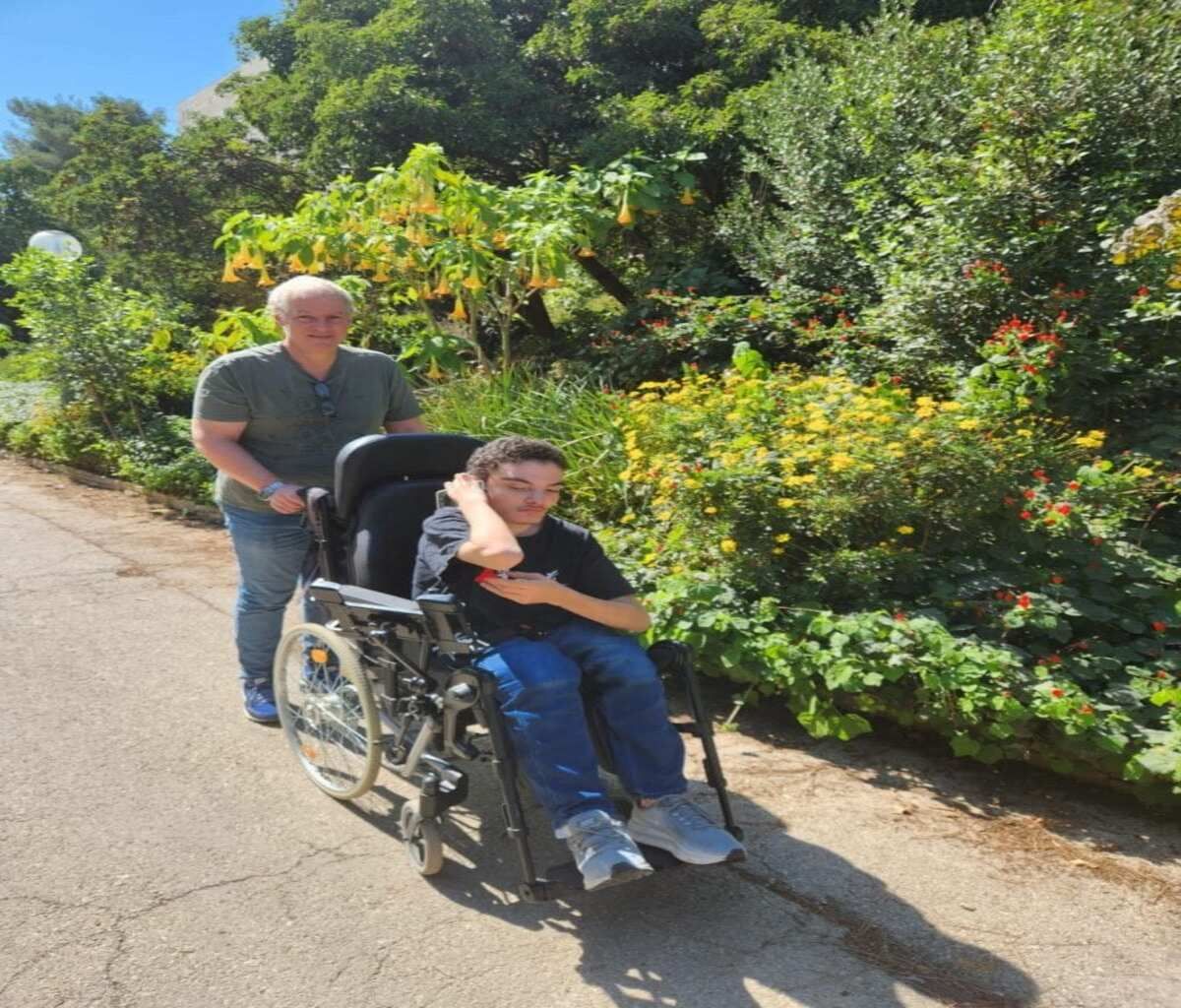
His ultimate goal is to find a treatment for his son Lear, born 23 years ago born with familial dysautonomia, a rare and progressive genetic neurological disorder.
Segal is not an obvious candidate for the job. He trained as a physicist, specializing in climate, satellites, and three-dimensional models of the atmosphere.
But when Lear was diagnosed at the age of three months, Segal decided that he would devote his energy, passion and intellect to finding an effective treatment.
He isn’t there yet, but in the long – and often frustrating – process of trying, he has made some remarkable discoveries about the brain’s ability to repair itself, and has developed a treatment that has been proven to help stroke patients live more independent lives.
Segal is confident that the same technology will, at some point in the future, also benefit people living with depression, PTSD, ADHD, spinal cord injuries, traumatic brain injuries and other brain-related conditions … and familial dysautonomia.
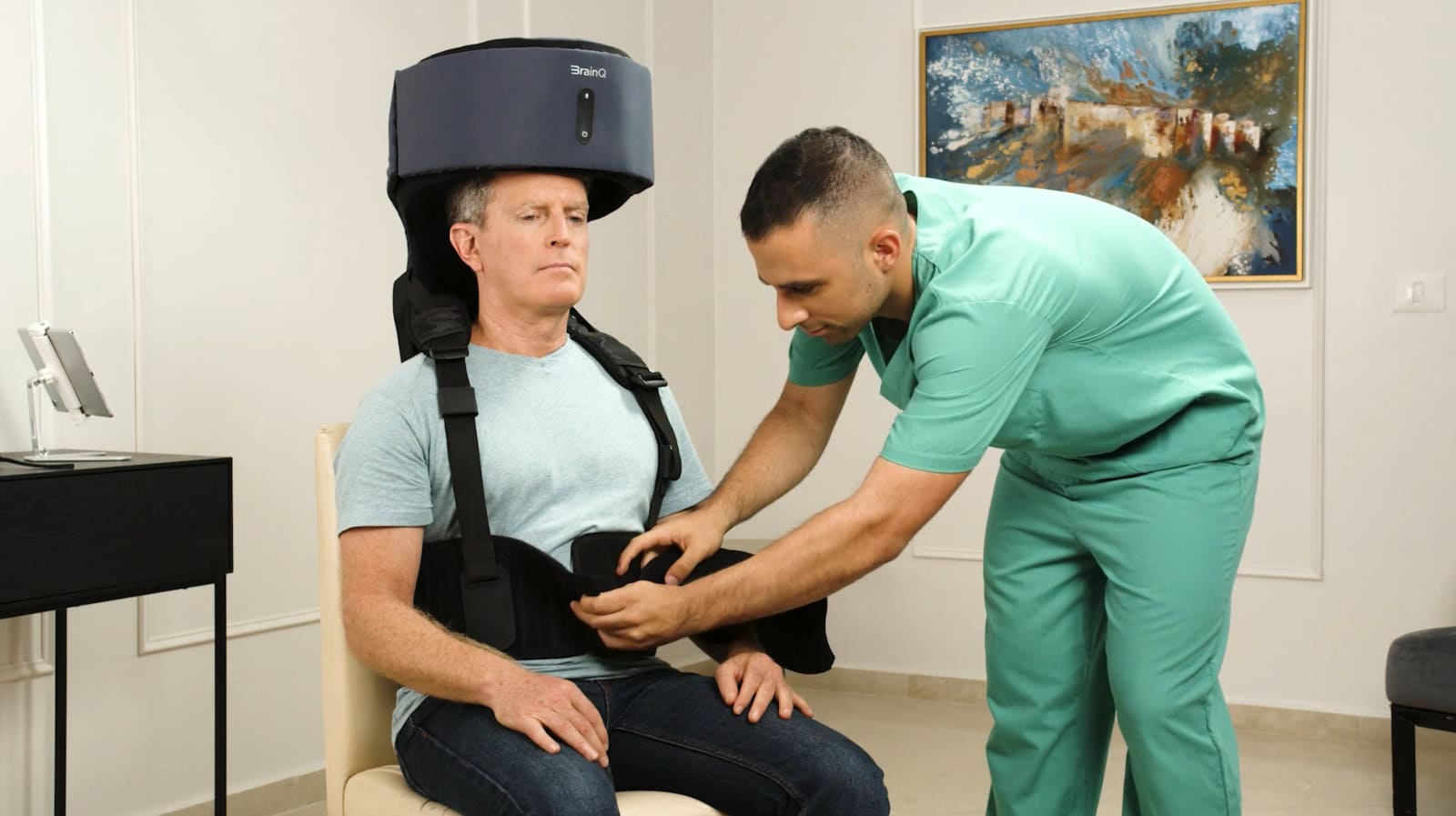
His noninvasive, cloud-based “brainwave helmet” activates a low-intensity electromagnetic field around the patient’s head. The artificial brainwaves mimic healthy neural networks to rebalance the brain over the course of the treatment period.
In clinical trials with stroke patients, the helmet has been shown to encourage the growth of new links between brain cells – links that can get broken by a trauma, or in the case of familial dysautonomia, never existed in the first place.
BrainQ, the startup Segal founded in 2016, now has 25 staff in Israel and the USA and has attracted $50 million in funding.
The company’s brainwave helmet has the European Union’s CE seal of approval and has been designated by the US Food and Drug Administration (FDA) as a breakthrough device – a regulatory pathway intended to provide patients and healthcare providers with timely access to medical devices for life-threatening or irreversibly debilitating diseases or conditions by speeding up development, assessment and review processes.
Segal was, as he puts it, “the crazy guy” who became convinced that the adult brain was capable, with encouragement, of repairing itself. Not completely, but significantly. His theory flew in the face of received medical wisdom.
“Neuroplasticity” is the brain’s ability to change and adapt throughout a person’s life and reorganize its structure, functions and connections in response to new experiences, learning or environmental changes.
But that couldn’t happen in damaged parts of the brain where there is no neural activity – until Segal’s breakthrough.
He started experimenting in 2010, funded by friends and family, and within two years he’d shown that mice and rats could, with an early form of his treatment, learn to walk and function again after suffering a brain injury or a broken spinal cord.
A potential investor showed the raw data from Segal’s experiment to an expert, who simply refused to accept it was possible. The dismissive response, Segal recalls, was: “I don’t believe it happened. You cannot revive links between cells.”
Segal was disappointed but not dismayed. The next step was to test his breakthrough on humans.
In clinical trials conducted in India, stroke patients wore the brainwave helmet for 45 minutes a day, for two months.
“We found that the people who were treated recovered much more quickly than those who weren’t,” says Segal.
“Some recovered dramatically in the first month, some in the second, some needed more time, depending on how injured the brain was.
“People regained everyday function so that they didn’t need help with eating or changing clothes or bathing.
“After two months of treatment someone who couldn’t move their legs and was in a wheelchair could walk. Sometimes with a stick, but they could walk.”
Nine out of 10 stroke patients experience long-term disability. BrainQ’s treatment reduces disability and enhances the potential to recover.
“We are not affecting the brain directly,” says Segal. “We are affecting the ability of the brain to regenerate connections between cells.
“I don’t want to push the brain to do something that it can’t do by itself. I want to harness its natural pattern of waves,” he explains.
“You can take a tow truck and drive your broken car all around the city. But I want to take it to the mechanic who will use simple tools and fix the problem.”
How did he feel when he saw how the first patients had recovered?
“I wanted to cry,” he says. He goes on to relate the story of a woman in Israel who suffered a spinal cord injury in a car crash and has regained control of her legs and bowels, thanks to BrainQ.
And there are many more examples. BrainQ, based at the Hebrew University’s Givat Ram campus in Jerusalem, is now conducting trials of the device at patients’ homes after they’ve been discharged from the hospital.
“In the beginning I was the CEO because there was nobody else in the company,” says Segal. “Then I became the chief technical officer and now I’m chief of innovation because I think this is where I’m doing the best work I can do.”
Although his son Lear’s diagnosis set him on this journey, Segal eventually honed in on treating strokes because, in neurological terms, they are less complex than familial dysautonomia (also known as Riley-Day syndrome).
Familial dysautonomia, particularly prevalent among individuals of Ashkenazi Jewish descent, affects the autonomic nervous system that controls involuntary bodily functions such as breathing, swallowing, digestion, tear production and muscle stability.
Lear doesn’t have natural tears, can’t drink liquids, has to eat condensed food, and needs to be held while attempting to walk. In addition, he had spinal fusion surgery at the age of 10.
“The most serious situation is when he is in crisis, meaning that whenever he has stress, his autonomic nervous system tries to balance his blood pressure, temperature and chemical balance, and fails. His body goes into ‘panic’ conditions, very similar to those when a normal person is bitten by a snake — he starts to vomit, his blood pressure skyrockets, his temperature increases,” Segal says.
“The only way to help him is using medication that brings his autonomic nervous system to a halt, causing it to reset and resume normal operation.”
Segal is hopeful that, in time, BrainQ will find a way to re-grow neural links in people with this condition. Meanwhile, he is gratified that the technology can aid stroke patients.
Produced in association with ISRAEL21c












