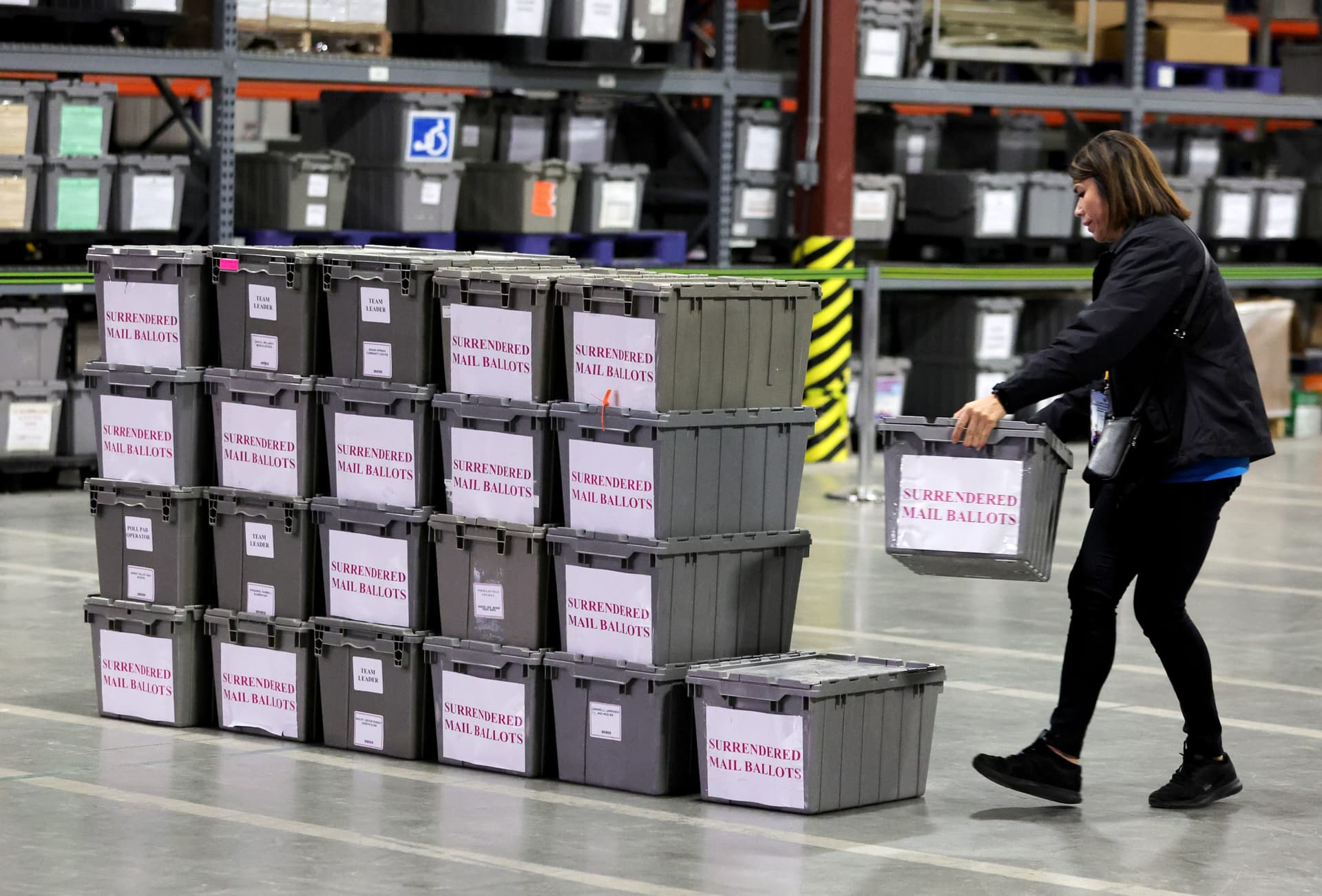
For the second congressional election in a row, a journalist has demonstrated that there is a potential hole that could be exploited in the way one Nevada county deals with mail-in ballots.
In 2020, columnist Victor Joecks of the Las Vegas Review-Journal tested Clark County, Nevada’s signature verification process for mail-in ballots, and found that eight ballots were accepted in which the handwriting on the envelope containing the ballot and the ballot itself was different.
This year, six ballots made it through, he wrote in the Las Vegas Review-Journal.
“I had 11 people send me a picture of their ballot envelope. I then wrote their name in my handwriting. Each voter then copied my version of their signature onto their ballot return envelope.
“They sent me a picture to ensure it wasn’t their normal handwriting. This simulated signing someone else’s ballot,” he wrote. “It’s also legal because each voter signed his or her own ballot.”
In a perfect system, all 11 would have been set aside, he said. Instead, only five failed to make it through.
“These sample sizes are too small to say definitively that things have gotten better. Let’s hope they have. But either way, one thing is obvious: Signature verification isn’t the fail-safe security measure election officials claim it is,” he wrote.
“That’s not surprising. Signatures aren’t a unique identifier. They morph over time. They change based on how quickly you write or what you’re writing on. Nevada’s law also makes it hard to reject a signature. The rejected signature must contain ‘multiple, significant and obvious’ differences. Two officials have to decide it’s not a match. That wiggle room allows mismatched signatures to get through,” he wrote.
Joecks said one state gets it right.
“This is fixable. To verify absentee ballots, Georgia requires a unique identifier, such as the last four digits of a driver’s license number,” he wrote.
Joecks noted that he is not endorsing any claims of faulty election security advanced by anyone else.
“What this proves is that Nevada’s mail ballots remain vulnerable to fraud. Even small-scale fraud can shift races,” he wrote.
Nevada has one close race that has been called for Democratic Sen. Catherine Cortez Masto who has been declared the winner in her contest with Republican Adam Laxalt.
According to Associated Press numbers published by The New York Times, Cortez Masto, with 48.77 percent of the vote, had a 6,568-vote margin of Laxalt, who was at 48.11 percent of the vote.
Joecks noted that the root of the issue is that mass mailing can make ballots vulnerable to fraud.
Nevada voters had until Monday to resolve problems with mail-in ballots, a process known as curing.
Joe Gloria, Clark County’s registrar of voters, said that as of Saturday there were 14,651 uncured ballots in his county, of which 7,139 remained unresolved as of Saturday, according to The Washington Post.
This article appeared originally on The Western Journal.