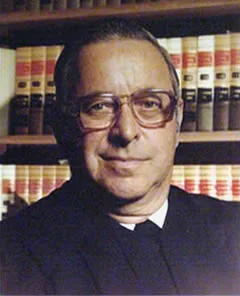
The case involved a civil rights lawsuit brought by the mother of Ronald P. Lach, Jr., who drowned in the Monongahela River after fleeing from university security officers and municipal police following a traffic stop. The plaintiff alleged violations of 42 U.S.C. § 1983 against the officers, their employers, and supervisors for failing to rescue Lach, along with related state law claims for wrongful death and survival. The court granted summary judgment to all defendants on the federal claims, holding that there is no constitutional right to police protection absent a special relationship, which was not present here as the officers did not create the danger or have knowledge of a special danger to Lach individually. The pendent state law claims were dismissed without prejudice due to the elimination of federal claims and Eleventh Amendment considerations.
In this civil rights action under 42 U.S.C. § 1983, plaintiff Harold E. Brown alleged that defendants Charles B. Johnston and his attorney conspired with the district attorney to refile forgery charges against him, knowing Brown was innocent and that the prior nolle-prossed charges barred a successful second prosecution. The defendants moved for summary judgment, contending that no violation of Brown's civil rights had occurred. The court denied the motion because genuine issues of material fact remained, including whether the refiling met the elements of malicious prosecution under Pennsylvania law (such as favorable termination consistent with innocence) or constituted abuse of process, and whether an unlawful conspiracy with state actors existed. These factual disputes precluded judgment as a matter of law under Fed. R. Civ. P. 56.
In this case, Rita Geibel sued the United States under the Federal Tort Claims Act for medical malpractice, alleging that a VA physician negligently increased her dosage of blood pressure medication, causing physical injuries and emotional harm. After a bench trial, the court entered judgment for the United States. The decision rested on findings that the plaintiff's expert witness was unqualified due to limited review of records and potential bias, that her emotional issues predated the relevant treatment, and that claimed damages for future psychiatric care were too speculative because she had declined such treatment and showed no intent to pursue it.
This case involves the owners of a contaminated scrap metal site suing manufacturers and suppliers of electrical components containing PCBs under CERCLA and state tort law to recover cleanup costs and damages from spills and dioxin pollution. The court addressed multiple motions to dismiss, granting them in part by dismissing products liability and failure-to-warn claims against manufacturers because the recycling and dismantling of junk components was not a reasonably foreseeable use of their new products. It denied dismissal of claims against suppliers and rejected the unclean hands defense at the pleading stage, as the complaint alleged the plaintiffs were innocent victims and external records raised only factual issues. The core reasoning focused on the requirement of foreseeable use for tort liability under Restatement § 402A and § 388, along with construing allegations favorably to plaintiffs on CERCLA defenses.
This case involved the Equal Employment Opportunity Commission suing the City of Mt. Lebanon over two disability benefit plans that allegedly discriminated based on age in violation of the Age Discrimination in Employment Act (ADEA). The court granted summary judgment to the city on the claim regarding the former plan (R16-73) because it was time-barred under the ADEA's two-year statute of limitations for non-willful violations. On the claim regarding the current MEIT plan, the court also granted summary judgment to the city, finding that the plan qualified as a statutorily exempt bona fide employee benefit plan with a valid business purpose that did not constitute a subterfuge to evade the ADEA or force involuntary retirement.
In this case, plaintiff LaVern Pettibon sued his former employers, Pennzoil Products Company and Pennzoil Company, alleging that his termination was due to age discrimination in violation of the federal Age Discrimination in Employment Act (ADEA), and adding a pendent state-law claim for intentional infliction of emotional distress seeking punitive damages. Defendants moved under Rule 12(b) to dismiss the emotional distress claim, arguing that it would improperly expand remedies beyond those authorized by the ADEA. The court denied the motion, holding that the ADEA does not preempt state tort claims and that considerations of judicial economy, convenience, and fairness to the parties supported exercising discretion to hear the pendent claim alongside the federal claim. The court noted that Pennsylvania law on intentional infliction of emotional distress was sufficiently developed for federal courts to apply and that the state claim arose from the same nucleus of facts as the ADEA claim.