



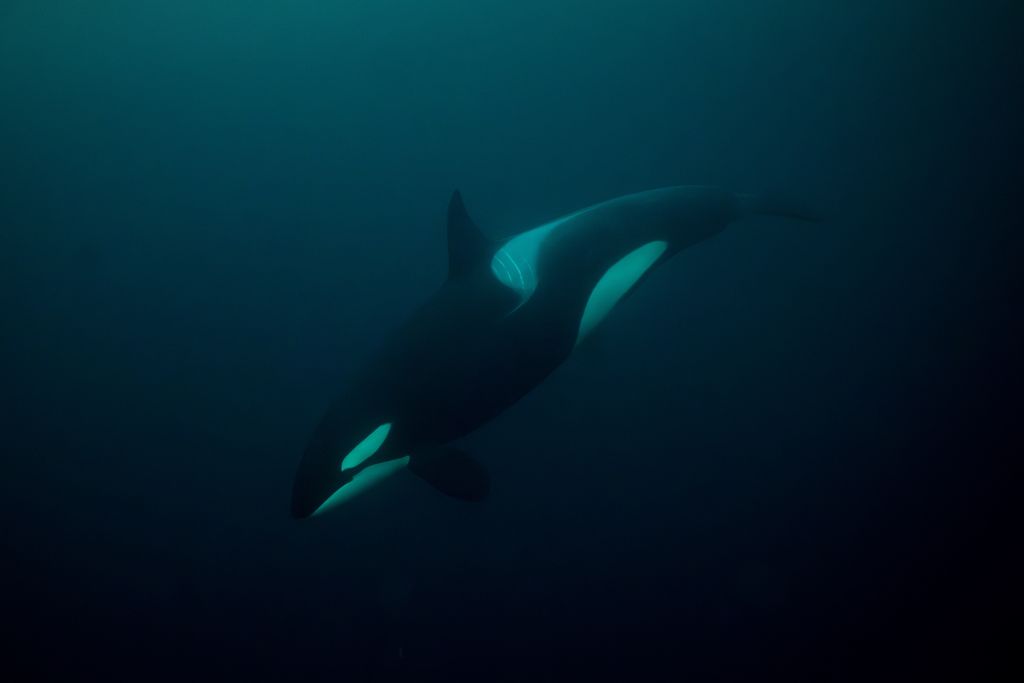
Some orcas have developed a deadly taste for liver — specifically, the livers of great white sharks.
According to NBC News, scientists in Mexico captured stunning new footage showing how killer whales in the Gulf of California hunt and disembowel young great white sharks to extract their nutrient-rich organs. The findings, based on two recorded hunts in 2020 and 2022, were published Monday in Frontiers in Marine Science.
The videos show orcas flipping sharks onto their backs to induce a state of paralysis known as “tonic immobility,” before slicing their sides open to remove the liver. In one clip, members of the pod share the pink, fatty organ as the shark’s body sinks into the deep.
“I saw in the monitor that the shark had the liver hanging out on the side, already popped off. And a few minutes later, they came up with the liver in their mouth,” said marine biologist and filmmaker Erick Higuera, who coauthored the study. “I was surprised that it could be a great white. I was not believing it.”
Higuera said the hunts appear to be the work of the same group of orcas, dubbed the “Moctezuma pod,” which has been tracked off Baja California for more than a decade. The whales are known to prey exclusively on sharks and rays.
Researchers say this hunting technique mirrors similar orca behavior observed in South Africa, where killer whales have long targeted great whites for their livers. However, the South African predators mostly attack adult sharks, while those in Mexico focus on juveniles.
“Seeing this behavior in Mexico suggests that specific orca groups have developed their own strategies for hunting sharks,” said Alison Towner, a marine biologist at Rhodes University. “The same organ is targeted, but the handling technique differs slightly … which points to group-specific learning.”
The sharks’ livers, which make up about a quarter of their body mass, are rich in fat and energy. “It provides a lot of energy,” said Francesca Pancaldi, a shark researcher and coauthor of the study.
Scientists say it’s likely that orcas have been hunting sharks this way for centuries — it’s only now that drone and video technology allow researchers to witness it firsthand.
“I think it’s been going on for centuries. It’s just that it’s not easy to observe something like this,” Pancaldi said.
Experts also warn that the behavior could alter marine ecosystems, as seen in South Africa, where great white sharks fled coastal feeding grounds after repeated orca attacks — causing ripple effects through the food chain.
“It’s possible the same thing could happen in Mexico if these hunts become more common,” Towner said.












