
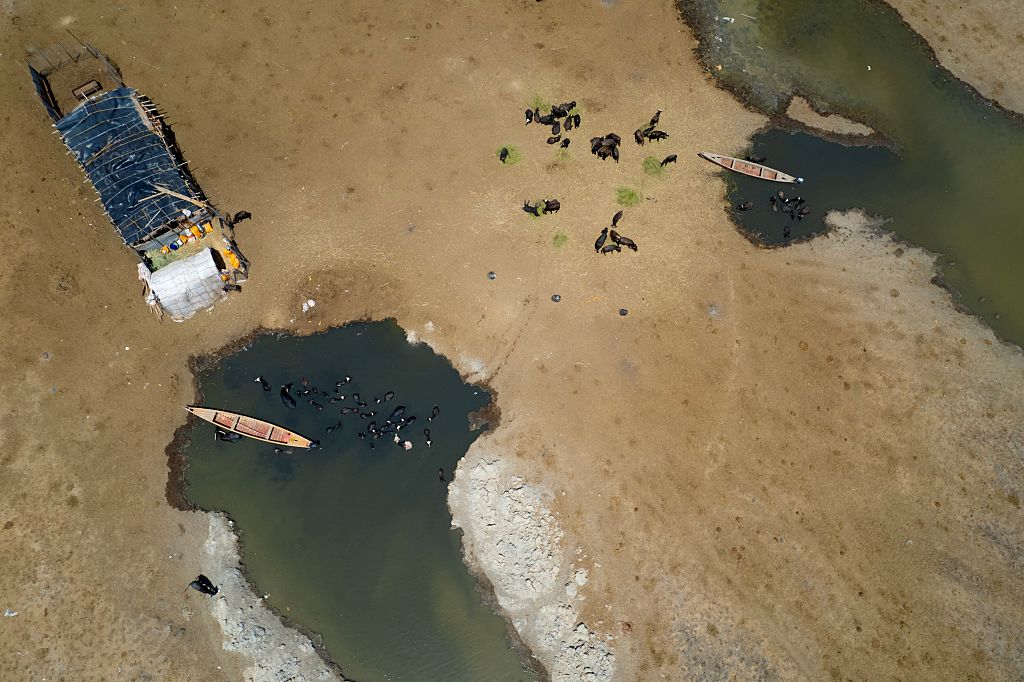
A worsening water crisis in the Middle East is reviving ancient biblical prophecies as the once-mighty Euphrates River continues to shrink at a dramatic pace.
According to the New York Post, the historic river, long considered one of the birthplaces of human civilization, has seen water levels plunge in recent years due to drought, climate pressures, and heavy groundwater use.
But for some Christians, the environmental disaster carries a far deeper meaning.
The Euphrates stretches nearly 1,800 miles from eastern Turkey through Syria and Iraq before joining the Tigris River and eventually emptying into the Persian Gulf.
The waterway helped sustain some of the world’s earliest civilizations in the Fertile Crescent, often described as the “cradle of civilization.”
Now, images of drying riverbeds and worsening conditions across the region have sparked renewed discussion online about a passage in the Book of Revelation.
Revelation 16:12 states: “The sixth angel poured out his bowl on the great river Euphrates, and its water was dried up to prepare the way for the kings from the East.”
Some believers interpret the verse as a warning that the river’s disappearance would set the stage for the Battle of Armageddon, the final conflict believed by many Christians to occur before the Second Coming of Jesus Christ.
The Euphrates is also referenced in the Old Testament. Jeremiah 50:38 reads: “A drought on her waters! They will Dry up.”
While prophecy watchers point to scripture, scientists and environmental experts say the crisis has more immediate causes.
A 2013 NASA report found that the Tigris and Euphrates river basins lost approximately 117 million acre-feet of freshwater between 2003 and 2009. Researchers blamed severe drought conditions and aggressive groundwater pumping across the region.
Officials in Iraq have reportedly warned that the Euphrates could potentially run Dry by 2040 if current trends continue.
Communities that have depended on the river for centuries are already facing mounting problems tied to the water shortage, including failing agriculture and worsening public health conditions.
“Diarrhea, chicken pox, measles, typhoid fever and cholera are currently spreading across Iraq because of the water crisis, and the government no longer provides vaccines to its citizens,” climate activist Naseer Baqar told BJM, according to The Mirror.
The drying river has also revived interest in broader biblical theories connected to the Middle East.
Last year, computer engineer Dr. Konstantin Borisov proposed a controversial theory suggesting the Garden of Eden may not have been located in Mesopotamia, as traditionally believed, but instead in Egypt near the Great Pyramid of Giza.
In a paper published in “Archaeological Discovery,” Borisov argued that the rivers mentioned in Genesis could correspond to the Nile, Tigris, Euphrates, and Indus rivers.
“By examining a map from around 500 BC, it becomes apparent that the only four rivers emerging from the encircling Oceanus are the Nile, Tigris, Euphrates and Indus,” Borisov wrote.
He also suggested the Great Pyramid could symbolically connect to the biblical “Tree of Life,” citing simulations that produced branching patterns and colored light emissions.
“At this point, all the rivers of the Bible are identified, and it seems that all we need is to follow the course of the Oceanus River around the globe to pinpoint the location of Eden,” he wrote.
Even so, Borisov acknowledged that questions remain unanswered — including the exact path of the mythical river itself.