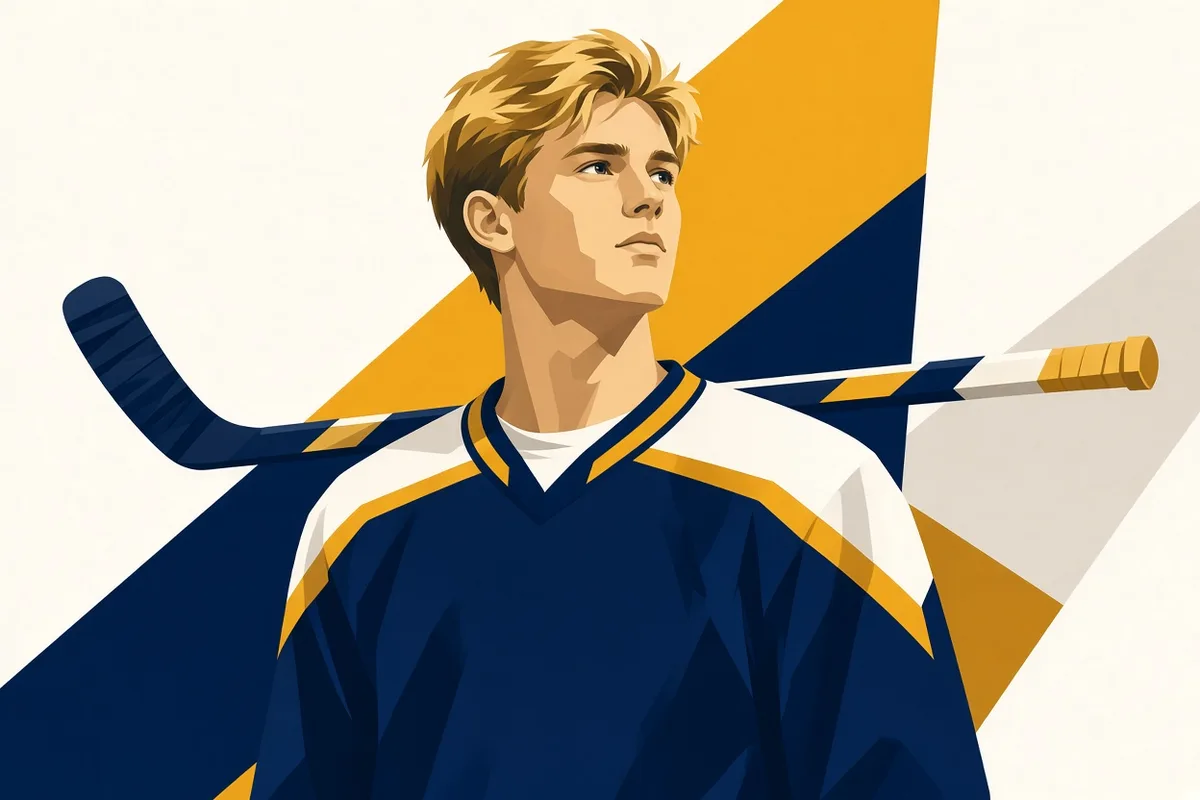
The Buffalo Sabres are a professional ice hockey team based in Buffalo, New York. The Sabres compete in the National Hockey League (NHL) as a member of the Atlantic Division in the Eastern Conference. The team was established in 1970, along with the Vancouver Canucks, when the league expanded to 14 teams. The Sabres have played their home games at KeyBank Center since 1996, having previously played at the Buffalo Memorial Auditorium since their inception. The Sabres are owned by Terry Pegula, who purchased the club in 2011 from Tom Golisano.
The team has twice advanced to the Stanley Cup Final, losing to the Philadelphia Flyers in 1975 and to the Dallas Stars in 1999. The Sabres, along with the Canucks, are the oldest active NHL franchises to have never won the Stanley Cup. The Sabres held the NHL record longest playoff drought in the NHL at 14 seasons, which occurred between the 2010–11 and 2025–26 seasons.
Contents
History
Early years and the French Connection (1970–1981)
The Sabres, along with the Vancouver Canucks, joined the NHL in the 1970–71 season. Their first owners were Seymour H. Knox III and Northrup Knox, scions of a family long prominent in Western New York and grandsons of the co-founders of the Woolworth's variety store chain; along with Robert O. Swados, a Buffalo attorney. On the team's inaugural board of directors were Robert E. Rich Jr., later the owner of the Buffalo Bisons minor league baseball team; and George W. Strawbridge Jr., an heir to the Campbell Soup Company fortune. Buffalo had a history of professional hockey; immediately prior to the Sabres' establishment, the Buffalo Bisons were a pillar of the American Hockey League (AHL), having existed since 1940 (and before that, another Bisons hockey team played from 1928 to 1936), winning the Calder Cup in their final season.
Wanting a name other than "bison" (a generic stock name used by Buffalo sports teams for decades), the Knoxes commissioned a name-the-team contest. With names like "Mugwumps", "Buzzing Bees" and "Flying Zeppelins" being entered, the winning choice, "Sabres", was chosen because Seymour Knox felt a saber was a weapon carried by a leader, and could be effective on both offense and defense. The Knoxes tried twice before to get an NHL team, first when the NHL expanded in 1967, and again when they attempted to purchase the Oakland Seals with the intent of moving them to Buffalo. Their first attempt was thwarted when Pittsburgh Steelers owner Art Rooney persuaded his horse racing friends James and Bruce Norris to select Pittsburgh over Buffalo. The second attempt was due to the NHL not wanting an expansion market to give up on a team so soon, nor isolate the Los Angeles Kings (the only NHL team other than the Seals west of St. Louis at the time) from the rest of the NHL entirely. At the time of their creation, the Sabres created their own AHL farm team, the Cincinnati Swords. Former Toronto Maple Leafs general manager and head coach Punch Imlach was hired in the same capacity with the Sabres.
The Sabres' debut in 1970 also coincided with the AFL–NFL merger in which the Buffalo Bills joined the National Football League, and the National Basketball Association's Buffalo Braves also began to play. The city of Buffalo went from having no teams in the established major professional sports leagues to three in one off-season. Between the Braves and the Sabres, the Sabres would prove to be by far the more successful of the two; Paul Snyder, the nouveau riche Braves owner, publicly feuded with the old money Knoxes and the local college basketball scene, eventually losing those feuds and being forced to sell his team in 1976. Subsequent owners of the Braves, in a series of convoluted transactions tied to the ABA–NBA merger, moved the team out of Buffalo.
Adams/Northeast Division rivalries (1981–1996)
In 1981–82, the NHL realigned its conferences and adopted an intra-divisional playoff format for the first two rounds. It was the beginning of an era in which the Sabres would finish in the middle of the Adams Division standings with regularity, and then face the near-certainty of having to get past either the Boston Bruins or Canadiens to make it to the conference finals. Aside from first-round victories over Montreal in 1983 and Boston in 1993, the era saw the Sabres lose to division rivals Boston, the Quebec Nordiques and Montreal in the Adams Division semifinals (first round) a combined eight times, and miss the playoffs altogether in 1985–86 and 1986–87—only third and fourth times out of the playoffs in franchise history. Perrault reached the 500-goal mark in the 1985–86 season and retired after playing 20 games in 1986–87, 17 years after joining the Sabres as their first draft pick.
The Sabres drafted Pierre Turgeon with the first pick in the 1987 NHL entry draft, and he quickly made an impact with the team. During his rookie season in 1987–88, he helped the Sabres reach the playoffs for the first time in three years. He was joined in 1989 by Alexander Mogilny, who with the help of Sabres officials became the first Soviet player to defect to the NHL. In the 1989–90 season, the Sabres would improve to finish with 98 points—third-best in the NHL, but the playoff futility continued with a first-round loss to Montreal. The Sabres traded Turgeon to the New York Islanders in 1991 as part of a blockbuster seven-player trade that brought Pat LaFontaine to Buffalo.
In 1992–93, goaltender Dominik Hašek joined the team in a trade from the Chicago Blackhawks. In the 1993 playoffs, the Sabres upset the Bruins in a four-game sweep in the Adams Division semifinals, their first playoff series victory in ten years. Brad May's series-winning goal in overtime of game four in Buffalo was made famous by Rick Jeanneret's "May Day!" call. However, the eventual Stanley Cup champion Montreal Canadiens swept the Sabres in the division final, with the Sabres losing all four games by a 4–3 score.
With the NHL adopting a conference playoff format for the 1993–94 season, the Sabres faced the New Jersey Devils in the Eastern Conference playoffs' first round. Despite Hašek winning a 1–0 quadruple overtime goaltending duel with the Devils' Martin Brodeur in game six, Buffalo would lose the series in seven games. Another first-round playoff loss to the Philadelphia Flyers in the lockout-shortened 1994–95 season was followed by a fifth-place finish in the Northeast Division in 1995–96, as the team missed the playoffs for the first time in nine years. It was the first season under head coach Ted Nolan and the last for the Sabres at Buffalo Memorial Auditorium. During his coaching tenure, Buffalo was referred to as the "hardest-working team in hockey". This season also featured the debut of veteran Randy Burridge, who earned a spot on the roster after he attended training camp on a try-out basis. He scored 25 goals that season and was second in team scoring to Pat LaFontaine. Burridge also earned the Tim Horton Award for being the unsung hero and was voted team most valuable player.
Final trip and ownership turnover (1996–2005)
Ted Nolan and the Sabres rebounded in 1996–97, their first at Marine Midland Arena, by winning their first division title in 16 years, with Nolan winning the Jack Adams Award as the NHL's top coach, Dominik Hašek winning both the Hart and Vezina Trophies (the first goaltender to do so since Montreal's Jacques Plante in 1962), Michael Peca taking home the Frank J. Selke Trophy as the best defensive forward in the NHL and general manager John Muckler honored as Executive of the Year. The team also acquired Miroslav Šatan in a trade with the Edmonton Oilers.
However, the regular season success was overshadowed by what had taken place during the playoffs. Tensions between Nolan and Hašek had been high for most of the season. After being scored upon in game three of the first round against the Ottawa Senators, Hašek left the game, forcing backup Steve Shields to step in. Hašek claimed he felt his knee pop, and the team doctor pronounced him day-to-day. The Buffalo News columnist Jim Kelley wrote a column that night for the next day's newspaper questioning the severity of the injury, which irked Hašek. After the Senators won game five, Hašek came out of the Sabres' training room and attacked Kelley, tearing his shirt. Despite the fact Hašek issued an apology, things went downhill after the incident. Shields started as the Sabres goaltender for the remainder of the series as the team rallied to defeat Ottawa. However, before the next series against the Philadelphia Flyers, the NHL announced Hašek had been suspended for three games, with the Sabres informing the NHL Hašek was healthy. Set to return in game four with the Sabres down by three games to none, Hašek told the Sabres' coaching staff he felt a twinge in his knee and left the ice after the pre-game skate. Although the Sabres staved off elimination in game four, they lost in game five.
Team president Larry Quinn fired general manager John Muckler, who had a noted feud with Nolan. Hašek, who supported Muckler, openly told reporters at the NHL Awards Ceremony he did not respect Nolan. The new general manager, Darcy Regier, offered Nolan just a one-year contract, but Nolan refused. Regier then pulled the contract off the table and did not offer another one, ending Nolan's tenure as Sabres coach. Former Sabres captain Lindy Ruff was hired as head coach on July 21, 1997, agreeing to a three-year contract.
During the 1997–98 season, the Sabres, which had lost $32 million over the previous three seasons and nearly missed payroll in December 1997, were sold by Northrop Knox to John Rigas, owner of Adelphia Communications. Shortly thereafter, Quinn was dismissed and replaced by John's son, Timothy Rigas. The Sabres reached the conference finals that season, but lost to the Washington Capitals in six games.
Post-lockout success (2005–2010)
In 2005, the Sabres lost their main cable television broadcaster, as the Empire Sports Network, which had been on the air since 1991, ceased operations during the Adelphia scandal and reorganization. Like the Sabres, Empire had been owned by Adelphia prior to the NHL's seizure of the franchise. Adelphia sold their rights to Sabres telecasts and for the 2005–06 campaign Madison Square Garden Network (MSG), a New York City-based channel which broadcasts New York Rangers, New York Islanders and New Jersey Devils games, took over the rights to broadcast Sabres games to television viewers in western New York, with the Sabres controlling all aspects of the broadcast. The agreement was later extended through 2017, then again through 2027.
In the 2005–06 season, the Sabres finished with their best record in over 20 years and clinching their first playoff berth since the 2000–01 season. The team finished the regular season with 52 wins, surpassing the 50-win mark for the first time in franchise history. They also finished with 110 points, their first 100-point season in 23 years and tied the 1979–80 club for the second-best point total in franchise history. The Sabres tied the Ottawa Senators and Carolina Hurricanes for the most wins in the Eastern Conference. They finished with the fifth-best record in the NHL, behind Detroit, Ottawa, Dallas and Carolina.
Buffalo defeated the Philadelphia Flyers in the first round of the 2006 playoffs in six games, then the top-seeded Ottawa in five games in the second round. The Sabres advanced to play Carolina in their first conference finals since 1999. However, injuries began to mount. They were forced to play without four of their top defensemen, Teppo Numminen, Dmitri Kalinin, Jay McKee, and Henrik Tallinder, and their top powerplay scorer, Tim Connolly, for much of the series. Despite this, the Sabres forced the series to seven games before falling to the eventual Stanley Cup champions Carolina. The Sabres' impressive season was recognized on June 22, 2006, at the NHL Awards Ceremony when Lindy Ruff edged Hurricanes coach Peter Laviolette to win the Jack Adams Award as coach of the year in the closest vote in the award's history. Ruff was the second Sabres coach to win the award.
The Sabres started the 2006–07 season 10–0, setting a new franchise record for consecutive wins to start a season, and becoming just the second team in NHL history, after the 1993–94 Toronto Maple Leafs, to open a season with a ten-game winning streak. They also set a new NHL record for consecutive road wins to start a season (eight), which was extended to ten games (tying the team record for consecutive road wins) after a 7–4 win over the Carolina Hurricanes on November 13, 2006. This record would be beaten by the 2023–24 Los Angeles Kings. The team reached the 50-win plateau for the second time in franchise history. The Sabres won the Presidents' Trophy for the first time in franchise history, giving them the home-ice advantage for their entire run in the 2007 playoffs. They also tied the 1974–75 team's franchise record for points in a season. The team defeated the New York Islanders and the New York Rangers to reach their second consecutive conference finals. However, on May 19, they were eliminated by the Ottawa Senators after five games.
The Pegula era (2010–present)
On November 30, 2010, Ken Campbell of The Hockey News reported a story that billionaire Terry Pegula had signed a letter of intent to purchase the Sabres for US$150 million. Pegula was the founder, president and CEO of East Resources, one of the largest privately held companies in the United States before he sold the company. After the report was released, Sabres managing partner Larry Quinn claimed it was "untrue" but refused further comment. The $150 million was later determined to be an undervalued amount, as Forbes magazine had valued the team at just under $170 million in 2010. In December, Pegula officially expressed interest in buying the Sabres for $170 million and submitted a letter of intent to the NHL. In January, Golisano reportedly issued a counteroffer with an asking price of US$175 million. Pegula and Golisano reached an agreement to sell the team on January 29, 2011, with Pegula purchasing the team for $189 million ($175 million with $14 million in debt included) with the Sabres and Golisano officially making an announcement in a press conference on February 3, 2011. NHL owners approved the sale on February 18.
In the conference, it was stated that an unnamed bidder submitted a much higher bid than Pegula's, but made the bid contingent upon moving the team. The description is consistent with that of Jim Balsillie, who has made public his efforts to move a team to Hamilton, Ontario, a move the Sabres have actively opposed. Terry Pegula named former Pittsburgh Penguins executive Ted Black to be team president. Pegula was introduced as the Sabres' owner in a public ceremony at HSBC Arena on February 23, accompanied by what would be the final appearance of all three members of The French Connection before Rick Martin's death three weeks later. Around the 2010–11 trade deadline, the team attempted to trade Craig Rivet, but was unsuccessful. After initially clearing waivers, Rivet entered re-entry waivers and was claimed by the Columbus Blue Jackets. Late on February 27, the team acquired Brad Boyes from the St. Louis Blues in exchange for a second-round draft pick. This was the Sabres' sole trade of the deadline. After Pegula's official takeover of the team, the Sabres finished the regular season 16–4–4, never losing two consecutive games in that span, and landed the seventh seed in the Eastern Conference. Pegula's approach was credited by players, fans and the public with bringing new energy to the team, sparking a run to the playoffs that seemed improbable only months earlier. On April 8, the Sabres clinched a playoff berth for the second consecutive season, defeating the Philadelphia Flyers 4–3 in overtime. The Sabres clinched the seventh seed and faced Philadelphia in the first round. The Sabres had a three games to two lead but lost the series in seven games.
Team information
Logo and uniforms
The Sabres have had, for the most part, used a primary logo featuring a bison atop two crossed sabers in a blue circle with gold trim. This logo was first used from 1970 to 1996 and was restored in 2020 after the Sabres 50th anniversary season was complete.
Throughout their 26-year tenure at the Buffalo Auditorium, the Sabres have worn white uniforms with a blue and gold shoulder yoke and alternating gold, white and blue stripes. On the road they wore blue uniforms with gold stripes. In 1978 the primary logo was added on the shoulders.
Upon moving to what is now KeyBank Center (formerly Marine Midland and HSBC Arena, later First Niagara Center) in 1996, the Sabres changed their logo and colors. Red, black and silver replaced blue and gold while the primary "bison head" logo was unveiled as the primary logo. Black road (later home) and white home (later road) uniforms were also released featuring a bull's head silhouette design in front and the "Sabre B" alternate logo on the shoulders.
The first third jersey of the Buffalo Sabres was created in 2000. The primary color was Sabre red, with black and silver stripes on the sleeves. It also featured the word "Buffalo" written on a black stripe outlined by silver near the waist. The logo was a black circle with two sabers crossing each other (a nod to the original logo).
On October 7, 2001, the Sabres wore a modified version of their white jerseys in a road game against the New York Rangers. The uniform replaced the "bison head" with the "NEW YORK" diagonal wordmark as a tribute to the state of New York in the wake of the September 11 attacks.
On September 16, 2006, the Sabres unveiled new home and away jerseys featuring midnight blue, maize (gold), silver and white colors. Front chest numbers were also added. The new logo, a stylized bison, was widely reviled, drawing unfavorable comparisons to a banana slug (hence the nickname "Buffaslug"). Despite the criticism, five of the top ten player jerseys sold in the first two months of the 2006–07 season were Sabres "slug" designs. Nevertheless, the Sabres brought back the classic blue jerseys as a third jersey, but continued to pair the look with the navy helmet and pants. When the Reebok Edge template was unveiled in 2007, the Sabres kept their "Buffaslug" uniforms, but the following season, they released a new third jersey featuring the classic look depicted in the navy, gold, silver and white colors. The Sabres also wore the original white uniforms during the 2008 Winter Classic.
Broadcasters
Current
Past
National anthems
The Canadian and U.S. national anthems are sung before every Sabres home game, regardless if the visiting team is Canadian or American, because Buffalo is adjacent to the Canadian border and many spectators come from Canada. Saint Catharines, in particular, is noted for its residents' Sabres fandom, and the city is included in the team's regional territory. Doug Allen sang the Canadian and US national anthems at most home games (except in cases where there is a conflict with his charitable work for the Wesleyan Church) until resigning in 2021 because of his refusal to take a COVID-19 vaccine. Curtis Cook is the arena's in-game organist. During Tom Golisano's ownership, the team occasionally used the services of singer Ronan Tynan who sang "God Bless America" while Allen performed the Canadian anthem (in such cases, the U.S. anthem was not performed). As of 2024, the anthems have been performed by Cami Clune, former semi-finalist on The Voice.
In-game hosting
Rich Gaenzler, morning host at WGRF, took over as in-game host beginning in 2018 before he was fired in 2021 over an unrelated dispute pertaining to his WGRF show, which was canceled at the same time. WBFO personality Jay Moran is the current public address announcer; he succeeded Milt Ellis in the position.
In November 2021, the Sabres added an official team dog, named Rick, a Newfoundland puppy trained as a service animal. Rick was graduated to daily service and succeeded by Nikki, a Golden Retriever puppy.
Minor league affiliates
The Sabres are presently affiliated with two minor league teams, the Rochester Americans of the American Hockey League, and the Jacksonville Icemen of the ECHL. The Americans play at the Blue Cross Arena in Rochester, New York. Founded in 1956, the Americans were previously the Sabres AHL affiliate from the 1979–80 season to the 2007–08 season. During the original Sabres affiliation, the Americans won three Calder Cup championships and finished as runners-up another six times. They finished out of the playoffs only five times in 28 years. The Sabres became re-affiliated with the Americans starting with the 2011–12 season when after buying the Sabres, Pegula purchased the Americans from former owner Curt Styres.
The Jacksonville Icemen are based in Jacksonville, Florida and have been the Sabres ECHL affiliate since the 2023–24 season. Unlike the Americans, the Icemen are not owned by Pegula but are instead owned by SZH Hockey LLC.
Season-by-season record
This is a partial list of the last five seasons completed by the Sabres. For the full season-by-season history, see List of Buffalo Sabres seasons
Note: GP = Games played, W = Wins, L = Losses, OTL = Overtime Losses/SOL = Shootout Losses, Pts = Points, GF = Goals for, GA = Goals against
Players and personnel
Current roster
Updated July 14, 2026
Team captains
Reference:
Front office
Jarmo Kekäläinen, who previously served as general manager of the Columbus Blue Jackets from 2013 to 2024, was named general manager on December 15, 2025. He had previously been hired by the team in May 2025 as a senior advisor.
Head coaches
The Sabres named Lindy Ruff head coach on April 22, 2024. He returned for a second tenure with the team, after previously coaching Buffalo from 1997 to 2013.
Of the 20 head coaches the Sabres have used in their history, seven of them had previously played for the Sabres during their playing career: Floyd Smith, Bill Inglis, Jim Schoenfeld, Craig Ramsay, Rick Dudley, Ruff, and Phil Housley. Two others, Dan Bylsma and Ted Nolan, had played in the Sabres' farm system.
Team and league honors
Hockey Hall of Famers
The Buffalo Sabres has an affiliation with a number of inductees to the Hockey Hall of Fame. Sabres inductees include 14 former players and four builders of the sport. The four individuals recognized as builders by the Hall of Fame includes former general managers, head coaches, and owners. In addition to players and builders, three broadcasters for the Buffalo Sabres were also awarded the Foster Hewitt Memorial Award from the Hockey Hall of Fame, Ted Darling in 1994, Rick Jeanneret in 2012, and Harry Neale in 2013.
Four sports writers from publications based in Buffalo, and St. Catharines, Ontario (which is within Buffalo's media territory), were also awarded the Elmer Ferguson Memorial Award from the Hockey Hall of Fame. Recipients of the award include Charlie Barton (Buffalo Courier-Express) in 1985, Dick Johnston (Buffalo News) in 1986, Jack Gatecliff (St. Catharines Standard) in 1995, and Jim Kelley (Buffalo News) in 2004.
Players
Builders
Scotty Bowman
Punch Imlach
Seymour H. Knox III
Roger Neilson
Retired numbers
1 When the No. 14 of Robert and the No. 7 of Martin were retired, Gilbert Perreault was present, as the entire "French Connection" line was given retirement together. Perreault's No. 11 was lowered and then raised back in the center under the French Connection banner, as shown above.
SHK III and NRK (team founders Seymour H. Knox III and Northrup R. Knox. Two banners bearing their initials and the Sabres blue and gold reside in the KeyBank Center's rafters.)
RJ (longtime play-by-play announcer Rick Jeanneret. A banner bearing his initials was raised on April 1, 2022.)
Although Alexander Mogilny's number 89 is not officially retired by the team, it has only been issued once since his departure following the 1994–95 season, to Alex Tuch in 2021. Cory Conacher switched to 88 expressly out of deference to Mogilny in 2014. Likewise, Ryan Miller, who traditionally wore 39, wore 30 during his time with the Sabres out of deference to Hašek, long before 39 was announced to be retired. Miller's number 30 would also eventually be retired on January 19, 2023.
The NHL retired Wayne Gretzky's No. 99 for all its member teams at the 2000 NHL All-Star Game.
Buffalo Sabres Hall of Fame
Reference:
Franchise leaders
These are the top-ten-point-scorers in franchise regular season history. Figures are updated after each completed NHL regular season.
* – current Sabres player
Note: Pos = Position; GP = Games played; G = Goals; A = Assists; Pts = Points; P/G = Points per game
These goaltenders rank in the top ten in franchise history for wins. Figures are updated after each completed NHL season.
* – current Sabres player
Note: GP = Games played; W = Wins; L = Losses; T/O = Ties/Overtime losses; GA = Goal against; GAA = Goals against average; SA = Shots against; SV% = Save percentage; SO = Shutouts