The Detroit Tigers are an American professional baseball team based in Detroit. The Tigers compete in Major League Baseball (MLB) as a member club of the American League (AL) Central Division. One of the AL's eight charter franchises, the club was founded in Detroit as a member of the minor league Western League in 1894 and is the only Western League team still in its original city. They are also the oldest American League team still playing in their original city under their original name.
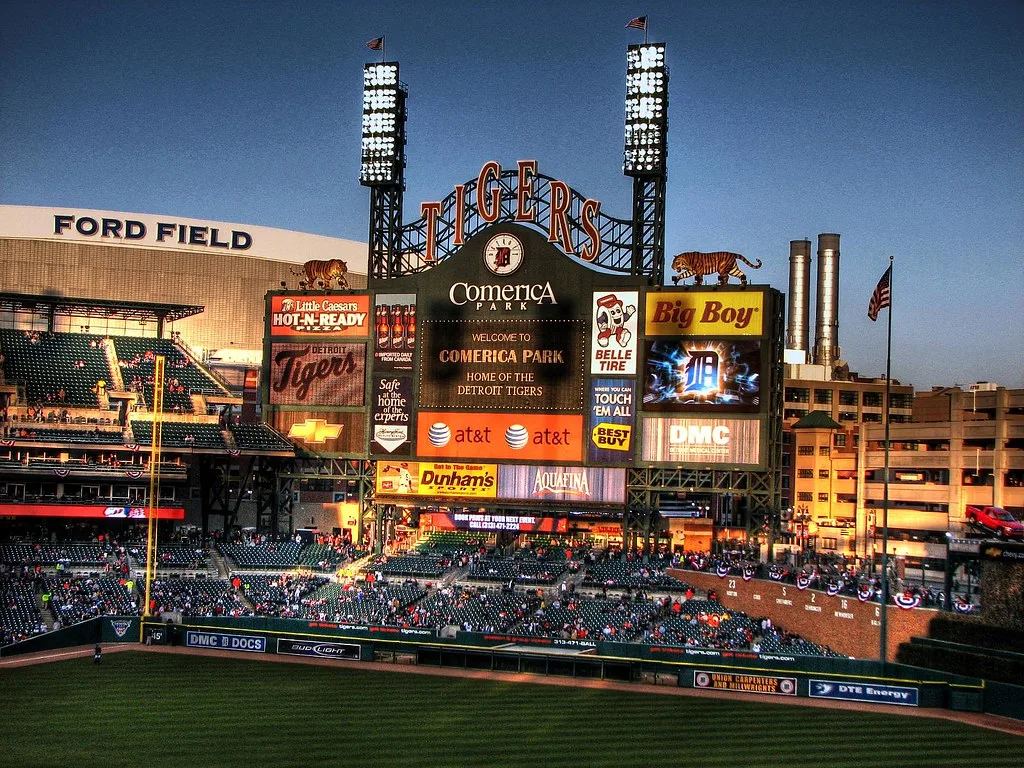
Since their establishment as a major league franchise in 1901, the Tigers have won four World Series championships (1935, 1945, 1968, and 1984), 11 AL pennants (1907, 1908, 1909, 1934, 1935, 1940, 1945, 1968, 1984, 2006, 2012), and four AL Central division championships (2011, 2012, 2013 and 2014). They also won division titles in 1972, 1984, and 1987 as a member of the AL East. Since 2000, the Tigers have played their home games at Comerica Park in Downtown Detroit.
The Tigers constructed Bennett Park at the corner of Michigan Avenue and Trumbull Avenue in Corktown just west of Downtown Detroit and began playing there in 1896. In 1912, the team moved into Navin Field, which was built on the same location. It was expanded in 1938 and renamed Briggs Stadium. It was renamed Tiger Stadium in 1961 and the Tigers played there until 1999.
From 1901 to 2025, the Tigers' overall win–loss record is 9,763–9,642–93 (.503). The franchise's best winning percentage was .656 in 1934, while its worst was .265 in 2003. The franchise record for most wins in a season is 104 in 1984, when the club won 35 of its first 40 games en route to the World Series championship.
Contents
History
Western League beginnings (1894–1900)
The franchise was founded as a member of the reorganized Western League in 1894. They originally played at Boulevard Park, sometimes called League Park. It was located on East Lafayette, then called Champlain Street, between Helen and East Grand Boulevard, near Belle Isle. In 1895, owner George Vanderbeck decided to build Bennett Park at the corner of Michigan and Trumbull Avenues, which would remain the team's base of operations for the next 104 seasons. The first game at The Corner was an exhibition on April 13, 1896. The team, now occasionally called the "Tigers," beat a local semi-pro team, known as the Athletics, by a score of 30–3. The Tigers played their first Western League game at Bennett Park on April 28, 1896, defeating the Columbus Senators 17–2.
At the end of the 1897 season, Rube Waddell was loaned to the team to gain professional experience. After being fined, Waddell left Detroit to pitch in Canada.
When the Western League renamed itself the American League for 1900, it was still a minor league, but the next year, it broke from the National Agreement and declared itself a major league, openly competing with the National League for players and for fans in four contested cities. For a while, there were rumors of the team relocating to Pittsburgh. However, these rumors were put to rest when the two leagues made peace in 1903 when they signed a new National Agreement.
First Major League season (1901)
The Tigers were established as a charter member of the now major league American League in 1901. They played their first game as a major league team at home against the Milwaukee Brewers on April 25, 1901, with an estimated 10,000 fans at Bennett Park. After entering the ninth inning behind 13–4, the team staged a dramatic comeback to win 14–13. The team finished third in the eight-team league.
That initial season they were the first major league team to have a mascot—a red tiger on a dark background—on their ballcap. It was replaced by the letter "D" in 1903, and their iconic Olde English-style letterform appeared the following year.
The Cobb era (1905–1926)
In 1905, the team acquired 18-year-old Ty Cobb, a fearless player who came to be regarded as one of the greatest players of all time. The addition of Cobb to an already talented team that included Sam Crawford, Hughie Jennings, Bill Donovan and George Mullin quickly yielded results.
Behind the hitting of outfielders Ty Cobb (.350) and Sam Crawford (.323), and the pitching of Bill Donovan and Ed Killian (25 wins each), the Tigers went 92–58 to win the AL pennant in 1907 by 1.5 games over the Philadelphia Athletics. They moved on to their first World Series appearance against the Chicago Cubs.
Game 1 ended in a rare 3–3 tie, called due to darkness after 12 innings. The Tigers scored only three runs in the succeeding four games, never scoring more than one run in a game, and lost the Series, 4–0.
The Tigers won the AL by just a half-game over the 90–64 Cleveland Naps with a 90–63 record. Cobb hit .324, while Sam Crawford hit .311 with 7 home runs, which was enough to lead the league in the "dead ball" era.
The Cubs, however, defeated the Tigers again in the 1908 World Series, this time in five games. This would be the Cubs' last World Championship until 2016.
In 1909, Detroit posted a 98–54 season, winning the AL pennant by 3.5 games over the Athletics. Ty Cobb won the batting triple crown in 1909, hitting .377 with 9 home runs (all inside-the-park) and 107 RBIs. He also led the league with 76 stolen bases. George Mullin was the pitching hero, going 29–8 with a 2.22 ERA, while fellow pitcher Ed Willett went 21–10. Mullin's 11–0 start in 1909 was a Tigers record for 104 years, finally being broken by Max Scherzer's 13–0 start in 2013.
It was hoped that a new opponent in the 1909 Series, the Pittsburgh Pirates, would yield different results. The Tigers performed better in the Fall Classic, taking Pittsburgh to seven games, but they were blown out 8–0 in the decisive game at Bennett Park.
The Tigers dropped to third place in the American League in 1910 with an 86–68 record. They posted 89 wins in 1911 to finish second, but were still well behind a powerhouse Philadelphia Athletics team that won 101 games. The team sunk to a dismal sixth place in both the 1912 and 1913 seasons. A bright spot in 1912 was George Mullin pitching the franchise's first no-hitter in a 7–0 win over the St. Louis Browns on July 4, his 32nd birthday.
The Tigers break through (1927–1940)
Though the Tigers struggled with mediocre records in the seven years following Cobb's departure, they were building a solid foundation, adding slugging first baseman Hank Greenberg and pitchers Tommy Bridges and Schoolboy Rowe to a lineup that already included second baseman Charlie Gehringer.
In 1927, Harry Heilmann flirted with a .400 batting average all year, eventually finishing at .398 and winning his fourth AL batting title.
Following the 1933 season, the Tigers added perhaps the final piece of the puzzle, acquiring catcher Mickey Cochrane from the Philadelphia Athletics to serve as player-manager.
The Tigers won the 1934 AL pennant with a 101–53 record, at the time a team record for wins, and still the best win percentage (.656) in team history. The Tigers infield (Hank Greenberg and Charlie Gehringer, along with shortstop Billy Rogell and third baseman Marv Owen) accumulated 462 runs during the season, with Gehringer (214 hits, .356 average) leading the way. Schoolboy Rowe led a strong pitching staff, winning 16 straight decisions at one point of the season and finishing with a 24–8 record.
The Tigers would fall in the 1934 World Series in seven games to the "Gashouse Gang" St. Louis Cardinals. After winning a tight battle in Game 5 with a 3–1 decision over Dizzy Dean, Detroit took a 3–2 series lead, but would lose the next two games at Navin Field (Tiger Stadium). For the second time in a World Series Game 7, Detroit folded. St. Louis scored seven times in the third inning off starter Elden Auker and a pair of relievers, while Dean baffled the Tiger hitters en route to an 11–0 victory. The final game was marred by an ugly incident. After spiking Tigers third baseman Marv Owen in the sixth inning, Cardinals left fielder Joe Medwick had to be removed from the game for his own safety by Commissioner Kenesaw Mountain Landis after being pelted with debris from angry fans in the large temporary bleacher section in left field.
The Tigers 1935 lineup featured four future Hall of Famers (Hank Greenberg, Mickey Cochrane, Goose Goslin and Charlie Gehringer). Although they did not challenge the 1934 team's 101 wins, their 93–58 record was good enough to give them the AL pennant by three games over the New York Yankees. Greenberg was named AL MVP after hitting .328 and leading the league in home runs (36), extra-base hits (98) and RBIs (168). Incredibly, Greenberg's RBI total was 48 higher than the next closest player (Lou Gehrig, with 120). The Tigers also got strong contributions from Gehringer (.330), Cochrane (.319) and starting pitchers Tommy Bridges (21–10) and Elden Auker (18–7).
The war years (1941–1945)
With Hank Greenberg serving in World War II for all or parts of the 1941–1944 seasons, the Tigers struggled to recapture the glory of 1940. They finished no higher than fifth place in 1941–1943, but did manage a second-place finish in 1944, largely on the strength of pitchers Hal Newhouser and Dizzy Trout, who won 29 and 27 games, respectively. Newhouser, who was 29–9 with a 2.22 ERA, won the first of his two consecutive AL MVP awards this season. The Tigers were in first place as late as September 18, but would finish one game behind the St. Louis Browns for the AL pennant.
With the end of World War II and the timely return of Hank Greenberg and others from the military, the Tigers won the AL pennant by just 1.5 games over the Washington Senators with an 88–65 record. Virgil Trucks returned from the U.S. Navy in time to pitch 5+1⁄3 innings of 1-run ball in the pennant-clinching game, with starter Hal Newhouser pitching the final 3+2⁄3 innings in relief. Greenberg provided the hitting heroics, slugging a go-ahead grand slam homer in the top of the ninth inning. Newhouser won the pitching triple crown, leading the AL in wins (25), ERA (1.81) and strikeouts (212). He became the first pitcher in the history of the AL, and still the only pitcher as of 2025, to win the MVP Award in two consecutive seasons.
With Newhouser, Trucks and Dizzy Trout on the mound and Greenberg leading the offense, Detroit responded in a World Series Game 7 for the first time, staking Newhouser to a 5–0 lead before he threw a pitch en route to a 9–3 victory over the Cubs. Because many stars had not yet returned from the military, some baseball scholars have deemed the 1945 World Series to be among the worst-played contests in World Series history. For example, prior to the World Series, Chicago sportswriter Warren Brown was asked who he liked, and he answered, "I don't think either one of them can win."
A long drought (1946–1967)
Following their World Series win in 1945, the Tigers continued to have winning records for the remainder of the decade, finishing second in the AL three times, but never winning the pennant.
Hal Newhouser had another outstanding season in 1946, again leading the league in wins (26) and ERA (1.94) while striking out a career-high 275 batters. He nearly won his third straight AL MVP award, finishing second to Ted Williams, who had led the Boston Red Sox to 104 wins (12 games ahead of the second-place Tigers). Also in 1946, the Tigers acquired George Kell, a third baseman who would become a 10-time all-star and Hall of Famer. He batted over .300 in eight straight seasons (1946–53), and finished with a career .306 average. Kell won the batting title in a very close race with Ted Williams in 1949, going 2-for-3 on the last day of the season to edge out the Red Sox slugger, .34291 to .34276.
The 1950 season was particularly frustrating, as the Tigers posted a 95–59 record for a .617 winning percentage, the fourth-best in team history at the time. However, they finished that season three games behind a strong New York Yankees team that went on to sweep the Philadelphia Phillies in the World Series.
Over the next 10 years, the Tigers sank to the middle and lower ranks of the American League. The team had only three winning records over this span and never finished higher than fourth place. The last place 1952 team went 50–104 (.325), which was the worst season in Tigers history until the 2003 team lost 119 games. Despite the dismal season, starter Virgil Trucks threw two no-hitters in 1952, becoming only the third pitcher in major league history to accomplish this feat. 1952 also saw Tiger first baseman Walt Dropo get a hit in 12 consecutive plate appearances over a three-game stretch from July 14 to 15, tying a major league record set by Johnny Kling in 1902.
Team owner Walter Briggs Sr. died in 1952. His son Walter Briggs Jr. inherited the team, but he was forced to sell it in 1956 to broadcast media owners John Fetzer and Fred Knorr.
Notwithstanding Detroit's fall in the standings, the decade saw the debut of outfielder Al Kaline in 1953. One of the few major league players who never played a day in the minor leagues, he would hit over .300 nine times in his career. He also made 15 All-Star teams, won 10 Gold Gloves, and featured one of the league's best arms in right field. In 1955, the 20-year-old Kaline hit .340 to become the youngest-ever batting champion in major league history, finishing runner-up to Yogi Berra in that season's AL MVP voting.
1968–1972
The Tigers finally returned to the World Series in 1968. The team grabbed first place from the Baltimore Orioles on May 10 and would not relinquish the position, clinching the pennant on September 17 and finishing with a 103–59 record. In a year that was marked by dominant pitching, starter Denny McLain went 31–6 (with a 1.96 ERA), the first time a pitcher had won 30 or more games in a season since Dizzy Dean accomplished the feat in 1934; no pitcher has accomplished it since. McLain won the AL MVP and Cy Young Award for his efforts.
In the 1968 World Series, the Tigers met the defending World Series champion St. Louis Cardinals, led by starter Bob Gibson, who had posted a modern-era record 1.12 ERA during the regular season, and speedy outfielder Lou Brock. This was the first time the Tigers and Cardinals had met in the World Series since 1934. The series was predicated with a bold decision by manager Mayo Smith to play center fielder Mickey Stanley at shortstop, replacing the slick fielding but weak hitting of Ray Oyler. Stanley had never played shortstop before, but was a Gold Glover in the outfield and an excellent athlete. Smith played him at short for the final nine games of the regular season and all seven World Series games, with Oyler only appearing as a late-inning defensive replacement. This allowed Smith to play an outfield of Willie Horton, Jim Northrup and Al Kaline in every game.
In Game 1, Gibson completely shut down the Detroit lineup, striking out a World Series record 17 batters en route to an easy 4–0 win. However, due in no small part to pitcher Mickey Lolich's victories in Games 2 and 5, the Tigers climbed back into the World Series. Many fans believe the turning point came in the fifth inning of Game 5, with the Tigers down three games to one, and trailing in the game, 3–2. Left fielder Willie Horton made a perfect throw to home plate to nail Lou Brock, who tried to score from second base standing up, as catcher Bill Freehan blocked the plate with his foot. The Tigers came back with three runs in the seventh to win that game, 5–3, and stay alive. The Cardinals would not threaten to score the rest of this game, and scored only two more meaningless runs over the remainder of the series. In Game 6, McLain ensured a Game 7 by notching his only win of the World Series, a 13–1 blowout, despite pitching on only two days' rest.
In Game 7 at Busch Memorial Stadium, Lolich, also pitching on two days' rest, faced Gibson. Both men pitched brilliantly, putting zeros up on the scoreboard for much of the game. In the bottom of the sixth inning, the Cardinals looked primed to take the lead as Lou Brock singled to lead off the inning, only to be promptly picked off by Lolich. One out later, Curt Flood followed with another single, and was also picked off by Lolich. In the top of the seventh, an exhausted Gibson finally cracked, giving up two-out singles to Norm Cash and Willie Horton. Jim Northrup then struck the decisive blow, lashing a triple to center field over the head of Flood, who appeared to misjudge how hard the ball was hit. That scored both Cash and Horton; Northrup himself was then brought home by a Bill Freehan double. Detroit added an insurance run in the ninth. A ninth-inning solo home run by Mike Shannon was all the Cardinals could muster against Lolich as the Tigers took the game, 4–1, and the World Series, 4–3.
A slow decline (1973–1978)
The 1973 season saw the Tigers drop to third place in the division, with an 85–77 record. Joe Coleman posted another 23 wins, but the other Tiger starters had subpar seasons. Willie Horton hit .316, but injuries limited him to just 111 games. Jim Northrup posted the best batting average of his career (.307) but was inexplicably limited to part-time duty (119 games played), which Northrup attributed to an ongoing feud with Billy Martin that had actually started in the 1972 ALCS. Northrup even proclaimed to the press that Martin "took the fun out of the game." Martin did not survive the 1973 season as manager. He was fired that September after ordering his pitchers to throw spitballs (and telling the press that he did so) in protest of opposing Cleveland Indians pitcher Gaylord Perry, whom Martin was convinced was doing the same. Third base coach Joe Schultz served as interim manager for the remainder of the season.
A bright spot for the Tigers in 1973 was relief pitcher John Hiller, who marked his first full season since suffering a heart attack in 1971 by collecting a league-leading 38 saves and posting a brilliant 1.44 ERA. Hiller's saves total would stand as a Tiger record until 2000, when it was broken by Todd Jones' 42 saves (Jones' record would later be broken by José Valverde's 49 saves in 2011).
After the season, the Tigers hired Ralph Houk to be their new manager. Houk served in that capacity for five full seasons, through the end of the 1978 season. The roster of players who played under Houk were mostly aging veterans from the 1960s, whose performance had slipped from their peak years. The Tigers did not have a winning season from 1974 to 1977, and their 57 wins in the 1975 season was the team's lowest since 1952. Perhaps the biggest signal of decline for the Tigers was the retirement of Kaline following the 1974 season, after he notched his 3,000th career hit. Kaline finished with 3,007 hits and was elected to the Baseball Hall of Fame in his first year of eligibility in 1980.
Tiger fans were provided a glimmer of hope when 21-year-old rookie Mark Fidrych made his debut in 1976. Fidrych, known as "The Bird", was a colorful character known for talking to the baseball and other eccentricities. During a game against the Yankees, Graig Nettles responded to Fidrych's antics by talking to his bat. After making an out, he later lamented that his Japanese-made bat did not understand him. Fidrych entered the All-Star break at 9–2 with a 1.78 ERA, and was the starting pitcher for the American League in the All-Star Game played that year in Philadelphia to celebrate the American Bicentennial. He finished the season with a record of 19–9 and an American League-leading ERA of 2.34. Fidrych, the AL Rookie of the Year, was one of the few bright spots that year with the Tigers finishing next to last in the AL East in 1976.
The "Bless You Boys" era (1979–1987)
Houk's immediate successor as Tigers manager in 1979 was Les Moss, but Moss would only last until June of that year. From June 14, 1979, until the end of the 1995 season, the team was managed by George "Sparky" Anderson, one of baseball's winningest managers and winner of two World Series rings as manager of the Cincinnati Reds during their peak as The Big Red Machine. When Anderson joined the Tigers in 1979 and assessed the team's young talent, he boldly predicted that it would be a pennant winner within five years.
Acerbic Detroit TV sports anchor Al Ackerman initiated the phrase "Bless You Boys". Originally used as a sarcastic remark, Ackerman's phrase would take on a new meaning in 1984.
As in 1968, the Tigers' next World Series season would be preceded by a disappointing second-place finish, as the 1983 Tigers won 92 games to finish six games behind the Baltimore Orioles in the AL East.
The first major news of the 1984 season actually came in late 1983, when broadcasting magnate John Fetzer, who had owned the Tigers since 1957, sold the team to Domino's Pizza founder and CEO Tom Monaghan for $53 million.
The 1984 team got off to a 9–0 start highlighted by Jack Morris tossing a nationally televised no-hitter against Chicago in the fourth game of the season. They stayed hot for most of the year, posting a 35–5 record over their first forty games and cruising to a franchise-record 104 victories. The Tigers led the division from opening day until the end of the regular season and finished a staggering 15 games ahead of the second-place Toronto Blue Jays. Closer Willie Hernández, acquired from the 1983 NL champion Philadelphia Phillies in the offseason, won both the Cy Young Award and AL MVP, a rarity for a relief pitcher.
The Tigers faced the Kansas City Royals in the American League Championship Series. In Game 1, Alan Trammell, Lance Parrish and Larry Herndon went deep to crush the Royals 8–1 at Royals Stadium (now Kauffman Stadium). In Game 2, the Tigers scored twice in the 11th inning when Johnny Grubb doubled off Royals closer Dan Quisenberry en route to a 5–3 victory. The Tigers completed the sweep at Tiger Stadium in Game 3. Marty Castillo's third-inning RBI fielder's choice would be all the help Detroit would need. Milt Wilcox outdueled Charlie Leibrandt, and after Hernandez got Darryl Motley to pop out to preserve the 1–0 win, the Tigers were returning to the World Series.
A new approach (1988–1995)
Despite their 1987 division title victory, the Tigers proved unable to build on their success. The team lost Kirk Gibson to free agency in the offseason, but still spent much of 1988 in first place in the AL East. A late season slump left the team in second place at 88–74, one game behind the Boston Red Sox.
In 1989, the team collapsed to a 59–103 record, worst in the majors. The franchise then attempted to rebuild using a power-hitting approach, with sluggers Cecil Fielder, Rob Deer and Mickey Tettleton joining Trammell and Whitaker in the lineup (fitting for the team with the most 200+ home run seasons in baseball history). In 1990, Fielder led the American League with 51 home runs (becoming the first player to hit 50 since George Foster in 1977, and the first AL player since Roger Maris and Mickey Mantle in 1961), and finished second in the voting for AL MVP. He hit 44 home runs and collected 132 RBI in 1991, again finishing second in the AL MVP balloting. Behind the hitting of Fielder and others, the Tigers improved by 20 wins in 1990 (79–83), and posted a winning record in 1991 (84–78). However, the team lacked quality pitching, despite Bill Gullickson's 20 wins in 1991, and its core of key players began to age, setting the franchise up for decline. Their minor league system was largely barren of talent as well, producing only a few everyday players during the 1990s. Adding insult to injury, the Tigers and radio station WJR announced in December 1990 that they were not renewing the contract of long-time Hall of Fame play-by play announcer Ernie Harwell, and that the 1991 season would be Harwell's last with the team. The announcement was met with resounding protests from fans, both in Michigan and around the baseball world.
1992 saw the Tigers win only 75 games, with Fielder being one of the few bright spots as he won the AL RBI title for a third straight season (124). In August 1992, the franchise was sold to Mike Ilitch, the president and CEO of Little Caesars Pizza, who also owned the Detroit Red Wings. One of Ilitch's first moves as the new owner was to rehire Ernie Harwell. Late in the season, Sparky Anderson won his 1,132nd game as a Tiger manager, passing Hughie Jennings for the most all-time wins in franchise history. The team also responded with an 85–77 season in 1993, but it would be their last winning season for a number of years.
On October 2, 1995, manager Sparky Anderson chose to not only end his career with the Tigers, but retire from baseball altogether.
Randy Smith era (1996–2002)
From 1994 to 2005, the Tigers did not post a winning record, the longest sub-.500 stretch in franchise history. In 1996, the Tigers lost a then-team record 109 games, under new general manager Randy Smith. The only team in the majors to have a longer stretch without a winning season during this time were the Pittsburgh Pirates, who did not have a winning record in the years spanning 1993 to 2012. The Tigers' best record over this span was 79–83, recorded in 1997 and 2000.
In 1998, the Tigers moved from the AL East, where they had been since the divisions were created in 1969, to the AL Central as part of a realignment necessitated by the addition of the expansion Tampa Bay Devil Rays.
In 2000, the team left Tiger Stadium in favor of Comerica Park.
Soon after it opened, Comerica Park drew criticism for its deep dimensions, which made it difficult to hit home runs; the distance to left-center field (395 ft), in particular, was seen as unfair to hitters. This led to the nickname "Comerica National Park." The team made a successful bid to bring in slugger Juan González from the Texas Rangers for the inaugural season at Comerica Park. After four consecutive seasons of no fewer than 39 home runs, González only hit 22 homers in 2000. He cited Comerica Park's dimensions as a major reason why he turned down a multiyear contract extension. In 2003, the franchise largely quieted the criticism by moving in the left-center fence to 370 feet (110 m), taking the flagpole in that area out of play, a feature carried over from Tiger Stadium. In 2005, the team moved the bullpens to the vacant area beyond the left field fence and filled the previous location with seats.
In late 2001, Dave Dombrowski, former general manager of the 1997 World Series champion Florida Marlins, was hired as team president. In 2002, the Tigers started the season 0–6, prompting Dombrowski to fire the unpopular Smith, as well as manager Phil Garner. Dombrowski then took over as general manager and named bench coach Luis Pujols to finish the season as interim manager. The team finished 55–106. After the season was over, Pujols was let go.
Most losses in franchise history (2003)
Dave Dombrowski hired popular former shortstop Alan Trammell to manage the team in 2003. With fellow 1984 teammates Kirk Gibson and Lance Parrish on the coaching staff, the rebuilding process began. On August 30, 2003, the Tigers' defeat at the hands of the Chicago White Sox caused them to join the 1962 New York Mets, who were a first-year expansion team, as the only modern MLB teams to lose 100 games before September. They avoided tying the 1962 Mets' then modern MLB record of 120 losses only by winning five of their last six games of the season, including three out of four against the Minnesota Twins, who had already clinched the AL Central and were resting their stars.
Mike Maroth went 9–21, becoming the first pitcher to lose 20 games since Brian Kingman lost 20 for the Oakland Athletics in 1980. Maroth, Jeremy Bonderman (6–19), and Nate Cornejo (6–17) were the top three pitchers in losses in the entire major leagues, the first time in history that this had occurred.
The Tigers finished 43–119, the worst record in franchise history. This eclipsed the previous AL record of 117 losses set by the 1916 Philadelphia Athletics, which was later surpassed by the 2024 Chicago White Sox. While the 2003 Tigers rank as the fourth worst team in major league history based on total losses, they fare slightly better based on winning percentage. Their .265 win percentage is the majors' seventh-worst since 1900.
Rebuilding the franchise (2004–2006)
After the embarrassing 2003 season, the Tigers vowed to make changes. Under Dave Dombrowski, the franchise demonstrated a willingness to sign marquee free agents. In 2004, the team signed or traded for several talented but high-risk veterans, such as Fernando Viña, Rondell White, Iván Rodríguez, Ugueth Urbina, and Carlos Guillén, and the gamble paid off. The 2004 Tigers finished 72–90, a 29-game improvement over the previous season. This was the largest improvement in the AL since the Baltimore Orioles had a 33-game improvement from 1988 to 1989.
Prior to the 2005 season, the Tigers spent a large sum for two prized free agents, Troy Percival and Magglio Ordóñez. On June 8, 2005, the Tigers traded pitcher Ugueth Urbina and infielder Ramón Martínez to the Philadelphia Phillies for Plácido Polanco. The Tigers stayed on the fringes of contention for the AL wild card for the first four months of the season, but then faded badly, finishing 71–91. The collapse was perceived as being due both to injuries and to a lack of player unity; Rodríguez in particular was disgruntled, taking a leave of absence during the season to deal with a difficult divorce. Trammell, though popular with the fans, took part of the blame for the poor clubhouse atmosphere and lack of continued improvement, and he was fired at the end of the season.
A highlight of the 2005 campaign was Detroit's hosting of the Major League Baseball All-Star Game, its first since 1971. In the Home Run Derby, Rodríguez finished second, losing to the Phillies' Bobby Abreu.
In October 2005, Jim Leyland, who managed Dombrowski's 1997 World Series champion Florida Marlins, replaced Trammell as manager; two months later, in response to Troy Percival's arm problems, closer Todd Jones, who had spent five seasons in Detroit (1997–2001), signed a two-year deal to return to the Tigers. Veteran left-hander Kenny Rogers also joined the Tigers from the Texas Rangers in late 2005.
After years of futility, the 2006 season showed signs of hope. The impressive rookie campaigns of eventual AL Rookie of the Year Justin Verlander, centerfielder Curtis Granderson, and flamethrowing relief pitcher Joel Zumaya, coupled with a well-publicized early-season tirade by Leyland, helped the team explode and quickly rise to the top of the AL Central. The team reached a high point when they were 40 games over .500, but a second half swoon started to raise questions about the team's staying power. On August 27, a 7–1 victory over the Cleveland Indians gave the Tigers their 82nd victory and their first winning season since 1993. On September 24, the Tigers beat the Kansas City Royals 11–4 to clinch their first playoff berth since 1987. A division title seemed inevitable. All that was required was one win in the final five games of the season, which included three games against the Royals, whom the Tigers had manhandled much of the season. However, the Tigers lost all five games to finish 95–67, and the division title went to the 96–66 Minnesota Twins. The Tigers instead settled for the AL wild card.
Falling short (2007–2010)
During the offseason, the Tigers traded for outfielder Gary Sheffield, who had been a part of the 1997 World Series champion Florida Marlins managed by Jim Leyland. In addition to acquisitions, Dombrowski developed a productive farm system. Justin Verlander and Joel Zumaya, the most notable rookie contributors to the 2006 team, were followed by Andrew Miller, who was drafted in 2006 and called up early in the 2007 campaign, and minor leaguer Cameron Maybin, an athletic five-tool outfielder ranked #6 in Baseball America's 2007 Top 100 Prospects.
On June 12, Verlander threw the Tigers' first no-hitter since 1984 (Jack Morris) and the first in Comerica Park history, in a 4–0 win over the Milwaukee Brewers. The Tigers had the best record in baseball in late July, but lost a few players to injuries and started to play poorly in the second half. The Tigers were officially eliminated from playoff competition on September 26, 2007, when the New York Yankees clinched a wild card berth. The Tigers, at 88–74, finished second in the AL Central.
Magglio Ordóñez captured the AL batting title in 2007 with a .363 average, becoming the first Tiger to win it since Norm Cash did so in 1961.
Going into the 2008 season, the franchise traded for prominent talent in Édgar Rentería (from the Atlanta Braves) and Miguel Cabrera and Dontrelle Willis (from the Florida Marlins). However, the Tigers, who now boasted the second-highest team payroll in the majors at over $138 million, began the regular season by losing seven straight games. The Tigers climbed back, and at the midway point of the season, they were 42–40. In the end, the team finished miserably, slumping to a 74–88 record. Justin Verlander finished with his worst season as a pro, as he went 11–17 with a 4.84 ERA. The Tigers also lost closer Todd Jones to retirement on September 25, 2008. Despite the disappointing season, the team set an attendance record in 2008, drawing 3,202,654 customers to Comerica Park.
Going into the 2009 season, the Tigers acquired starter Edwin Jackson from the 2008 AL Champion Tampa Bay Rays, and called up rookie and former #1 draft pick Rick Porcello. Jackson was outstanding in the first half, making his first All-Star team, while Porcello was solid most of the year, posting a 14–9 record with a 3.96 ERA and displaying grit and maturity beyond his 20 years of age. Justin Verlander bounced back from an off 2008 to win 19 games. He posted a 3.45 ERA and led the AL in strikeouts (269) to finish third in the AL Cy Young balloting. Fernando Rodney assumed the closer role in spring training, replacing the retired Todd Jones. Rodney responded with 37 saves in 38 tries, while Bobby Seay, Fu-Te Ni, Brandon Lyon, and Ryan Perry shored up the middle relief that plagued the team in 2007 and 2008.
Division winners (2011–2014)
The Tigers returned much of their roster from 2010, while adding relief pitcher Joaquín Benoit, catcher/DH Victor Martinez, and starting pitcher Brad Penny.
On May 7, Verlander took a perfect game against the Toronto Blue Jays into the 8th inning. After a walk to J. P. Arencibia, Verlander coaxed a double-play grounder and went on to the 9th inning to complete his second career no-hitter by facing the minimum 27 batters. It was the seventh no-hitter in Tigers history. On August 27, Verlander defeated the Minnesota Twins, 6–4, to become the first Tiger since Bill Gullickson in 1991 to win 20 games in a season. Verlander also became the first major league pitcher since Curt Schilling in 2002 to reach 20 wins before the end of August.
In May, the Tigers were as many as eight games back of the first place Cleveland Indians. However, they would start to play better.
The Tigers sent five players to the 2011 All-Star Game. Catcher Alex Avila was voted in as a starter, while Justin Verlander, José Valverde and Miguel Cabrera were added as reserves. Verlander was unavailable to play in the All-Star Game due to the rule where starting pitchers who play the Sunday beforehand are ineligible. Shortstop Jhonny Peralta was later added to the All-Star team when the Yankees' Derek Jeter was unable to play due to injury.
As a three-way battle for the division title developed between the Tigers, Indians, and Chicago White Sox, the Tigers put together an 18–10 record in August to begin to pull away. Starter Doug Fister, who was acquired at the trade deadline, provided an immediate spark, going 8–1 over the final two months of the season with a sparkling 1.79 ERA. After a loss on September 1, the Tigers reeled off a 12-game winning streak to put any thoughts of another late-season collapse to rest. The streak consisted of four consecutive three-game sweeps over their AL Central Division rivals. It was the Tigers' longest winning streak since the 1934 team won 14 straight. On September 16, the Tigers clinched the AL Central Division title with a 3–1 win over the Oakland Athletics. It was their first AL Central title since joining the division in 1998, and first division title of any kind since 1987.
Members of the 2011 Tigers won multiple statistical awards in 2011. Verlander won the pitching triple crown, leading the AL in wins (24), ERA (2.40) and strikeouts (250). On November 15, Verlander was a unanimous selection for the AL Cy Young Award. In a much closer vote six days later, Verlander also won AL MVP, becoming the first pitcher to do so since Dennis Eckersley in 1992. Valverde was the AL saves leader with 49 (in 49 save opportunities), winning the 2011 MLB Delivery Man of the Year Award. Cabrera won the AL batting title with a .344 average, while also leading the AL in on-base percentage (.448) and doubles (48).
2015: Mid-season reboot
Brad Ausmus continued to manage the Tigers for a second season. Free agents Max Scherzer and Torii Hunter left for other teams at the end of the year, while Rick Porcello, Eugenio Suárez, Robbie Ray, and prospect Devon Travis were all lost through trades. On the receiving end, the Tigers traded for slugger Yoenis Céspedes, relief pitcher Alex Wilson, speedy outfielder Anthony Gose and starting pitchers Alfredo Simón and Shane Greene.
After winning the first six games of the year in record-breaking fashion, the season slowly went downhill for the Tigers. Inconsistent pitching, division rivals outperforming expectations, and injuries to multiple players, including Joe Nathan, who only appeared in one game, Victor Martínez, and career first stints on the disabled list for Justin Verlander and Miguel Cabrera, sent the team below the .500 mark as the trade deadline came and the decision was made to "reboot" the team. Within a two-day span in late July, the Tigers traded David Price, Joakim Soria and Cespedes, receiving six well regarded prospects in return, including Daniel Norris and Michael Fulmer.
On August 4, longtime general manager Dave Dombrowski was released by the team, with assistant GM Al Avila being promoted to general manager and president of baseball operations.
Despite difficulties, the Tigers still ended up sending four players to the 2015 MLB All-Star Game: Miguel Cabrera received his 10th career All-Star selection and the starting nod, but could not play due to injury; David Price received his 5th career selection as well as the credit for the win for the American League; and J.D. Martinez and Jose Iglesias both received their first career All-Star selections.
The Tigers ended the season in last place in the AL Central Division with a record of 74–87. The pitching staff was one of the worst in MLB, ending 27th in ERA, 28th in FIP, and 27th in WHIP. However, the team also ended with a team batting average of .270, the best in MLB, while Miguel Cabrera finished with the highest player batting average in the AL and MLB (.338), earning his fourth batting title in five years.
2016
Brad Ausmus and the Tigers entered the 2016 season with new pitching coach Rich Dubee and 9 out of 25 members of the 2015 roster being replaced through trades and free agency. Prominent additions included two highly sought free agents, starting pitcher Jordan Zimmermann and outfielder Justin Upton, as well as players acquired through trades: outfielder Cameron Maybin, and the veteran closer Francisco Rodriguez, who led a totally revamped bullpen. The Tigers lost two 2016 draft picks due to free agent compensation but, because of their bottom-ten finish in 2015, they kept their first round pick. Key veteran losses include catcher Alex Avila and outfielder Rajai Davis, who both signed free agent deals with other teams in the division.
The Tigers finished the season with a record of 86–75, eight games behind the first place Cleveland Indians. Detroit was the final team to fall out of contention for a wild card spot, losing Saturday and Sunday games to the Atlanta Braves, while the two teams they were chasing, Baltimore and Toronto, got needed wins.
Pitcher Michael Fulmer, acquired from the New York Mets organization in 2015, won the 2016 AL Rookie of the Year Award.
Rebuilding (2017–2023)
Mike Ilitch, the Tigers owner since 1992, died at the age of 87 on February 10, 2017. The team remains in an Ilitch family trust, under the leadership of Mike's son, Christopher Ilitch. Like the Detroit Red Wings, the Tigers honored their owner in multiple ways, the most prominent being a "Mr. I" uniform patch.
After a disappointing record through the All-Star break, the Tigers began committing to a rebuild, trading J. D. Martinez, Alex Avila and Justin Wilson in July, plus Justin Upton and Justin Verlander in August. On September 22, the Tigers announced that the team would not extend manager Brad Ausmus' contract past the 2017 season, ending his four-year tenure as manager. Under the management of Ausmus, the Tigers had a record of 314–332 (.486 winning percentage) and won one AL Central division title in 2014. The Tigers went 6–24 in September, ending the season in a tie for the worst record in MLB with the San Francisco Giants. However, due to a tiebreaker, the Tigers were awarded the number one overall pick in the 2018 MLB draft.
On October 20, 2017, the Tigers announced that Ron Gardenhire and the team had reached a three-year agreement for the former Minnesota Twins skipper to succeed Brad Ausmus as the team's manager. While rebuilding with young players, the team also lost slugger Miguel Cabrera and expected ace pitcher Michael Fulmer to extensive stints on the disabled list. This led the team to the same 64–98 record as the previous year, the fifth worst record in MLB, but still good for third place in a very weak AL Central division.
Significant changes to the 2019 season opening roster include the departure of José Iglesias, and the one-year signings of the middle infield tandem of Jordy Mercer and Josh Harrison, both formerly of the Pittsburgh Pirates. On March 19, it was announced that Michael Fulmer would undergo Tommy John surgery and miss the 2019 season. The Tigers finished the season with a 47–114 record, the worst in all of Major League Baseball, and their second worst season in franchise history after their 43–119 record in 2003. The 2019 Tigers tied the 1939 St. Louis Browns for the most home losses (59) during a season in the modern era.
On April 6, Al Kaline died at the age of 85. Kaline had been affiliated with the team for 67 years, most recently as an executive. The Tigers wore a No. 6 patch to honor him. In the shortened 60-game season due to the COVID-19 pandemic, the Tigers remained in playoff contention heading into September. On September 19, manager Ron Gardenhire announced his retirement from baseball effective immediately, citing health concerns. Bench coach Lloyd McClendon was named interim manager for the remainder of the season. The Tigers ultimately faded down the stretch, finishing with a 23–35 record.
Return to the playoffs (2024–present)
2024 was expected to be another quiet year for the Tigers. That appeared to be the case for much of the season as the team was 55–63 on August 10. The Tigers then went 31–11 to clinch a playoff berth for the first time since 2014 on September 27. They finished the season with a 86–76 record.
In the American League Wild Card Series, the Tigers swept the Houston Astros 2–0, securing their first postseason series win since 2013. In the American League Division Series, the Tigers were defeated by the Cleveland Guardians in five games.
Despite a strong first half where they had the best overall record at 59–34 on July 8, the Tigers faltered severely in the second half, going 28–37 after the All-Star Game, including a 7–17 record in September. As a result, the Cleveland Guardians, who were 15.5 games behind them on July 8 and 10.5 games back on September 1, won the AL Central Division title at 88–74. Their collapse has been described as one of the worst in all of MLB history. Nevertheless, on September 27, the Tigers clinched a postseason berth for the second consecutive season with a 2–1 win over the Boston Red Sox. They finished with the same 87–75 record as the Houston Astros, but secured the last playoff spot via the head-to-head tiebreaker.
The Tigers defeated the Guardians in the American League Wild Card Series, 2–1. In the American League Division Series, the Tigers were defeated by the Seattle Mariners in five games.
Nickname
The team was referred to as the Wolverines and Creams in their inaugural season in 1894 before they became the Tigers. There are various legends about how they got their nickname. One involves the striped socks they wore. George Stallings, the team's manager, took credit for the name. However, the earliest known use of it appeared in the Detroit Free Press on April 16, 1895, a year prior to Stallings joining the team.
In the book A Place for Summer: A Narrative History of Tiger Stadium, Richard Bak states that the name originated from the Detroit Light Guard military unit, who were known as "The Tigers". They had played significant roles in certain Civil War battles and in the 1898 Spanish–American War. Upon entry into the majors, the ballclub sought and received formal permission from the Light Guard to use its trademark. From that day forth, the team has been known as the Tigers.
Rivalries
Chicago White Sox
The series between the Tigers and Chicago White Sox is one of the oldest active rivalries in the league today. Both teams joined the American League in 1901 after being charter members of the original Western League. Both have actively played one another annually for over 120 seasons. As is often the case between professional sports teams located in Chicago or Detroit, there usually exists a rivalry as such with the Bulls–Pistons rivalry of the NBA, the Blackhawks–Red Wings rivalry of the NHL, and the Bears–Lions rivalry of the NFL. Despite playing one another for over 2,200 games, both teams have yet to meet in the postseason.
Cleveland Guardians
The Tigers also maintain a rivalry with the Cleveland Guardians. The rivalry with Cleveland came to a head when the Tigers played at Progressive Field on August 7, 2013, with the teams first and second in the AL Central standings. Many Tigers fans who made the short trip to Cleveland started several "Let's go Tigers!" chants while the game was tied in the 9th inning. Cleveland fans countered with a "Detroit's bankrupt!" chant, in reference to the city's 2013 bankruptcy. Footage of the chants from SportsTime Ohio circulated online, with many baseball fans on social media criticizing Cleveland fans for the chant due to the circumstances of Detroit's financial situation. The Tigers ended up defeating Cleveland 6–5 in 14 innings. The teams met in the postseason for the first time in the 2024 American League Division Series, which the Guardians won 3–2. They met again in the 2025 American League Wild Card Series, which the Tigers won 2–1.
Other teams
The Tigers maintain divisional rivalries with the two other teams in the AL Central: the Kansas City Royals and Minnesota Twins.
The Tigers have a holdover rivalry with the Toronto Blue Jays due to when the Tigers competed in the AL East.
Although the Tigers have had limited postseason matchups with their divisional rivals, they developed a significant playoff rivalry with the New York Yankees in 2006, 2011 and 2012, which saw the Tigers win each series, including a four-game sweep in the 2012 ALCS.
Additionally, the Tigers have had some rivalries with NL teams that they have faced repeatedly in the World Series, such as the Chicago Cubs (four times) and St. Louis Cardinals (three times). In interleague play, the Pittsburgh Pirates are the Tigers' "natural rival."
Fanbase
There are numerous Tigers fans along the Lake Erie region throughout the state of Michigan, northwestern Ohio, southwestern Ontario, as well as a small fan base in and around the Erie, Pennsylvania area, due in part to Detroit's proximity to these regions as well as the presence of the Tigers' Double-A affiliate Erie SeaWolves in northwestern Pennsylvania. The Tigers have their Triple-A affiliate Toledo Mud Hens in Toledo, Ohio in addition to their Double-A affiliate in Erie.
The Tigers have developed a sizable fan base in Ontario; the majority of baseball fans in southwestern Ontario generally support the Tigers over the Toronto Blue Jays. The cities of Windsor and Sarnia, Ontario, have large fan bases of loyal Tigers fans.
Home attendance
Rally cry
During the 1968 season, the team was cheered on by the phrase, "Go Get 'Em, Tigers", which was made popular by a song of the same name written and recorded by Artie Fields. "Sock it to 'em, Tigers!" was also a popular phrase during this time.
During the 1984 World Series championship run, the team was cheered on to the cry, "Bless You Boys," a phrase coined by sportscaster Al Ackerman.
In 2005, the team began using the phrase "Who's Your Tiger?" as its slogan.
During the 2006 season, a rally cry caught on in the Tigers' dugout. In a June game against the New York Yankees, Tigers pitcher Nate Robertson was featured in an in-game interview with FSN Detroit. During the interview, Robertson began to stuff Big League Chew bubble gum into his mouth. The Tigers would spark a rally, in which they came back to tie the game. As a result, the phrase "Gum Time" became popular.
Additionally, the chant of a local man, the late James Van Horn, who patrolled the streets around Comerica Park yelling out "Eat 'Em Up Tigers! Eat 'Em Up!", was very popular.
In 2009, the team used the phrase "Always a Tiger" as its slogan.
In 2011, the slogan was switched back to "Who's Your Tiger?"
During the 2018 season, a rally cry caught on with both players and fans. In a May game against the Los Angeles Angels, a goose appeared on the field during a second rain delay. After a few minutes, it left the field only to fly into the scoreboard. The goose was unharmed. When the game resumed, the Tigers scored five runs in the sixth inning and won the game, 6–1. As a result, the goose was referred to as the "Rally Goose" and the phrase became popular.
Uniforms and logos
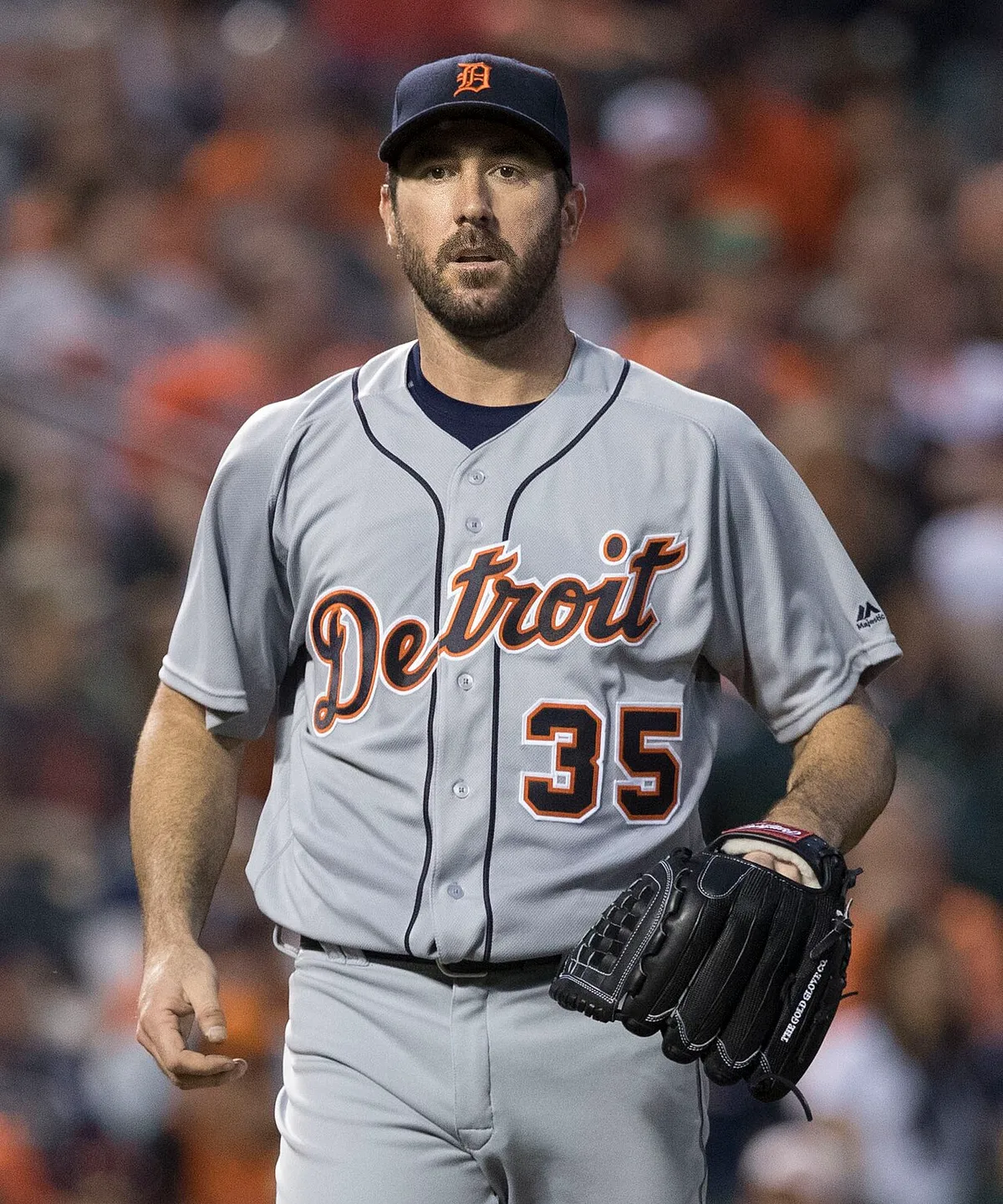
The Tigers have worn essentially the same home uniform since 1934 — solid white jersey with navy blue piping down the front and an Old English "D" on the left chest, white pants, navy blue hat with a white letter D in the blackletter or textur/textualis typeface associated with Middle and Early Modern English and popularly referred to as "Old English" even though it was not used for that language. On the Tigers' road uniforms, the D on their hats is orange and a script "Detroit" appears across the jersey. The script "Detroit" design was first used as part of their road jersey in 1930, and would remain so until 1959, when they changed it to a block lettering style.
The current version of the Tigers' road uniform was first worn in 1994, initially with racing stripes, before going with a stripe-free design from 1995 to 1997, and then to the current version featuring navy piping inspired by the team's mid-1950s road uniforms. Prior to readopting the orange "D" all-navy road cap with this uniform, the Tigers wore two different cap variations with orange brim: one with just the orange "D" which they only wore in 1994, and another featuring a tiger walking through a white "D" logo trimmed in orange, which they wore until 1997.
The Tigers previously sported road uniforms with a block "Detroit" lettering from 1960 to 1993, adding orange trim in 1972. The road uniforms were also worn in a pullover style from 1972 until 1984. The caps initially featured white trim within the orange "D" until 1982. A version of the team's blackletter D was first seen on Tigers uniforms in 1904, after using a simple block D in 1903. The blackletter D appeared frequently after that until being established in 1934. In 1960, the Tigers changed their uniform to read "Tigers" in script form, but the change only lasted one season before the traditional uniform was reinstated.
The Tigers used to have different versions of the Old English D on the cap and jersey. In 2018, the Tigers changed the classic curved logo on their home uniforms to match that of the sharp-cornered hat logo; additionally, the logo on the cap was enlarged. In 2019, the Tigers reverted to the smaller logo on the cap, but kept the cap sharp-cornered D on the home jerseys.
In 2023, the Tigers entered into a uniform sponsorship deal with Meijer, the state's major supercenter chain based in Grand Rapids and a longtime team sponsor. The uniform patch's logo (attached to the sleeve of the player's dominant hand) is rendered solely in navy blue on white for the home uniform, and white text on a black background for the road jersey with an orange outline.
Baseball Hall of Famers
Retired numbers and honorees
This is how the retired numbers and honored names are displayed on the outfield walls at Comerica Park:
In left field:
In right field:
Ty Cobb, Harry Heilmann, Heinie Manush, Hughie Jennings, and Sam Crawford are honored by their names on the wall at Comerica Park. They all played in an era where numbers were not worn on jerseys.
Though their numbers are not officially retired, the names of Mickey Cochrane and George Kell are displayed at Comerica Park to honor their contributions to the Detroit Tigers organization. Cochrane wore No. 3, later retired for Alan Trammell, and Kell wore No. 21 for five years, 7 for two years, and 15 for one year. They both entered the National Baseball Hall of Fame and Museum as Detroit Tigers, and their plaques in the Hall show them wearing the Tigers' cap.
Al Kaline was also a TV color commentator for the Tigers from 1975 to 2002. George Kell was also a play-by-play announcer for the Tigers from 1959 to 1963 and again from 1965 to 1996.
Ernie Harwell spent 42 years (in two stints) calling Tigers games on radio and television. Harwell, Kell and the aforementioned five players honored by name, are stacked together in right field.
Jackie Robinson's No. 42 was retired throughout Major League Baseball in 1997.
Almost all the players with retired numbers (and Ty Cobb) also have statues of themselves that sit behind their names, which are painted on the left-center field wall.
National Avenue, which runs behind the third-base stands at the Tigers' previous home Tiger Stadium, was renamed Cochrane Street for Mickey Cochrane. Cherry Street, which runs behind the left-field stands at Tiger Stadium, was renamed Kaline Drive for Al Kaline.
Team captains
Bill Coughlin 1907–1908
Germany Schaefer 1907–1909
George Moriarty 1911–1916
Brad Ausmus 1999
Doug Brocail 1999
Dean Palmer 1999
Minor league affiliations
The Detroit Tigers farm system consists of seven minor league affiliates.
Broadcasters
Radio
The Tigers' current flagship radio station is WXYT-FM (97.1 FM). Dan Dickerson does play-by-play with Bobby Scales, Dan Petry, and Andy Dirks rotating on color commentary. On games where Dickerson is assigned to work on television, Greg Gania serves as an alternate. Games are syndicated throughout Michigan, Toledo and Archbold, Ohio.
Television
In February 2026, Ilitch Sports + Entertainment announced that the Tigers regional broadcasts would be distributed by MLB Local Media beginning in the 2026 season. The agreement also included the co-owned Detroit Red Wings. The next month, Ilitch Sports + Entertainment announced the creation of Detroit SportsNet to continue syndicating games to cable and satellite providers in the Tigers' regional market.
The Tigers' television broadcast team consists of Jason Benetti on play-by-play with Andy Dirks, Dan Petry, Todd Jones, and Bobby Scales rotating on color commentary. On games where Benetti is assigned to work for NBC Sports, Dan Dickerson serves as an alternate.
Facilities
The team maintains a training center in the Dominican Republic.