




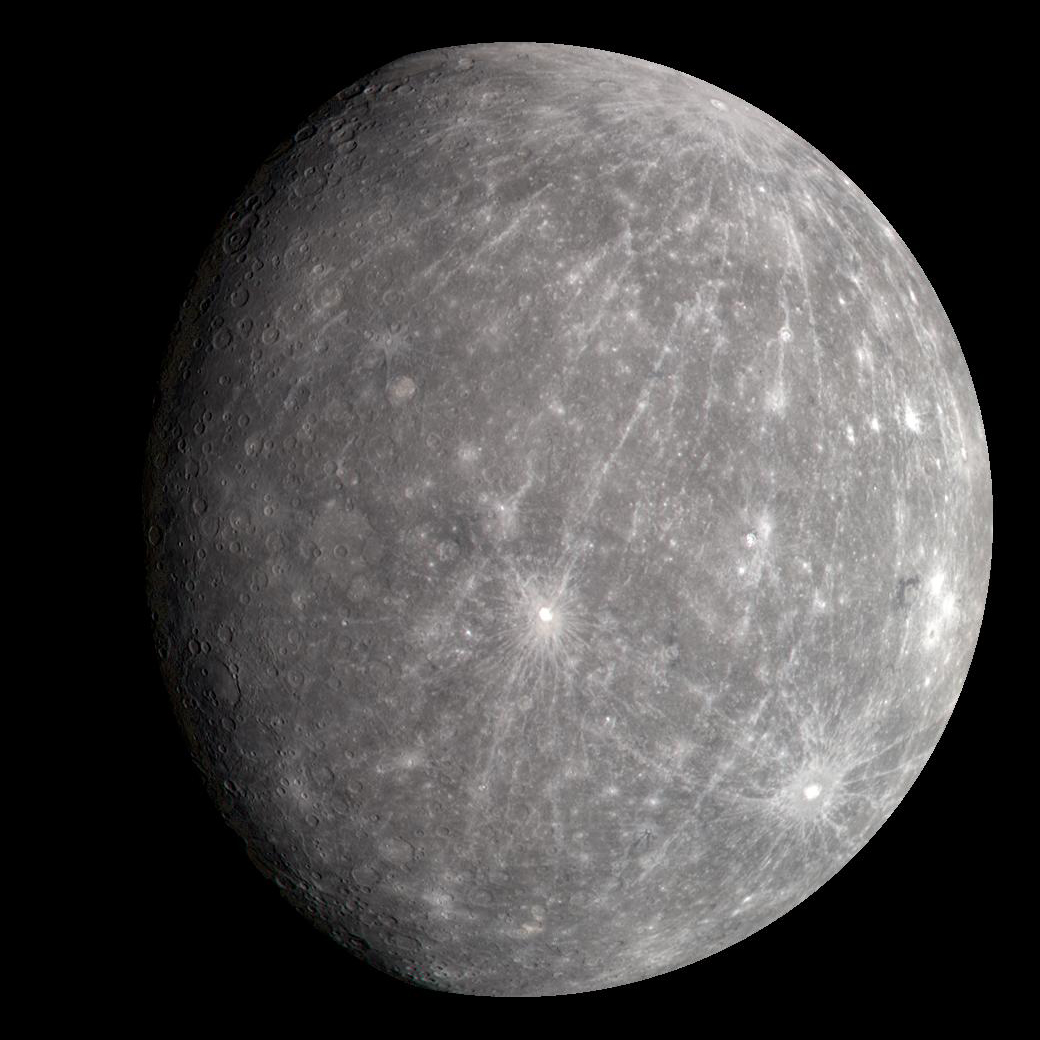
Mercury is the first planet from the Sun and the smallest in the Solar System. It is a rocky planet with a trace atmosphere and a surface gravity slightly lower than that of Mars. The surface of Mercury is similar to Earth's Moon, being cratered, with an expansive rupes system generated from thrust faults, and bright ray systems, formed by ejecta. Its largest crater, Caloris Planitia, has a diameter of 1,550 km (960 mi), which is about one-third the diameter of the planet (4,880 km or 3,030 mi). Being the most inferior orbiting planet, it always appears close to the Sun in Earth's sky, as either a "morning star" or an "evening star". It is the planet with the highest delta-v required for travel from Earth, as well as to and from the other planets in the Solar System.
Mercury's sidereal year (88.0 Earth days) and sidereal day (58.65 Earth days) are in a 3:2 ratio, in a spin–orbit resonance. Consequently, one solar day (sunrise to sunrise) on Mercury lasts for around 176 Earth days, or twice Mercury's sidereal year. This means that one side of Mercury will remain in sunlight for one Mercurian year of 88 Earth days; while during the next orbit, that side will be in darkness all the time until the next sunrise after another 88 Earth days. Above the planet's surface is an extremely tenuous exosphere and a faint magnetic field just strong enough to deflect solar winds. Combined with its high orbital eccentricity, the planet's surface has widely varying sunlight intensity and temperature, with the equatorial regions ranging from −170 °C (−270 °F) at night to 420 °C (790 °F) during sunlight. Despite being the closest planet to the sun, it is the second hottest after Venus, lacking an atmosphere to trap heat. Due to its very small axial tilt, the planet's poles are permanently shadowed. This strongly suggests that water ice could be present in the craters.
Like the other planets in the Solar System, Mercury formed approximately 4.5 billion years ago. There are competing hypotheses about Mercury's origins and development, some of which incorporate collision with planetesimals and rock vaporization; as of the early 2020s, many broad details of Mercury's geological history are still under investigation or pending data from space probes. Its mantle is highly homogeneous, which suggests that Mercury had a magma ocean early in its history, like the Moon. According to current models, Mercury may have a solid silicate crust and mantle overlaying a solid outer core, a deeper liquid core layer, and a solid inner core. Mercury is expected to be destroyed, along with Venus, and possibly the Earth and the Moon, when the Sun becomes a red giant in approximately seven or eight billion years.
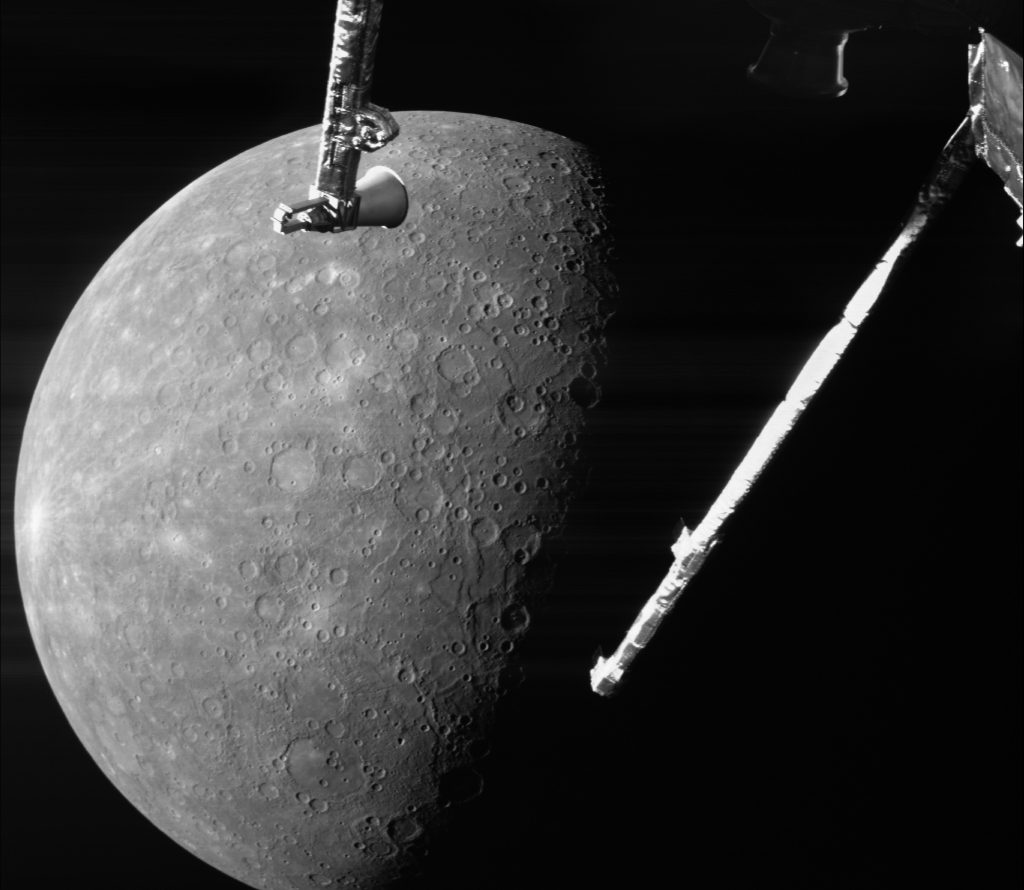
Mercury is a classical planet that has been observed and recognized throughout history as a planet (or wandering star). In English, it is named after the ancient Roman god Mercurius (Mercury), god of commerce and communication, and the messenger of the gods. The first successful flyby of Mercury was conducted by Mariner 10 in 1974, and it has since been visited and explored by the MESSENGER and BepiColombo orbiters.
Contents
Nomenclature
Historically, humans knew Mercury by different names depending on whether it was seen as an evening star or a morning star. By about 350 BC, the ancient Greeks had realized the two "stars" were the same. They knew the planet as Στίλβων Stilbōn, meaning "twinkling", and Ἑρμής Hermēs, for its fleeting motion, a name that is retained in modern Greek (Ερμής Ermis). The Romans named the planet after the swift-footed Roman messenger god, Mercury (Latin Mercurius), whom they equated with the Greek Hermes, because it moves across the sky faster than any other planet, though some associated the planet with Apollo instead, as detailed by Pliny the Elder. The astronomical symbol for Mercury is a stylized version of Hermes' caduceus; a Christian cross was added in the 16th century: ☿.
Physical characteristics
Mercury is one of four terrestrial planets in the Solar System, which means it is a rocky body like Earth. It is the smallest planet in the Solar System, with an equatorial radius of 2,439.7 kilometres (1,516.0 mi). Mercury is also smaller—albeit more massive—than the largest natural satellites in the Solar System, Ganymede and Titan. Mercury consists of approximately 70% metallic and 30% silicate material.
Internal structure
Mercury appears to have a solid silicate crust and mantle overlying a solid, metallic outer core layer, a deeper liquid core layer, and a solid inner core. The composition of the iron-rich core remains uncertain, but it likely contains nickel, silicon and perhaps sulfur and carbon, plus trace amounts of other elements. The planet's density is the second highest in the Solar System at 5.427 g/cm3, only slightly less than Earth's density of 5.515 g/cm3. If the effect of gravitational compression were to be factored out from both planets, the materials of which Mercury is made would be denser than those of Earth, with an uncompressed density of 5.3 g/cm3 versus Earth's 4.4 g/cm3. Mercury's density can be used to infer details of its inner structure. Although Earth's high density results appreciably from gravitational compression, particularly at the core, Mercury is much smaller and its inner regions are not as compressed. Therefore, for it to have such a high density, its core must be large and rich in iron.
The radius of Mercury's core is estimated to be 2,020 ± 30 km (1,255 ± 19 mi), based on interior models constrained to be consistent with a moment of inertia factor of 0.346±0.014. Hence, Mercury's core occupies about 57% of its volume; for Earth this proportion is 17%. Research published in 2007 suggests that Mercury has a molten core. The mantle-crust layer is in total 420 km (260 mi) thick. Projections differ as to the size of the crust specifically; data from the Mariner 10 and MESSENGER probes suggests a thickness of 35 km (22 mi), whereas an Airy isostacy model suggests a thickness of 26 ± 11 km (16.2 ± 6.8 mi). One distinctive feature of Mercury's surface is the presence of numerous narrow ridges, extending up to several hundred kilometers in length. It is thought that these were formed as Mercury's core and mantle cooled and contracted at a time when the crust had already solidified.
Mercury's core has a higher iron content than that of any other planet in the Solar System, and several theories have been proposed to explain this. The most widely accepted theory is that Mercury originally had a metal–silicate ratio similar to common chondrite meteorites, thought to be typical of the Solar System's rocky matter, and a mass approximately 2.25 times its current mass. Early in the Solar System's history, Mercury may have been struck by a planetesimal of approximately 1⁄6 Mercury's mass and several thousand kilometers across. The impact would have stripped away much of the original crust and mantle, leaving the core behind as a relatively major component. A similar process, known as the giant impact hypothesis, has been proposed to explain the formation of Earth's Moon.
Surface geology
Mercury's surface is similar in appearance to that of the Moon, showing extensive mare-like plains and heavy cratering, indicating that it has been geologically inactive for billions of years. It is more heterogeneous than the surface of Mars or the Moon, both of which contain significant stretches of similar geology, such as maria and plateaus. Albedo features are areas of markedly different reflectivity, which include impact craters, the resulting ejecta, and ray systems. Larger albedo features correspond to higher reflectivity plains. Mercury has "wrinkle-ridges" (dorsa), Moon-like highlands, mountains (montes), plains (planitiae), escarpments (rupes), and valleys (valles).
The planet's mantle is chemically heterogeneous, suggesting the planet went through a magma ocean phase early in its history. Crystallization of minerals and convective overturn resulted in a layered, chemically heterogeneous crust with large-scale variations in chemical composition observed on the surface. The crust is low in iron but high in sulfur, resulting from the stronger early chemically reducing conditions than is found on other terrestrial planets. The surface is dominated by iron-poor pyroxene and olivine, as represented by enstatite and forsterite, respectively, along with sodium-rich plagioclase and minerals of mixed magnesium, calcium, and iron-sulfide. The less reflective regions of the crust are high in carbon, most likely in the form of graphite.
Names for features on Mercury come from a variety of sources and are set according to the IAU planetary nomenclature system. Names coming from people are limited to the deceased. Craters are named for artists, musicians, painters, and authors who have made outstanding or fundamental contributions to their field. Ridges, or dorsa, are named for scientists who have contributed to the study of Mercury. Depressions or fossae are named for works of architecture. Montes are named for the word "hot" in a variety of languages. Plains or planitiae are named for Mercury in various languages. Escarpments or rupēs are named for ships of scientific expeditions. Valleys or valles are named for abandoned cities, towns, or settlements of antiquity.
Mercury was heavily bombarded by comets and asteroids during and shortly following its formation 4.6 billion years ago, as well as during a possibly separate subsequent episode called the Late Heavy Bombardment that ended 3.8 billion years ago. Mercury received impacts over its entire surface during this period of intense crater formation, facilitated by the lack of any atmosphere to slow impactors down. During this time Mercury was volcanically active; basins were filled by magma, producing smooth plains similar to the maria found on the Moon. One of the most unusual craters is Apollodorus, or "the Spider", which hosts a series of radiating troughs extending outwards from its impact site.
Surface conditions and exosphere
The surface temperature of Mercury ranges from 100 to 700 K (−173 to 427 °C; −280 to 800 °F). It never rises above 180 K (−93 °C) at the poles, due to the absence of an atmosphere and a steep temperature gradient between the equator and the poles. At perihelion, the equatorial subsolar point is located at longitude 0°W or 180°W, and it climbs to a temperature of about 700 K. During aphelion, this occurs at 90° or 270°W and reaches only 550 K. On the dark side of the planet, temperatures average 110 K, 110 K (−163 °C). The intensity of sunlight on Mercury's surface ranges between 4.59 and 10.61 times the solar constant (1,370 W·m−2).
Although daylight temperatures at the surface of Mercury are generally extremely high, observations strongly suggest that ice (frozen water) exists on Mercury. The floors of deep craters at the poles are never exposed to direct sunlight, and temperatures there remain below 102 K, far lower than the global average. This creates a cold trap where ice can accumulate. Water ice strongly reflects radar, and observations by the 70-meter Goldstone Solar System Radar and the VLA in the early 1990s revealed that there are patches of high radar reflection near the poles. Although ice was not the only possible cause of these reflective regions, astronomers thought it to be the most likely explanation. The presence of water ice was confirmed using MESSENGER images of craters at the north pole.
The icy crater regions are estimated to contain about 1014–1015 kg of ice, and may be covered by a layer of regolith that inhibits sublimation. By comparison, the Antarctic ice sheet on Earth has a mass of about 4×10¹⁸ kg, and Mars's south polar cap contains about 1016 kg of water. The origin of the ice on Mercury is not yet known, but the two most likely sources are from outgassing of water from the planet's interior and deposition by impacts of comets.
Mercury is too small and hot for its gravity to retain any significant atmosphere over long periods of time; it does have a tenuous surface-bounded exosphere at a surface pressure of less than approximately 0.5 nPa (0.005 picobars). It includes hydrogen, helium, oxygen, sodium, calcium, potassium, magnesium, silicon, and hydroxide, among others. This exosphere is not stable—atoms are continuously lost and replenished from a variety of sources. Hydrogen atoms and helium atoms probably come from the solar wind, diffusing into Mercury's magnetosphere before later escaping back into space. The radioactive decay of elements within Mercury's crust is another source of helium, as well as sodium and potassium. Water vapor is present, released by a combination of processes such as comets striking its surface, sputtering creating water out of hydrogen from the solar wind and oxygen from rock, and sublimation from reservoirs of water ice in the permanently shadowed polar craters. The detection of high amounts of water-related ions like O+, OH−, and H3O+ was a surprise. Because of the quantities of these ions that were detected in Mercury's space environment, scientists surmise that these molecules were blasted from the surface or exosphere by the solar wind.
Magnetic field and magnetosphere
Despite its small size and slow 59-day-long rotation, Mercury has a significant, and apparently global, magnetic field. According to measurements taken by Mariner 10, it is about 1.1% the strength of Earth's. The magnetic-field strength at Mercury's equator is about 300 nT. Like that of Earth, Mercury's magnetic field is dipolar and nearly aligned with the planet's spin axis (10° dipolar tilt, compared to 11° for Earth). Measurements from both the Mariner 10 and MESSENGER space probes have indicated that the strength and shape of the magnetic field are stable.
It is likely that this magnetic field is generated by a dynamo effect, in a manner similar to the magnetic field of Earth. This dynamo effect would result from the circulation of the planet's iron-rich liquid core. Particularly strong tidal heating effects caused by the planet's high orbital eccentricity would serve to keep part of the core in the liquid state necessary for this dynamo effect.
Mercury's magnetic field is strong enough to deflect the solar wind around the planet, creating a magnetosphere. The planet's magnetosphere, though small enough to fit within Earth, is strong enough to trap solar wind plasma. This contributes to the space weathering of the planet's surface. Observations taken by the Mariner 10 spacecraft detected this low energy plasma in the magnetosphere of the planet's nightside. Bursts of energetic particles in the planet's magnetotail indicate a dynamic quality to the planet's magnetosphere.
During its second flyby of the planet on October 6, 2008, MESSENGER discovered that Mercury's magnetic field can be extremely "leaky". The spacecraft encountered magnetic "tornadoes"—twisted bundles of magnetic fields connecting the planetary magnetic field to interplanetary space—that were up to 800 km wide or a third of the radius of the planet. These twisted magnetic flux tubes, technically known as flux transfer events, form open windows in the planet's magnetic shield through which the solar wind may enter and directly impact Mercury's surface via magnetic reconnection. This also occurs in Earth's magnetic field. The MESSENGER observations showed the reconnection rate was ten times higher at Mercury, but its proximity to the Sun only accounts for about a third of the reconnection rate observed by MESSENGER.
Orbit, rotation, and longitude
Mercury has the most eccentric orbit of all the planets in the Solar System; its eccentricity is 0.21 with its distance from the Sun ranging from 46,000,000 to 70,000,000 km (29,000,000 to 43,000,000 mi). It takes 87.969 Earth days to complete an orbit. The diagram illustrates the effects of the eccentricity, showing Mercury's orbit overlaid with a circular orbit having the same semi-major axis. Mercury's higher velocity when it is near perihelion is clear from the greater distance it covers in each 5-day interval. In the diagram, the varying distance of Mercury to the Sun is represented by the size of the planet, which is inversely proportional to Mercury's distance from the Sun.
This varying distance to the Sun leads to Mercury's surface being flexed by tidal bulges raised by the Sun that are about 17 times stronger than the Moon's on Earth. Combined with a 3:2 spin–orbit resonance of the planet's rotation around its axis, it also results in complex variations of the surface temperature. The resonance makes a single solar day (the length between two meridian transits of the Sun) on Mercury last exactly two Mercury years, or about 176 Earth days.
Mercury's orbit is inclined by 7 degrees to the plane of Earth's orbit (the ecliptic), the largest of all eight known solar planets. As a result, transits of Mercury across the face of the Sun can only occur when the planet is crossing the plane of the ecliptic at the time it lies between Earth and the Sun, which is in May or November. This occurs about every seven years on average.
Mercury's axial tilt is almost zero, with the best measured value as low as 0.027 degrees. This is significantly smaller than that of Jupiter, which has the second smallest axial tilt of all planets at 3.1 degrees. This means that to an observer at Mercury's poles, the center of the Sun never rises more than 2.1 arcminutes above the horizon. By comparison, the angular size of the Sun as seen from Mercury ranges from 1+1⁄4 to 2 degrees across.
At certain points on Mercury's surface, an observer would be able to see the Sun peek up a little more than two-thirds of the way over the horizon, then reverse and set before rising again, all within the same Mercurian day. This is because approximately four Earth days before perihelion, Mercury's angular orbital velocity equals its angular rotational velocity so that the Sun's apparent motion ceases; closer to perihelion, Mercury's angular orbital velocity then exceeds the angular rotational velocity. Thus, to a hypothetical observer on Mercury, the Sun appears to move in a retrograde direction. Four Earth days after perihelion, the Sun's normal apparent motion resumes. A similar effect would have occurred if Mercury had been in synchronous rotation: the alternating gain and loss of rotation over a revolution would have caused a libration of 23.65° in longitude.
Longitude convention
The longitude convention for Mercury puts the zero of longitude at one of the two hottest points on the surface, as described above. However, when this area was first visited, by Mariner 10, this zero meridian was in darkness, so it was impossible to select a feature on the surface to define the exact position of the meridian. Therefore, a small crater further west was chosen, called Hun Kal, which provides the exact reference point for measuring longitude. The center of Hun Kal defines the 20° west meridian. A 1970 International Astronomical Union resolution suggests that longitudes be measured positively in the westerly direction on Mercury. The two hottest places on the equator are therefore at longitudes 0° W and 180° W, and the coolest points on the equator are at longitudes 90° W and 270° W. However, the MESSENGER project uses an east-positive convention.
Spin-orbit resonance
For many years it was thought that Mercury was synchronously tidally locked with the Sun, rotating once for each orbit and always keeping the same face directed towards the Sun, in the same way that the same side of the Moon always faces Earth. Radar observations in 1965 proved that the planet has a 3:2 spin-orbit resonance, rotating three times for every two revolutions around the Sun. The eccentricity of Mercury's orbit makes this resonance stable—at perihelion, when the solar tide is strongest, the Sun is nearly stationary in Mercury's sky.
The 3:2 resonant tidal locking is stabilized by the variance of the tidal force along Mercury's eccentric orbit, acting on a permanent dipole component of Mercury's mass distribution. In a circular orbit there is no such variance, so the only resonance stabilized in such an orbit is at 1:1 (e.g., Earth–Moon), when the tidal force, stretching a body along the "center-body" line, exerts a torque that aligns the body's axis of least inertia (the "longest" axis, and the axis of the aforementioned dipole) to always point at the center. However, with noticeable eccentricity, like that of Mercury's orbit, the tidal force has a maximum at perihelion and therefore stabilizes resonances, like 3:2, ensuring that the planet points its axis of least inertia roughly at the Sun when passing through perihelion.
The original reason astronomers thought it was synchronously locked was that, whenever Mercury was best placed for observation, it was always nearly at the same point in its 3:2 resonance, hence showing the same face. This is because, coincidentally, Mercury's rotation period is almost exactly half of its synodic period with respect to Earth. Due to Mercury's 3:2 spin-orbit resonance, a solar day lasts about 176 Earth days. A sidereal day (the period of rotation) lasts about 58.7 Earth days.
Simulations indicate that the orbital eccentricity of Mercury varies chaotically from nearly zero (circular) to more than 0.45 over millions of years due to perturbations from the other planets. This was thought to explain Mercury's 3:2 spin-orbit resonance (rather than the more usual 1:1), because this state is more likely to arise during a period of high eccentricity. However, accurate modeling based on a realistic model of tidal response has demonstrated that Mercury was captured into the 3:2 spin-orbit state at a very early stage of its history, within 20 (more likely, 10) million years after its formation.
Advance of perihelion
In 1859, the French mathematician and astronomer Urbain Le Verrier reported that the slow precession of Mercury's orbit around the Sun could not be completely explained by Newtonian mechanics and perturbations by the known planets. He suggested, among possible explanations, that another planet (or perhaps instead a series of smaller "corpuscules") might exist in an orbit even closer to the Sun than that of Mercury, to account for this perturbation. Other explanations considered included a slight oblateness of the Sun. The success of the search for Neptune based on its perturbations of the orbit of Uranus led astronomers to place faith in this possible explanation, and the hypothetical planet was named Vulcan, but no such planet was ever found.
The observed perihelion precession of Mercury is 5,600 arcseconds (1.5556°) per century relative to Earth, or 574.10±0.65 arcseconds per century relative to the inertial ICRF. Newtonian mechanics, taking into account all the effects from the other planets and including 0.0254 arcseconds per century due to the oblateness of the Sun, predicts a precession of 5,557 arcseconds (1.5436°) per century relative to Earth, or 531.63±0.69 arcseconds per century relative to ICRF. In the early 20th century, Albert Einstein's general theory of relativity provided the explanation for the observed precession, by formalizing gravitation as being mediated by the curvature of spacetime. The effect is small: just 42.980±0.001 arcseconds per century (or 0.43 arcsecond per year, or 0.1035 arcsecond per orbital period) for Mercury; it therefore requires a little over 12.5 million orbits, or 3 million years, for a full excess turn. Similar, but much smaller, effects exist for other Solar System bodies: 8.6247 arcseconds per century for Venus, 3.8387 for Earth, 1.351 for Mars, and 10.05 for 1566 Icarus.
Observation
Mercury's apparent magnitude is calculated to vary between −2.48 (brighter than Sirius) around superior conjunction and +7.25 (below the limit of naked-eye visibility) around inferior conjunction. The mean apparent magnitude is 0.23 while the standard deviation of 1.78 is the largest of any planet. The mean apparent magnitude at superior conjunction is −1.89 while that at inferior conjunction is +5.93. Observation of Mercury is complicated by its proximity to the Sun, as it is lost in the Sun's glare for much of the time. Mercury can be observed for only a brief period during either morning or evening twilight.
Ground-based telescope observations of Mercury reveal only an illuminated partial disk with limited detail. The Hubble Space Telescope cannot observe Mercury at all, due to safety procedures that prevent its pointing too close to the Sun. Because the shift of 0.15 revolutions of Earth in a Mercurian year makes up a seven-Mercurian-year cycle (0.15 × 7 ≈ 1.0), in the seventh Mercurian year, Mercury follows almost exactly (earlier by 7 days) the sequence of phenomena it showed seven Mercurian years before.
Like the Moon and Venus, Mercury exhibits phases as seen from Earth. It is "new" at inferior conjunction and "full" at superior conjunction. The planet is rendered invisible from Earth on both of these occasions because of its being obscured by the Sun, except at its new phase during a transit. Mercury is technically brightest as seen from Earth when it is at a full phase. Although Mercury is farthest from Earth when it is full, the greater illuminated area that is visible and the opposition brightness surge more than compensates for the distance. The opposite is true for Venus, which appears brightest when it is a crescent, because it is much closer to Earth than when gibbous.
Mercury is best observed at the first and last quarter, although they are phases of lesser brightness. The first and last quarter phases occur at greatest elongation east and west of the Sun, respectively. At both of these times, Mercury's separation from the Sun ranges anywhere from 17.9° at perihelion to 27.8° at aphelion. At greatest western elongation, Mercury rises at its earliest before sunrise, and at greatest eastern elongation, it sets at its latest after sunset.
Mercury is more often and easily visible from the Southern Hemisphere than from the Northern. This is because Mercury's maximum western elongation occurs only during early autumn in the Southern Hemisphere, whereas its greatest eastern elongation happens only during late winter in the Southern Hemisphere. In both of these cases, the angle at which the planet's orbit intersects the horizon is maximized, allowing it to rise several hours before sunrise in the former instance and not set until several hours after sundown in the latter from southern mid-latitudes, such as Argentina and South Africa.
Observation history
Ancient astronomers
The earliest known recorded observations of Mercury are from the MUL.APIN tablets. These observations were most likely made by an Assyrian astronomer around the 14th century BC. The cuneiform name used to designate Mercury on the MUL.APIN tablets is transcribed as UDU.IDIM.GU\U4.UD ("the jumping planet"). Babylonian records of Mercury date back to the 1st millennium BC. The Babylonians called the planet Nabu after the messenger to the gods in their mythology.
The Greco-Egyptian astronomer Ptolemy wrote about the possibility of planetary transits across the face of the Sun in his work Planetary Hypotheses. He suggested that no transits had been observed either because planets such as Mercury were too small to see, or because transits were too infrequent.
In ancient China, Mercury was known as "the Hour Star" (Chen-xing 辰星). It was associated with the direction north and the phase of water in the Five Phases system of metaphysics. Modern Chinese, Korean, Japanese and Vietnamese cultures refer to the planet literally as the "water star" (水星), based on the Five elements. Hindu mythology used the name Budha for Mercury, and this god was thought to preside over Wednesday. The god Odin (or Woden) of Germanic paganism was associated with the planet Mercury and Wednesday. The Maya may have represented Mercury as an owl (or possibly four owls; two for the morning aspect and two for the evening) that served as a messenger to the underworld. Mercury was sometimes known as Stilbon (Greek: Στίλβων) meaning 'the shining, glittering'.
In medieval Islamic astronomy, the Andalusian astronomer Abū Ishāq Ibrāhīm al-Zarqālī in the 11th century described the deferent of Mercury's geocentric orbit, known under the name ʿUṭārid (Arabic: عُطَارِد), as being oval, like an egg or a pignon, although this insight did not influence his astronomical theory or his astronomical calculations. In the 12th century, Ibn Bajjah observed "two planets as black spots on the face of the Sun", which was later suggested as the transit of Mercury (ʿUṭārid, عُطَارِد) and/or Venus (az-Zuharah, الزُّهَرَة) by the Maragha astronomer Qotb al-Din Shirazi in the 13th century. Most such medieval reports of transits were later taken as observations of sunspots.
In India, the Kerala school astronomer Nilakantha Somayaji in the 15th century developed a partially heliocentric planetary model in which Mercury orbits the Sun, which in turn orbits Earth, similar to the Tychonic system later proposed by Tycho Brahe in the late 16th century.
Ground-based telescopic research
The first telescopic observations of Mercury were made by Thomas Harriot and Galileo from 1610. In 1612, Simon Marius observed the brightness of Mercury varied with the planet's orbital position and concluded it had phases "in the same way as Venus and the Moon". In 1631, Pierre Gassendi made the first telescopic observations of the transit of a planet across the Sun when he saw a transit of Mercury predicted by Johannes Kepler. In 1639, Giovanni Zupi used a telescope to discover that the planet had orbital phases similar to Venus and the Moon. The observation demonstrated conclusively that Mercury orbited the Sun.
A rare event in astronomy is the passage of one planet in front of another (occultation), as seen from Earth. Mercury and Venus occult each other every few centuries, and the event of May 28, 1737, is the only one historically observed, having been seen by John Bevis at the Royal Greenwich Observatory. The next occultation of Mercury by Venus will be on December 3, 2133.
The difficulties inherent in observing Mercury meant that it was far less studied than the other planets. In 1800, Johann Schröter made observations of surface features, claiming to have observed 20-kilometre-high (12 mi) mountains. Friedrich Bessel used Schröter's drawings to erroneously estimate the rotation period as 24 hours and an axial tilt of 70°. In the 1880s, Giovanni Schiaparelli mapped the planet more accurately, and suggested that Mercury's rotational period was 88 days, the same as its orbital period due to tidal locking. This phenomenon is known as synchronous rotation. The effort to map the surface of Mercury was continued by Eugenios Antoniadi, who published a book in 1934 that included both maps and his own observations. Many of the planet's surface features, particularly the albedo features, take their names from Antoniadi's map.
In June 1962, Soviet scientists at the Institute of Radio-engineering and Electronics of the USSR Academy of Sciences, led by Vladimir Kotelnikov, became the first to bounce a radar signal off Mercury and receive it, starting radar observations of the planet. Three years later, radar observations by Americans Gordon H. Pettengill and Rolf B. Dyce, using the 300-metre-wide (330 yd) Arecibo radio telescope in Puerto Rico, showed conclusively that the planet's rotational period was about 59 days. The theory that Mercury's rotation was synchronous had become widely held, and it was a surprise to astronomers when these radio observations were announced. If Mercury were tidally locked, its dark face would be extremely cold, but measurements of radio emission revealed that it was much hotter than expected. Astronomers were reluctant to drop the synchronous rotation theory and proposed alternative mechanisms such as powerful heat-distributing winds to explain the observations.
Research with space probes
Reaching Mercury from Earth poses significant technical challenges, because it orbits so much closer to the Sun than Earth. A Mercury-bound spacecraft launched from Earth must travel over 91 million kilometres (57 million miles) into the Sun's gravitational potential well. Mercury has an orbital speed of 47.4 km/s (29.5 mi/s), whereas Earth's orbital speed is 29.8 km/s (18.5 mi/s). Therefore, the spacecraft must make a larger change in velocity (delta-v) to get to Mercury and then enter orbit, as compared to the delta-v required for, say, Mars planetary missions.
The potential energy liberated by moving down the Sun's potential well becomes kinetic energy, requiring a delta-v change to do anything other than pass by Mercury. Some portion of this delta-v budget can be provided from a gravity assist during one or more fly-bys of Venus. To land safely or enter a stable orbit the spacecraft would rely entirely on rocket motors. Aerobraking is ruled out because Mercury has a negligible atmosphere. A trip to Mercury requires more rocket fuel than that required to escape the Solar System completely. As a result, only three space probes have visited it so far. A proposed alternative approach would use a solar sail to attain a Mercury-synchronous orbit around the Sun.
The first spacecraft to visit Mercury was NASA's Mariner 10 (1974–1975). The spacecraft used the gravity of Venus to adjust its orbital velocity so that it could approach Mercury, making it both the first spacecraft to use this gravitational "slingshot" effect and the first NASA mission to visit multiple planets. Mariner 10 provided the first close-up images of Mercury's surface, which immediately showed its heavily cratered nature, and revealed many other types of geological features, such as the giant scarps that were later ascribed to the effect of the planet shrinking slightly as its iron core cools. Unfortunately, the same face of the planet was lit at each of Mariner 10's close approaches. This made close observation of both sides of the planet impossible, and resulted in the mapping of less than 45% of the planet's surface.
The spacecraft made three close approaches to Mercury, the closest of which took it to within 327 km (203 mi) of the surface. At the first close approach, instruments detected a magnetic field, to the great surprise of planetary geologists—Mercury's rotation was expected to be much too slow to generate a significant dynamo effect. The second close approach was primarily used for imaging, but at the third approach, extensive magnetic data were obtained. The data revealed that the planet's magnetic field is much like Earth's, which deflects the solar wind around the planet. For many years after the Mariner 10 encounters, the origin of Mercury's magnetic field remained the subject of several competing theories.